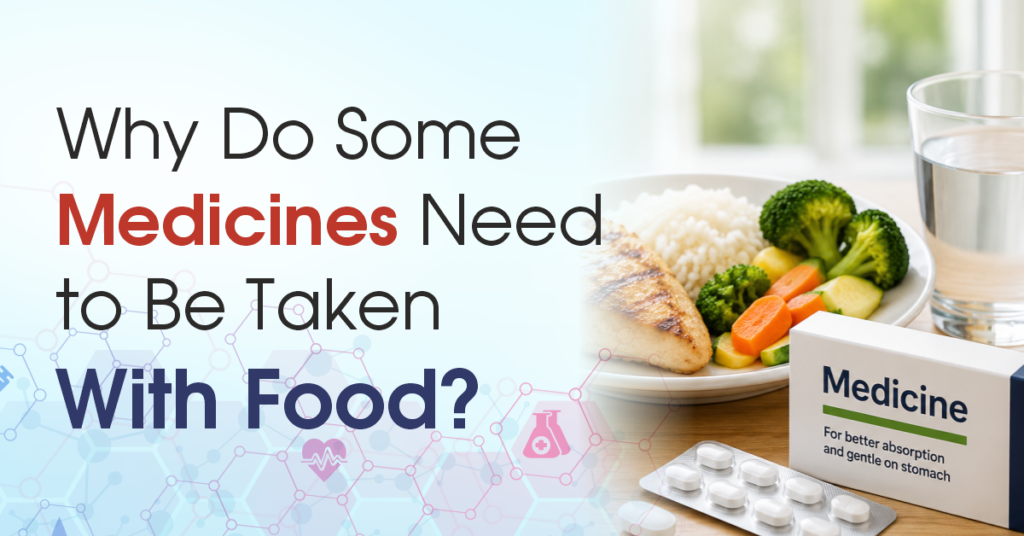
Look closely at a medicine label and you’ll often find a small instruction under the dosage: “take with food,” “take after food,” “take before meals,” or “take on an empty stomach.” Most people follow these without asking why, or skip them when in a hurry.
These instructions aren’t arbitrary. What’s in your stomach when you take a tablet can affect how much of the medicine reaches your bloodstream, how quickly it works, and how comfortable the process is. But food doesn’t affect every medicine the same way — some need food, some need an empty stomach, and many aren’t affected either way. This guide explains the general reasoning, while pointing you back to your own medicine’s label for the final word.
Why Do Some Medicines Need to Be Taken With Food?
Depending on the medicine, food-related instructions usually relate to one or more of these reasons:
- Improving absorption: Some active ingredients dissolve and enter the bloodstream more effectively with food present.
- Supporting fat-soluble drugs: A few medicines absorb better with some dietary fat present.
- Reducing stomach irritation: Food can act as a buffer for medicines that might otherwise irritate the stomach lining.
- Improving tolerability: Even without changing absorption, food can reduce nausea and make a medicine easier to take consistently.
- Matching the formulation: Some products are specifically tested and dosed with food intake in mind.
It’s equally important to know what food doesn’t do: it doesn’t automatically make a medicine safer, and it doesn’t universally improve absorption. For many medicines, food makes little difference — and for some, it can actually get in the way.
How Does Food Affect Medicine Absorption?
After swallowing a tablet, it must dissolve and cross into the bloodstream — mostly through the small intestine, not the stomach. Food slows gastric emptying, changes stomach acidity, and dilutes whatever else is present, including the medicine. Depending on the drug, these changes can speed up absorption, slow it down, reduce the total amount absorbed, or make little difference. That’s why two similar-looking tablets can carry very different food instructions. For a fuller picture of how a medicine travels through the body, see our guide on how medicines work in the body.
What Is Bioavailability and Why Does It Matter?
Bioavailability is the proportion of a dose that reaches the bloodstream in active form, and how quickly. Food can push bioavailability up, down, or leave it largely unchanged, depending on the drug. In some well-known cases, food actually reduces absorption, yet the medicine is still recommended with meals because better comfort and consistent use outweigh the modest drop in absorption. There’s no single rule — which is why product-specific instructions matter more than general assumptions.
Food Can Help Protect the Stomach
Some medicines can irritate the stomach lining, causing nausea, discomfort, or heartburn, especially on an empty stomach. NSAIDs such as ibuprofen are a well-known example; NHS guidance recommends taking them with or just after food. That said, food isn’t a universal safeguard — for some medicines it’s a genuine buffer, for others the benefit is mainly comfort rather than proven protection against serious stomach damage. If discomfort persists, talk to a doctor or pharmacist rather than simply eating more before each dose.
Does Taking Medicine With Food Make It Work Better?
It depends. For some medicines, food improves absorption or reduces a limiting side effect. For others it makes little practical difference, which is why some labels say “with or without food.” For a number of medicines, food actually delays or reduces the effect, which is why an empty stomach is specified instead. There’s no shortcut that applies across “all tablets” — your specific product’s instructions are the most reliable guide.
What Does “Take With Food” Actually Mean?
In practice, it usually means taking the dose during or shortly after a meal — not necessarily right after finishing a large plate of food. The exact window varies by medicine and label. What matters most is following your specific medicine’s instructions rather than personal habit: a light snack may satisfy one medicine’s instruction, while another calls for a proper meal. When the label isn’t specific, a pharmacist can clarify.
What Does “Take After Food” Mean?
Food-related instructions generally fall into a few broad categories:
| Instruction | General Meaning |
|---|---|
| Take with food | During or shortly after eating, so food is in the stomach with the dose. |
| Take after food | Once a meal is finished, sometimes with a short additional gap. |
| Take before food | A specified period ahead of eating, while a meal is still to come. |
| Take on an empty stomach | With no recent food present, often first thing in the morning or with a defined gap before and after eating. |
These categories are useful for orientation, but not interchangeable across every medicine — a “before food” instruction can mean different things on different products. Your label or pharmacist always takes priority.
Why Some Medicines Should Be Taken on an Empty Stomach
Some medicines are recommended on an empty stomach because food meaningfully reduces absorption:
- Levothyroxine (for underactive thyroid) is typically taken on an empty stomach, 30–60 minutes before breakfast, since food, coffee, and certain minerals can reduce absorption, per MedlinePlus and Mayo Clinic.
- Alendronate, a bisphosphonate used for osteoporosis, has very low absorption to begin with; NHS and FDA labelling note that anything other than plain water sharply cuts how much is absorbed.
- Certain proton pump inhibitors work best taken shortly before a meal. See our guide to proton pump inhibitors (PPIs).
These examples don’t mean every similar medicine behaves the same way — always check the specific product.
Examples of Medicines That May Have Food-Related Instructions
These are individual, well-documented examples — not a guide to entire drug classes, since related products can carry different instructions depending on formulation.
| Medicine | Typical Food Instruction | Why It Matters |
|---|---|---|
| Metformin (immediate-release) | Usually with meals | Food modestly lowers peak absorption but meaningfully reduces GI side effects, per MedlinePlus and FDA labelling. See our Metformin guide. |
| Ibuprofen and similar NSAIDs | Often with or just after food | May reduce stomach irritation for some people, per NHS guidance, though it isn’t a guarantee against all GI side effects. |
| Levothyroxine | Empty stomach, 30–60 minutes before breakfast | Food, coffee, and calcium- or fibre-rich items can reduce absorption, per MedlinePlus. |
| Alendronate | Empty stomach, first thing, plain water only | Even small amounts of food or non-water drinks cut absorption sharply, per NHS and FDA. |
| Sucralfate | Empty stomach, about 1 hour before meals | Needs direct contact with the stomach lining; food can interfere. See our Sucralfate guide. |
If your medicine isn’t listed here, that tells you nothing either way — always check its specific label or ask a pharmacist.
Can Food Change How Quickly a Medicine Works?
Yes. It helps to separate how much of a medicine is eventually absorbed from how quickly it gets there. Food often affects speed more than total absorption — a medicine taken with a meal may peak later, even if the amount absorbed is similar. For other medicines, food affects both, which is why fast-acting medicines are often timed carefully around meals, while medicines for steady, long-term control may be less sensitive to exact timing.
Food and Drug Interactions
Beyond general food timing, specific foods and drinks can interact with particular medicines:
- Grapefruit and grapefruit juice can raise blood levels of certain statins and calcium channel blockers, per the FDA.
- Dairy and other calcium-rich foods can bind to some antibiotics, including certain tetracyclines and fluoroquinolones, reducing absorption; these are usually separated from dairy by a couple of hours.
- Vitamin K–rich leafy greens don’t need to be avoided with warfarin, but keeping intake fairly consistent helps keep its effect stable.
These are examples, not a complete list. A pharmacist can quickly check anything you’re unsure about, and there’s rarely a need to cut a healthy food out entirely.
Why Medicine Formulation Matters
How a medicine is designed also shapes whether food matters. Standard tablets, enteric-coated tablets, extended-release formulations, and capsules can behave differently even with similar active ingredients, since coatings and release mechanisms change how sensitive a product is to food — see our guide on the difference between tablets and capsules. This is also why an immediate-release and an extended-release version of the same drug can carry different food instructions.
What Happens If You Take a Medicine at the Wrong Time?
The effect of getting the timing wrong depends entirely on the medicine — sometimes little happens, sometimes absorption or side effects change noticeably. This usually isn’t cause for alarm if occasional, but if you’re unsure what to do after taking a medicine incorrectly, or you’ve missed a dose, check that medicine’s instructions or contact a pharmacist rather than guessing — and don’t double the next dose to “catch up.”
Common Mistakes People Make When Taking Medicines With Food
- Assuming every medicine should be taken after meals.
- Ignoring the package leaflet and relying on habit instead.
- Taking medicine with unsuitable beverages, such as milk or grapefruit juice, without checking first.
- Taking medicine with only a token bite of food when a proper meal is intended.
- Crushing or splitting tablets without checking if that’s safe.
- Changing a long-term medicine’s timing without professional advice.
- Assuming every medicine in a drug class shares the same food instruction.
Common Myths About Taking Medicines With Food
Myth: Every tablet should be taken after food.
Fact: Instructions are medicine-specific — some need food, some need an empty stomach, many work either way.
Myth: Food always makes medicines safer.
Fact: Food can improve tolerability, but it doesn’t guard against every side effect, and for some medicines it reduces effectiveness.
Myth: If a medicine upsets your stomach, food always fixes it.
Fact: Food helps with some medicines, but persistent symptoms deserve a doctor’s attention, not just dietary workarounds.
Myth: Taking medicine with milk is the same as with food.
Fact: Milk’s calcium can interact with and reduce absorption of certain medicines, including some antibiotics.
Myth: Medicines taken with food always work more slowly.
Fact: Food can speed up, slow down, reduce, or not affect a medicine at all, depending on the product.
How to Check Whether Your Medicine Should Be Taken With Food
- Your doctor’s prescription instructions.
- The label on the medicine’s packaging.
- The patient information leaflet or package insert.
- Guidance from your pharmacist, especially for over-the-counter products.
If these sources seem to conflict, don’t guess — ask a pharmacist or doctor to clarify.
Role of Pharmaceutical Manufacturers in Food-Related Medicine Instructions
Food-related dosing instructions usually trace back to a medicine’s development, where formulation scientists study how a product dissolves under different conditions and run food-effect studies comparing performance with and without a meal. These findings shape the administration instructions on the approved label, which packaging and labelling then carry through to the patient.
Why Accurate Medicine Labelling Matters
A label communicates far more than drug name and strength — dosage, timing, food requirements, storage, and warnings all depend on it. If packaging or labelling is unclear, patients and pharmacists lose an important safety check. Our article on the importance of pharmaceutical packaging in medicine safety looks at how packaging protects both the medicine and the information patients rely on.
How Rosette Pharma Fits Into Pharmaceutical Quality and Patient Safety
Rosette Pharma has operated in the pharmaceutical sector since 2006, offering DCGI-approved products manufactured through a network of WHO-GMP–compliant facilities, along with PCD Pharma Franchise and third-party manufacturing services across tablets, capsules, syrups, and injectables. Clear, accurate labelling — including administration and timing information — is part of how quality is maintained across that range.
This article is general education about how food and medicines interact. For any specific medicine, always refer to its approved label or package insert, or speak with a doctor or pharmacist.
Frequently Asked Questions
1. Why do some medicines need to be taken with food?
Depending on the medicine, food can improve absorption, reduce stomach irritation, or improve tolerability.
2. Does taking medicine with food improve absorption?
Sometimes. It increases absorption for some medicines, decreases it for others, and makes little difference for many.
3. What does “take with food” mean?
Generally, during or shortly after a meal — but the exact timing varies, so check your label.
4. What’s the difference between “with food” and “after food”?
“With food” usually means during or around a meal; “after food” means once eating is finished, sometimes with a short additional gap.
5. Why do some medicines need an empty stomach?
For medicines like levothyroxine and alendronate, food can significantly reduce absorption, so an empty stomach helps ensure a reliable effect.
6. Can I take medicine with milk?
It depends — milk’s calcium can interact with some medicines, including certain antibiotics, so check first.
7. Can food affect how quickly a medicine works?
Yes — it can delay how quickly a medicine peaks, and for some medicines it also affects the total amount absorbed.
8. What if I take a medicine with food when I was told to use an empty stomach?
The effect varies by medicine and usually isn’t an emergency, but if it happens often, check with a pharmacist or doctor.
9. Should all tablets be taken after meals?
No — some need food, some need an empty stomach, and many work either way.
10. Where can I check whether my medicine should be taken with food?
The prescription label, package insert or patient leaflet, or your pharmacist or doctor.
Conclusion
Food affects medicines in different ways — improving absorption for some, reducing it for others, and easing stomach discomfort for many, without being a universal safeguard. Some medicines are better tolerated with food, some depend on it for reliable absorption, some work best on an empty stomach, and certain foods interact directly with specific medicines. Because these instructions are medicine-specific, the most reliable approach is always to follow the label, package insert, or your doctor’s or pharmacist’s advice rather than a general rule of thumb.
Medicine instructions can vary by product and individual circumstances. Always follow the directions on the medicine label or advice from your doctor or pharmacist.
Sources & References
- U.S. Food and Drug Administration (FDA) — Grapefruit Juice and Some Drugs Don’t Mix; Alendronate/Fosamax prescribing information
- MedlinePlus (U.S. National Library of Medicine) — Metformin, Levothyroxine, and Sucralfate drug information
- Mayo Clinic — Levothyroxine (oral route) patient information
- NHS — How and when to take alendronic acid; Ibuprofen for adults; NHS inform on painkillers
- National Center for Biotechnology Information (NCBI/PMC) — research on fluoroquinolone absorption and multivalent cation chelation