
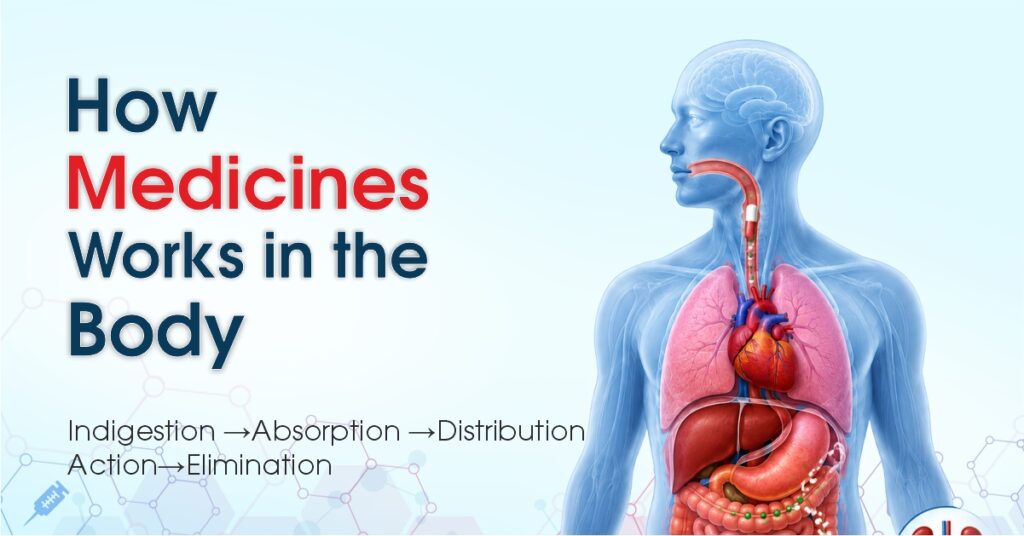
Every time you swallow a tablet or a spoon of syrup, something remarkable happens inside you. A tiny amount of medicine finds its way through your stomach, into your bloodstream, and all the way to the exact part of your body that needs help — whether that’s an aching joint, an irritated nose, or an infected throat.
Most of us never think about this journey. We swallow the tablet, wait for it to work, and move on with our day. But understanding what happens in between can help you use medicines more safely and get more value from every conversation with your doctor or pharmacist.
What Happens After You Swallow a Medicine?
The moment a tablet or capsule reaches your stomach, it begins to break down. From there, it must be absorbed into your blood, carried to the right organ, and made to act on a very specific target — a receptor, an enzyme, or a bacterial cell — before your body quietly breaks it down and removes it.
This entire process, called pharmacokinetics (how the body handles a drug) and pharmacodynamics (how a drug affects the body), explains why some medicines work within minutes while others take days. It also explains why the same tablet can behave differently in a child, an elderly person, or someone with kidney disease.
Why Do Different Medicines Work Differently?
Not all medicines follow the same path or attack the same target. A painkiller acts on inflammation chemicals. An antibiotic attacks bacterial cells. An antacid neutralises stomach acid. A proton pump inhibitor blocks the pump that produces acid in the first place. Each medicine class is designed with a specific mechanism, dose, and speed of action in mind.
Why Understanding Medicines Helps You Use Them Safely
When you understand that a tablet needs time to dissolve, travel, and act, you are less likely to expect instant results, more likely to complete a prescribed course, and better prepared to notice if something feels wrong. This knowledge does not replace medical advice — it simply helps you have a more informed conversation with your healthcare provider.
Quick Fact: No two medicines travel through the body in exactly the same way. Even two tablets that look identical on the outside can have very different journeys once swallowed.
This guide walks through that entire journey in simple language, using real medicine classes — including proton pump inhibitors, prokinetics, antihistamines, and antibiotics — as everyday examples of how these mechanisms work in practice.
A note before we begin: This article is meant to build general awareness about pharmacology. It is not a guide for choosing or adjusting your own medicines. Always consult a qualified doctor or pharmacist before starting, stopping, or changing any medication.
What Is a Medicine?
Before we follow a medicine’s journey, it helps to understand what a “medicine” actually is.
Drug vs Medicine
The words “drug” and “medicine” are often used together, but they mean slightly different things.
- A drug is any chemical substance that changes how the body works. This includes both medicines and substances that have nothing to do with treatment.
- A medicine is a drug (or a combination of drugs) that has been formulated, tested, and approved to prevent, diagnose, or treat a health condition.
In simple terms: every medicine contains a drug, but not every drug is a medicine.
What Is an Active Ingredient?
Inside every medicine is one or more active ingredients — the actual chemical compound responsible for the therapeutic effect. Everything else in the formulation (binders, coatings, flavouring, preservatives) helps deliver that active ingredient safely and consistently, but does not treat the condition itself.
For example, Pantoprazole is the active ingredient responsible for reducing stomach acid, no matter which brand’s tablet it comes in.
Dosage Forms: Why Medicines Come in Different Shapes
The same active ingredient can be packaged in several different dosage forms, chosen based on how quickly the medicine needs to act, who will take it, and how stable the drug is in different environments.
| Dosage Form | Common Use Case | Typical Absorption Speed |
|---|---|---|
| Tablet | General oral use, cost-effective, stable | Moderate |
| Capsule | Protects sensitive drugs, easier to swallow for some | Moderate |
| Syrup | Liquid medicine, often for children or those who cannot swallow tablets | Fast |
| Dry Syrup | Powder reconstituted with water just before use, improves shelf life | Fast (once mixed) |
| Injection | Bypasses digestion, used for rapid or precise dosing | Very fast |
| Drops | Used for eyes, ears, nose, or in infants | Localised or fast |
Did You Know? A dry syrup is not a different drug — it is simply a powder form of a liquid medicine. It is mixed with water only shortly before use because some antibiotics become unstable once dissolved for long periods.
The Journey of a Medicine Inside the Body
Once swallowed, a medicine goes through a fairly predictable sequence of events before it reaches its target and eventually leaves the body.
The Medicine Journey — A Simple Visual Timeline
1. Swallowing
      ↓
2. Dissolving (in stomach fluids)
      ↓
3. Absorption (mainly in the small intestine)
      ↓
4. Entry into the Bloodstream
      ↓
5. Distribution (to organs and tissues)
      ↓
6. Action on Target Organs (the therapeutic effect)
      ↓
7. Metabolism (mainly in the liver)
      ↓
8. Elimination (via kidneys, stool, sweat, or breath)
This eight-step journey is often summarised by pharmacologists using the acronym ADME — Absorption, Distribution, Metabolism, Elimination. Everything a medicine does in your body can be traced back to these four processes.
Quick Fact: Depending on the medicine, this entire journey can take anywhere from a few minutes (for fast-acting injections) to several hours (for slow-release tablets).
Step 1 — Absorption: How Medicine Enters the Blood
Absorption is the process by which a medicine moves from where it was taken — usually the gut — into the bloodstream.
Where Are Most Oral Medicines Absorbed?
Contrary to popular belief, very little absorption happens in the stomach. The stomach’s main job is to dissolve the tablet or capsule. The real absorption work happens in the small intestine, which has a huge surface area (thanks to tiny finger-like projections called villi) and a rich blood supply, making it ideal for pulling dissolved medicine into the blood.
Think of the small intestine as a long, highly absorbent sponge lining a very active highway of blood vessels — the moment dissolved medicine touches this lining, it starts entering circulation.
Why Does Food Affect Absorption?
Food can speed up, slow down, or occasionally reduce how much of a medicine gets absorbed. This is why some medicines are recommended on an empty stomach (to avoid competing with food) and others are recommended after meals (to reduce stomach irritation or improve absorption of fat-soluble drugs).
Fast vs Slow Absorption
- Fast absorption: Liquid medicines, drops, and injections tend to act quickly because they skip the “dissolving” step or bypass digestion entirely.
- Slow absorption: Coated tablets, sustained-release formulations, and capsules taken with food generally act more gradually, providing a steadier effect over a longer period.
Did You Know? This is one reason your doctor may specifically say “take on an empty stomach” or “take after food” — it is not a generic instruction, but often based on how that particular medicine is absorbed.
Step 2 — Distribution: How Medicine Reaches Different Organs
Once a medicine enters the bloodstream, it does not stay in one place. Blood constantly circulates through the entire body, and as it does, it carries dissolved medicine along with it — a process called distribution.
Think of the bloodstream as a vast delivery network of rivers and streams, with blood vessels branching into every organ, right down to the smallest capillaries.
How Medicine Reaches Different Parts of the Body
| Organ / Tissue | How Medicine Reaches It | Example |
|---|---|---|
| Brain | Must cross the blood-brain barrier, a protective filter | Certain pain and neurological medicines |
| Lungs | Reached via pulmonary circulation | Inhaled bronchodilators, some antibiotics |
| Heart | Reached directly through coronary circulation | Cardiac medicines |
| Skin | Reached via small skin capillaries | Oral antihistamines, topical creams |
| Bones | Reached via bone marrow blood supply | Certain antibiotics, calcium supplements |
| Stomach lining | Reached via gastric mucosal blood vessels | Proton pump inhibitors |
| Kidneys | Reached as blood is filtered | Diuretics, many eliminated drugs |
Some organs are easier to reach than others. The brain, for instance, is protected by the blood-brain barrier, a tightly guarded filter that blocks many substances, allowing through only those medicines specifically designed to cross it.
Quick Fact: Not all of a medicine dose reaches its target. Some binds to blood proteins, some is stored temporarily in fat or muscle tissue, and only the “free” portion is active at any given moment.
Step 3 — How Medicines Find Their Target
This is where things get interesting. Once a medicine arrives at the right organ, how does it know what to do? The answer lies in molecular targets — specific structures in the body that a medicine is designed to interact with.
Think of it like a key searching for the one lock it was cut to fit. A medicine molecule is shaped to interact with a very specific target, and it generally has little effect elsewhere.
Common Molecular Targets
- Receptors: Proteins on cell surfaces that receive chemical signals. A medicine can either activate a receptor (an “agonist”) or block it (an “antagonist”). Antihistamines, for example, block histamine receptors.
- Enzymes: Proteins that speed up chemical reactions in the body. Some medicines block a specific enzyme to stop an unwanted reaction — for instance, blocking the enzyme responsible for producing stomach acid.
- Bacteria: Living microorganisms with their own cell walls, proteins, and genetic machinery. Antibiotics target structures unique to bacteria (like their cell wall), which is why they don’t harm human cells in the same way.
- Acid Pumps: Specialised proteins in the stomach lining that push out acid. Certain medicines specifically switch off this pump.
- Histamine Receptors: Found on cells throughout the body, especially in the nose, skin, and airways. When histamine binds here during an allergic reaction, it triggers sneezing, itching, and swelling. Blocking this receptor calms these symptoms.
Did You Know? The idea of a drug fitting a target “like a key in a lock” was proposed by scientist Emil Fischer over a century ago, and it remains one of the simplest ways to understand how modern medicines work.
Step 4 — Medicine Starts Working (Mechanism of Action)
Once a medicine locks onto its target, it triggers a chain of biological events that produces the effect you actually feel — less pain, reduced acidity, fewer allergy symptoms, or a cleared infection. This is called the medicine’s mechanism of action.
Here is how a few common medicine classes work at this stage:
- Antibiotics interfere with bacteria’s ability to build their cell walls or reproduce, which either kills the bacteria directly or stops them from multiplying so the immune system can clear the infection.
- Proton Pump Inhibitors (PPIs) switch off the pump responsible for producing stomach acid, reducing overall acidity in the stomach.
- Antihistamines occupy histamine receptors so histamine itself cannot bind there, reducing sneezing, itching, and a runny nose.
- Painkillers (NSAIDs) block enzymes involved in producing inflammation-causing chemicals, easing pain and swelling.
Every medicine class has its own unique mechanism, but the underlying idea is consistent: find the target, interact with it, and change a specific biological process in a predictable way.
Real Examples: How Common Medicine Classes Work
Understanding pharmacology becomes much easier with real-world examples. Below, we walk through how a few well-known medicine classes work, using formulations from Rosette Pharma’s product range purely as educational illustrations of these mechanisms. These examples are meant to build understanding of pharmacology — not to suggest self-selection of any medicine. Always use any medicine strictly as prescribed by a qualified healthcare professional.
Example 1: Pantoprazole — A Proton Pump Inhibitor
Molecule: Pantoprazole Formulation example: Sintop-40
Pantoprazole belongs to a class of medicines called Proton Pump Inhibitors (PPIs). The stomach produces acid using a specialised protein called the proton pump, found in the cells lining the stomach wall.
Pantoprazole travels through the bloodstream, reaches these stomach lining cells, and switches off the proton pump. With the pump inactive, acid production drops sharply.
This mechanism is why PPIs like Pantoprazole are commonly associated with managing conditions linked to excess stomach acid, such as acid reflux and stomach ulcers, always under a doctor’s guidance. You can read a more detailed breakdown of this mechanism in our dedicated guide on how Pantoprazole works.
Quick Fact: PPIs don’t neutralise acid that is already present (like an antacid does) — they reduce how much new acid is produced in the first place.
Example 2: Pantoprazole + Domperidone — A Combination Approach
Formulation example: Sintop DSR
Some digestive conditions involve more than one underlying issue — excess acid production and sluggish stomach movement. This is where a combination formulation may be considered by a doctor.
Pantoprazole  →  Reduces acid production
Domperidone   →  Improves stomach movement (motility)
Domperidone belongs to a class called prokinetics. It works by blocking specific dopamine receptors in the gut, which helps the stomach empty its contents more efficiently and reduces symptoms like bloating and nausea. You can learn more in our detailed article on what Domperidone does and how it works.
When these two actions are combined, a doctor may find it more convenient to address both acid-related and motility-related symptoms with a single prescription, rather than two separate medicines — though this decision always depends on individual patient assessment.
Example 3: Levocetirizine — An Antihistamine
Formulation example: Lezet
Allergic reactions happen when the immune system releases a chemical called histamine in response to something like pollen, dust, or pet dander. Histamine binds to receptors in the nose, eyes, and skin, triggering the classic allergy symptoms.
Histamine released → binds to receptors → allergy symptoms appear
Levocetirizine → blocks histamine receptors → symptoms reduce
Levocetirizine is a second-generation antihistamine. It occupies histamine receptors before histamine can reach them, which is why it is commonly linked to reduced sneezing, a calmer runny nose, and less itching during allergic episodes. Our detailed guide on how Levocetirizine works covers this mechanism further.
Example 4: Levocetirizine + Montelukast — Dual-Action Allergy Relief
Formulation example: Lezet MT
Allergic reactions don’t only involve histamine. Another group of chemicals called leukotrienes also contributes to inflammation, nasal congestion, and airway tightening.
Histamine blocker (Levocetirizine)  +  Leukotriene blocker (Montelukast)
                    ↓
       Two different allergy pathways addressed together
Montelukast works by blocking leukotriene receptors, reducing the inflammation and congestion associated with allergic rhinitis. When combined with an antihistamine, this dual mechanism may be considered by doctors for patients whose allergy symptoms involve both pathways — always based on individual clinical evaluation, and never as a self-directed choice.
Example 5: Cefpodoxime — A Cephalosporin Antibiotic
Formulation example: REFPO-200 DT
Cefpodoxime belongs to a class of antibiotics called cephalosporins. Here is a simplified look at its journey:
Absorption → Enters bloodstream → Travels to site of infection
    ↓
Binds to proteins bacteria use to build their cell wall
    ↓
Cell wall weakens → Bacteria can no longer survive → Infection clears
Because this mechanism specifically targets bacterial cell walls — a structure human cells do not have — cephalosporins like Cefpodoxime act on bacteria without directly affecting human cells in the same way.
It is essential to remember that antibiotics work only against bacterial infections. They have no effect on viral illnesses like the common cold or flu, and should be used strictly as prescribed by a doctor, for the full recommended duration.
Example 6: Cefpodoxime + Clavulanate — Overcoming Bacterial Resistance
Formulation example: REFPO-CV
Some bacteria develop an enzyme called beta-lactamase, which can break down and inactivate certain antibiotics, including cephalosporins, before they get a chance to work.
Clavulanate is not an antibiotic itself — it is a beta-lactamase inhibitor. It binds to this bacterial enzyme and blocks it, protecting Cefpodoxime from being destroyed. This allows Cefpodoxime to remain active for longer and act effectively against certain resistant bacterial strains, when specifically prescribed by a doctor based on the type of infection involved.
Why Different Medicines Work at Different Speeds
Not every tablet is designed to act at the same speed. Manufacturers deliberately design formulations to release their active ingredient at different rates, depending on the clinical need.
| Release Type | How It Works | Typical Onset |
|---|---|---|
| Immediate-release | Dissolves quickly, releases the full dose at once | Minutes to an hour |
| Delayed-release | Has a special coating that only dissolves in the intestine, protecting the drug from stomach acid | 1–3 hours |
| Sustained/Extended-release | Releases the drug slowly over many hours for a steady effect | Several hours, spread out |
Capsules vs Tablets
Capsules often protect drugs that are sensitive to stomach acid or have an unpleasant taste, while tablets are generally more cost-effective and stable for long-term storage. Neither form is universally “faster” — it depends entirely on the specific formulation.
The Role of Food, Once Again
As mentioned earlier, food can delay stomach emptying, which in turn can delay how quickly a medicine reaches the small intestine for absorption. This is why timing instructions (“before food” or “after food”) are not arbitrary — they are based on how a specific medicine behaves.
What Happens in the Liver?
After a medicine has done its job, the body needs to break it down and prepare it for removal. Most of this work happens in the liver, through a process called metabolism.
Think of the liver as a highly efficient processing plant. It uses specialised enzymes (a family called Cytochrome P450 enzymes) to chemically alter medicines, usually making them easier for the kidneys to remove.
Why Do Some Medicines Last Longer Than Others?
If the liver breaks down a medicine quickly, its effect tends to be shorter, and more frequent doses may be needed. If metabolism is slower, the medicine stays active in the body longer.
Why Does Liver Disease Affect Medicines?
In someone with liver disease, these processing enzymes may not work efficiently. As a result, medicines can build up in the body for longer than expected, increasing the risk of side effects. This is one of the many reasons doctors ask about liver health before prescribing certain medicines, and why self-adjusting doses is never advisable.
Did You Know? Grapefruit juice can interfere with some of the same liver enzymes that process medicines, which is why certain medicines come with a specific warning about avoiding grapefruit.
How Medicines Leave the Body
The final stage of a medicine’s journey is elimination — removing the drug and its breakdown products from the body entirely.
Main Routes of Elimination
- Kidneys and Urine: The most common route. Blood is continuously filtered by the kidneys, and water-soluble drug breakdown products are passed out in urine.
- Stool: Some medicine is never absorbed and passes through the digestive tract unchanged, while some is excreted via bile into the intestines.
- Sweat: A small amount of certain drugs can be eliminated through sweat glands.
- Breathing: Certain volatile substances, like some anaesthetic gases, are eliminated through the lungs when you exhale.
Why Kidney Function Matters
Because the kidneys play such a central role in removing medicines, doctors often check kidney function before prescribing certain drugs, especially in older adults or those with existing kidney conditions. Reduced kidney function can mean a medicine stays in the body longer, requiring dose adjustments that only a healthcare professional should make.
Why Doctors Prescribe Different Doses for Different People
You may have noticed that a child, an elderly relative, and a healthy adult are rarely prescribed the exact same dose of a medicine, even for a similar condition. This is intentional, and based on several factors:
- Age: Children and elderly individuals often metabolise and eliminate medicines differently than younger adults.
- Weight: Dosing for some medicines is calculated based on body weight, especially in children.
- Kidney Function: Reduced kidney function may require a lower dose or longer gap between doses.
- Liver Function: Impaired liver function can affect how quickly a medicine is broken down.
- Disease Severity: More severe conditions may require a different dose or duration than mild ones.
- Drug Interactions: Other medicines a person is already taking can affect how a new medicine is absorbed, metabolised, or eliminated.
This is precisely why doctors ask detailed questions before prescribing, and why sharing your full medical history and current medicines is so important.
Why Completing a Medicine Course Matters
This point deserves special attention, particularly with antibiotics.
When you start an antibiotic course, it begins killing or weakening the most vulnerable bacteria first. If you stop early — even if you feel better — some hardier bacteria may survive. These survivors can multiply and, over time, contribute to antibiotic resistance, making future infections harder to treat.
Completing the full prescribed duration, even after symptoms improve, gives the medicine enough time to clear the infection completely and reduces the risk of it returning or becoming resistant.
Quick Fact: Antibiotic resistance is recognised by health authorities worldwide as one of the biggest challenges in modern medicine, and incomplete antibiotic courses are a known contributing factor.
Common Mistakes While Taking Medicines
Even well-intentioned patients sometimes make small mistakes that reduce a medicine’s effectiveness or increase risk:
- Skipping doses: This can lead to inconsistent drug levels in the blood, reducing effectiveness.
- Stopping early: Especially risky with antibiotics, as explained above.
- Taking a double dose to “catch up”: This does not speed up recovery and can increase the risk of side effects.
- Mixing medicines without guidance: Some combinations can interact in unpredictable ways.
- Using expired medicines: Expired medicines may lose potency or, in rare cases, become chemically unstable.
- Sharing medicines with others: A medicine prescribed for one person’s condition, weight, and health profile may not be appropriate or safe for someone else.
Tips for Safe Medicine Use
Here is a simple checklist to keep in mind:
✔ Read labels carefully before every dose. ✔ Follow your doctor’s instructions exactly, including timing and food advice. ✔ Complete the prescribed course, even if you feel better early. ✔ Store medicines correctly — away from heat, moisture, and direct sunlight. ✔ Never self-medicate or adjust your dose without professional guidance. ✔ Keep a note of all medicines you take, including over-the-counter products, to share with your doctor. ✔ Ask your pharmacist if you are ever unsure about how or when to take a medicine.
Myths vs Facts About Medicines
| # | Myth | Fact |
|---|---|---|
| 1 | Medicines work instantly. | Different medicines have different onset times, from minutes to days. |
| 2 | More medicine means faster recovery. | Taking extra medicine does not speed up healing and can be harmful. |
| 3 | Antibiotics treat viral infections like the common cold. | Antibiotics work only against bacterial infections, not viruses. |
| 4 | You can stop antibiotics once you feel better. | Stopping early can allow bacteria to survive and contribute to resistance. |
| 5 | All tablets are absorbed in the stomach. | Most oral medicines are actually absorbed in the small intestine. |
| 6 | Capsules always work faster than tablets. | Speed depends on the specific formulation, not just the dosage form. |
| 7 | Natural remedies have no drug interactions. | Herbal and natural products can also interact with prescribed medicines. |
| 8 | If a medicine works for a friend, it will work the same way for you. | Individual factors like age, weight, and organ function affect how a medicine works. |
| 9 | Expired medicines are still completely safe to use. | Expired medicines can lose potency or, in some cases, become unsafe. |
| 10 | Higher price always means better quality medicine. | Quality depends on manufacturing standards and regulatory approval, not price alone. |
| 11 | You can stop taking medicine once symptoms disappear. | Some conditions need the full prescribed duration even after symptoms ease. |
| 12 | It is fine to share your prescription medicine with a family member with similar symptoms. | Doses and suitability vary by individual; sharing medicines can be unsafe. |
| 13 | Injections always work better than tablets. | The right route depends on the medicine and the clinical situation, not general superiority. |
| 14 | Painkillers can be taken freely for any type of pain. | Different painkillers suit different types of pain, and overuse can cause side effects. |
| 15 | All allergy medicines cause drowsiness. | Many modern antihistamines are designed to be non-drowsy, though individual responses vary. |
| 16 | Food never affects how medicine works. | Food can significantly speed up, slow down, or reduce absorption of many medicines. |
Frequently Asked Questions
1. How do medicines work in the body? Medicines are absorbed into the blood, carried to specific organs, and act on precise biological targets like receptors or enzymes to produce their effect.
2. How long does medicine take to work? It varies widely — from minutes for injections and liquids to hours for tablets, depending on the formulation and the individual.
3. Where are tablets absorbed in the body? Most tablets are absorbed mainly in the small intestine, not the stomach.
4. How do antibiotics kill bacteria? Many antibiotics target structures unique to bacteria, such as the cell wall, weakening the bacteria until they can no longer survive.
5. How do allergy medicines work? Antihistamines block histamine receptors, preventing histamine from triggering allergy symptoms like sneezing and itching.
6. What does Pantoprazole do? Pantoprazole is a proton pump inhibitor that reduces the production of stomach acid.
7. What does Domperidone do? Domperidone is a prokinetic that helps improve stomach movement and emptying.
8. How does Levocetirizine work? Levocetirizine blocks histamine receptors, helping reduce allergy symptoms such as a runny nose and itching.
9. What is Montelukast used for? Montelukast blocks leukotriene receptors, which are involved in inflammation and congestion during allergic reactions.
10. Why do medicines have side effects? Because most medicines interact with more than one target in the body, some effects beyond the intended one can occur.
11. Why should medicines be taken with water? Water helps tablets dissolve properly and move smoothly through the digestive tract, reducing the risk of irritation.
12. Can food affect how a medicine works? Yes, food can alter how quickly and how much of a medicine is absorbed.
13. How are medicines removed from the body? Mainly through the kidneys (in urine), and also through stool, sweat, and breath, depending on the medicine.
14. Why do medicines come in different strengths? Different strengths allow doctors to tailor the dose to a patient’s age, weight, and condition severity.
15. Can medicines interact with each other? Yes, some medicines can affect how others are absorbed, metabolised, or eliminated, which is why doctors need a full medication history.
16. Why should antibiotic courses always be completed? Stopping early can leave surviving bacteria that may cause the infection to return or become resistant to treatment.
17. How does the liver process medicines? The liver uses specialised enzymes to chemically break down medicines, usually making them easier to eliminate.
18. How do kidneys remove medicines? The kidneys filter blood continuously and pass water-soluble drug byproducts into urine.
19. Why are some medicines taken before meals? Some medicines are absorbed better on an empty stomach or need to act before food is digested.
20. Why are some medicines taken after meals? Others can irritate the stomach lining or are better absorbed alongside food.
21. What is the difference between a drug and a medicine? A drug is any chemical that alters body function, while a medicine is a drug formulated and approved specifically to treat, prevent, or diagnose a condition.
22. What is an active ingredient? The active ingredient is the specific chemical compound in a medicine responsible for its therapeutic effect.
23. Why do some medicines work faster than others? This depends on their dosage form, formulation (immediate vs sustained-release), and how quickly they are absorbed.
24. Can two people react differently to the same medicine? Yes, factors like age, weight, genetics, and organ function can all influence individual response.
25. Is it safe to take someone else’s prescribed medicine? No. A medicine prescribed for one person’s specific condition and profile may not be safe or effective for someone else.
26. What is a proton pump inhibitor? A class of medicines that reduces stomach acid production by blocking the acid-producing pump in the stomach lining.
27. Do all antibiotics work the same way? No, different classes of antibiotics target different bacterial structures or processes.
Conclusion
A medicine’s journey through the body is a carefully coordinated sequence — from swallowing and dissolving, to absorption, distribution, targeted action, metabolism, and finally elimination. Every stage matters, and small variations in any one of them can influence how well a medicine works for a particular person.
Understanding these basics — why some tablets are taken before food, why antibiotic courses must be completed, or why a combination medicine may be prescribed for certain conditions — can help you engage more confidently with your healthcare provider and use medicines more responsibly.
Rosette Pharma manufactures a range of pharmaceutical formulations, including proton pump inhibitors, prokinetics, antihistamines, and antibiotics, built on these same well-established pharmacological principles. This article does not suggest that any product is superior to alternatives available in the market; it simply uses real formulations to illustrate how these mechanisms work in everyday medicine.
Whatever medicine you are prescribed, the safest path is always the same: follow your doctor’s or pharmacist’s guidance, complete your course as directed, and never hesitate to ask questions about how your medicine works.
Disclaimer: This article is for educational purposes only and should not be considered medical advice. Always consult a qualified healthcare professional before starting, stopping, or changing any medication.


