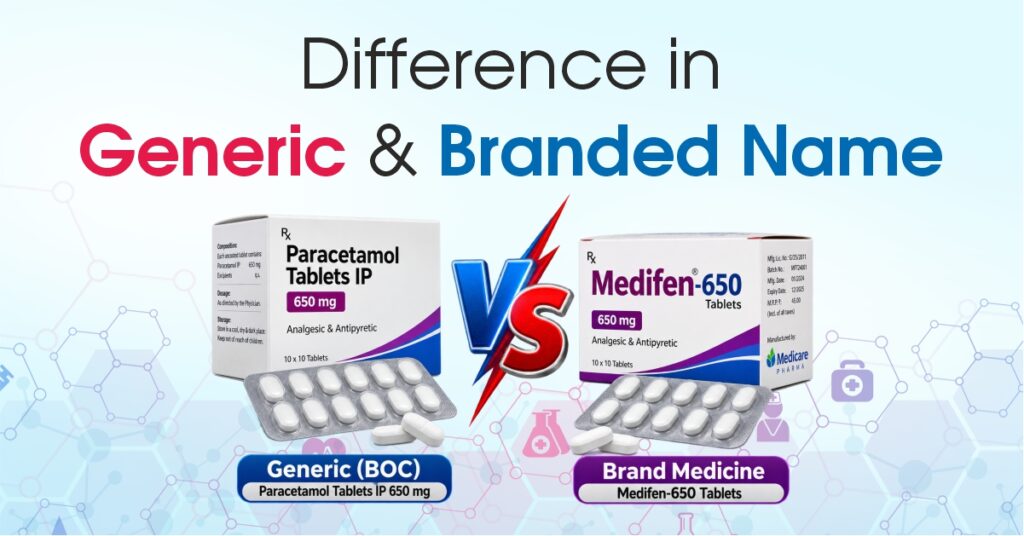
Stand in front of a pharmacy counter and you will often see two boxes for the same complaint — one with a well-known brand name and a higher price, the other with the chemical name printed in bold and a lower price. It raises a fair question: are these medicines really the same thing, or is one of them a compromise?
The honest answer is more nuanced than “identical” or “different.” Brand-name and generic medicines can share the same active ingredient, strength, and dosage form, and both are expected to meet applicable regulatory requirements before they reach a pharmacy shelf. At the same time, they are not necessarily identical in every respect — inactive ingredients, appearance, packaging, manufacturer, and price can differ. Understanding exactly where the similarities end and the differences begin helps patients, caregivers, and healthcare professionals make informed decisions rather than relying on assumptions.
This article breaks down brand-name versus generic medicines point by point — active ingredients, inactive ingredients, bioequivalence, safety, effectiveness, pricing, packaging, and regulatory approval — so you can understand what actually changes between the two, and what stays the same.
What Is a Brand-Name Medicine?
A brand-name medicine is sold under a proprietary or trade name chosen by the pharmaceutical company that markets it, rather than under the name of its active ingredient alone. The brand name is typically trademarked and used in marketing, packaging, and prescribing.
It’s worth clarifying a point that often gets blurred: “brand-name” is not always the same thing as “innovator” or “originator” medicine. An originator medicine is the one first developed and approved by the company that discovered or patented the active ingredient, often after extensive clinical research. However, many companies — including manufacturers of generic medicines — also market their products under their own brand names. These are commonly referred to as branded generics: medicines that use an established, already-approved active ingredient but are sold under a company-specific trade name rather than the ingredient name alone.
In India, in particular, branded generics make up a large share of the retail pharmaceutical market. So when comparing “brand-name” and “generic” medicines, it helps to ask a more precise question: is this a comparison between an originator product and a generic, or between two different companies’ branded versions of the same generic molecule? The applicable regulatory pathway and history of clinical data can differ depending on which comparison is actually being made.
What Is a Generic Medicine?
A generic medicine generally refers to a medicine marketed using its established active ingredient name (or a company’s own brand name for that ingredient) once the exclusivity period associated with an originator product has ended, or once it has otherwise been approved through the applicable regulatory pathway for such products. Generic medicines can be manufactured by companies other than the one that originally developed the reference product, subject to the legal and regulatory requirements that apply in a given country.
A generic medicine is not simply a “copy” made without oversight. Before a generic medicine can be marketed, manufacturers are typically required to demonstrate to the applicable regulatory authority that the product meets defined standards for quality, strength, purity, and — for many medicines — equivalence to a reference product. This includes controls over raw materials, the active pharmaceutical ingredient (API), manufacturing processes, and finished-product testing.
Our related guide, What Are Generic Medicines? A Complete Guide, goes deeper into how generic medicines are defined and developed, if you’d like more background on that side of the comparison.
Brand-Name vs Generic Medicine: Key Differences
The table below summarises how brand-name and generic medicines typically compare. Individual cases can vary depending on the specific medicine, manufacturer, and country.
| Feature | Brand-Name Medicine | Generic Medicine |
|---|---|---|
| Name | Sold under a proprietary/trade name chosen by the marketing company | Usually sold under the active ingredient name or a company’s own brand name for that ingredient |
| Active Ingredient | Contains the active ingredient the product was developed or approved around | Generally contains the same active ingredient as the applicable reference product, at the approved strength |
| Therapeutic Purpose | Intended for the approved indication(s) | Intended for the same approved indication(s) as the reference product, where applicable |
| Strength | As approved by the relevant regulatory authority | Expected to match the approved strength of the reference product |
| Dosage Form | Tablet, capsule, injection, syrup, etc., as approved | Generally the same dosage form, though this can vary by product and market |
| Inactive Ingredients | Determined by the original formulation | Can differ — fillers, binders, coatings, colours, or flavours may vary between manufacturers |
| Appearance | Specific colour, shape, and markings set by the manufacturer | Colour, shape, size, and markings often differ from the brand-name product due to trademark and formulation differences |
| Packaging | Manufacturer-specific packaging and labelling | Manufacturer-specific packaging and labelling, which will differ in design from the brand-name product |
| Manufacturer | The company that developed or holds marketing rights for the brand | Can be manufactured by the same or a different company, subject to applicable approvals |
| Regulatory Pathway | Follows the pathway applicable to new or already-approved brand-name products in that country | Follows the regulatory pathway applicable to generic medicines in that country, which often includes equivalence requirements |
| Pricing | Pricing varies by product, market, and company strategy — not always higher | Often, though not always, priced lower due to market and development-cost factors |
| Bioequivalence | Not typically applicable in the same sense, since it is often the reference product itself | For many generic medicines, demonstrating bioequivalence to the reference product is part of the approval process |
Do Brand-Name and Generic Medicines Have the Same Active Ingredient?
For most generic medicines, the active ingredient, its strength, and its intended route of administration are meant to correspond to those of the applicable reference product — this is a core part of what qualifies a product as a “generic” version under most regulatory systems. The active ingredient is the component responsible for the medicine’s therapeutic effect.
That said, the active ingredient is only one part of the complete formulation. A finished medicine also includes inactive ingredients, a specific manufacturing process, and a particular dosage form, all of which can vary between manufacturers even when the active ingredient and strength are the same. So while the active ingredient is a central point of comparison, it is not the only factor that defines how a medicine is formulated or how it should be evaluated.
Can Inactive Ingredients Be Different?
Yes. Inactive ingredients — also called excipients — are the components of a medicine that are not responsible for its therapeutic effect but play a role in how the product is made, how it looks, how it is absorbed, and how stable it remains over time. Common examples include:
- Fillers and diluents
- Binders that hold a tablet together
- Coatings that affect appearance or release
- Colouring agents
- Flavouring agents (particularly in syrups and chewable forms)
- Preservatives
Different manufacturers can choose different excipients, which is one reason a generic tablet may look, taste, or dissolve slightly differently from its brand-name counterpart, even when the active ingredient and strength are the same. A difference in inactive ingredients does not, on its own, indicate that a generic medicine is of lower quality.
However, excipients are not always inert for every patient. Certain individuals may have sensitivities or intolerances to specific inactive ingredients — for example, particular dyes, sugars, or preservatives. This is one of the reasons patients with known allergies or sensitivities should review the ingredient list and speak with a doctor or pharmacist before switching between products.
Are Generic Medicines as Effective as Brand-Name Medicines?
Generic medicines that have been approved by the applicable regulatory authority are required to meet defined standards intended to support their use as a substitute for the reference product. For many medicines, this includes demonstrating bioequivalence — a scientific comparison of how the generic and reference product behave in the body.
Within the framework set by regulators, an approved generic medicine is intended to provide comparable therapeutic benefit to its reference product for the approved indication. This does not mean every patient will experience an identical response to every product; individual factors such as other medications, health conditions, and personal sensitivity to specific formulations can influence how any medicine — brand-name or generic — works for a particular person. If a patient notices a meaningful change in how a medicine is working after switching products, this should be discussed with a doctor or pharmacist rather than resolved through self-adjustment.
What Is Bioequivalence?
Bioequivalence is a concept used by regulatory authorities to compare how much of a medicine’s active ingredient reaches the bloodstream, and how quickly, when a generic product is compared with its reference product. Two commonly used pharmacokinetic measures in this comparison are:
- Cmax — the peak concentration of the drug reached in the blood
- AUC (Area Under the Curve) — a measure of the total amount of drug absorbed into the bloodstream over time
Regulators use these and related pharmacokinetic parameters to assess whether a generic product’s rate and extent of absorption are close enough to the reference product to be considered equivalent for regulatory purposes. The specific studies required, and how they are evaluated, are set by each regulatory authority and can vary depending on the medicine, its dosage form, and its therapeutic use — for instance, requirements can differ for narrow therapeutic index drugs or certain modified-release formulations. Bioequivalence is one of the scientific tools regulators use to support confidence that an approved generic medicine can perform comparably to its reference product.
Why Are Generic Medicines Often Less Expensive?
Price differences between brand-name and generic medicines are usually driven by economic and market factors rather than differences in raw material cost alone. Some of the more common factors include:
- Development costs: Bringing a new molecule to market typically involves years of research, clinical trials, and regulatory review, all of which represent a substantial upfront investment for the originator company. Generic manufacturers do not repeat this full development process for an already-approved active ingredient.
- Market exclusivity: During a period of patent protection or market exclusivity, an originator product may face limited or no direct competition, which can support higher pricing.
- Number of manufacturers: Once a medicine becomes eligible for generic competition, multiple manufacturers can enter the market. Increased competition often puts downward pressure on prices.
- Marketing and promotional spend: Brand-name products are often supported by significant marketing investment, which can be reflected in pricing.
It’s important not to equate a lower price with lower quality. Price is shaped largely by market dynamics and competition, not by a reduction in the regulatory standards a product must meet. At the same time, it would be inaccurate to say every generic medicine is cheaper than every brand-name product in every market — pricing can vary by country, therapeutic category, and specific product.
Are Generic Medicines Safe?
An approved generic medicine is expected to meet the applicable quality, safety, and manufacturing standards set by the relevant regulatory authority in the country where it is sold. This generally includes requirements around Good Manufacturing Practices (GMP), raw material and API quality, in-process and finished-product testing, stability testing, and accurate labelling.
That said, “safe” is not an unconditional guarantee that applies automatically to any product labelled as generic, regardless of its source. Medicines obtained from unverified, informal, or unlicensed sources — including counterfeit products sold outside legitimate supply chains — may not have gone through any of these controls, whether they claim to be “generic” or “branded.” The safety assurances associated with generic medicines apply to products that have actually been through the applicable regulatory approval and quality-control process, which is why sourcing medicines from licensed pharmacies and legitimate supply chains matters.
Do Brand-Name and Generic Medicines Look Different?
Often, yes. Trademark law generally prevents a generic manufacturer from copying the exact appearance, colour combination, or imprint of a brand-name product, so differences in colour, shape, size, coating, and tablet markings are common and expected. Differences in inactive ingredients, discussed earlier, can also contribute to appearance changes.
These visual differences do not, on their own, indicate anything about a medicine’s therapeutic purpose, strength, or quality. A patient switching from a familiar-looking brand-name tablet to a different-looking generic tablet is not necessarily receiving a “weaker” or “different” medicine — but if the change in appearance causes confusion or concern, it is reasonable to confirm with a pharmacist that the active ingredient and strength remain the same.
Does Packaging Make a Medicine Better?
Packaging plays a genuine functional role in pharmaceutical quality — but that role is about protection and information, not about making a medicine more or less effective. Well-designed packaging contributes to:
- Protecting the medicine from moisture, light, and contamination
- Maintaining product stability through the labelled shelf life
- Clear identification of the product, strength, and batch
- Accurate storage instructions
- Tamper-evidence, where applicable, to support patient safety
A more elaborate or visually polished package does not indicate a pharmacologically superior product, and a simpler package does not indicate an inferior one. What matters is whether the packaging correctly protects the medicine and clearly communicates the information a patient or pharmacist needs. Our article on the importance of pharmaceutical packaging in medicine safety covers this topic in more depth.
Brand-Name vs Generic Medicine: Which One Should You Choose?
There is no single answer that applies to every patient or every medicine. The appropriate choice can depend on factors such as:
- The specific medicine and its therapeutic category
- The prescriber’s clinical recommendation
- Individual patient circumstances, including known allergies or sensitivities to specific excipients
- Local availability of the product
- Cost considerations
- Local regulatory and healthcare guidance
This article is intended to help you understand the general differences between brand-name and generic medicines — it is not a recommendation to select or switch any specific medicine on your own. Decisions about which product is appropriate for a given condition should be made with a qualified doctor or pharmacist.
Can You Switch From a Brand-Name Medicine to a Generic?
In many healthcare systems, pharmacists are permitted, and in some cases expected, to dispense an approved generic equivalent of a prescribed brand-name medicine, subject to prescription requirements and any restrictions the prescriber has noted. However, the specific rules around generic substitution — including which medicines can be substituted, and under what conditions — vary by country and are set by local pharmacy and medical regulations.
For certain categories of medicines, such as those with a narrow therapeutic index or specific formulation considerations, a prescriber may have particular reasons for specifying a particular product. This is not a decision a patient should make unilaterally. If you are considering a switch between a brand-name and generic version of a medicine, it is best discussed with your prescribing doctor or your pharmacist, who can advise based on the specific medicine and your individual health situation.
Common Myths About Generic Medicines
Myth 1: Generic medicines are low-quality medicines.
Fact: Approved generic medicines are required to meet the quality and regulatory standards set by the applicable authority before they can be marketed.
Myth 2: Generic medicines are just copies with no testing.
Fact: Generic medicines typically undergo formulation development, manufacturing controls, and testing — including, for many products, bioequivalence evaluation — as part of the applicable approval process.
Myth 3: Brand-name medicines always work better.
Fact: When a generic medicine has been approved based on demonstrated equivalence to its reference product, it is intended to provide comparable therapeutic benefit for the approved use.
Myth 4: Generic medicines are always cheaper.
Fact: Pricing varies by product, market, and country. While generics are often less expensive due to competition, this is not a universal rule for every medicine.
Myth 5: Generic medicines contain completely different ingredients.
Fact: The active ingredient is generally the same as the reference product at the approved strength. Only the inactive ingredients — fillers, coatings, colours, and similar components — may differ.
Myth 6: A different-looking tablet means it works differently.
Fact: Differences in colour, shape, or size are typically the result of trademark restrictions and formulation choices, not a change in how the medicine works.
How to Compare a Brand-Name and Generic Medicine
If you want to compare two products for the same condition, the following checklist can help you focus on the details that actually matter:
- Active ingredient and strength
- Dosage form (tablet, capsule, syrup, injection, etc.) and route of administration
- Manufacturer name and licensing details on the label
- Expiry date and batch number
- Inactive ingredients, particularly if you have known sensitivities
- Storage requirements printed on the pack
- Prescribing or usage instructions provided by your doctor or pharmacist
- Regulatory and labelling information on the packaging
Avoid choosing or switching between products based on price or appearance alone. If anything on the label is unclear, your pharmacist is the right person to ask.
Brand-Name and Generic Medicines in India’s Pharmaceutical Industry
India has one of the largest pharmaceutical manufacturing bases in the world, with a substantial share of production dedicated to generic medicines for both the domestic market and export. This scale is supported by a wide manufacturing ecosystem, including companies engaged in formulation development, third-party manufacturing, and PCD (Propaganda Cum Distribution) pharma franchise distribution models, which help bring both branded and generic products to healthcare providers and patients across the country.
Within India, medicines — whether branded generics, unbranded generics, or originator brand-name products — are expected to meet the regulatory requirements set by the Central Drugs Standard Control Organisation (CDSCO) and applicable state drug authorities. Manufacturing facilities supplying the domestic and export markets are also expected to operate under Good Manufacturing Practices consistent with national and, where applicable, international standards.
The Indian pharmaceutical sector’s manufacturing capacity and cost structure are frequently cited as contributing factors to the relatively lower cost of generic medicines produced domestically, alongside the broader competitive dynamics described earlier in this article. Readers interested in the manufacturing side of this industry can review our guide on choosing a pharma company for third-party manufacturing.
Role of Pharmaceutical Manufacturers in Generic Medicine Quality
The quality of any generic medicine depends heavily on the practices followed by its manufacturer. Key areas that responsible manufacturers focus on include:
- Sourcing and controlling the quality of raw materials and the active pharmaceutical ingredient (API)
- Formulation development to achieve the required strength, stability, and performance
- Manufacturing processes carried out under Good Manufacturing Practices (GMP)
- Quality assurance and quality control testing at multiple production stages
- Stability testing to establish appropriate shelf life and storage conditions
- Accurate packaging and labelling
- Documentation and traceability throughout production
Not every manufacturer follows identical internal processes, and the specific quality systems in place can vary between companies, even within the same regulatory framework. This is one reason regulatory oversight, inspections, and post-market surveillance play an important role in maintaining consistent standards across the industry. For readers interested in how manufacturing quality is verified over a product’s shelf life, our article on pharmaceutical stability testing explains the process in more detail.
How Rosette Pharma Fits Into the Pharmaceutical Industry
Rosette Pharma is a pharmaceutical company operating in India, offering a portfolio of tablets, capsules, syrups, ointments, and other dosage forms, along with PCD pharma franchise opportunities and third-party manufacturing services for partner brands. Like other companies operating in this space, our work sits within the same regulatory and quality framework described throughout this article — one where active ingredients, formulation, manufacturing controls, and applicable approvals all play a role in the medicines that eventually reach patients.
If you’re exploring how branded and generic pharmaceutical products are developed, manufactured, or distributed in India, our PCD Pharma Franchise page outlines how that distribution model works.
Frequently Asked Questions
1. What is a brand-name medicine?
A brand-name medicine is sold under a proprietary trade name chosen by the company that markets it, rather than under its active ingredient name alone.
2. What is a generic medicine?
A generic medicine generally uses an established active ingredient and is approved through the regulatory pathway applicable to such products in a given country, often after the exclusivity period of the reference product has ended.
3. What is the main difference between brand-name and generic medicines?
The core difference usually lies in the name, manufacturer, inactive ingredients, appearance, and packaging — not necessarily in the active ingredient, strength, or intended therapeutic use, which are generally expected to correspond to the reference product for an approved generic.
4. Are generic medicines as effective as brand-name medicines?
Approved generic medicines are intended to provide comparable therapeutic benefit to their reference product, often supported by bioequivalence data. Individual response can still vary, as it can with any medicine.
5. Are generic medicines safe?
Generic medicines approved by the applicable regulatory authority are expected to meet defined quality and safety standards. Medicines from unverified or unlicensed sources may not meet these standards, regardless of how they are labelled.
6. Why are generic medicines often cheaper?
Lower prices are usually linked to reduced development costs, increased market competition once multiple manufacturers are approved, and lower promotional spending — not to reduced regulatory standards.
7. Can generic and brand-name medicines have different inactive ingredients?
Yes. Fillers, binders, coatings, colours, and flavours can differ between manufacturers, even when the active ingredient and strength are the same.
8. Can generic medicines look different from brand-name medicines?
Yes, often due to trademark restrictions and differences in formulation. Appearance differences do not indicate a difference in therapeutic purpose or quality.
9. Can I switch from a brand-name medicine to a generic?
This depends on the specific medicine, your prescription, and local substitution rules. Always confirm with your doctor or pharmacist before switching.
10. How can I compare a generic medicine with a brand-name medicine?
Compare the active ingredient, strength, dosage form, manufacturer, expiry date, and any inactive ingredients relevant to known sensitivities — and ask a pharmacist if anything is unclear.
Conclusion
Brand-name and generic medicines are best understood as two ways of bringing a medicine to market rather than as a simple “original vs copy” comparison. For most approved generic medicines, the active ingredient, strength, dosage form, and intended therapeutic use are meant to correspond closely to the reference product, and equivalence — including bioequivalence, where applicable — is a core part of the regulatory approval process. What typically differs is the name, manufacturer, inactive ingredients, appearance, packaging, and often the price.
A generic medicine should not automatically be considered inferior simply because it looks different, carries a different name, or costs less. At the same time, patients should not assume that every medicine is fully interchangeable in every situation without checking — particularly where known allergies, specific health conditions, or medicines with narrow therapeutic margins are involved. When in doubt, a conversation with a doctor or pharmacist remains the most reliable way to make an informed decision.
Sources & References
- U.S. Food and Drug Administration (FDA) — Generic Drugs
- World Health Organization (WHO) — Guidance on generic medicines and bioequivalence
- Central Drugs Standard Control Organisation (CDSCO), Government of India
- NHS — Medicines information on brand-name and generic drugs
- MedlinePlus (U.S. National Library of Medicine) — Generic drugs