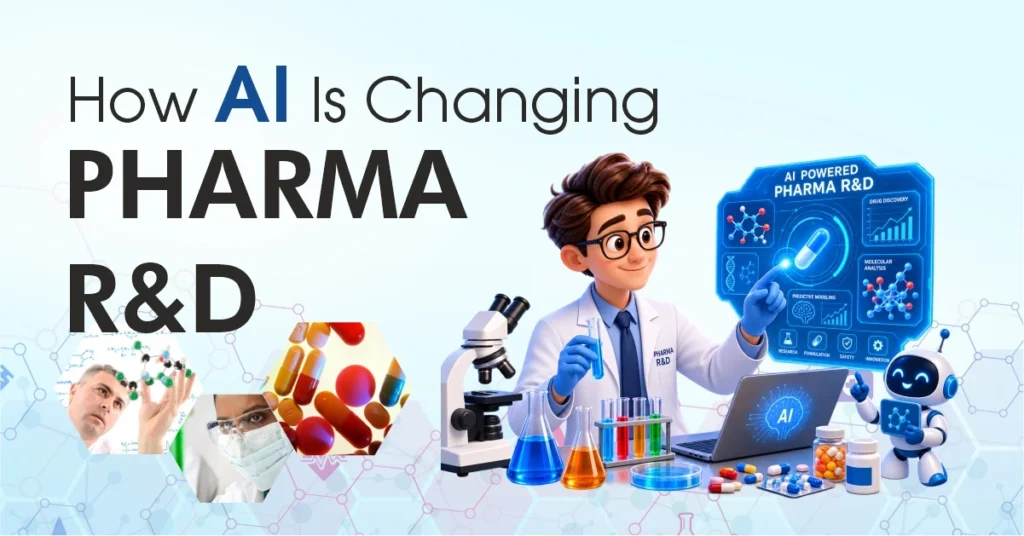
Pharmaceutical research and development is defined by scale: enormous volumes of genomic, chemical, and clinical data; biological systems with thousands of interacting variables; research programmes that can run for over a decade; and development costs that regularly climb into the billions of dollars for a single approved medicine. Against this backdrop, artificial intelligence (AI) and machine learning (ML) are increasingly being explored and applied across the pharmaceutical R&D lifecycle, from early target identification through to clinical trial support and manufacturing.
It’s worth being clear from the outset: AI is a tool that supports researchers, not a replacement for them. Computational predictions still need experimental validation, human interpretation, and regulatory oversight before they translate into medicines patients can use. This article looks at where AI in pharmaceutical R&D is currently being applied, what the evidence actually shows, and where the technology’s real limitations lie.
What Is AI in Pharmaceutical R&D?
In simple terms, artificial intelligence refers to computer systems designed to perform tasks that typically require human reasoning, such as recognising patterns or making predictions. Machine learning, a subset of AI, involves training algorithms on existing data so they can identify patterns and make predictions on new data. Deep learning uses layered neural networks to handle particularly complex, high-dimensional data, such as molecular structures or medical images. More recently, generative AI — models capable of generating new content, including candidate molecular structures — has begun to be explored for tasks like molecule design.
In pharmaceutical research, these technologies are primarily used to process large, complex datasets and surface patterns that would be slow or impractical to identify through manual analysis alone.
Why Is AI Becoming Important in Pharmaceutical R&D?
Several long-standing industry pressures explain the growing interest in artificial intelligence in pharmaceutical R&D:
- Research increasingly draws on large, complex datasets — genomic, proteomic, clinical, and real-world data
- Biological systems and disease mechanisms are highly interconnected and difficult to model manually
- Candidate screening involves evaluating vast libraries of molecules against multiple criteria
- Drug development timelines can extend well beyond a decade, with high attrition at every stage
- Development costs remain substantial, and continue to rise, across the industry
AI can help address parts of these challenges, but it does not automatically solve them. Data quality, experimental design, and scientific judgement remain essential, regardless of how advanced the underlying model is.
How AI Is Transforming Drug Discovery
Drug discovery is the area where AI in drug discovery has seen the most visible activity, spanning several distinct applications.
Target Identification and Validation
AI models can analyse genomic data, proteomic data, biomedical literature, and clinical datasets to help researchers identify potential biological targets — proteins or genes that may be involved in a disease process. This kind of analysis can surface candidate targets faster than manual literature review alone. However, a computationally flagged target is a hypothesis, not a conclusion: it still requires experimental validation in laboratory, and eventually clinical, settings before it can inform a development programme.
AI-Powered Virtual Screening
Virtual screening uses computational models to estimate how likely a large number of candidate molecules are to interact with a chosen target, before any physical testing takes place. Because compound libraries can run into the millions, AI-based prioritisation can help researchers narrow the field to a more manageable shortlist for laboratory work. Virtual screening does not replace laboratory validation — it is a filtering step that informs which molecules are worth testing first.
AI in Drug Design and Molecule Development
Generative AI is increasingly being explored for designing new molecular structures with desired characteristics, while other machine learning models predict properties such as solubility, toxicity-related signals, and pharmacokinetic behaviour — how a compound might be absorbed, distributed, metabolised, and eliminated. One widely discussed example is rentosertib, an Insilico Medicine candidate for idiopathic pulmonary fibrosis whose target and molecule were both identified using AI models. A randomised phase 2a trial published in Nature Medicine in 2025 reported safety and early signs of efficacy — a genuine milestone for AI-enabled drug discovery, though still an early-stage clinical result rather than proof that the drug works or will reach approval. AI-generated molecules, like any other candidate, still have to clear preclinical testing, full clinical trials, and regulatory review.
AI in Preclinical Research
In preclinical research, AI can support the analysis of large experimental datasets, help flag potential toxicity signals for further investigation, assist in interpreting pharmacology and animal-study data, and support biomarker identification. These applications can help researchers prioritise where to focus limited laboratory resources. As with earlier discovery stages, AI-generated predictions here require confirmation through established scientific and experimental methods before they inform decisions about advancing a candidate.
AI in Clinical Trials
Clinical trials generate substantial amounts of structured and unstructured data, making them a natural area for AI-assisted analysis. Current and emerging applications include:
- Supporting patient recruitment by identifying potentially eligible candidates from health records
- Assisting eligibility screening against trial protocols
- Informing trial-site selection using historical enrolment and population data
- Supporting patient stratification, helping group participants by relevant clinical characteristics
- Analysing trial data and monitoring for potential safety signals
- Assisting in modelling possible trial outcomes to inform trial design
None of these applications replace the roles of clinical investigators, institutional review boards, or regulatory authorities. Ethical oversight, informed consent, and regulatory requirements remain central to how clinical trials are conducted, regardless of which analytical tools are used behind the scenes.
AI and Drug Repurposing
Drug repurposing looks for new therapeutic uses for medicines that are already approved or well studied. AI can support this work by analysing existing drug databases, disease biology data, scientific literature, and clinical datasets to identify molecular relationships that might suggest a new application for an existing compound. Because repurposing candidates already have established safety profiles from prior use, this route can sometimes offer a shorter path to further clinical testing than starting from an entirely new molecule. Even so, any AI-generated repurposing hypothesis still needs dedicated clinical and scientific validation before it can inform treatment decisions.
AI in Pharmaceutical Formulation, Manufacturing R&D, and Stability
Beyond discovery and clinical development, AI applications are also being explored across formulation science and pharmaceutical manufacturing.
Formulation and Manufacturing R&D
In formulation research, AI and ML models can help analyse how different excipients and processing conditions might affect a formulation’s behaviour, supporting decisions during development. On the manufacturing side, AI-assisted approaches are being explored for process parameter analysis, predictive maintenance of equipment, and process monitoring — intended to support more consistent output rather than replace established quality systems. Reliable use of AI in a GMP environment still depends on the same fundamentals it always has: calibrated instruments and validated processes. For manufacturers, understanding the difference between calibration and validation remains just as relevant as AI-based tools are introduced into quality workflows.
AI and Pharmaceutical Stability Testing
AI and machine learning are increasingly being explored to support the analysis of stability data — identifying trends across storage conditions, helping model how formulation or packaging factors might influence degradation, and supporting the broader research that informs shelf-life decisions. This does not change what pharmaceutical stability testing fundamentally involves: laboratory testing under specified conditions, using scientifically validated methods, remains essential. AI can help researchers interpret stability data more efficiently; it does not replace the underlying testing.
Benefits of AI in Pharmaceutical R&D
Used appropriately, AI offers several potential benefits across the R&D lifecycle:
| Area | Potential Benefit |
|---|---|
| Data analysis | Faster processing of large, complex research datasets |
| Candidate screening | Help prioritising which molecules or targets to pursue first |
| Pattern recognition | Identification of complex relationships that may be difficult to spot manually |
| Research efficiency | Potential reduction in time spent on repetitive analytical tasks |
| Decision support | Better-informed prioritisation of research directions |
| Candidate attrition | Potential to reduce the number of weak candidates advanced to costly later stages |
These are potential, and in many cases still-emerging, benefits rather than guaranteed outcomes. Actual results vary by application, dataset quality, and how the tools are implemented.
Challenges and Limitations of AI in Pharmaceutical R&D
AI’s role in pharmaceutical R&D comes with real limitations that responsible use has to account for:
- Data quality: models trained on incomplete or biased data can produce unreliable predictions — better algorithms cannot compensate for poor input data
- Interpretability: some AI models function as “black boxes,” making it hard to understand why a prediction was made
- Validation and reproducibility: AI-generated results need independent, experimental confirmation, and reproducibility across datasets remains under scientific scrutiny
- Data privacy and cybersecurity: handling patient and proprietary research data raises governance and security considerations
- Regulatory uncertainty: guidance for AI use in drug development is still evolving in most jurisdictions
- Workflow integration: incorporating AI tools into existing laboratory and manufacturing workflows takes time and validation
- Overreliance: treating AI outputs as conclusions rather than hypotheses risks compounding errors downstream
Does AI Replace Pharmaceutical Scientists?
No. AI can automate certain analytical tasks, help prioritise candidates, surface patterns in large datasets, generate hypotheses, and support decision-making — but it does not replace the judgement pharmaceutical scientists bring to the work. Human expertise remains central to:
- Designing sound experiments
- Interpreting results in scientific and biological context
- Validating findings in the laboratory
- Exercising clinical judgement
- Making regulatory and ethical decisions
- Assessing risk in ways that go beyond what a model was trained to evaluate
AI works best as a tool that extends what scientists can analyse — not as a substitute for scientific expertise.
AI, Data Security and Ethics in Pharmaceutical R&D
The growing use of AI in pharmaceutical research raises data governance questions that companies need to actively manage: protecting patient data privacy, safeguarding confidential research data and intellectual property, addressing potential bias in training datasets, and maintaining meaningful human oversight of AI-assisted decisions. Regulators, including the US FDA and the European Medicines Agency, have begun publishing formal guidance addressing these questions, reflecting how central responsible AI governance has become to pharmaceutical R&D.
Future of AI in Pharmaceutical R&D
Looking ahead, several developments appear realistic rather than speculative: more advanced, multimodal AI models capable of integrating different types of biological data; closer integration between AI tools and laboratory automation; improved analytics for clinical trial design and monitoring; and continued expansion of AI-supported approaches in personalised medicine research, where treatment strategies are informed by an individual’s biological data. Greater integration between AI and pharmaceutical manufacturing is also a plausible direction, with implications for research efficiency and competitive positioning across pharmaceutical businesses.
It’s worth distinguishing between what’s currently in use, what’s emerging, and what remains a future possibility. Much of what is discussed under “AI in pharma” today is still at the research or early-application stage; broad, routine use across the industry is not yet the norm.
How Rosette Pharma Fits Into a Changing Pharmaceutical Industry
Rosette Pharma has operated in the pharmaceutical sector since 2006, working from its facility in the HSIIDC Industrial Area, Sector 3, Karnal, Haryana, with a WHO-GMP–compliant manufacturing network supplying DCGI-approved products across 500+ formulations. The company offers third-party manufacturing for allopathic, derma, and herbal formulations, alongside a PCD Pharma Franchise model with territory-based rights for partners, across dosage forms including tablets, capsules, syrups, injectables, ointments, and eye, ear, and nasal drops.
As AI-supported tools continue to be explored across pharmaceutical research and manufacturing, the fundamentals that franchise partners, distributors, and manufacturing clients rely on — consistent quality systems, GMP compliance, and transparent documentation — remain the foundation any new technology sits on top of, not a substitute for it.
Frequently Asked Questions
1. How is AI used in pharmaceutical R&D?
AI is used across the R&D lifecycle — from target identification and virtual screening to clinical trial data analysis and manufacturing process monitoring — mainly to help analyse large datasets and prioritise research directions.
2. How is AI helping drug discovery?
AI can help identify potential biological targets, prioritise candidate molecules through virtual screening, and predict molecular properties, though all findings still require laboratory validation.
3. Can AI replace pharmaceutical researchers?
No. AI supports research by automating certain analytical tasks, but experimental design, interpretation, and validation still depend on human scientific expertise.
4. How does AI help in clinical trials?
AI can support patient recruitment, eligibility screening, site selection, and data analysis, though it does not replace investigators, ethics oversight, or regulatory requirements.
5. Can AI predict whether a drug will work?
AI can generate predictions about a candidate’s likely properties or behaviour, but these remain hypotheses that require confirmation through laboratory and clinical testing.
6. What is machine learning in pharmaceutical research?
Machine learning is a subset of AI in which algorithms are trained on existing data to identify patterns and make predictions on new, unseen data.
7. What are the limitations of AI in drug development?
Key limitations include dependence on data quality, limited model interpretability, the ongoing need for experimental validation, and evolving regulatory expectations.
8. How can AI help pharmaceutical manufacturing?
AI is being explored for process monitoring, predictive maintenance, and analysis of manufacturing and stability data, generally to support — not replace — existing quality systems.
9. Is AI currently used in pharmaceutical companies?
Yes, to varying degrees. Many companies are exploring or applying AI tools in research and development, though broad, standardised adoption is still developing across the industry.
10. What is the future of AI in pharmaceutical R&D?
Likely developments include more advanced multimodal models, closer integration with laboratory automation, and expanded use in personalised medicine research, alongside continued regulatory development.
Conclusion
Across pharmaceutical R&D, AI is increasingly being used to process complex datasets, help prioritise research opportunities, and support data-driven decision-making — from early drug discovery through to clinical trials and manufacturing. What it does not do is replace the laboratory research, clinical judgement, and regulatory oversight that pharmaceutical development has always depended on. Validation, data quality, and scientific rigour remain as essential as ever.
As these tools mature, the pharmaceutical companies that benefit most are likely to be the ones that combine emerging technology with established scientific expertise and quality systems — rather than treating either as a replacement for the other.