Outsourcing pharmaceutical production involves far more than comparing prices, minimum order quantities, or the length of a product list. A credible manufacturing partner should be assessed for regulatory suitability, documented quality systems, product-specific permissions, manufacturing capability, packaging controls, and supply reliability.
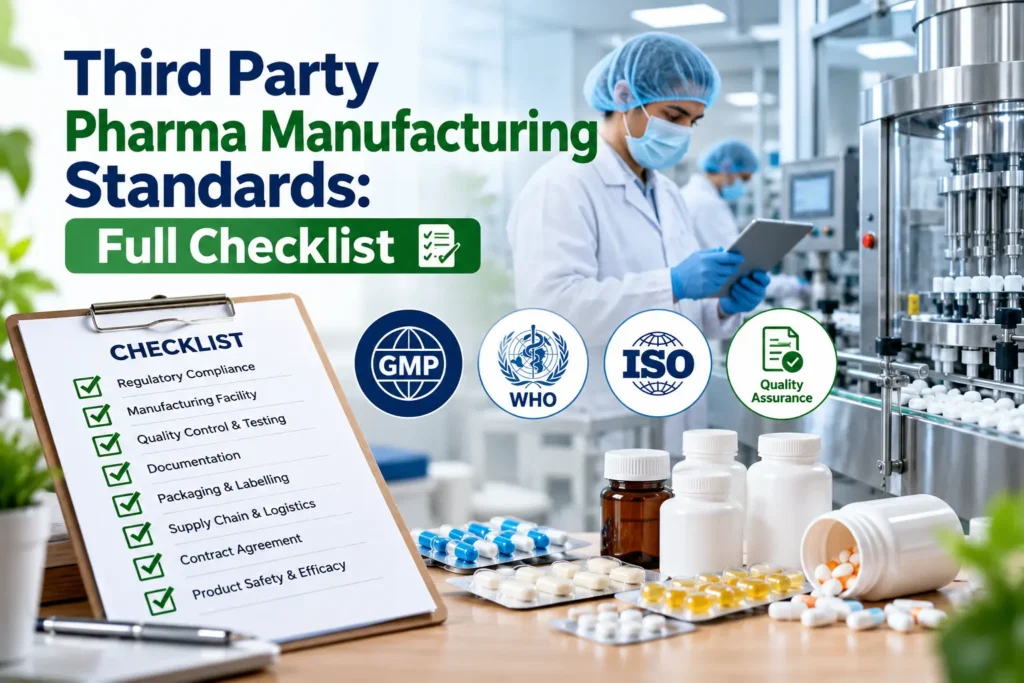
This guide sets out the third party pharma manufacturing standards that brands, PCD franchise owners, and distributors can check before choosing a manufacturer in India. It works as a practical third party pharma manufacturing checklist, with a fill-in table near the end. One caution applies throughout: no single certificate proves that a manufacturer, or every product it supplies, meets all requirements.
What Is Third-Party Pharmaceutical Manufacturing?
In third-party manufacturing, a brand owner or marketing company has its medicines produced by a separate licensed manufacturer. The marketer typically handles branding, sales, and distribution. The manufacturer handles production and testing, and often packaging, according to agreed specifications.
Related terms are often used loosely, so it helps to separate them:
- Third-party or contract manufacturing: the manufacturer produces products for another company’s brand.
- Loan licence arrangement: a specific arrangement under India’s Drugs Rules where a company without its own plant has products made at another licensed site. Its legal basis differs from a purely commercial supply contract.
- PCD (Propaganda Cum Distribution) franchise: a company grants a partner marketing and distribution rights for its products in a defined territory. The partner usually does not manufacture.
Responsibilities between the site and the marketing company should be written into agreements. Even so, regulatory responsibility depends on the product, the licence, the approvals, the manufacturing arrangement, and applicable law. Outsourcing production does not remove the need to verify permissions, documentation, quality responsibilities, and legal compliance.
Why Third Party Pharma Manufacturing Standards Matter
Quality and regulatory standards help support:
- consistent manufacturing processes;
- control of contamination and product mix-ups;
- appropriate identity, strength, quality, and purity;
- documented testing and batch release;
- traceability from raw material to finished pack;
- suitable packaging and storage;
- investigation of quality complaints; and
- regulatory compliance and commercial credibility.
These systems reduce and manage risk. They do not guarantee zero defects or any particular clinical outcome.
Checklist 1: Verify Manufacturing Licences and Regulatory Permissions
Do this before you place any order. Requirements differ by product type, composition, dosage form, intended market, and manufacturing arrangement.
- Confirm the legal identity and address of the actual manufacturing site.
- Verify the manufacturing licence and its current status.
- Confirm the licence covers the relevant activity and dosage forms.
- Check whether your product and its composition have the required permissions or approvals.
- Establish which entity holds the relevant product permissions.
- Confirm the proposed arrangement (own licence, loan licence, or supply to a marketer) is consistent with applicable requirements.
- Check that labels, claims, and marketing plans are legally appropriate.
- Ask for supporting documents and verify them with the relevant authority where possible.
Understanding DCGI, CDSCO, and State Drug Authorities
The Central Drugs Standard Control Organisation (CDSCO) is India’s national regulatory authority for drugs, working under the Directorate General of Health Services, Ministry of Health and Family Welfare. The Drugs Controller General of India (DCGI) heads CDSCO. Under the Drugs and Cosmetics Act and Rules, responsibilities are shared between central and state regulators.
In general terms:
- State drug licensing authorities play a central role in licensing manufacturing premises.
- CDSCO is responsible for functions such as approving new drugs and coordinating state regulators. CDSCO and state regulators jointly handle licences for certain specialised categories, such as blood products, I.V. fluids, vaccines, and sera.
- The applicable authority and approval pathway depend on the product and the relevant legal provisions.
Be careful with the phrase “DCGI-approved.” It is not a blanket description that fits every medicine or manufacturer, and not every product follows an identical direct approval route through the DCGI. Ask which permission applies to your product, who issued it, and who holds it.
These documents are not interchangeable:
- a manufacturing licence;
- a product permission or approval;
- GMP compliance;
- a WHO-GMP-related certificate; and
- a batch test report.
Checklist 2: Evaluate GMP and WHO-GMP Documentation
Good Manufacturing Practices (GMP) are the practices that help ensure medicines are consistently produced and controlled to appropriate quality standards. When reviewing a manufacturer, look at:
- the quality management system;
- trained personnel and hygiene;
- facility design and maintenance;
- equipment qualification, calibration, and maintenance;
- raw material sourcing and controls;
- manufacturing procedures and in-process checks;
- prevention of contamination and mix-ups;
- quality control laboratories and testing;
- documentation, traceability, and deviation management; and
- storage and handling.
WHO-GMP vs GMP vs Schedule M
| Term | Meaning | What It Demonstrates | What to Verify |
|---|---|---|---|
| GMP | Practices ensuring medicines are consistently produced and controlled to appropriate quality standards. | A site works within a quality framework. Only an inspection or audit shows how well it is applied. | Which GMP standard applies and how compliance was assessed. |
| WHO GMP guidance or applicable WHO-GMP framework | Guidance published by the World Health Organization, used as a reference standard by many regulators. | A benchmark. Guidance alone is not a certificate. | Which WHO text or national framework the manufacturer follows. |
| WHO-GMP-related certificate, where applicable | A document issued by a competent authority under the applicable certification arrangements, often needed for export registration. | A site or product was assessed by that authority at a certain time, within a stated scope. | Issuing authority, site, scope, dates, and current status. |
| Schedule M in India | The part of the Drugs Rules, 1945 that sets GMP and premises, plant, and equipment requirements. | The legal baseline for licensed manufacturers in India. | Compliance with the revised Schedule M and the latest inspection position. |
WHO publishes GMP guidance, including its GMP standards. Certification and inspection arrangements depend on the applicable framework and the issuing authority. WHO does not directly certify every pharmaceutical manufacturer, and facilities described as “WHO-GMP compliant” do not all hold an identical certificate.
On Schedule M, the Government of India notified a revised version through G.S.R. 922(E) on 28 December 2023. The original timelines were six months for manufacturers with turnover above ₹250 crore and twelve months for smaller manufacturers, according to a Parliamentary reply. Later reports indicate the deadline for smaller units was extended to 31 December 2025. Confirm the current enforcement position with CDSCO or the state licensing authority.
What Should a Brand Ask to See?
- The manufacturing licence.
- Applicable GMP-related documentation.
- Manufacturing-site details.
- For any certificate: scope, issuing authority, dates, and status.
- The product categories or dosage forms covered.
- Supporting documents for your proposed product and arrangement.
Check every certificate against the actual site, its scope, and its current status. One certificate does not automatically cover every product or every site a company operates.
Checklist 3: Review Product Quality and Quality Control Systems
Quality assurance (QA) is the set of systems and processes designed to maintain quality throughout manufacturing. Quality control (QC) is the sampling, testing, and related work used to evaluate materials and products against specifications. Our overview of a pharmaceutical quality management system shows how the two fit together.
For pharmaceutical quality assurance and pharmaceutical quality control, ask about:
- approved raw material specifications and supplier qualification;
- incoming material identification, testing, and sampling procedures;
- in-process checks;
- finished-product testing against approved specifications, using qualified analytical methods;
- equipment calibration and laboratory controls;
- handling of out-of-specification (OOS) results;
- deviation investigations and corrective and preventive actions (CAPA);
- batch release procedures; and
- retained samples and complaint investigations, as applicable.
The tests that apply depend on the dosage form and the approved specification. This guide to how medicine quality is tested explains the common ones. A certificate does not replace product-specific testing or batch release.
Checklist 4: Verify Batch Documentation and Traceability
Batch records let a manufacturer show what was made, from which materials, on which equipment, with what results. Without them, a problem batch is hard to investigate. Pharmaceutical batch documentation typically includes:
- batch manufacturing records;
- batch packaging records;
- raw material batch numbers and traceability;
- equipment and production records;
- in-process monitoring records;
- laboratory test results;
- deviations and investigations;
- batch release documentation;
- relevant product specifications;
- records supporting complaints, returns, or recalls; and
- retention and retrieval of records as required.
The exact documents depend on the product, the arrangement, applicable regulations, and the agreed quality responsibilities.
What Is a Certificate of Analysis?
A Certificate of Analysis (CoA) reports test results for a material or finished product against stated specifications. Its value depends on the tests reported, the specification used, who issued it, and whether it can be traced to the batch you receive. A CoA is not a manufacturing licence, and on its own it does not show that a facility holds WHO-GMP-related certification. Always confirm how the document relates to the actual batch supplied.
Checklist 5: Check Pharmaceutical Packaging and Labelling Compliance
Packaging is part of product quality and regulatory compliance, not only branding. Our article on pharmaceutical packaging and medicine safety covers the basics. For pharma packaging compliance, review:
- suitability of packaging materials and compatibility with the product;
- protection against moisture, light, contamination, or other relevant risks;
- container-closure integrity, where applicable;
- packaging-line controls to prevent mix-ups;
- printed material approval and reconciliation;
- batch number, manufacturing details, and manufacturing and expiry dates, where required;
- storage instructions;
- required composition, strength, and dosage-form information;
- applicable warnings, directions, and statutory declarations; and
- traceability and any relevant tamper-evident features.
Requirements depend on the dosage form, product category, applicable drug rules, approved product information, and other legislation. Labelling under the Drugs Rules, 1945 should be distinguished from any additional requirements under the Legal Metrology framework, which may apply differently by product. Do not assume one rule applies identically to every product, and confirm applicability with a regulatory professional or the relevant authority.
Checklist 6: Evaluate Multi-Product and Multi-Dosage-Form Capabilities
Tablets, capsules, oral liquids, topical preparations, and other dosage forms can need different equipment, facilities, controls, test methods, and permissions. A broad catalogue does not prove that all products are made at one site, or that the company owns the facilities that make them.
Ask:
- Which site will manufacture my dosage form?
- Is that site licensed for the relevant activity?
- Which product categories and capabilities are documented?
- Are suitable testing and packaging facilities available?
- Are specialised storage or handling conditions needed?
- What are the lead times and minimum order quantities?
- Which manufacturing and quality responsibilities belong to each party?
Checklist 7: Assess Stability, Storage, and Shelf-Life Controls
Settle stability and storage questions before approving a product. Review:
- product-specific stability data and the studies behind it;
- the justification for shelf life and storage instructions;
- whether the packaging suits the product;
- sensitivity to temperature, humidity, and light, where relevant;
- warehouse conditions and transport controls;
- expiry tracking and stock rotation; and
- handling of damaged, returned, or expired stock.
Requirements depend on the product and the applicable framework. There are no universal storage conditions or shelf-life durations. For background, see pharmaceutical stability testing and why storage conditions matter.
Checklist 8: Review Quality Agreements and Commercial Terms
Agreements should define both parties’ responsibilities clearly. Pharmaceutical contract manufacturing requirements usually address:
- product specifications and approved composition;
- identification of the manufacturing site;
- quality and regulatory responsibilities;
- testing and batch release;
- artwork and label approval;
- change control;
- deviations and out-of-specification results;
- complaints and recalls;
- documentation access and retention;
- confidentiality and intellectual property;
- minimum order quantities and payment terms;
- lead times and supply continuity; and
- rejection, replacement, and dispute procedures.
Legal and regulatory responsibilities cannot simply be removed by writing them into a commercial contract. Have agreements reviewed in light of applicable law.
Full Third-Party Pharma Manufacturer Evaluation Checklist
Use this table when you assess a prospective third party pharma manufacturer in India. Tick the status box only after you have seen and checked the evidence yourself.
| Evaluation Area | Questions to Ask | Documents or Evidence to Review | Status |
|---|---|---|---|
| Legal identity and manufacturing site | Who is the legal entity, and where will my product be made? | Registration details, site address, ownership or arrangement proof | ☐ |
| Manufacturing licence | Is it current, and does it cover my dosage form? | Licence copy; verification with the issuing authority | ☐ |
| Product-specific permissions | Which permission applies to my product, and who holds it? | Product permission or approval documents | ☐ |
| GMP and relevant WHO-GMP documentation | What was assessed, by whom, and when? | Certificates showing scope, site, authority, dates | ☐ |
| Quality assurance system | How are deviations, changes, and CAPA handled? | Quality manual or SOP list; audit history | ☐ |
| Quality control and testing | What is tested in-house and what is outsourced? | Specifications, test methods, laboratory details | ☐ |
| Raw material sourcing | How are suppliers qualified and materials tested? | Supplier qualification records, material specifications | ☐ |
| Batch manufacturing records | Can I review a sample record format? | Sample batch manufacturing and packaging records | ☐ |
| Certificate of Analysis | Is a CoA issued per batch, and what does it report? | Sample CoA tied to a batch number | ☐ |
| Packaging and labelling | Who approves artwork, and how is reconciliation done? | Artwork approval process, packaging specifications | ☐ |
| Stability and shelf-life support | What data supports the shelf life? | Stability summary for the product and pack | ☐ |
| Dosage-form capabilities | Is my dosage form made at the named site? | Licence scope, capability statement | ☐ |
| Storage and distribution | How are storage and transport controlled? | Warehouse and dispatch procedures | ☐ |
| Complaints and recalls | Who investigates complaints, and how is a recall run? | Complaint and recall procedures | ☐ |
| Quality agreement | Are quality responsibilities written down? | Draft quality agreement | ☐ |
| Commercial terms and supply reliability | What are MOQs, lead times, and payment terms? | Quotation, supply terms, delivery track record | ☐ |
How to Prioritise the Checklist
Start with the items that decide whether you can legally sell the product: legal identity, licence, product-specific permissions, and GMP-related documentation. Next, review quality control, batch records, and packaging. Compare price, minimum order quantity, and lead time last. A low quote does not help if the licence or permission does not fit your product.
Common Mistakes to Avoid When Selecting a Manufacturer
If you are working out how to choose a third party pharma manufacturer, watch for these errors. Our broader buyer’s guide to choosing a pharma manufacturing company covers the wider selection process.
- Choosing solely on low price.
- Accepting an unverified certification claim.
- Confusing a manufacturing licence with a product-specific approval.
- Assuming a certificate covers every facility and product.
- Skipping review of batch documentation.
- Ignoring packaging and labelling requirements.
- Not identifying who handles complaints and recalls.
- Assuming a broad product list proves every dosage form is made at one facility.
- Placing a large order before checking permissions and quality documents.
- Leaving responsibilities undefined in writing.
How Rosette Pharma Fits into Third-Party Manufacturing Evaluation
Rosette Pharma, based in Karnal, Haryana, is one company you can investigate when exploring third party pharma manufacturing in India and PCD franchise options. According to its About Us page, it has been in the pharmaceutical sector since 2006.
The Rosette Pharma website says the company offers third-party manufacturing for allopathic, derma, and herbal formulations, with support from product development through to packaging. It lists dosage forms including tablets, capsules, syrups, dry syrups, injectables, ointments, softgel capsules, drops and suspensions, and sachets. Its divisions are Rosette Pharmaceuticals, Admetus Pharma, Yeux Care, and Rosette Organics. It also runs a PCD pharma franchise model with territory-based rights.
The website describes its products as sourced from WHO-GMP-compliant facilities and as DCGI-approved. Treat these as statements to verify, using the checklist above. The site describes a manufacturing network, so ask which licensed site makes your specific product, what its licence and certificate scope covers, and which permission applies to your formulation. This is the same diligence you should apply to any manufacturer.
Before committing to an order, request the manufacturing-site details, product permissions, quality documentation, and commercial terms in writing.
Frequently Asked Questions
1. What standards should a third-party pharma manufacturer follow in India?
A manufacturer should hold a valid manufacturing licence and comply with Schedule M of the Drugs Rules, 1945. Other requirements depend on the product, such as product permissions, labelling rules, and pharmacopoeial standards.
2. What is the difference between WHO-GMP and GMP?
GMP is the general concept of consistent, controlled manufacturing. WHO publishes GMP guidance, and WHO-GMP-related certificates are issued by competent authorities under applicable arrangements, with a stated scope.
3. Does DCGI approve every pharmaceutical product in India?
No, not through one identical direct process. The approval pathway depends on the product and the legal provisions that apply, and state licensing authorities are also involved.
4. Which documents should I request from a third-party pharma manufacturer?
Ask for the manufacturing licence, product permissions, GMP-related documentation, sample batch records, a sample CoA, stability support, and the draft quality agreement.
5. What is a Certificate of Analysis in pharmaceutical manufacturing?
It is a document reporting test results for a material or batch against specifications. It is not a licence and does not by itself prove WHO-GMP certification.
6. Why are batch manufacturing records important?
They document how a batch was made and checked, which supports traceability, investigations, and recalls.
7. What packaging compliance requirements should pharma brands check?
Check material suitability, artwork approval, batch and date details, storage instructions, and labelling under the Drugs Rules. Also check whether Legal Metrology requirements apply to your product.
8. Can one manufacturer produce multiple pharmaceutical dosage forms?
It can, but each dosage form may need different facilities, controls, and permissions. Confirm the site and licence scope for your dosage form.
9. How can I verify a manufacturer’s GMP-related claims?
Review the certificate’s scope, site, issuing authority, and dates. Cross-check with the issuing authority where possible, and consider an audit or site visit.
10. What should be included in a third-party manufacturing quality agreement?
Cover specifications, site, testing and release, artwork approval, change control, deviations, complaints, recalls, and documentation access.
11. Does WHO-GMP certification guarantee the quality of every batch?
No. It reflects an assessment at a point in time. Batch quality still depends on day-to-day controls, testing, and release.
12. What should I check before choosing Rosette Pharma for third-party manufacturing?
Request the manufacturing site for your dosage form, the licence and certificate scope, product-specific permissions, sample quality documents, and written commercial terms.
Conclusion
Sound third party pharma manufacturing standards come down to verification: licences, product permissions, GMP-related documents, batch records, testing, packaging, storage, and quality agreements. The best partner is not necessarily the cheapest or the one with the longest catalogue. It is the one whose documented capabilities, regulatory position, quality systems, and commercial terms match your requirements.
If you are exploring third-party manufacturing, you can contact Rosette Pharma to discuss your produc