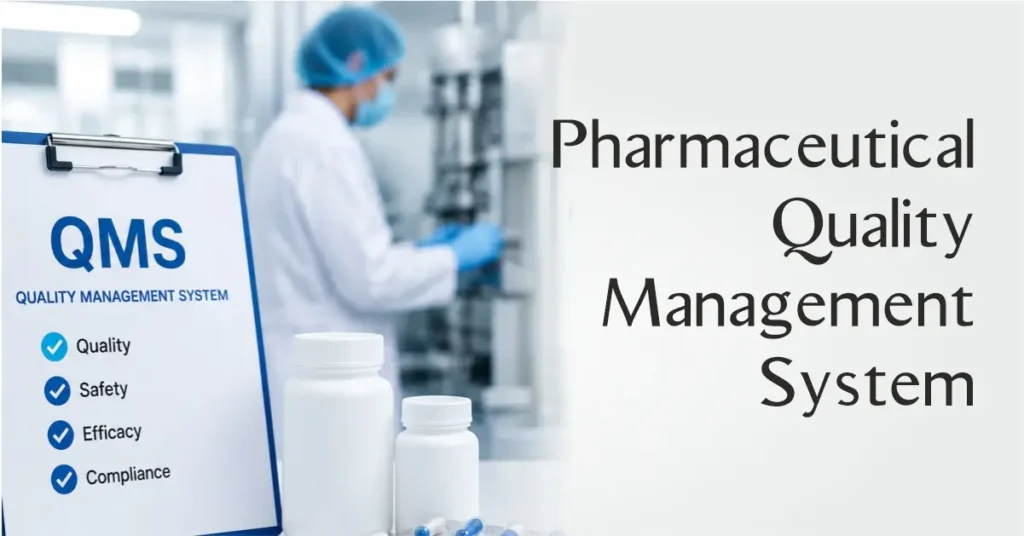
A pharmaceutical quality management system (QMS) is the organized set of policies, procedures, responsibilities, controls, documentation, and improvement activities a company uses to ensure every medicine it produces consistently meets appropriate quality and safety standards — connecting raw material approval, manufacturing, testing, and problem-solving into one coordinated system rather than disconnected checks.
In short, a pharmaceutical QMS is what lets a company answer “how do we know this medicine is the same quality every time?” with evidence. This article explains what a pharmaceutical QMS involves, how it relates to GMP and the ICH Q10 guideline, and why it matters to manufacturers, franchise partners, and patients.
What Is a Pharmaceutical Quality Management System? (Definition)
A Pharmaceutical Quality Management System (Pharmaceutical QMS, or PQMS) is a structured framework of processes, roles, controls, documentation, and continual-improvement activities designed to ensure pharmaceutical products are consistently manufactured, tested, and controlled to appropriate quality standards throughout their lifecycle. It is the “operating system” that ties quality assurance, quality control, manufacturing controls, risk management, and documentation together, so quality is built into every stage rather than checked for only at the end.
Why Is a Pharmaceutical QMS Important?
Medicines differ from most consumer products because a manufacturing failure can directly affect a patient’s health. A pharmaceutical QMS helps:
- Reduce the risk of manufacturing errors, contamination, mix-ups, and documentation gaps
- Support batch-to-batch consistency
- Give regulators verifiable evidence that processes are controlled and followed
- Provide a structured way to investigate problems and prevent recurrence
- Build the documentation trail needed for regulatory submissions and inspections
- Enable continual improvement rather than one-time compliance
An effective QMS reduces the risk of quality failures — it does not guarantee that problems will never occur.
Pharmaceutical QMS vs GMP: What Is the Difference?
GMP is a set of regulatory requirements and practices governing how medicines must be produced and controlled — covering facility hygiene, equipment, personnel training, documentation, and testing. A Pharmaceutical Quality System, as described in ICH Q10, is broader: an integrated management framework connecting quality activities across the entire product lifecycle, from development through commercial manufacturing to discontinuation.
Neither replaces the other. ICH Q10 states that its pharmaceutical quality system model is intended to augment regional GMP requirements by adding lifecycle-wide elements — such as knowledge management and formal management review — that regional GMP rules do not always spell out, especially for development. GMP itself is generally a regulatory requirement; the additional elements ICH Q10 introduces beyond existing GMP are described by the guideline as optional enhancements, not new legal obligations.
| Aspect | GMP | Pharmaceutical QMS (ICH Q10 model) |
|---|---|---|
| Primary focus | Manufacturing and control practices | Integrated quality management across the lifecycle |
| Scope | Commercial manufacturing operations | Development, tech transfer, manufacturing, discontinuation |
| Nature | Largely a regulatory requirement | A management model; elements beyond GMP are optional |
| Relationship | Provides operational rules | Provides the overarching system GMP operates within |
Understanding ICH Q10
ICH Q10 is a guideline from the International Council for Harmonisation describing a model for an effective pharmaceutical quality system across a product’s lifecycle. It works alongside ICH Q8 (Pharmaceutical Development) and ICH Q9 (Quality Risk Management). ICH Q10 identifies three objectives: product realization (delivering products with attributes appropriate for patient needs), establishing and maintaining a state of control (consistent, capable processes), and facilitating continual improvement.
It frames quality activities across four lifecycle stages: Pharmaceutical Development, Technology Transfer, Commercial Manufacturing, and Product Discontinuation. Importantly, ICH Q10 is an internationally harmonized guideline, not a law automatically binding in every country — its influence comes from being incorporated into regional GMP expectations, not from standing on its own as legislation.
Core Components of a Pharmaceutical QMS
| Component | Purpose |
|---|---|
| Quality Management/Leadership | Sets quality policy, objectives, and accountability |
| Quality Assurance (QA) | Prevents failures through sound systems and procedures |
| Quality Control (QC) | Tests materials and products against specification |
| Document Control | Keeps SOPs and records accurate and traceable |
| Training & Competency | Ensures staff can correctly perform quality-related tasks |
| Deviation Management | Captures and investigates departures from procedure |
| CAPA | Corrects problems and prevents recurrence |
| Change Control | Evaluates and controls changes before implementation |
| Risk Management | Prioritizes controls based on risk to patients and product |
| Internal Audits | Checks whether the QMS is followed in practice |
| Supplier Qualification | Confirms external materials/services meet requirements |
| Complaint Handling | Captures and investigates feedback on marketed products |
| Product Quality Reviews | Periodically checks that processes remain in control |
| Stability Management | Confirms products stay within spec over shelf life |
| Data Integrity | Keeps records accurate, complete, and trustworthy |
| Validation & Qualification | Confirms equipment/processes perform as intended |
| Batch Release | Formal decision to release or reject a batch |
| Recall Management | Structured removal of non-conforming products |
| Management Review | Leadership reviews QMS performance and resourcing |
| Continual Improvement | Strengthens the system using data and lessons learned |
Quality Assurance vs Quality Control
QA is largely process-oriented and preventive, focusing on whether systems and procedures are appropriate and consistently followed. QC is testing- and inspection-oriented, evaluating materials and products against specifications. Both are essential, complementary parts of the same quality system — not competing functions.
| Feature | Quality Assurance | Quality Control |
|---|---|---|
| Main focus | Systems and process reliability | Testing against specification |
| Approach | Preventive, process-oriented | Detective, inspection-oriented |
| Typical activities | SOPs, audits, training, change control | Raw material, in-process, and finished-product testing |
| Role in product quality | Builds confidence the system can consistently deliver quality | Confirms a specific batch meets specification |
CAPA: Corrective and Preventive Action
CAPA responds to a quality problem by fixing its immediate cause and reducing the chance it recurs. A corrective action addresses an existing problem’s root cause; a preventive action addresses a potential problem before it occurs. Effective CAPA depends on genuine root cause analysis — not just treating symptoms — followed by an effectiveness check.
Example: A packaging line repeatedly produces cartons with a missing batch-coding stamp. A functioning QMS would typically: (1) document the deviation each time it occurs, (2) investigate the root cause, (3) implement a corrective action, (4) implement a preventive measure such as revised training or an added check, and (5) monitor later batches to confirm the problem doesn’t recur.
Change Control
Manufacturers cannot casually change raw materials, suppliers, equipment, processes, packaging, specifications, testing methods, or software without evaluating the impact first. Change control ensures a proposed change is assessed for its effect on quality and regulatory status before implementation, then documented, approved, and verified afterward. Whether a specific change requires regulatory approval depends on its nature and significance and applicable requirements — not every change triggers a filing.
Deviation Management
A deviation is any departure from an approved procedure, specification, or process. When one occurs, a QMS requires it to be documented, investigated for root cause, and assessed for impact on quality — which may trigger a CAPA. Treating deviations as routine paperwork rather than genuine investigations is a common weakness regulators look for during inspections.
Quality Risk Management
Quality risk management is the systematic process of identifying, assessing, controlling, communicating, and reviewing risks to product quality — a concept formalized in ICH Q9. Risk-based thinking helps direct more scrutiny toward areas with greater potential impact on patients and product quality, and proportionately less toward lower-risk activities, rather than treating every issue with equal intensity.
Data Integrity
Because quality decisions — including batch release — rely on recorded data, that data must be trustworthy. Data integrity means records are accurate, complete, consistent, and traceable, and protected from unauthorized alteration. Many regulators, including the World Health Organization, reference the ALCOA+ framework: data should be Attributable, Legible, Contemporaneous, Original, and Accurate, plus Complete, Consistent, Enduring, and Available. In practice, this means controlled documentation, audit trails where applicable, restricted access, and recording activities at the time they happen.
Documentation
Documentation makes a QMS demonstrable rather than theoretical. Core records include SOPs, batch manufacturing records, specifications, test records, validation reports, training records, deviation reports, CAPA records, change-control records, and audit records. A widely repeated principle is that if an activity isn’t properly documented, it becomes difficult to demonstrate it was performed correctly — a practical reality rather than an identical legal rule everywhere.
Supplier and Raw Material Quality
Product quality starts with the materials that go into it. A QMS typically addresses this through supplier qualification, quality agreements where appropriate, incoming material testing, ongoing supplier performance monitoring, and periodic audits — with the depth of oversight generally proportionate to the criticality of the material or service.
How QMS Operates Across Manufacturing
A simplified flow (exact steps vary by company, product, and dosage form):
Raw Materials → Material Testing/Approval → Manufacturing → In-Process Controls → Packaging → QC Testing → Batch Review → Release → Distribution → Post-Market Monitoring → Continual Improvement
Role of QMS in Medicine Safety
An effective QMS helps reduce the likelihood of manufacturing errors, contamination, mix-ups, documentation problems, uncontrolled changes, and inadequate investigations. It helps reduce risk — it does not guarantee that defects can never occur.
QMS Across the Product Lifecycle
- Pharmaceutical development: Building quality into formulation and process design
- Technology transfer: Ensuring knowledge and controls carry over accurately between sites or stages
- Commercial manufacturing: Day-to-day GMP, monitoring, and improvement
- Distribution: Maintaining product integrity and traceability
- Post-market monitoring: Tracking complaints and quality trends after launch
- Product discontinuation: Managing orderly wind-down while retaining records
How Does a Pharmaceutical QMS Work?
A simplified overview — actual systems involve considerably more detail:
- Establish quality objectives and policy
- Define roles and responsibilities
- Create controlled SOPs
- Train personnel
- Monitor manufacturing and testing
- Identify and document deviations
- Investigate root causes
- Implement CAPA
- Control and evaluate changes
- Conduct audits and management reviews
- Monitor quality trends
- Continually improve the system
Benefits and Challenges
Benefits commonly associated with a mature QMS include more consistent product quality, stronger patient safety protection, better inspection readiness, clearer documentation, fewer recurring problems, improved process control, structured risk management, better supplier oversight, and greater accountability. These are realistic benefits, not guarantees — a QMS does not by itself guarantee regulatory approval.
Common challenges include consistent staff training, managing documentation without slowing operations, maintaining data integrity across paper and electronic systems, avoiding change-control bottlenecks, qualifying a broad supplier base, resourcing quality functions adequately, sustaining a genuine quality culture rather than a “paperwork” culture, and keeping SOPs current under production pressure. A QMS is not simply a binder of documents — it only works when people actually follow it.
Quality Culture
A QMS works best when quality is a shared responsibility across the organization, not something owned only by the QA department. A strong quality culture involves visible management commitment, accountability at every level, meaningful training, encouragement to report problems early, and moving away from blame-based responses to mistakes.
Role of Technology in Modern Pharmaceutical QMS
Many companies now use electronic Quality Management Systems (eQMS), electronic batch records, laboratory information systems, automated workflows, and digital training tools to improve traceability and strengthen audit-trail controls. Not every company uses the same level of digital infrastructure, and technology does not replace the underlying procedures, training, and culture that make a QMS effective.
QMS for Third-Party Pharmaceutical Manufacturing
When a business works with a third-party or contract manufacturer, that manufacturer’s quality system effectively becomes part of the business’s own quality chain. Relevant areas include manufacturing consistency, availability of quality documentation, batch traceability, raw material and packaging controls, and how complaints are handled — all part of the due diligence any brand owner or distributor should apply. For a deeper look at evaluating a manufacturing partner more broadly, see our guide on how to choose the best pharma manufacturing company.
QMS and PCD Pharma Franchise Businesses
For PCD pharma franchise partners, the quality system behind the products they sell has a direct, practical impact: it supports consistent product quality, dependable supply, proper documentation, confidence among doctors and chemists in a territory, structured complaint handling, and stronger long-term business relationships. Our related article on why quality matters in pharmaceutical manufacturing explores this from a franchise and distributor perspective in more depth.
Related Quality Concepts
A pharmaceutical QMS touches several related disciplines covered elsewhere on our site, including pharmaceutical stability testing, pharmaceutical packaging and medicine safety, and the difference between calibration and validation — each a supporting pillar within the broader quality system described here.
| Concept | What It Primarily Covers |
|---|---|
| Pharmaceutical QMS | Integrated quality management across the product lifecycle |
| GMP | Regulatory requirements for manufacturing and control |
| Quality Assurance | Preventive oversight of systems and procedures |
| Quality Control | Testing materials/products against specification |
| Quality Risk Management | Identifying and prioritizing risks to product quality |
Common Misconceptions About Pharmaceutical QMS
Myth: “QMS is just paperwork.”
Fact: It’s an integrated system of processes, responsibilities, controls, monitoring, and improvement — documentation supports it but isn’t the whole system.
Myth: “Quality is only the QA department’s job.”
Fact: Quality works best as a shared responsibility across manufacturing, QC, procurement, and management, coordinated by QA.
Myth: “GMP and QMS are exactly the same thing.”
Fact: They’re closely related, but GMP covers manufacturing and control practices while a pharmaceutical quality system provides a broader lifecycle framework.
Myth: “Testing the finished product alone guarantees quality.”
Fact: Finished-product testing is one checkpoint; quality depends on controls throughout sourcing, manufacturing, and distribution.
Myth: “CAPA means fixing the immediate problem only.”
Fact: Effective CAPA addresses the root cause and helps prevent recurrence, not just the immediate symptom.
Myth: “Every manufacturing change requires regulatory approval.”
Fact: Regulatory impact depends on the nature and significance of the change and applicable requirements.
Myth: “QMS guarantees zero defects.”
Fact: An effective QMS helps identify, control, and reduce quality risks, but cannot guarantee problems will never occur.
Frequently Asked Questions
1. What is a Pharmaceutical Quality Management System?
A structured system of policies, procedures, controls, documentation, and improvement activities that helps ensure medicines are consistently manufactured and controlled to appropriate quality standards.
2. Why is QMS important in pharmaceutical manufacturing?
Because manufacturing errors can directly affect patient health, a QMS helps reduce defect risk, supports batch consistency, and supports regulatory compliance.
3. What is the difference between QMS and GMP?
GMP sets manufacturing and control requirements; a pharmaceutical QMS is a broader framework connecting quality activities across the full product lifecycle, working alongside GMP.
4. What are the main components of a pharmaceutical QMS?
QA, QC, document control, training, deviation management, CAPA, change control, risk management, audits, supplier qualification, complaint handling, and continual improvement, among others.
5. What is CAPA in pharmaceutical quality?
Corrective and Preventive Action — a process for fixing the root cause of a quality problem and preventing recurrence.
6. What is change control in pharmaceutical manufacturing?
The process of evaluating, approving, documenting, and verifying any change before it is implemented, to manage its impact on product quality.
7. What is deviation management?
The process of documenting, investigating, and assessing any departure from an approved procedure or specification.
8. What is the difference between QA and QC?
QA is preventive and focuses on systems and procedures; QC is testing-based and checks materials and products against specification.
9. What is ICH Q10?
An internationally harmonized guideline describing a model for an effective pharmaceutical quality system across a product’s lifecycle, alongside ICH Q8 and ICH Q9.
10. How does QMS help ensure medicine quality?
By coordinating controls across raw materials, manufacturing, testing, documentation, and post-market monitoring, so a medicine reliably meets its intended attributes.
11. Why is data integrity important in pharmaceutical manufacturing?
Because quality decisions, including batch release, rely on recorded data — compromised data integrity undermines every decision built on it.
12. Does every pharmaceutical company use the same QMS?
No. Systems are built around similar principles and applicable GMP requirements, but specific procedures and technology vary by company and market.
Why Pharmaceutical Quality Management Matters to Rosette Pharma’s Customers
For franchise partners, distributors, and businesses evaluating a manufacturing relationship, understanding what sits behind “quality management system” is a practical part of due diligence — it affects whether products perform consistently and how documentation and issues are handled.
Rosette Pharma has operated in the pharmaceutical sector since 2006, offering third-party manufacturing for allopathic, derma, and herbal formulations, along with a PCD Pharma Franchise model built around district-level monopoly rights. Its manufacturing network is described as WHO-GMP compliant, supplying DCGI-approved products across 500+ formulations. The concepts covered in this article — QA and QC roles, documentation, change control, and risk-based thinking — are useful questions to bring into any conversation with a prospective manufacturing partner.
Sources & References
- ICH Q10 Pharmaceutical Quality System, International Council for Harmonisation (via European Medicines Agency) — pharmaceutical quality system objectives, lifecycle scope, and relationship to regional GMP
- ICH Q9(R1) Quality Risk Management, International Council for Harmonisation / U.S. FDA — quality risk management process (identification, assessment, control, communication, review)
- World Health Organization, WHO Technical Report Series No. 996, Annex 5 — guidance on good data and record management practices (data integrity, ALCOA+)
- Central Drugs Standard Control Organisation (CDSCO), Government of India — regulatory oversight of pharmaceutical manufacturing in India
Disclaimer
This article is provided for educational purposes and is not a substitute for official regulatory guidance, pharmaceutical quality procedures, or professional regulatory advice. Applicable requirements may vary by country, product, and manufacturing activity.