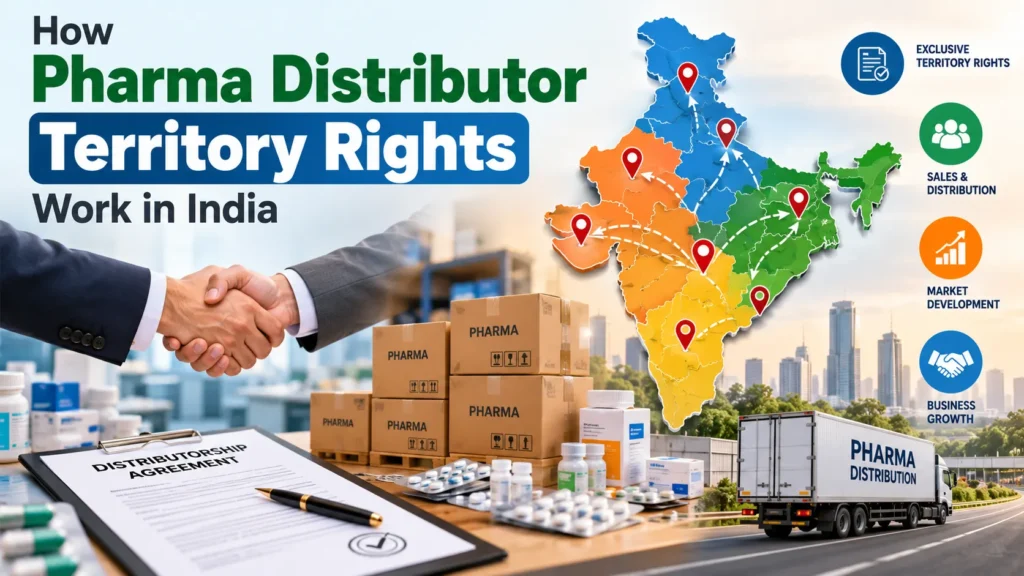
Before you invest in a PCD pharma franchise or a distribution arrangement, one question matters more than most: who else can sell the same products in my area? Pharma distributor territory rights decide where you may sell, which products you may sell, and whether anyone else, including the company itself, can operate in the same space.
Beginners often ask questions like these:
- Can two distributors sell the same company’s products in the same area?
- Does a territory agreement automatically provide exclusivity?
- What happens if the company appoints another distributor nearby?
- How can I protect my investment and customer relationships?
- What should I check before signing?
The honest answer to each is “it depends”. The outcome turns on the written agreement, the type of business arrangement, how precisely the territory is defined, and applicable law. This article explains the moving parts in simple terms. It is general educational information, not legal advice.
What Are Pharma Distributor Territory Rights?
Territory rights are the contractual or commercial terms that govern where a distributor or franchise partner may market, sell or distribute specified products. They are created by an agreement between the parties. They are not an automatic legal entitlement.
A territory can be defined by:
- a district, city or state;
- PIN codes or a map;
- named accounts, such as particular hospitals or chemists;
- another clearly specified boundary.
Two ideas are often confused:
- Permission to operate in an area means you may sell there. It says nothing about whether others may too.
- Exclusive rights mean the company has agreed, in writing, to restrict who else may sell the covered products in that area.
Having a territory does not give you ownership of a geographic area or a general legal monopoly. Verbal assurances are also hard to rely on if a dispute arises, because the written document is usually what is examined. A good territory clause identifies the products, the sales channels and any exceptions, not just the place name.
Different Types of Pharma Territory Arrangements
Non-Exclusive Distribution Rights
The company may allow several distributors to sell the same products in the same territory. This can mean more price competition, overlapping visits to the same chemists, and less certainty that your marketing effort will benefit only you. On the other hand, entry terms may be lighter, and the company may reach the market faster.
Exclusive Distribution Rights
Here, one distributor receives exclusive rights to sell specified products in a defined territory, subject to the contract. Exclusivity usually comes with conditions, exceptions, performance requirements and a fixed duration. Read these as carefully as the exclusivity clause itself.
PCD Pharma Franchise Monopoly Rights
PCD stands for “Propaganda cum Distribution”. In some PCD arrangements, the company allocates a defined territory to one partner and agrees not to appoint another partner for the same products there. This is commonly called a pharma franchise monopoly basis. The precise scope varies by company and contract.
The word “monopoly” is a commercial label. It does not guarantee that competing brands, generic medicines, retailers or other pharma businesses cannot operate in your area. Usually it means only that the company will not appoint another partner for its own products in that territory, with whatever exceptions are written down. For a benefits-focused overview, see Rosette Pharma’s article on monopoly pharma franchise benefits for distributors.
Conditional or Performance-Based Territory Rights
A company may link continued exclusivity to agreed targets, timely payments, ordering frequency, regulatory compliance or other written conditions. Check that these conditions are realistic, measurable and clearly documented. A target that cannot be measured, or can be changed unilaterally, gives you little security.
How Pharma Territory Allocation Works in India
There is no single mandatory legal process. Many companies follow a workflow like this:
- The distributor or franchise partner identifies the intended market.
- The company checks availability and any existing arrangements.
- The parties define the territory boundaries.
- They agree the products and channels covered.
- They document exclusivity, restrictions and exceptions.
- They agree pricing, orders, payment terms and performance conditions.
- The company confirms the arrangement in writing.
- Both sides follow the agreement and applicable law.
A Hypothetical Example
This is an illustration only, not a real case. Imagine two arrangements for the same district.
| Factor | Arrangement A (exclusive, with conditions) | Arrangement B (non-exclusive) |
|---|---|---|
| Who may sell the covered products | One partner, for named products in the defined district | Several distributors in the same district |
| Competition for the same brand | Reduced within the written terms | Possible between distributors |
| Pricing pressure | Generally lower from same-brand sellers | Can be higher |
| Obligations | Targets, payment and ordering conditions | Often lighter, but varies |
| Main risk | Losing exclusivity if conditions are missed | Weaker return on relationship-building effort |
Neither arrangement promises profit. Arrangement A may suit someone willing to meet targets in return for clarity. Arrangement B may suit someone who wants flexibility and accepts more competition. Results depend on the market, the products and your effort.
What Should a Pharma Territory Agreement Include?
Use this as a checklist when reviewing any pharma distributor territory agreement or PCD pharma franchise agreement terms.
1. Exact Territory Definition
Look for named districts, cities, PIN codes or a map. Avoid vague wording such as “nearby areas” or “surrounding districts”.
2. Products Covered
Specify brands, formulations, dosage forms and categories. Check whether newly launched products are covered automatically or need separate written confirmation.
3. Exclusivity and Exceptions
State exactly what is exclusive, who is restricted from appointing competing partners, and what exceptions apply. Clarify direct sales, online sales, institutional sales and key accounts.
4. Duration and Renewal
Note the start date, term, renewal process, notice periods and renewal conditions.
5. Sales Targets and Performance Conditions
Identify minimum purchase quantities, reporting duties and what happens if you miss a target. Try to negotiate targets that are achievable and measurable.
6. Pricing and Payment Terms
Review price revisions, payment deadlines, credit terms and minimum orders.
7. Marketing and Business Support
Write down any promised promotional material, product information or onboarding help. Do not assume every company offers the same support.
8. Product Availability and Supply
Clarify ordering procedures, lead times, stock availability, and how shortages or discontinued products will be handled.
9. Termination and Territory Changes
Review grounds for termination, notice, cure periods where applicable, and whether the company may change boundaries or appoint another partner.
10. Dispute Resolution
Identify the process (for example negotiation, mediation or arbitration), the governing law and the courts or tribunal with jurisdiction. Get legal advice on these clauses. Their enforceability and interpretation depend on the contract and applicable law.
What Legal and Contractual Protections Do Pharma Distributors Have?
Your rights mainly come from the written agreement and general Indian law. Indian law does not give every distributor automatic exclusivity, renewal or compensation. Several areas are relevant.
Contract law. The Indian Contract Act, 1872 is the starting point. A few provisions are worth knowing:
- Section 27 provides that agreements restraining a lawful trade or business are void to that extent. Restrictions that continue after an agreement ends are generally looked at more closely than restrictions that apply only during its term. The result depends on the clause and the facts.
- Section 29 deals with agreements that are uncertain in meaning. This is one more reason to define territory and products precisely.
- Sections 73 and 74 deal with compensation for breach of contract and with stipulated sums. Whether any compensation is available depends on proving the breach, proving the loss, and the contract’s own terms.
Competition law. The Competition Act, 2002 covers certain vertical agreements, including “exclusive distribution agreements”. The Act’s definition includes agreements that allocate an area or market for the sale of goods. Under Section 3(4), such an agreement is a problem only if it causes, or is likely to cause, an appreciable adverse effect on competition in India. Commentary generally describes this as an effects-based, case-by-case assessment rather than automatic illegality. Whether a particular district-level arrangement raises any issue depends on its terms and market circumstances, so this article does not say any specific clause is valid or invalid.
In practice, your strongest protections are usually clear documentation, defined obligations, notice and termination provisions, records of orders, payments and communications, and a workable dispute-resolution clause.
This article is general educational information. It is not a substitute for advice from a qualified Indian lawyer who has read your actual agreement.
What Happens When Territory Rights Are Violated?
These are hypothetical situations, not real cases:
- The company appoints another partner in a territory you understood to be exclusive.
- The boundaries were never clearly documented.
- You miss a target and the company invokes a performance clause.
- The agreement allows direct or institutional sales you did not expect.
- The company changes its portfolio or discontinues a product.
- A partner sells outside the agreed territory.
In each case, a distributor can consider these steps:
- Review the written agreement and any amendments.
- Collect correspondence, orders, invoices and territory confirmations.
- Identify the specific clause involved.
- Raise the issue formally and professionally, in writing.
- Follow the contract’s dispute-resolution process.
- Get qualified legal advice before taking significant legal action.
No outcome is guaranteed. It depends on the contract, the evidence, applicable law and the facts. Often the first question is simply whether the contract actually covered what you assumed.
How to Negotiate Better Pharma Distributor Territory Rights
If you are wondering how to negotiate pharma distributor rights, start with these practical points:
- Ask for written confirmation that the territory is available before you invest.
- Define exact boundaries instead of relying on verbal descriptions.
- Specify the products and channels covered by exclusivity.
- Ask about existing distributors, direct accounts, institutional customers and online sales.
- Negotiate reasonable targets and a realistic ramp-up period.
- Clarify minimum orders and working-capital needs.
- Confirm what happens if products are unavailable or discontinued.
- Seek clear notice and cure provisions where appropriate.
- Ask for a written procedure for adding new products to your territory.
- Keep every agreed change in writing.
- Have a qualified lawyer review significant or complex agreements.
Questions to ask before signing:
- Is this territory genuinely available?
- Is exclusivity written into the agreement?
- Which products and sales channels are covered?
- Can the company appoint another distributor in the same area?
- Are there exceptions for direct or institutional sales?
- What sales targets must I meet?
- Can the territory change during the agreement?
- What happens if either party wants to terminate?
- What happens if products are unavailable?
- Which dispute-resolution process applies?
For more general starting questions, see Rosette Pharma’s guide to the top 10 questions to ask before starting a PCD pharma franchise.
Pharma Distributor Territory Rights vs PCD Franchise Monopoly Rights
| Factor | Pharma Distributor Territory Rights | PCD Franchise Monopoly Rights |
|---|---|---|
| Main commercial purpose | Supply and distribution of products to a defined market | Promotion and sale of a company’s brands in an assigned area |
| Typical relationship | Distributor or stockist buying from one or more suppliers | Franchise partner for one company’s brands |
| Territory definition | Varies: district, state, channel or account list | Often district-wise, but varies by company |
| Exclusivity | May be non-exclusive or exclusive, per contract | Usually one partner per area for the company’s own products, per contract |
| Products covered | Can be multi-brand | Usually the company’s own range |
| Sales and marketing responsibilities | Often supply-focused; marketing support varies | Often includes local promotion to doctors and chemists |
| Performance conditions | Purchase or volume targets may apply | Targets, ordering or payment conditions may apply |
| Written agreement | Distribution or supply agreement | Franchise or partnership agreement |
| Important risks | Stock holding, credit cycles, overlapping distributors | Vague boundaries, exceptions, conditional exclusivity, product availability |
These are commercial models, not legal categories. Details vary by company and contract, and the two can overlap: a PCD franchise can include distribution-related rights, depending on the agreement. For a broader look at investment and licensing, see Rosette Pharma’s PCD pharma franchise vs distributorship comparison.
How Rosette Pharma’s Pre-Defined Monopoly Territory Model Can Help Clarify Expectations
Rosette Pharma is a PCD pharma franchise and third-party manufacturing company based in Karnal, Haryana. It publicly describes a territory-based model. Here is what its website said on 16 October 2026:
- Its PCD pharma franchise page describes district-level monopoly rights, where one partner handles one area.
- The same page says these rights apply only to the company’s own brands and do not stop other pharma companies from selling similar medicines. It also tells readers to check how clearly rights are written down and how consistently they are followed.
- Its Rajkot franchise page describes allocation at taluka level and says government or institutional tenders remain open across territories.
- The site indicates that a drug licence is required to become a partner.
A pre-defined territory can help you understand the intended arrangement before you commit. You can see the boundary, the type of exclusivity and at least some of the exceptions. Treat that as one useful factor when comparing franchise companies, not as proof that one model is better than another.
Website copy is not the contract. Pages describe territory protection in different levels of detail, and figures such as investment packages or partner numbers appear in different forms in different places. A pre-defined territory does not by itself guarantee fairness, legal exclusivity, freedom from competition or protection against every third-party sale, and no sales or profit is guaranteed.
Before joining, ask Rosette Pharma to confirm in writing:
- the precise territory boundaries (district, taluka, PIN codes);
- the products covered, and how new products are treated;
- what is exclusive and what is excepted, such as institutional or tender sales;
- any performance, ordering or payment conditions;
- whether and how the territory can change;
- termination, notice and dispute-resolution terms.
Common Mistakes to Avoid When Accepting Territory Rights
- Relying on verbal monopoly promises.
- Signing with vague geographic boundaries.
- Assuming exclusivity covers every product and sales channel.
- Ignoring performance conditions.
- Not checking existing distribution arrangements.
- Overlooking direct, online or institutional sales exceptions.
- Ignoring termination and renewal clauses.
- Investing heavily before territory availability is confirmed.
- Failing to keep written records.
- Assuming “monopoly rights” mean no competing pharma brands can sell in the area.
Frequently Asked Questions
1. What are pharma distributor territory rights?
They are the agreed terms on where, and for which products, a distributor or franchise partner may sell. Whether they are exclusive depends on the written agreement.
2. Are exclusive pharma distribution rights automatic in India?
No. Exclusivity usually exists only if the agreement provides for it. Without such a clause, do not assume you are the only seller.
3. What is the difference between distributor territory rights and PCD monopoly rights?
Distributor rights are a broad idea covering where you may supply. PCD monopoly rights usually mean one partner per area for one company’s brands. Both vary by contract and can overlap.
4. Can a pharmaceutical company appoint two distributors in the same territory?
Often yes, unless the agreement restricts it. If exclusivity is written in, the company’s freedom is limited by those terms.
5. Does a PCD pharma franchise monopoly guarantee that no competitors can operate in the area?
No. It generally covers only the company’s own products and appointments. Other brands, generics and retailers may still operate.
6. What should a pharma distributor territory agreement include?
An exact territory, products, exclusivity and exceptions, duration, targets, pricing and payment terms, supply, termination and dispute resolution.
7. Can a company change a distributor’s territory?
Only as far as the agreement and applicable law allow. Check whether the contract gives the company a right to adjust boundaries and what notice is required.
8. What can a distributor do if agreed exclusive rights are breached?
Review the clause, gather records, raise the issue in writing, follow the dispute process and take legal advice. Outcomes depend on the contract, evidence and facts.
9. How can I negotiate better territory rights?
Get boundaries, products, channels, targets and termination terms in writing before investing, and have a lawyer review complex agreements.
10. What should I confirm about Rosette Pharma’s monopoly territory model before joining?
Ask for written confirmation of boundaries, products covered, exclusivity conditions, exceptions (such as tenders), performance requirements and termination terms.
Conclusion
Pharma distributor territory rights are shaped by the agreement, the product coverage, the geographic boundaries, the exceptions, the performance conditions and applicable law. A label like “monopoly” or “exclusive” is only the start of the conversation. Put written clarity ahead of verbal assurances, and understand what exclusivity actually covers before you invest.
If you are exploring a PCD pharma franchise, you can review Rosette Pharma’s website and contact the team to request written details of its territory arrangements and franchise terms. Compare them against the checklist above, and consider legal review before you sign.