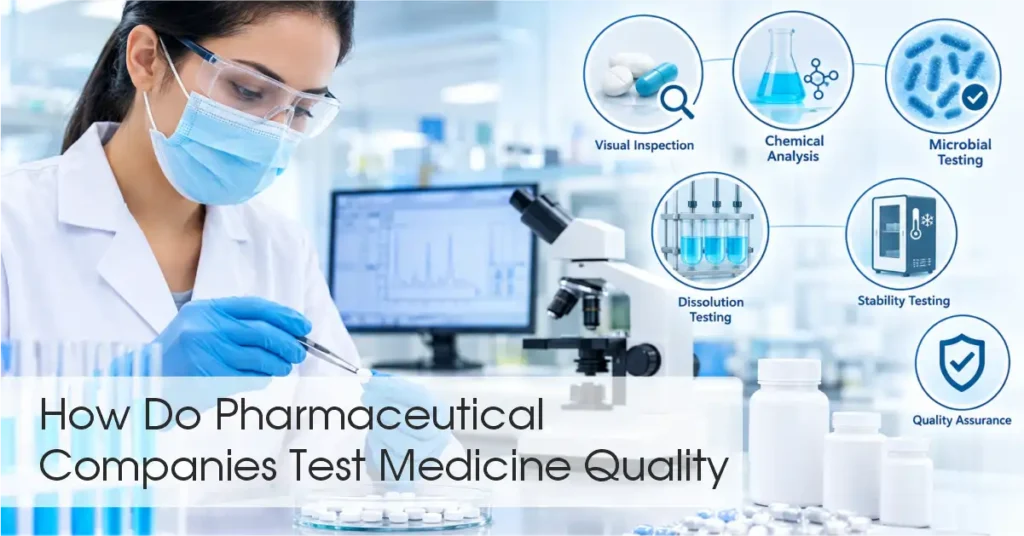
Before a medicine reaches a pharmacy shelf, it has already passed through a long chain of checks. Pharmaceutical companies test medicine quality through a combination of raw-material testing, in-process controls during manufacturing, laboratory testing of the finished product, stability studies, and an overarching Good Manufacturing Practices (GMP) and Quality Assurance (QA) system that governs every step in between. No single test at the end of the production line is responsible for “proving” a medicine is good — quality is built in from the first incoming material to the final packed carton.
This matters because medicines are expected to consistently deliver the identity, strength, quality, and purity described on their label, batch after batch. Understanding how do pharmaceutical companies test medicine quality helps explain why:
- Patients can reasonably expect a tablet to contain what the label says it contains
- Doctors and pharmacists can rely on consistent dosing from batch to batch
- A medicine performs the way it was designed to perform (for example, dissolving and being absorbed appropriately)
- Products remain within acceptable limits for impurities and degradation throughout their shelf life
- Manufacturing errors, contamination, or labeling mistakes are far less likely to reach a patient
This article walks through pharmaceutical quality testing in a structured, practical way — from raw materials to finished-product release — for anyone who wants a clearer, technically grounded picture of how medicine quality control actually works.
What Does “Medicine Quality” Actually Mean?
“Quality” in a pharmaceutical context is not a single measurement. It is a set of predefined attributes that a product must meet, as described in official pharmacopoeial monographs and in the approved product specification. Depending on the drug substance, formulation, and dosage form, relevant quality attributes may include:
- Identity – confirmation that the product actually contains the active ingredient it claims to contain
- Strength or assay – confirmation of how much active ingredient is present relative to the labeled amount
- Purity – the extent to which the product is free from unacceptable levels of impurities or degradation products
- Potency – for certain biological or complex products, a measure of biological activity, where applicable
- Uniformity – consistency of drug content and physical characteristics across dosage units in a batch
- Stability – how well the product retains its quality attributes over time under defined storage conditions
- Dissolution – for solid oral dosage forms, how the active ingredient is released from the dosage form, where applicable
- Physical characteristics – such as appearance, color, odor, hardness, or viscosity, depending on the dosage form
- Microbiological quality – control of microbial contamination, relevant for certain non-sterile and all sterile products
- Packaging and labeling conformity – ensuring the correct product information, batch details, and container specifications are met
The U.S. Food and Drug Administration (FDA) describes common quality attributes evaluated for pharmaceutical products — including identity, strength (assay), quality, purity, and, where relevant, dissolution — as the basis on which finished products are assessed against their approved specifications.
It is important to understand that the exact tests performed on a given medicine depend on its dosage form, the active pharmaceutical ingredient (API), the formulation, the route of administration, applicable pharmacopoeial monographs, and the approved product specification. Not every medicine is tested for the same attributes in the same way — an injectable product, for instance, is evaluated very differently from an oral tablet.
Pharmaceutical Quality Control vs Quality Assurance
Two terms are often used interchangeably but describe different — and complementary — functions.
Quality Control (QC) refers to the laboratory testing and related activities used to determine whether raw materials, in-process samples, and finished products meet established specifications. QC is largely test-based: sampling, analysis, and comparison of results against predefined acceptance criteria.
Quality Assurance (QA) is the broader system of planned and systematic activities that ensures pharmaceutical quality requirements are consistently met. QA covers process design, documented procedures (SOPs), training, change control, deviation management, supplier qualification, audits, and oversight of the entire manufacturing and testing lifecycle — not just the final analytical result.
The World Health Organization’s guidance on Good Manufacturing Practices explains that quality cannot be tested into a product after it has already been made — it must be built into the product through appropriately designed and controlled processes. In other words, QC tells you whether a batch meets specification at a given point; QA is what makes it far more likely that the batch will meet specification in the first place. The two functions depend on each other: QC generates the data, and QA ensures that the systems generating and interpreting that data are reliable, documented, and consistently followed.
How Is Medicine Quality Tested Step by Step?
Pharmaceutical quality testing does not happen only at the end of production. It occurs at three broad stages, each catching different types of problems.
1. Testing of Raw Materials
Before any material enters the manufacturing process, it is sampled and evaluated against a predefined specification. This applies to:
- Active pharmaceutical ingredients (APIs) — the substance responsible for the therapeutic effect
- Excipients — fillers, binders, coatings, preservatives, and other non-active components
- Solvents and processing aids used during manufacturing
- Packaging materials such as blister foils, bottles, caps, and labels
- Water and other critical utilities used directly in manufacturing, where applicable
Depending on the material and its intended use, testing may include:
- Identity testing — confirming the material is what it is labeled as
- Purity testing — checking for unacceptable levels of related substances or contaminants
- Assay — quantifying the active content of an API
- Moisture or water content — relevant to stability and degradation risk for many materials
- Physical characteristics — such as particle size, appearance, or solubility, where relevant to performance
- Microbiological testing — for materials where microbial contamination is a relevant risk
Not every raw material is subject to the same battery of tests. A solvent used only in an early processing step is evaluated differently from an API that determines the therapeutic effect of the finished product. Specifications are set based on the material’s function, source, and regulatory/pharmacopoeial requirements. Materials that do not meet specification are rejected and are not permitted to enter production.
2. In-Process Quality Checks
Waiting until a batch is finished to discover a problem is inefficient and, more importantly, risky. This is why manufacturers build checks directly into the production process — often referred to as in-process controls (IPC). Depending on the dosage form and process, examples include:
- Weight variation — checking that individual tablets or capsules fall within an acceptable weight range
- Tablet hardness — assessing mechanical strength during compression
- Thickness — a consistency check for tablets
- Friability — resistance to chipping or abrasion during handling
- Blend uniformity — checking that the active ingredient is evenly distributed in a powder blend before compression, where applicable
- pH — for liquid and semi-solid formulations, monitored as an in-process attribute
- Viscosity — relevant for certain liquids, creams, and gels
- Fill volume or fill weight — for liquids, injectables, and semi-solids
- Appearance — visual checks for color, clarity, or physical defects
- Environmental or process parameters — such as temperature, humidity, or pressure, where these affect product quality
Which of these checks apply — and how frequently they are performed — depends entirely on the dosage form and the manufacturing process used. A sterile injectable manufacturing line, for example, involves environmental monitoring that would not be relevant to a solid oral dosage line.
3. Finished Product Testing
Once a batch is manufactured, a sample is drawn and tested in the quality control laboratory against the approved finished-product specification before the batch can be considered for release. Depending on the product, this may involve:
- Appearance — visual conformity to the approved description
- Identification — confirming the presence of the correct active ingredient
- Assay — quantifying the active ingredient content
- Impurities / related substances — measuring degradation products or process-related impurities
- Dissolution — for many solid oral dosage forms, evaluating drug release
- Disintegration — how a tablet or capsule breaks down, where applicable
- Uniformity of dosage units — consistency of active content across individual units
- pH — for liquid formulations
- Microbial limit testing — for products where microbial quality is a relevant attribute
- Sterility — for products required to be sterile, such as injectables and certain ophthalmic products
- Preservative-related testing — where a preservative system is part of the formulation
- Physical characteristics — such as viscosity, particle size, or clarity, depending on the dosage form
Not every test applies to every product. A non-sterile oral tablet is not tested for sterility, and an ointment is not evaluated for dissolution in the same way a tablet is. The applicable tests are defined by the approved specification for that specific product.
Common Laboratory Tests Used to Check Medicine Quality
The table below summarizes tests frequently referenced in pharmaceutical quality control, along with what they generally check. Not all tests apply to all products.
| Test | What It Checks | Why It Matters | Examples of Products Where Applicable |
|---|---|---|---|
| Identification testing | Confirms presence of the correct active ingredient | Prevents mix-ups or mislabeling | Most dosage forms |
| Assay | Quantifies active ingredient content | Confirms labeled strength | Tablets, capsules, injections, liquids |
| Impurity / related-substance testing | Detects and quantifies process-related impurities or degradation products | Keeps impurities within established limits | Most drug products and APIs |
| Dissolution testing | Measures rate of drug release from the dosage form | Relevant to expected product performance | Immediate- and modified-release tablets, capsules |
| Disintegration testing | Time for a solid dosage form to break apart in fluid | An early indicator of formulation behavior | Tablets, some capsules |
| Uniformity of dosage units | Consistency of active content across units | Ensures each unit delivers a similar dose | Tablets, capsules |
| Friability | Resistance to chipping/abrasion | Relevant to handling and transport durability | Uncoated tablets |
| Hardness | Mechanical strength of a tablet | Affects disintegration and handling | Tablets |
| Weight variation | Consistency of unit weight in a batch | Indirect indicator of dose consistency | Tablets, capsules |
| pH testing | Acidity/alkalinity of a formulation | Relevant to stability, solubility, tolerability | Oral liquids, injections, ophthalmic products |
| Moisture / water-content testing | Amount of water present in a material or product | Relevant to stability and degradation risk | Powders, granules, certain APIs |
| Microbial limit testing | Levels of bacteria/fungi present | Controls microbiological quality where relevant | Non-sterile oral and topical products, where applicable |
| Sterility testing | Absence of viable microorganisms | Critical for products intended to be sterile | Injectables, certain ophthalmic products |
| Bacterial endotoxin testing | Levels of bacterial endotoxins | Relevant to safety of certain parenteral products | Injectable products, where applicable |
| Viscosity testing | Flow behavior of a liquid or semi-solid | Relevant to formulation performance and consistency | Suspensions, syrups, creams, gels (where suitable) |
| Particle-size testing | Distribution of particle sizes in a formulation | Can affect dissolution, suspension stability, and performance | Suspensions, certain solid dosage forms, where relevant |
What Laboratory Instruments Are Used for Pharmaceutical Quality Testing?
Analytical instruments are chosen based on the specific attribute being measured and the properties of the material or product. Commonly referenced technologies in a pharmaceutical testing laboratory include:
- High-Performance Liquid Chromatography (HPLC) — commonly used for assay and impurity/related-substance analysis of many drug substances and products
- UV-Visible spectrophotometer — can be used for quantitative or identification-related analytical procedures, depending on the product and the validated method
- FTIR / IR spectroscopy — can assist with identification of raw materials and, in some cases, finished products
- Gas Chromatography (GC) — used for volatile compounds, residual solvents, and certain assay or impurity determinations
- GC-MS — used where more detailed compound identification alongside separation is needed, such as certain impurity investigations
- Dissolution apparatus — used to evaluate drug release from solid oral dosage forms, where dissolution is part of the specification
- Disintegration apparatus — used to measure how quickly a tablet or capsule breaks apart
- Friability tester — used to assess tablet resistance to abrasion
- Hardness tester — used to measure tablet mechanical strength
- pH meter — used across liquid and semi-solid product testing
- Analytical balance — used for precise weighing across nearly all testing activities
- Moisture determination equipment (such as Karl Fischer titration or loss-on-drying apparatus) — used to assess water content
- Microbiological testing equipment — including incubators, laminar airflow units, and related equipment used for microbial limit and sterility testing
No single instrument is universally used for every medicine. The choice of technique depends on the chemical and physical properties of the active ingredient, the dosage form, and the validated analytical method established for that specific product.
Why Are Analytical Methods Validated?
An analytical result is only meaningful if the method used to generate it can be trusted. This is the purpose of analytical method validation — a documented process used to demonstrate that a test method is suitable for its intended use. Regulatory guidance from the FDA and ICH quality guidelines commonly reference validation characteristics such as:
- Accuracy — how close a measured result is to the true value
- Precision — how consistent results are when a measurement is repeated
- Specificity — the method’s ability to measure the intended substance without interference from other components
- Linearity — whether results are proportional to concentration across a defined range
- Range — the interval over which the method has been shown to be accurate and precise
- Robustness — how well the method performs under small, deliberate variations in conditions
- Detection limit — the lowest amount of a substance that can be reliably detected, where applicable
- Quantitation limit — the lowest amount that can be reliably measured with acceptable accuracy and precision, where applicable
The World Health Organization’s good practices for pharmaceutical quality control laboratories emphasize that laboratories should use validated methods and maintain confidence in their analytical procedures through appropriate qualification, calibration, and ongoing verification. Without this, even a well-run laboratory cannot be confident that a “pass” or “fail” result actually reflects the true quality of the material being tested.
How Do Pharmaceutical Companies Test Medicines for Impurities?
Pharmaceutical impurities are unwanted chemical entities present in a drug substance or drug product, distinct from the intended active ingredient. Impurities can originate from several sources:
- Process-related impurities — residues or byproducts introduced during synthesis or manufacturing
- Degradation products — substances formed when the active ingredient breaks down over time
- Impurities introduced during storage — arising from interactions with packaging, moisture, light, or temperature over time
Impurity limits are not arbitrary; they are established for each specific drug substance and product based on toxicological data, stability data, and applicable pharmacopoeial or regulatory requirements, in line with frameworks such as the relevant ICH quality guidelines on impurities. Analytical techniques such as HPLC, and in some cases GC or GC-MS, are commonly used to separate, detect, and quantify impurities against these established, product-specific limits. Because impurity specifications vary by drug substance, dosage form, and regulatory jurisdiction, there is no single universal numerical limit that applies across all medicines.
How Is Microbiological Quality Checked?
Microbiological quality matters most where microbial contamination poses a meaningful risk to the patient — this varies significantly by product type. Relevant testing may include:
- Microbial limit testing — used for many non-sterile products to confirm that total microbial counts and specified organisms remain within acceptable limits
- Sterility testing — used for products that are required to be free of viable microorganisms
- Bacterial endotoxin testing — relevant for certain parenteral (injectable) products, where endotoxin levels are a safety consideration
- Preservative effectiveness testing — used where a formulation relies on an added preservative system to control microbial growth over its shelf life
There is an important distinction between sterile and non-sterile pharmaceutical products. Sterile products — such as injectables and certain ophthalmic preparations — are manufactured and tested under conditions designed to eliminate viable microorganisms entirely. Non-sterile products, such as most oral tablets, syrups, and topical creams, are instead controlled to keep microbial levels within defined acceptable limits, rather than being required to be completely free of microorganisms. Not all medicines are, or need to be, sterile — the requirement depends on the route of administration and the intended use of the product.
How Do Companies Test the Stability of Medicines?
Pharmaceutical stability testing evaluates how a drug substance or drug product’s quality changes over time under defined environmental conditions, typically involving temperature, humidity, and light. Stability programs are used to help establish:
- Shelf life — the period during which the product is expected to remain within specification
- Storage conditions — such as room temperature, refrigeration, or protection from light
- Degradation behavior — how and at what rate the active ingredient or formulation may break down
- Potency changes — whether the active content declines meaningfully over the proposed shelf life
- Physical changes — such as changes in color, clarity, or texture
- Impurity formation — tracking whether degradation products increase over time
- Packaging interaction — assessing whether the container-closure system affects product stability
Because standard assay or purity methods are not always designed to detect degradation-related changes, stability programs typically rely on stability-indicating analytical methods — methods specifically validated to distinguish the active ingredient from its degradation products. Stability studies are generally designed with reference to internationally recognized frameworks such as the ICH stability guideline, which outlines long-term, intermediate, and accelerated testing conditions used to support shelf-life and storage-condition decisions.
Rosette Pharma has published a more detailed explanation of how pH, one attribute commonly tracked across stability studies, connects to formulation performance in its article on pH testing in pharmaceutical products.
What Happens When a Medicine Batch Fails a Quality Test?
When a laboratory result falls outside the approved specification, it is classified as an Out-of-Specification (OOS) result. This does not automatically mean the batch is discarded. Instead, an established investigation process is followed, generally involving:
- Laboratory investigation — checking for possible errors in sampling, testing, calculation, or instrumentation
- Manufacturing or process investigation — if a laboratory error is ruled out, reviewing manufacturing records, equipment performance, and process parameters for that batch
- Documentation — recording each step of the investigation for traceability and regulatory accountability
- Root-cause analysis — identifying the underlying reason for the deviation, where determinable
- Corrective and Preventive Actions (CAPA) — actions taken to address the immediate issue and reduce the likelihood of recurrence
- Batch disposition decision — a formal decision, made according to internal procedures and applicable regulatory requirements, on whether the batch can be released, needs reprocessing (where permissible), or must be rejected
The appropriate outcome depends entirely on the investigation findings, the applicable procedures, the product’s specifications, relevant regulatory requirements, and the scientific evidence gathered — there is no single default outcome that applies to every OOS result.
How Does GMP Help Maintain Medicine Quality?
Good Manufacturing Practices (GMP) are the set of principles and requirements designed to ensure medicines are consistently produced and controlled according to appropriate quality standards. According to WHO, GMP is aimed at reducing the risks inherent in pharmaceutical production that cannot be eliminated through testing the final product alone — such as cross-contamination, mix-ups, and undetected deviations. GMP in pharmaceutical manufacturing typically covers:
- Controlled manufacturing environments — appropriate facility design, cleanliness, and environmental controls where relevant to the product
- Trained personnel — staff qualified and trained for their specific responsibilities
- Validated processes — manufacturing steps demonstrated to consistently produce the intended result
- Equipment qualification — verification that equipment is suitable, calibrated, and properly maintained
- Sanitation — hygiene practices appropriate to the manufacturing environment
- Documentation — accurate, contemporaneous records of every significant activity
- Raw-material controls — qualification and testing of incoming materials
- Process controls — in-process monitoring during manufacturing
- Laboratory controls — validated methods and properly maintained QC facilities
- Deviation management — systematic handling of unexpected events
- Change control — formal evaluation of any proposed change to materials, processes, or equipment
- Complaint handling — investigation and response to product quality complaints
- Traceability — the ability to trace a batch back through its materials, processing steps, and testing records
The central idea behind GMP is that quality is designed and controlled into the manufacturing process, not verified only through final testing. A batch that passes final release testing but was produced using an uncontrolled process may still carry undetected risks; GMP systems are intended to reduce that possibility well before a sample ever reaches the laboratory. Rosette Pharma’s overview of a broader pharmaceutical quality management system explores how these GMP-related elements fit together as part of a connected quality system, in its article on a pharmaceutical quality management system.
What Is the Role of Pharmacopoeias in Medicine Quality Testing?
Pharmacopoeias are official compendia that establish recognized quality standards, including monographs, test methods, and acceptance criteria for specific drug substances and products. Depending on the market and the product, applicable pharmacopoeias may include:
- Indian Pharmacopoeia (IP) — the official standard recognized under Indian drug regulations
- United States Pharmacopeia (USP) — widely referenced for products marketed in or sourced for the U.S. market, and often used internationally as an analytical reference
- British Pharmacopoeia (BP) — the official standard in the United Kingdom, also referenced in several other markets
- European Pharmacopoeia (Ph. Eur.) — the official compendium applicable across countries that are signatories to the relevant European convention
A given product does not need to comply with every pharmacopoeia simultaneously. Manufacturers typically test against the pharmacopoeial monograph relevant to their regulatory market and product registration, while a monograph from another pharmacopoeia may sometimes be used as an additional analytical reference where appropriate and permitted.
How Does Pharmaceutical Quality Control Differ by Dosage Form?
Because dosage forms differ in composition, route of administration, and intended performance, the applicable quality tests differ accordingly. The table below illustrates commonly relevant tests — actual specifications vary by product.
| Dosage Form | Examples of Relevant Quality Tests |
|---|---|
| Tablets | Identification, assay, dissolution, disintegration, hardness, friability, weight variation, uniformity of dosage units, impurity testing |
| Capsules | Identification, assay, dissolution or disintegration, weight variation, uniformity of dosage units, moisture content, impurity testing |
| Syrups | Identification, assay, pH, viscosity, microbial limit testing, appearance, impurity/degradation testing |
| Suspensions | Identification, assay, pH, particle-size distribution, redispersibility, microbial limit testing, viscosity where relevant |
| Oral solutions | Identification, assay, pH, clarity, microbial limit testing, impurity/degradation testing |
| Topical creams | Identification, assay, pH, viscosity, appearance, microbial limit testing, preservative-related testing where applicable |
| Ointments | Identification, assay, appearance, homogeneity, microbial limit testing where applicable |
| Gels | Identification, assay, pH, viscosity, appearance, microbial limit testing where applicable |
| Injections / sterile products | Identification, assay, sterility, bacterial endotoxin testing, particulate matter, pH, appearance, impurity testing |
This variation is one of the reasons quality systems in pharmaceutical manufacturing quality control are built around product-specific specifications rather than a single fixed checklist applied uniformly across all dosage forms.
What Is the Difference Between QC Testing and Product Inspection?
Laboratory testing is only one part of how a batch is evaluated before release. Other controls include:
- Laboratory analytical testing — quantitative and qualitative chemical, physical, and microbiological analysis
- Visual inspection — checking for particulate matter, discoloration, container defects, or physical inconsistencies
- Packaging checks — confirming correct primary and secondary packaging components
- Labeling verification — confirming batch number, expiry date, and label content accuracy
- Documentation review — checking that all required records were completed correctly
- Batch record review — a comprehensive review of the manufacturing and testing history of the batch before disposition
Medicine quality is therefore the result of multiple, overlapping controls — not a single laboratory test performed at the end of the process.
How Are Pharmaceutical Test Results Documented?
Documentation underpins the entire quality system, because it provides the evidence that controls were actually followed. Common elements include:
- Specifications — the approved acceptance criteria for materials and products
- Standard Operating Procedures (SOPs) — written instructions for how tasks are performed
- Test methods — validated procedures used for analysis
- Laboratory records — raw data, instrument printouts, and analyst observations
- Certificates of Analysis (COAs) — summarized test results confirming a batch meets specification
- Batch manufacturing records — a full account of how a batch was produced
- Batch packaging records — documentation of the packaging process for that batch
- Deviation reports — records of any departure from an established procedure
- OOS investigations — formal records of out-of-specification result handling
- Stability records — ongoing data supporting shelf-life and storage-condition decisions
Traceability and data integrity are emphasized across regulatory guidance because they allow every batch to be reconstructed and reviewed after the fact — a critical capability if a quality issue is later identified. Documentation requirements can vary somewhat by country and regulatory authority, so manufacturers align their systems with the specific requirements applicable to their markets.
How Does Quality Testing Protect Patients?
Bringing the technical process back to the patient: appropriately designed and executed quality systems are intended to reduce risks such as:
- Incorrect identity of the active ingredient
- Incorrect strength — too much or too little active ingredient
- Excessive levels of impurities or degradation products
- Microbial or particulate contamination
- Inconsistent dosage across units in a batch
- Premature degradation of the active ingredient
- Use of unsuitable storage conditions that compromise the product
- Packaging or labeling errors that could lead to incorrect use
These systems work together to reduce, rather than eliminate, risk — which is why ongoing pharmacovigilance, post-market surveillance, and ongoing quality monitoring remain important even after a product reaches the market.
Quality Testing in Pharmaceutical Third-Party Manufacturing
In the pharmaceutical third-party manufacturing and PCD franchise model, a marketing company partners with a manufacturer that handles production on its behalf. Because the marketing company’s brand and reputation depend on the manufactured product, quality systems remain just as central in this arrangement as they are for any in-house manufacturer. Relevant considerations in this space typically include:
- Raw-material controls at the manufacturing facility, since finished-product quality begins with qualified incoming materials
- Manufacturing controls, including validated processes and in-process checks appropriate to the dosage form
- QC testing against the product’s approved specification before batch release
- Batch documentation that allows traceability of each manufactured lot
- Finished-product specifications agreed upon between the marketing company and the manufacturer
- Packaging checks to confirm correct labeling, batch coding, and expiry information
- Stability considerations relevant to the formulation and its approved shelf life
- Quality assurance oversight spanning the manufacturing relationship
- Traceability across the supply chain, from raw material to finished, packed product
For businesses evaluating a third-party manufacturing or PCD franchise partner, understanding these quality building blocks provides a useful framework for asking informed questions about how a prospective manufacturing partner approaches product quality.
Frequently Asked Questions
1. How do pharmaceutical companies test medicine quality?
Pharmaceutical companies test medicine quality through a combination of raw-material testing, in-process checks during manufacturing, laboratory testing of the finished product against an approved specification, and ongoing stability studies — all supported by a GMP and quality assurance system that governs how these activities are conducted and documented.
2. What tests are performed on pharmaceutical products?
Depending on the dosage form and specification, tests may include identification, assay, impurity/related-substance testing, dissolution or disintegration, uniformity of dosage units, pH, microbial limit testing, and, for sterile products, sterility and bacterial endotoxin testing. Not every test applies to every product.
3. What is pharmaceutical quality control?
Quality control (QC) refers to the laboratory testing and related activities used to verify that raw materials, in-process samples, and finished products meet their established specifications before a batch is considered for release.
4. How is the strength of a medicine tested?
The strength of a medicine is typically evaluated through an assay test, which quantifies the amount of active pharmaceutical ingredient present relative to the labeled amount, commonly using techniques such as HPLC or, for some products, UV-Visible spectrophotometry.
5. What is an assay test in pharmaceuticals?
An assay test is an analytical procedure used to quantify the amount of active ingredient present in a raw material, in-process sample, or finished product, and to confirm that it falls within the approved specification range.
6. How are impurities detected in medicines?
Impurities are typically detected and quantified using validated analytical techniques such as HPLC, and in some cases GC or GC-MS, which can separate the active ingredient from process-related impurities or degradation products and measure them against product-specific limits.
7. Are all medicines tested for sterility?
No. Sterility testing applies specifically to products required to be sterile, such as injectables and certain ophthalmic preparations. Most oral and topical non-sterile products are instead evaluated using microbial limit testing, which checks that microbial counts remain within acceptable limits rather than requiring complete absence of microorganisms.
8. What happens if a pharmaceutical batch fails a quality test?
A failing result is classified as an out-of-specification (OOS) result and triggers a formal investigation covering laboratory and, where relevant, manufacturing process review. Based on the root cause identified and applicable procedures and regulations, the batch may be released, reprocessed where permissible, or rejected — the outcome depends on the specific investigation findings rather than being automatic.
Conclusion
Understanding how do pharmaceutical companies test medicine quality makes clear that quality is not the result of a single test performed at the end of production. It is a continuous system that begins with raw-material testing, continues through in-process controls during manufacturing, extends into finished-product laboratory testing using validated analytical methods, and is supported by ongoing stability studies that establish appropriate shelf life and storage conditions. Microbiological controls, where relevant, and rigorous documentation — from specifications and SOPs to Certificates of Analysis and batch records — tie the entire system together.
Underlying all of this is Good Manufacturing Practice and a functioning Quality Assurance and Quality Control system, working together to ensure that quality is designed and controlled into the product rather than verified only at the finish line. For patients, healthcare professionals, pharma students, and businesses involved in pharmaceutical manufacturing and distribution alike, understanding these systems provides a clearer, more accurate picture of what actually stands between a raw material and a finished medicine.