Understanding how pharmaceutical products are developed starts with a simple correction: making a medicine is not just selecting ingredients and running a tablet press or a filling line. Every tablet, syrup, ointment or injection that reaches a chemist’s shelf is the result of scientific design, repeated testing, documented quality systems, regulatory compliance and careful commercial planning.
Formulation development and quality assurance matter because a medicine must deliver the right amount of active ingredient, stay stable until its expiry date, and be consistent from one batch to the next. This guide follows the pharmaceutical product development process from the first product idea to commercial availability, with a focus on how things work in India.
Note: This article is educational. Development and approval requirements differ by product type, dosage form and regulatory pathway, and nothing here is legal, regulatory or medical advice.
What Is Pharmaceutical Product Development?
Pharmaceutical product development is the process of turning an active ingredient into a safe, effective, stable and manufacturable medicine in a specific dosage form. It covers formulation design, laboratory evaluation, stability studies, quality systems, regulatory compliance, manufacturing and packaging.
Drug discovery versus formulation development
These are different activities and are often confused:
- New drug discovery and development means identifying a new molecule, studying its safety and efficacy, and often running clinical trials. In India, new drugs are governed by the New Drugs and Clinical Trials Rules, 2019, and generally need central approval before they can be manufactured or marketed.
- Formulation development using an established API means designing a dosage form around an active pharmaceutical ingredient (API) that is already known and in use. Most generic and branded-generic medicines follow this route. The work focuses on formulation, stability, quality and manufacturing, not on discovering a new molecule.
- New formulations of existing drugs, such as a new fixed-dose combination or a new delivery system, can still be treated as “new drugs” and may need additional approval.
A wide team is involved: formulation scientists, analytical chemists, pharmacists, quality-control and quality-assurance professionals, regulatory affairs specialists and manufacturing staff. The exact path varies with the product category and regulatory route, so no single sequence fits every medicine. The stages below are a general framework.
Step 1 – Identifying the Product Requirement and Market Opportunity
Development usually begins with a question: is there a real need for this product? Companies typically look at:
- Therapeutic needs and gaps in available treatment options.
- Existing products, competitor brands and how crowded the segment is.
- The target patient population, such as children, older adults or patients who cannot swallow tablets.
- Suitable dosage forms and product category.
- Whether the required API is available in suitable quality and quantity.
- Commercial and manufacturing feasibility.
Commercial demand alone does not make a product scientifically or legally suitable. A product that sells well elsewhere may still be unsuitable for a market because of stability, regulatory status or manufacturing constraints.
Step 2 – Selecting the Active Pharmaceutical Ingredient (API)
The API is the component that produces the intended pharmacological effect. Excipients are the other ingredients in the formulation. They do not provide the therapeutic effect, but they give the medicine its form, stability, taste, appearance and release behaviour. A paracetamol tablet, for example, contains paracetamol as the API and excipients that hold the tablet together, help it break up in the body and keep it stable.
API selection considers:
- Quality and purity against defined specifications.
- Physical and chemical properties such as solubility, particle characteristics and sensitivity to heat, moisture or light.
- Compatibility with planned excipients and packaging.
- Stability of the API itself.
- Regulatory status and supporting documentation.
Manufacturers normally qualify API suppliers, set approved specifications and verify incoming material with documentation such as a Certificate of Analysis. Supplier qualification matters because a variation in API quality can affect every batch made from it.
Step 3 – Formulation Development
This is the heart of drug formulation development. Formulation scientists convert the API into a dosage form that is safe, effective, stable, acceptable to patients and practical to manufacture at scale.
Understanding the Desired Dosage Form
The pharmaceutical formulation process depends on the dosage form. Common examples include:
- Tablets and capsules, the most common oral solid forms.
- Syrups and oral liquids, useful for children and patients who cannot swallow solids.
- Dry syrups, powders reconstituted with water before use, often chosen when the API is unstable in liquid form.
- Suspensions, where insoluble API is dispersed in a liquid.
- Creams and ointments for topical use.
- Injectables, which must meet sterility and other stringent requirements.
- Ophthalmic preparations, such as eye drops, which are also sterile.
The choice depends on the API’s properties, the route of administration, the patient’s needs and the product’s intended use. Sterile products such as injectables and eye drops are generally more demanding to develop and manufacture than basic oral solids.
Selecting Excipients
Excipients are chosen for specific functions, and a given formulation uses only those it needs:
- Binders help powder particles stick together in tablets.
- Fillers or diluents add bulk so the dose is practical to handle.
- Disintegrants help a tablet break apart after swallowing.
- Lubricants reduce friction during tablet compression and capsule filling.
- Preservatives help protect multi-dose liquids and topicals from microbial growth.
- Stabilizers help protect the API from degradation.
- Sweeteners and flavouring agents improve palatability in oral liquids where appropriate.
- Solvents and other formulation-specific ingredients, such as suspending agents in suspensions.
API and Excipient Compatibility
Ingredients can interact physically or chemically. An excipient might react with the API, absorb moisture that degrades it, or change how quickly it dissolves. Compatibility studies, in which the API is combined with candidate excipients and examined under stress conditions, help scientists choose a workable combination early.
A formulation that looks fine on the day it is made is not automatically stable. Stability has to be demonstrated with data over time, which is covered in Step 5.
Step 4 – Laboratory Trials and Prototype Development
Once candidate formulations are chosen, scientists make small laboratory batches and evaluate them. This stage typically involves:
- Preparing prototype batches with different compositions.
- Evaluating physical and chemical properties.
- Adjusting the formulation based on results.
- Selecting a suitable manufacturing method.
- Documenting every trial so the development logic is traceable.
What is tested depends on the dosage form and the applicable specifications. Illustrative examples, not universal requirements, include:
- Tablets: hardness, friability, disintegration and dissolution.
- Oral liquids: appearance, pH, viscosity and other relevant parameters.
- Suspensions: particle distribution, redispersibility and physical stability.
- Creams and ointments: consistency, homogeneity and performance characteristics relevant to the product.
- Injectables and eye drops: sterility and other parameters relevant to sterile products.
Step 5 – Stability Testing and Shelf-Life Evaluation
Drug stability testing studies how the quality of an API or finished product changes over time under the influence of factors such as temperature, humidity and light. The aim is to show the product keeps acceptable quality throughout its shelf life.
Typical elements include:
- Long-term studies under the intended storage conditions.
- Accelerated studies under more demanding conditions to detect likely changes sooner.
- Packaging evaluation, because the container and closure affect how well the product is protected.
Stability data supports the shelf life and storage instructions printed on the label. An expiry date should rest on appropriate supporting data, not assumption. Study design, conditions and duration depend on the product, dosage form, intended markets and applicable regulatory guidance. The WHO guidelines on stability testing of APIs and finished pharmaceutical products (TRS 1010, Annex 10) describe the core stability data package that regulators commonly expect. WHO notes that alternative approaches can be used when scientifically justified.
Step 6 – Quality Control and Quality Assurance
These two terms are related but not the same:
- Quality control (QC) is the laboratory and testing function. It checks that materials, in-process samples and finished products meet their specifications.
- Quality assurance (QA) is the system that builds quality into the whole process: procedures, documentation, training, change control, audits and batch release decisions.
Common pharmaceutical quality control and QA activities include:
- Raw material testing before use.
- In-process checks during manufacturing.
- Finished-product testing against specifications.
- Microbiological testing where applicable.
- Batch documentation and record review.
- Equipment qualification and calibration.
- Process validation, where applicable.
- Deviation management and corrective and preventive actions.
- Final batch review and release.
Which of these apply, and how, depends on the product, its dosage form, its specifications and the applicable regulatory standards.
Step 7 – Regulatory Compliance and Product Approval in India
Pharmaceutical regulatory approval in India is not one single process. Different products and activities fall under different requirements.
The legal framework
The import, manufacture, distribution and sale of drugs in India are regulated under the Drugs and Cosmetics Act, 1940 and the rules made under it, including the Drugs Rules, 1945 and the New Drugs and Clinical Trials Rules, 2019. The Central Drugs Standard Control Organisation (CDSCO) is the central regulator. State Licensing Authorities generally grant manufacturing licences for most formulations, and CDSCO is responsible for central approvals such as new drugs. The official CDSCO New Drugs and Clinical Trials Rules, 2019 page lists the rules and their amendments.
Four situations to keep separate
- A formulation made with an established approved API. This typically needs the manufacturer to hold the appropriate licence for that product and dosage form, and the product must meet applicable standards and labelling rules.
- A new drug or a new drug formulation. This may need central approval under the New Drugs and Clinical Trials Rules, 2019, with data requirements that go well beyond routine formulation work. Combinations of active ingredients are a common area where “new drug” status needs to be checked carefully.
- Manufacturing in an existing licensed facility. The facility must hold a valid licence covering the relevant dosage forms and operate to Good Manufacturing Practice (GMP) requirements under Schedule M of the Drugs Rules.
- Third-party and other licensing arrangements. A company without its own plant may market products made at another licensed manufacturer’s facility, under a legal arrangement that depends on the product and the state. Confirm the correct route with the licensing authority.
Revised Schedule M (GMP) was notified in December 2023 under G.S.R. 922(E). Larger manufacturers had to comply first, and a conditional extension for eligible smaller manufacturers ran until 31 December 2025. Brand owners should therefore ask any manufacturer for its current Schedule M compliance status.
Other compliance areas
- Labelling and packaging: statutory particulars such as name, composition, batch number, manufacturing and expiry dates, and storage conditions, as applicable to the product.
- Documentation and recordkeeping: batch records, test results, specifications and approvals must be maintained and be traceable.
Requirements vary by product category, and Ayurvedic, cosmetic and other categories may follow different rules. Always confirm current requirements with the relevant licensing authority or a qualified regulatory professional.
Step 8 – Scale-Up and Commercial Manufacturing
A formulation that works in a small laboratory batch cannot simply be multiplied. Larger equipment changes mixing, heating, drying and compression behaviour, so scale-up needs planning and evaluation. Key elements include:
- Scale-up planning and manufacturing process development.
- Checking that equipment and facility are suitable for the dosage form.
- Process validation or qualification, where applicable, to show the process consistently produces product that meets specifications.
- Maintaining batch-to-batch consistency.
- Reliable raw material sourcing.
- Production planning, documentation and traceability.
- Quality oversight throughout manufacturing.
This stage is where the medicine manufacturing process becomes a repeatable, controlled operation instead of a successful experiment.
Step 9 – Packaging, Labelling, and Final Product Verification
Packaging is not only branding. It protects the product, identifies it and carries mandatory information. Considerations include:
- Choosing materials that protect against moisture, light and contamination where relevant.
- Confirming the formulation is compatible with the packaging.
- Printing product identification, batch details, manufacturing and expiry dates, and storage instructions.
- Meeting statutory labelling requirements for the product category.
- Final inspection and verification before release.
Step 10 – Commercial Launch and Market Distribution
Once a batch is released, the commercial phase begins:
- Launch planning and distribution channel selection.
- Stock planning to keep products available.
- Accurate product information and compliant promotional material.
- Coordination between sales, marketing and supply teams, and relationships with distributors and retailers.
- Collecting customer feedback and handling product complaints.
- Post-market quality monitoring and pharmacovigilance, where applicable.
Launch does not end a company’s responsibility for quality and safety. Complaints, quality issues and adverse-event reports must still be handled properly.
How Third-Party Pharma Manufacturing Fits Into Product Development
In third-party pharma manufacturing, also called contract pharmaceutical manufacturing, a brand owner or marketing company has its products made by an established licensed manufacturer. Depending on the agreement, the manufacturer may handle formulation support, raw material procurement, production, in-process and finished-product testing, and packaging. The brand owner typically handles market selection, branding, sales and distribution.
This route gives access to existing manufacturing infrastructure without the brand owner building its own plant. It does not remove the brand owner’s responsibilities. Quality oversight, labelling accuracy, complaint handling and regulatory obligations still need clear ownership, and the allocation should be written into a manufacturing agreement. Indian drug rules were amended in 2020 to place quality responsibility on marketers as well, according to a CDSCO presentation, so confirm the exact obligations that apply to your arrangement.
Before signing, verify the manufacturer’s licence, product-specific permissions, quality documentation and the scope of any GMP certificate. Our guides on how third-party manufacturing works in pharma and choosing a pharma manufacturing company cover the workflow and checklist in more depth.
Common Challenges During Pharmaceutical Product Development
- API and excipient incompatibility: arises when ingredients interact chemically or physically. Early compatibility studies reduce the risk.
- Formulation instability: moisture, heat, light or pH can degrade the product. Stability data and protective packaging help manage it.
- Inconsistent batch quality: often traced to variable materials or poorly controlled processes. Validated processes and in-process checks help.
- Scale-up problems: larger equipment behaves differently. Planned scale-up trials and process qualification address this.
- Raw material supply issues: dependence on a single supplier creates risk. Qualified alternative sources help.
- Regulatory documentation gaps: missing records delay approvals. Good documentation practice from the first trial prevents this.
- Packaging compatibility problems: some products react with or permeate through certain materials. Packaging studies alongside stability work catch this.
- Unexpected testing failures: these require investigation, root-cause analysis and corrective action under a quality system.
- Commercial feasibility: a technically sound product may still be uneconomical. Early costing and demand checks reduce wasted effort.
How Rosette Pharma Fits Into the Pharmaceutical Manufacturing Process
Rosette Pharma is a Karnal, Haryana-based company that states it has operated since 2006. Based on its website, it offers third-party manufacturing for allopathic, derma and herbal formulations, with support from product development to packaging, alongside PCD pharma franchise opportunities.
The company describes its products as sourced from a manufacturing network of WHO-GMP–compliant facilities and as DCGI-approved, with a portfolio of 500+ formulations. It lists dosage forms including tablets, capsules, syrups, dry syrups, injectables, ointments, softgel capsules, sachets, drops and suspensions, and eye, ear and nasal drops. Its offerings are organised across four product divisions: Rosette Pharmaceuticals, Admetus Pharma, Yeux Care and Rosette Organics.
Rosette Pharma’s website does not describe it as carrying out new drug discovery, and this article does not suggest it does. Its potential relevance is as a manufacturing and supply partner for established formulations. As with any manufacturer, ask for licence copies, product permissions, certificate scope, quality documentation, minimum order quantities and lead times in writing before committing.
Frequently Asked Questions
1. How are pharmaceutical products developed?
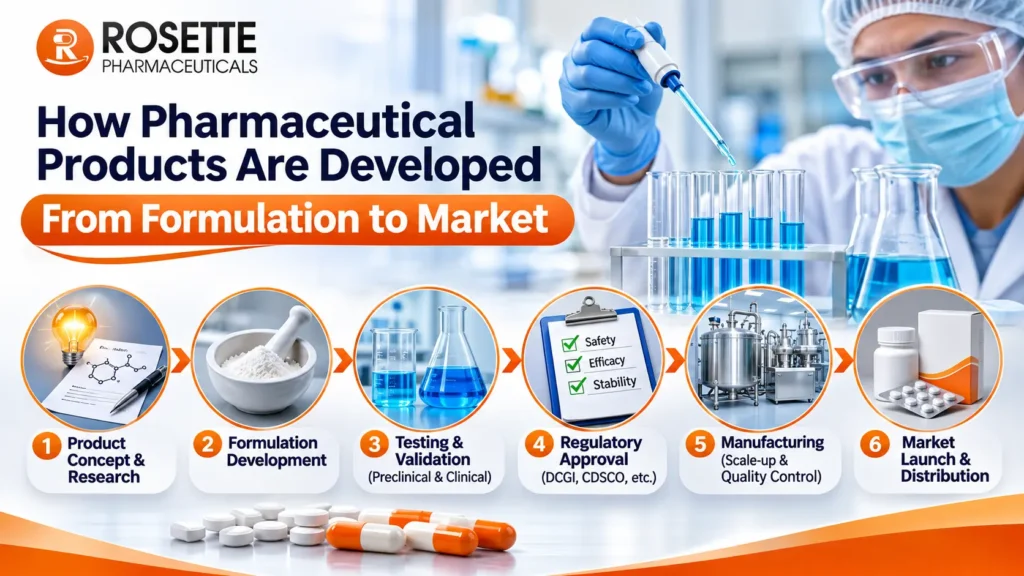
Development usually moves from identifying a product need and selecting an API, through formulation design, laboratory trials, stability testing and quality checks, to regulatory compliance, scale-up, packaging and launch. The exact path varies with the product type and regulatory pathway.
2. What are the main stages of pharmaceutical formulation development?
Key stages are choosing the dosage form, selecting excipients, running compatibility studies, preparing and evaluating prototype batches, refining the composition, and confirming stability before scale-up.
3. What is the difference between API and excipients?
The API produces the therapeutic effect. Excipients are the other ingredients that give the medicine its form, stability, taste, appearance or release behaviour. They are not intended to treat the condition.
4. How is a pharmaceutical formulation tested?
Testing depends on the dosage form and specifications. Tablets may be checked for hardness, friability, disintegration and dissolution. Liquids may be checked for appearance, pH and viscosity. Sterile products require sterility testing. Stability studies are run alongside.
5. Why is stability testing important in medicine development?
It shows how a product’s quality changes over time under temperature, humidity, light and packaging conditions. The data supports the shelf life and storage instructions on the label.
6. What is the difference between quality control and quality assurance?
Quality control is the testing of materials and products against specifications. Quality assurance is the overall system of procedures, documentation, audits and release decisions that builds quality into the process.
7. How are pharmaceutical products approved in India?
There is no single route. Manufacturers need appropriate licences and must follow the Drugs and Cosmetics Act and the Drugs Rules, including GMP under Schedule M. New drugs may also need central approval under the New Drugs and Clinical Trials Rules, 2019. Requirements depend on the product category.
8. What is the role of third-party manufacturing in pharmaceutical product development?
A licensed manufacturer can handle production, testing and packaging for another company’s brand, and may support formulation work. The brand owner still carries responsibilities and should document them in an agreement.
9. Can a pharmaceutical company launch its own brand without owning a manufacturing facility?
Yes, commonly through arrangements with licensed manufacturers, though the correct legal route depends on the product and state, so confirm it with the licensing authority. Our guide on launching your own pharma brand in India explains the business side.
10. How long does pharmaceutical product development take?
There is no universal timeline. It varies considerably with the product, formulation complexity, testing needs, regulatory pathway and manufacturing arrangements. A simple formulation with an established API will usually move differently from a complex or new-drug product.
Conclusion
Understanding how pharmaceutical products are developed shows why quality medicines depend on more than good ingredients. The journey runs from product concept and API selection, through formulation, testing and stability studies, to regulatory compliance, commercial manufacturing, packaging and launch. At every stage, scientific planning, documentation, quality systems and regulatory compliance protect patients and the businesses that serve them.
If you are exploring third-party manufacturing, review Rosette Pharma’s published services and request documentation for your specific products. You can reach the team through the Rosette Pharma contact page.