
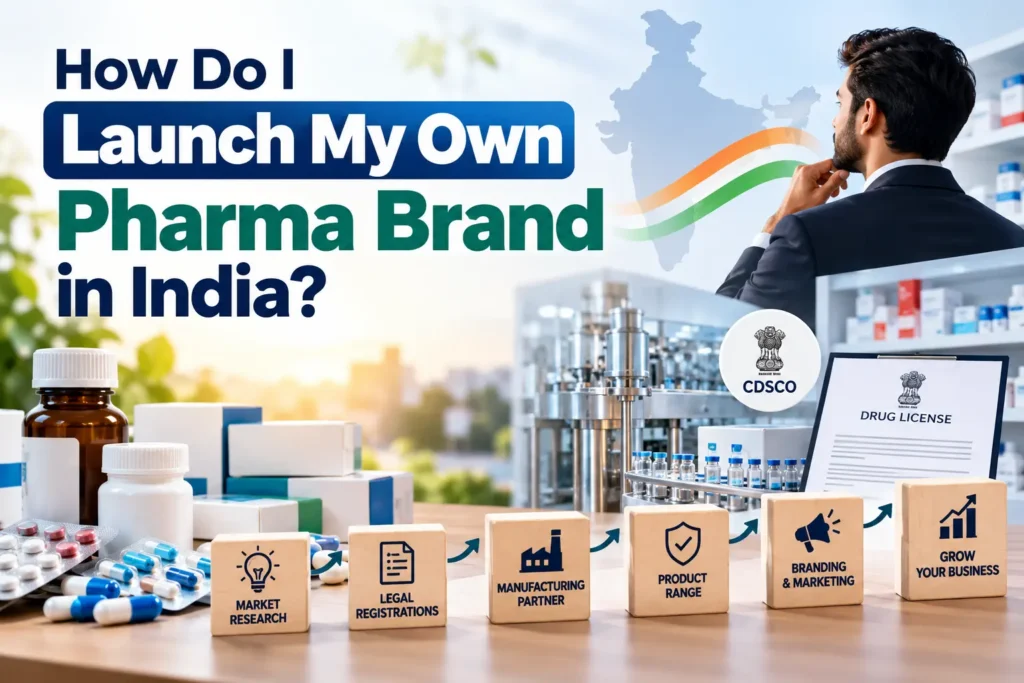
If you are asking how do I launch my own pharma brand in India, the short answer is this: choose a business model, understand which licences and approvals apply to your products, pick products and a licensed manufacturing arrangement, build a compliant brand, and set up distribution before you place large orders. Most new entrepreneurs do not build a factory. They work with a licensed manufacturer instead.
This guide explains each stage in plain language. Requirements differ by product category, business model and state, so treat it as a planning roadmap and not as legal advice.
1. Understand What Launching Your Own Pharma Brand Means
People use “pharma business” for four quite different set-ups:
- Brand with third-party manufacturing: you own the brand and sales effort, and a licensed manufacturer produces the medicine. We cover this route in more detail in our guide on launching your own medicine brand.
- Own manufacturing facility: you hold the manufacturing licence and run the plant, with the compliance burden that follows.
- PCD pharma franchise: you promote and sell another company’s brands in an agreed area. You do not own the brand.
- Distribution: you buy from companies and supply wholesalers or retailers, usually without a brand of your own.
These models differ in investment, control, licences and risk. The rest of this article focuses on launching your own brand, while showing how the other models compare.
2. Choose the Right Business Model
The table gives general considerations only. We have deliberately not included rupee figures, because costs depend on products, quantities and quotations.
| Business model | How it works | General investment considerations | Operational responsibilities | Regulatory considerations | Best suited for |
|---|---|---|---|---|---|
| Third-party manufacturing | You own the brand; a licensed manufacturer produces it | Batch or minimum-order stock, packaging, artwork, registrations, working capital | Product choice, quality oversight, branding, sales, inventory | Depends on arrangement: for example a loan licence or an arrangement with the manufacturer’s licence, plus sale or distribution permissions | Entrepreneurs and distributors who want brand ownership without a plant |
| Own manufacturing facility | You build and operate a licensed plant | Land, building, equipment, technical staff, approvals; far higher than other models | Production, GMP, quality control, staffing, plus sales | Manufacturing licence, premises and staff requirements, GMP compliance | Well-funded promoters with technical teams |
| PCD pharma franchise | A company grants you promotion and distribution rights for an area | Stock purchase, sales costs, working capital; terms vary by company | Local sales, doctor and chemist relationships, stock handling | Mainly sale and distribution licensing; the franchisor handles manufacturing | Medical representatives and small distributors testing a market |
| Distribution | You buy and supply medicines to retailers or wholesalers | Premises, stock, credit to customers, working capital | Storage, logistics, collections, expiry control | Wholesale licensing and storage conditions | Businesses with existing trade relationships |
3. Research the Market and Select Your Product Category
Thinking how do I launch my own pharma brand in India? Start with your customer, not the manufacturer’s catalogue. Ask who will prescribe, dispense or buy your product, and why they would choose your brand over established ones. Evaluate:
- Therapeutic category and intended market: which segment you understand and can reach.
- Competition: how many established brands already serve the same prescribers.
- Supply reliability: whether your manufacturer can supply consistently.
- Distribution network: whether you already have access to stockists, chemists or hospitals.
- Storage, transport and shelf life: cold-chain or short-expiry products carry extra risk.
- Product-specific rules: some products need extra approvals, as explained in section 6.
Talk to doctors, chemists and stockists in your target area. We do not claim that any category is the most profitable. Demand differs by region and changes over time.
4. Decide Which Products to Launch First
A focused portfolio is easier to fund, promote and track than a long list. Every extra product adds stock, expiry risk and marketing effort. When shortlisting, compare:
- Dosage form, strength and pack size.
- Expected demand and the strength of competing brands.
- Minimum order quantities and batch sizes.
- Manufacturing lead time and expiry-related inventory risk.
- Product documentation and quality requirements.
Check approval status first. Combining two or more active ingredients in one product can make it a “new drug” that needs central approval. India’s drug regulator has acted against unapproved fixed-dose combinations, and the Delhi High Court has upheld its power to review state-issued licences for such products. Ask your manufacturer to show the approval status of every combination before you commit. See the reports on the Delhi High Court ruling and the CDSCO directive on 35 FDCs.
The right portfolio depends on your market research, regulatory status, the manufacturer’s capabilities and your budget.
5. Find and Evaluate a Third-Party Pharmaceutical Manufacturer
In third-party manufacturing, a licensed unit produces medicines for your brand under agreed specifications and commercial terms. Our explainer on how third-party manufacturing works in pharma walks through the typical workflow. Before you choose a manufacturer, verify the following in writing:
- Valid manufacturing licence and permission for each product you want, including the dosage form.
- GMP compliance, including the scope of any certificate (which site, which dosage forms, valid until when).
- Product-specific manufacturing capability and capacity.
- Quality-control procedures and batch documentation you will receive.
- Raw material sourcing and traceability.
- Stability data and shelf-life support, where applicable.
- Packaging, labelling and artwork review process.
- Batch sizes and minimum order quantities.
- Lead times and supply consistency.
- Testing, release documents and complaint handling.
- Written commercial terms and each party’s responsibilities.
- Procedures for defective batches, recalls and other quality issues.
No single certificate proves compliance for every product or facility, and the documents you need depend on the product and the legal arrangement. Our buyer’s guide to choosing a pharma manufacturer includes a longer list of questions and red flags. Do not choose a manufacturer on the lowest quotation alone.
6. Understand the Legal and Regulatory Requirements in India
The import, manufacture, distribution and sale of drugs in India are regulated under the Drugs and Cosmetics Act, 1940 and the rules made under it, including the Drugs Rules, 1945 and the New Drugs and Clinical Trials Rules, 2019. You can find these on the CDSCO Acts and Rules page. Not every brand needs the same licence, so the table below shows what may apply.
| Activity or topic | What may apply | Important points |
|---|---|---|
| Manufacturing | A manufacturing licence held by the producing unit, or a loan licence for a company that uses another licensee’s facilities | A loan licence lets you use a licensed unit’s facilities without owning a plant. The licensing authority checks that the host unit has adequate equipment, staff and testing facilities. State drug-control guidance notes that a consent letter from the manufacturer and a wholesale licence are needed for a loan licence. See the Goa Food and Drugs Administration guidance. A loan licence depends on the host unit, so ask your regulatory adviser how this affects you. |
| Wholesale or distribution | A wholesale drug licence from the State Licensing Authority | Conditions include suitable premises and a qualified competent person, and they can vary by state. The Delhi Drug Control Department checklist is one example. Check your own state’s rules. |
| New drugs and combinations | Central approval under the NDCT Rules, 2019, where a product is a “new drug” | Do not assume a state licence is enough for a new combination (see section 4). |
| GMP standards | Revised Schedule M (GMP) applies to manufacturers | It was notified in December 2023. Smaller manufacturers were given extra time, conditionally, until 31 December 2025, according to Business Standard. Ask your manufacturer for its current compliance status. |
| Other categories | Ayurvedic, Siddha and Unani drugs, cosmetics and supplements may be governed by different rules | Confirm your product’s classification before you plan the launch. |
| Price control | Drugs (Prices Control) Order, 2013 (DPCO) | Ceiling prices apply to scheduled formulations. For non-scheduled formulations, MRP cannot rise by more than 10% in a year. See the Rajya Sabha reply on medicine prices. |
| GST | GST rates on medicines and your registration and invoicing | From 22 September 2025, the GST Council moved most drugs and medicines from 12% to 5%, and some life-saving drugs to nil. See the GST Council press release. Confirm product classification with your accountant. |
| Advertising and promotion | Drugs and Magic Remedies (Objectionable Advertisements) Act, 1954, and the Uniform Code for Pharmaceutical Marketing Practices (UCPMP) 2024 | The Act prohibits misleading drug advertisements (India Code). The Department of Pharmaceuticals issued the UCPMP in March 2024 and asked companies for annual self-declarations (Department of Pharmaceuticals). How far the Code is legally enforceable has been debated, so treat it as a compliance baseline. |
Who is responsible for what?
The manufacturer, brand owner or marketer, distributor and seller each have separate obligations under the licences they hold. Using a third-party manufacturer does not automatically remove your quality, labelling, complaint-handling or promotion responsibilities. Define who handles each in your agreement.
Labelling, pharmacovigilance and recall duties depend on the product and the arrangement. Ask your manufacturer’s regulatory team, your State Drug Control authority and a qualified regulatory or legal professional for advice on your specific products. This article does not give a universal approval process or timeline, because none exists.
7. Estimate Your Pharma Brand Startup Costs
We have not assigned market prices here. Replace the “how to estimate” column with written quotations.
| Cost category | Why it matters | How to estimate |
|---|---|---|
| Product development or selection | Custom formulations take longer and cost more than ready products | Ask the manufacturer for itemised quotes per product |
| Manufacturing and minimum orders | Often the largest early cash outlay | Unit price multiplied by minimum batch or order quantity |
| Testing, documentation, regulatory support | Needed for compliance and traceability | Ask what is included and what is charged separately |
| Packaging and artwork | Affects presentation and compliance | Quotes for design, printing, cartons and foils |
| Branding and website | Builds trust with prescribers and buyers | Quotes from designers, trademark advisers and developers |
| Warehousing and inventory | Storage conditions and expiry affect losses | Space, equipment and expected stock holding period |
| Distribution, logistics, sales | Products do not sell themselves | Team, travel, freight and credit terms |
| Marketing and promotional material | Must stay within legal limits | Compliant printed and digital material |
| Working capital and contingency | Cash is tied up in stock and receivables | See our guide to calculating working capital, and build your own cash-flow forecast |
8. Build Your Brand Identity and Product Presentation
- Brand name and trademark: choose a short, distinct name and search the register independently. IP India administers the Trade Marks Act, 1999 (IP India). A clear search is a starting point, not a guarantee, so consider an IP professional.
- Product naming: avoid names that could mislead or confuse prescribers.
- Logo and packaging: keep labels clear and have your manufacturer’s regulatory team review them for legal compliance.
- Product information: keep accurate composition, dosage-form and storage details ready.
- Website and contact details: list your business name, address and licence information accurately.
- Claims: every medical or comparative claim must be accurate, lawful and supported.
Medicine names, labels and claims can be subject to specific legal requirements.
9. Plan Distribution and Sales Before Manufacturing
Do not manufacture a product only because a manufacturer offers it. Decide first how it will reach the customer:
- Choose a target geography and test it with real customer conversations.
- Identify channels: wholesalers, distributors, pharmacies, hospitals or others.
- Confirm the licence needed for the sales activity you plan.
- Agree distributor margins and commercial terms case by case. There are no standard percentages. Our PTS and PTR calculator helps you work through pricing. Enter the current GST rate yourself.
- Plan order management, delivery, credit periods and collections.
- Plan inventory rotation and expiry control, as explained in our guide to managing slow-moving medicine stock.
To validate demand, start with a small, trackable launch in one area. Collect repeat-order and feedback data before you add products or territories.
10. Create a Pharmaceutical Marketing Strategy
- A professional website with accurate company and product information.
- Search-friendly educational content that does not make therapeutic claims.
- Business enquiry and lead-generation forms, with prompt follow-up.
- Relationships with distributors and retailers.
- Compliant product literature and promotional material.
- Training and support for your sales team.
- Customer service and complaint handling.
Pharmaceutical promotion is restricted. Avoid unsupported therapeutic claims, misleading comparisons and improper promotion of prescription medicines. Review the laws and codes in section 6 before printing any material.
11. Common Mistakes to Avoid When Launching a Pharma Brand
- Selecting products without market research.
- Choosing a manufacturer on a low quotation alone.
- Not verifying licences and product permissions.
- Ignoring batch documentation and quality controls.
- Starting with excessive inventory.
- Underestimating working capital.
- Using unverified medical claims.
- Skipping trademark checks.
- Ordering large quantities before distribution is ready.
- Assuming third-party manufacturing removes your regulatory responsibilities.
12. How Rosette Pharma May Fit Into Your Pharma Business Plan
Based on its current website, Rosette Pharma is a Karnal, Haryana company that says it was established in 2006. It lists third-party manufacturing for allopathic, derma and herbal formulations, with support from product development to packaging. It also lists PCD pharma franchise opportunities, product divisions (Rosette Pharmaceuticals, Admetus Pharma, Yeux Care and Rosette Organics) and dosage forms such as tablets, capsules, syrups, injectables and ointments.
If you are still deciding between building your own brand and working under an existing one, you can read about the company’s PCD pharma franchise model. If you want to discuss manufacturing requirements, ask for product lists, licences, certificate copies, minimum order quantities, lead times and terms in writing. Apply the checklist in section 5 to Rosette Pharma as you would to any manufacturer. You can start by contacting the Rosette Pharma team.
No manufacturer or franchisor can guarantee sales, profits or business success.
13. A Practical Roadmap for Launching Your Pharma Brand
- Define your business model and target market.
- Conduct market and competitor research.
- Select a manageable product portfolio.
- Verify regulatory requirements for your products and arrangement.
- Evaluate suitable manufacturers.
- Obtain written quotations and compare total costs.
- Complete documentation and commercial agreements.
- Finalise your brand identity and compliant product presentation.
- Validate distribution and sales channels.
- Plan the initial launch and working capital.
- Monitor quality, sales, customer feedback and inventory.
- Expand only after reviewing results and operational capacity.
The order of regulatory, manufacturing and commercial steps can change with your product category and business model. Some checks, such as approval status and licensing, may need to happen before others.
Frequently Asked Questions
1. How do I launch my own pharma brand in India?
Choose a business model, research the market, select products, verify regulatory requirements, choose a licensed manufacturer, build a compliant brand and set up distribution. Requirements vary by product and arrangement.
2. Can I launch a medicine brand without owning a factory?
Yes, commonly through third-party manufacturing, including arrangements such as a loan licence. The legal route depends on your products and state, so confirm it with the licensing authority.
3. Is third-party pharmaceutical manufacturing suitable for a new entrepreneur?
It can be, because it avoids the cost of building a plant. You still need to manage quality, compliance, distribution and working capital.
4. What licences or registrations may be required to sell medicines under my own brand?
This depends on your model. It may include a wholesale or other sale licence, a loan or manufacturing licence, GST and business registrations, and product-specific approvals. There is no single list.
5. How do I select a reliable third-party pharma manufacturer?
Verify licences, product permissions, GMP scope, quality systems, documentation, capacity and agreement terms. Request copies and compare more than price.
6. How much investment is required to start a pharma brand?
There is no fixed amount. It depends on the number of products, minimum orders, packaging, registrations, sales effort and working capital. Build your estimate from written quotations.
7. How many products should I launch initially?
Often a small, focused set. The right number depends on demand research, approval status, minimum orders and budget.
8. How can I protect my pharmaceutical brand name?
Search the trade mark register, consider registering the mark, and take advice from an IP professional. Check that the name is not confusing or misleading for a medicine.
9. Can a third-party manufacturer help with product documentation and packaging?
Many offer some support, but scope differs. Ask exactly which documents, artwork reviews and packaging services are included and who is responsible for label compliance.
10. What should I check before placing my first manufacturing order?
Check the licence and product permission, approval status of any combination, written quotation, minimum order quantity, lead time, artwork approval, batch documentation, quality and complaint terms, and your distribution plan.
Conclusion
So, how do I launch my own pharma brand in India? Start by validating the market, then confirm what the law requires for your specific products and arrangement. Work with a manufacturer whose licences, quality systems and documents you have verified. Plan distribution and working capital before you manufacture, and launch small. Quality, compliance and patient safety should guide every decision.
If third-party manufacturing or a PCD arrangement fits your plan, Rosette Pharma’s team can discuss current terms with you. Please ask for everything in writing and verify it independently.


