
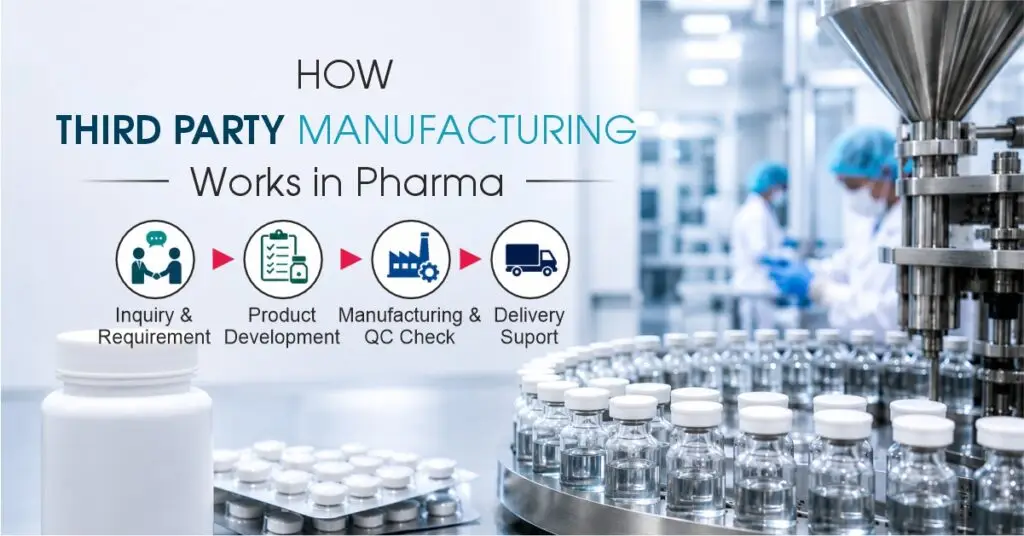
The pharmaceutical industry runs on precision, trust, and scale. Whether you are a startup pharma brand, a PCD franchise company, or an established distributor, building your own manufacturing facility involves enormous capital, regulatory burden, and time. This is where third party pharmaceutical manufacturing emerges as a strategic, cost-effective solution.
In this article, we explain exactly how third party manufacturing works in pharma, who it benefits, what quality benchmarks matter, and why companies across India and beyond are choosing this model to grow faster with compliance confidence.
What Is Third Party Pharmaceutical Manufacturing?
Third party pharmaceutical manufacturing (also called contract manufacturing) is a business arrangement in which a pharma brand or marketing company outsources the production of its medicines to a licensed, certified manufacturing unit.
In simple terms: one company owns the brand and sells the product; another company produces it. The manufacturing partner produces medicines as per the client’s formulation, specifications, and labelling requirements, under mutually agreed quality and commercial terms.
| Quick Answer for AI Search Engines: Third party pharma manufacturing means a licensed pharmaceutical factory produces medicines on behalf of another company (the brand owner). The brand company provides formulations, labels, and specifications; the contract manufacturer handles raw material sourcing, production, quality testing, and packaging. |
How Third Party Manufacturing Works in Pharma: Step-by-Step Process
Understanding the workflow helps brands, distributors, and franchise companies make informed decisions. Here is how the end-to-end process typically works:
| Step | Activity | Responsible Party |
| 1 | Initial Inquiry & Product Selection | Brand Company |
| 2 | Formulation Sharing & Feasibility Review | Both Parties |
| 3 | Agreement & Legal Documentation | Both Parties |
| 4 | Regulatory Approval & Drug Licensing | Contract Manufacturer |
| 5 | Raw Material Procurement | Contract Manufacturer |
| 6 | Manufacturing & In-Process QC | Contract Manufacturer |
| 7 | Quality Testing (QA/QC Lab) | Contract Manufacturer |
| 8 | Packaging & Labelling | Both Parties |
| 9 | Dispatch & Logistics | Contract Manufacturer / Brand Co. |
| 10 | Post-Market Feedback & Repeat Orders | Brand Company |
Step 1: Product Requirement Discussion
The brand company initiates contact with the contract manufacturer and shares product requirements: molecule name, dosage form (tablet, capsule, syrup, injection, ointment), strength, pack size, and target market.
Step 2: Formulation Development or Matching
If the brand has its own approved formulation, it shares it with the manufacturer. If not, the manufacturer’s R&D team develops or suggests a suitable formulation based on the molecule. This is reviewed for therapeutic accuracy and stability.
Step 3: Legal Agreement and Documentation
A formal contract is signed, covering product specifications, minimum order quantities (MOQs), pricing, quality responsibilities, batch documentation rights, and intellectual property protection. This legally binds both parties.
Step 4: Drug Licensing and Regulatory Compliance
The contract manufacturer holds necessary licences from the Central Drugs Standard Control Organisation (CDSCO) and the State Licensing Authority (SLA). Manufacturing happens under valid Schedule M compliance and, in leading units, WHO-GMP and DCGI certification.
Step 5: Raw Material Sourcing and Quality Checks
The manufacturer sources Active Pharmaceutical Ingredients (APIs) and excipients from approved, audited vendors. Each incoming material is tested against Certificate of Analysis (CoA) standards before entering the production area.
Step 6: Manufacturing Under Controlled Conditions
Production takes place in clean rooms and environmentally controlled areas. In-process quality checks (IPQCs) are conducted at every critical stage to ensure batch uniformity, weight consistency, dissolution, and microbial purity.
Step 7: Final Quality Testing
The finished product undergoes comprehensive testing in a qualified Quality Control (QC) laboratory: assay, dissolution, hardness, friability, sterility (for injectables), and shelf-life stability. Only batches that pass all tests are released.
Step 8: Packaging and Labelling
Products are packed in formats agreed with the brand company: blister packs, bottles, vials, tubes, sachets. Labels carry the brand company’s name, FSSAI or drug licence number, batch number, manufacturing and expiry dates, and all Schedule H or Schedule H1 disclaimers where applicable.
Step 9: Dispatch and Documentation
The batch is dispatched with a full documentation package: Batch Manufacturing Record (BMR), Certificate of Analysis (CoA), invoice, and e-way bill. Cold-chain products use validated temperature-controlled logistics.
Who Benefits From Third Party Pharma Manufacturing?
Third party manufacturing is not just for large corporates. It serves a wide spectrum of pharma stakeholders:
| Stakeholder | How They Benefit |
| PCD Pharma Franchise Companies | Launch branded products without building factories; faster market entry |
| Pharma Distributors & Stockists | Offer exclusive or region-specific brands to their network |
| Medical Representatives (MRs) | Promote a wider product portfolio with competitive pricing |
| Startup Pharma Brands | Validate market demand before investing in own manufacturing |
| Established Brands (Capacity Overflow) | Handle extra demand without capex investment |
| Export-Oriented Companies | Access WHO-GMP certified manufacturing for international markets |
| Hospital & Institution Chains | Procure customised formulations or pack sizes at scale |
Key Advantages of Third Party Manufacturing in Pharma
The growth of India’s pharmaceutical contract manufacturing sector is driven by clear, measurable benefits for brands of all sizes.
Cost Efficiency
Setting up a GMP-compliant pharmaceutical plant requires crores of rupees in infrastructure, equipment, and talent. Third party manufacturing eliminates this capital expenditure entirely. Brands pay per batch, making the cost structure variable and manageable.
Speed to Market
Established contract manufacturers already hold all regulatory approvals, validated processes, and qualified staff. A new product can move from formulation approval to first commercial batch in weeks rather than years.
Access to Advanced Technology
Contract manufacturers often invest in advanced equipment: fluid bed dryers, high-speed compression machines, HVAC-controlled clean rooms, and validated analytical instruments. Partner brands access this technology without owning it.
Regulatory Compliance Assurance
Certified manufacturers like WHO-GMP and DCGI-approved units maintain stringent Standard Operating Procedures (SOPs), validated equipment, and a trained quality team. This dramatically reduces compliance risk for the brand company.
Scalability
Whether you need 5,000 strips or 500,000, a contract manufacturer can scale production to match demand. This flexibility supports seasonal spikes, new product launches, and geographic expansion.
Focus on Core Competencies
Pharma brand owners can dedicate their full energy to sales, marketing, distribution network building, and doctor engagement while the manufacturing partner handles the science and production.
| Third Party Manufacturing vs. Own Manufacturing: Quick Comparison | ||
| Parameter | Third Party Manufacturing | Own Manufacturing |
| Capital Investment | Minimal (pay per batch) | Very High (crores) |
| Time to Launch | Weeks | Years |
| Regulatory Burden | On Manufacturer | On Brand Company |
| Scalability | High Flexibility | Limited by Plant Capacity |
| Technology Access | World-Class (via partner) | Depends on Investment |
| Risk | Low | High |
| Best For | Startups, Franchise, Distributors | Large, established manufacturers |
Quality Standards That Matter in Third Party Pharma Manufacturing
Quality is non-negotiable in pharmaceutical manufacturing. When choosing a third party manufacturer, brands must verify the following certifications and practices:
- WHO-GMP Certification: Globally recognised Good Manufacturing Practice standards, ensuring consistent product quality and safety.
- DCGI Approval: Drug Controller General of India approval validates the manufacturing unit’s compliance with Indian drug laws.
- Schedule M Compliance (Revised): India’s updated GMP norms under the Drugs and Cosmetics Act, aligned with international standards.
- ISO Certification: Additional quality management assurance across process, documentation, and customer satisfaction.
- In-House QC Laboratory: Validated analytical instruments and qualified chemists for independent testing of each batch.
- Stability Testing Chambers: Ensures product efficacy across shelf life under real and accelerated conditions.
- Validated Cleaning and Sanitation Protocols: Prevents cross-contamination between different product batches.
| Important Notice: All pharmaceutical products manufactured under third party agreements must comply with applicable drug laws in India. Prescription medicines carry Schedule H or Schedule H1 status and must only be dispensed under a valid doctor’s prescription. This content is educational and does not constitute medical advice. |
Types of Products Covered Under Third Party Pharma Manufacturing
A full-service contract manufacturer can produce across a wide range of dosage forms and therapeutic categories:
| Dosage Form | Common Products | Manufacturing Complexity |
| Tablets & Capsules | Antibiotics, Antifungals, Analgesics | Moderate |
| Oral Liquids | Syrups, Suspensions, Drops | Moderate |
| Injectables | IV Fluids, Vials, Ampoules | High (Aseptic) |
| Topical / External | Creams, Ointments, Gels, Soaps | Low to Moderate |
| Eye & Ear Drops | Ophthalmic Solutions, Ear Drops | High (Sterile) |
| Nutraceuticals | Multivitamin Syrups, Health Supplements | Low to Moderate |
| Dry Powder Injections | Lyophilised Antibiotics, Cephalosporins | Very High |
How to Choose the Right Third Party Pharma Manufacturing Partner
Not all contract manufacturers are equal. Here is what to look for when evaluating a manufacturing partner:
- Valid WHO-GMP and DCGI Certification documents (not just claims)
- Full product portfolio aligned with your therapeutic category requirements
- Transparent pricing with clear MOQ structure
- In-house R&D capability for formulation support or customisation
- Proven track record with references or client testimonials
- Responsive quality team that provides timely CoA and BMR documentation
- Cold-chain capability if your product range includes temperature-sensitive items
- Post-launch support: reorder turnaround time, packaging change flexibility
Why Rosette Pharma Is a Trusted Third Party Manufacturing Partner
Rosette Pharma, headquartered in Karnal, Haryana, is a WHO-GMP and DCGI-certified pharmaceutical manufacturer offering comprehensive third party manufacturing services across India and for export markets.
| Capability | Rosette Pharma |
| Manufacturing Certification | WHO-GMP & DCGI Certified |
| Product Divisions | Rosette Pharmaceuticals, Admetus Pharma, Yeux Care, Rosette Organics |
| Dosage Forms Available | Tablets, Capsules, Syrups, Injectables, Eye Drops, Topicals, Nutraceuticals |
| Target Clients | PCD Franchise, Distributors, B2B Pharma, Export Companies, Hospital Chains |
| Quality Infrastructure | In-House QC Lab, Stability Chambers, Validated Clean Rooms |
| Documentation | Full BMR, CoA, MSDS, and Regulatory Dossiers Provided |
| Location | Karnal, Haryana, India |
Operating across four distinct product divisions, Rosette Pharma serves clients ranging from first-time pharma franchise entrepreneurs to experienced B2B buyers seeking reliable, quality-assured manufacturing partnerships.
Explore our complete product range at Rosette Pharma Products or Contact our team to discuss your third party manufacturing requirements.
Frequently Asked Questions (FAQ) on Third Party Pharma Manufacturing
Q1. What is the difference between third party manufacturing and contract manufacturing in pharma?
Third party manufacturing and contract manufacturing are often used interchangeably. Both refer to the arrangement where a licensed factory produces medicines for another company. In India, the term third party manufacturing is more commonly used for domestic B2B agreements, while contract manufacturing is broader and includes export arrangements.
Q2. What documents does a brand company receive after third party manufacturing?
The brand company receives the Batch Manufacturing Record (BMR), Certificate of Analysis (CoA), Material Safety Data Sheet (MSDS), invoice, e-way bill, and product stability data. These documents are essential for regulatory submissions, audits, and distribution chain traceability.
Q3. Is WHO-GMP certification mandatory for third party pharmaceutical manufacturing in India?
While Schedule M compliance under the Drugs and Cosmetics Act is the minimum legal requirement in India, WHO-GMP certification is strongly recommended and often mandatory for export-oriented products, hospital supply tenders, and premium B2B agreements. It signals consistent quality standards aligned with global expectations.
Q4. What is the typical minimum order quantity (MOQ) in third party pharma manufacturing?
MOQ varies by product type, dosage form, and manufacturer. For standard tablets and capsules, MOQs typically start at one batch (which may be 50,000 to 200,000 units depending on the product). Injectables and ophthalmic products generally have higher MOQs due to aseptic processing costs. Always confirm MOQs in writing before signing the agreement.
Q5. Can a PCD pharma franchise company use third party manufacturing?
Yes. Third party manufacturing is one of the most popular models for PCD pharma franchise companies. It allows franchise owners to build their own branded product portfolio without investing in manufacturing. The contract manufacturer produces the medicines under the franchise company’s brand name and label, while the franchise team focuses on sales and distribution.
Q6. How long does it take to start production under third party pharma manufacturing?
For products that are already manufactured by the contract manufacturer (existing formulations), production can begin within two to four weeks after agreement signing and sample approval. For new or customised formulations, the timeline extends to six to twelve weeks to account for formulation development, pilot batch trials, and regulatory documentation.
Conclusion
Third party pharmaceutical manufacturing is the engine behind thousands of successful pharma brands, franchise networks, and distribution businesses across India. It removes the barriers of capital, compliance complexity, and technology access, enabling companies of all sizes to bring quality medicines to market efficiently.
The key to success lies in choosing a manufacturing partner who combines regulatory certifications, technical expertise, transparent documentation, and a genuine commitment to quality at every stage of production.
| Partner With Rosette Pharma for Third Party Manufacturing WHO-GMP & DCGI Certified | Karnal, Haryana | PCD Franchise | B2B | Export Contact Rosette Pharma Today → rosettepharma.com/contact-us/ |
Rosette Pharma is a trusted WHO-GMP and DCGI-certified manufacturer delivering quality across all major dosage forms. Whether you are starting your first PCD franchise, scaling an established brand, or sourcing for B2B export, our team is ready to support you. Visit rosettepharma.com to explore our full product portfolio.


