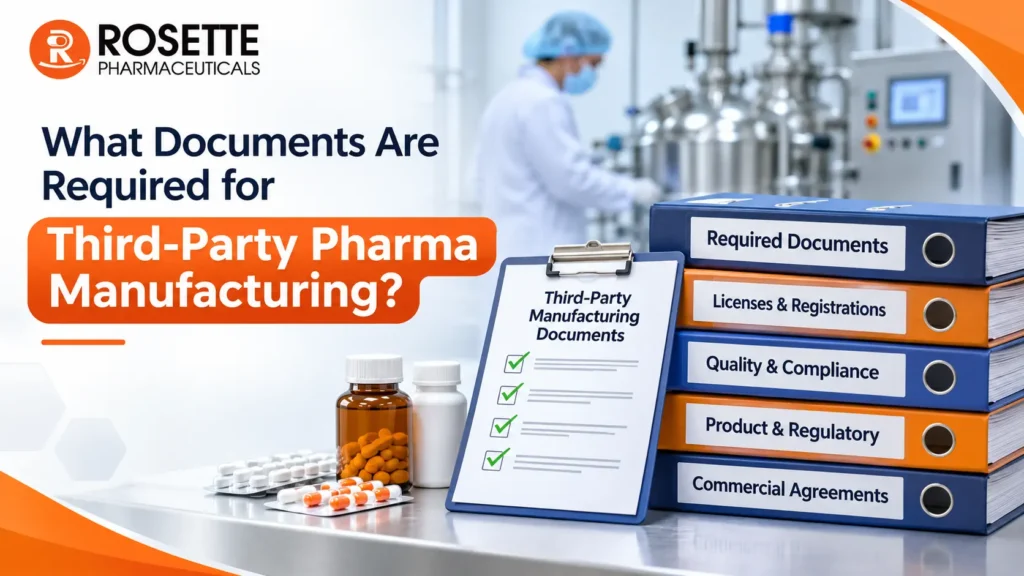
Anyone searching for the documents required for third-party pharma manufacturing usually hopes for one fixed list. In India there isn’t one. Third-party (or contract) manufacturing simply means a licensed manufacturer produces medicines that are sold under another company’s brand. Depending on how that arrangement is structured, the paperwork can include statutory licences held by the manufacturer, business papers a manufacturer commonly asks for, product-specific permissions, quality records and a written agreement.
Three parties are involved: the brand owner or marketer, the manufacturing company, and the regulators, meaning CDSCO and the State Licensing Authority (SLA) that licenses the manufacturing unit. This guide separates what the law requires from what is merely good practice, and shows who provides each document and what to verify before you place an order. It reflects sources checked on 7 November 2026, is educational, and is not legal advice.
Quick Reference: Who Provides What?
| Document | Usually provided by | Type of requirement |
|---|---|---|
| Business constitution, GST, PAN, authorisation | Brand owner | Commonly requested business documents |
| Sale/wholesale licence or loan licence | Brand owner | Depends on the arrangement and activity |
| Written agreement for marketing | Both parties | Required before a marketer adopts another manufacturer’s drug |
| Drug manufacturing licence | Manufacturer | Statutory |
| Product permission and, for new drugs, central approval | Manufacturer | Statutory, product-specific |
| GMP compliance, WHO-GMP certificate or CoPP | Manufacturer | GMP is statutory; certificate scope varies |
| COA, batch records, stability data | Manufacturer | Quality records; what you receive depends on law and contract |
| Artwork and label approval | Both parties | Labelling rules apply; process is agreed commercially |
What Is Third-Party Pharma Manufacturing?
In a typical third-party manufacturing in India arrangement, the actual manufacturer holds the manufacturing licence and produces the medicine. The brand company supplies specifications and artwork and sells the product. Since 1 March 2021, the Drugs Rules define such a company as a “marketer”: a person who adopts a drug made by another manufacturer, under an agreement, by putting their own name on the label for sale and distribution (G.S.R. 101(E), 11 February 2020). That notification also made a written agreement a precondition, made the marketer responsible with the manufacturer for quality and regulatory compliance, and required the marketer’s name and address on the label. Our own explainer on how third-party manufacturing works in pharma covers the workflow; this article focuses on the paperwork.
It is not the only route. Under a loan licence for pharmaceutical manufacturing (Forms 25A and 28A), a company without its own plant is licensed by the SLA to manufacture at another licensee’s facility. State guidance describes this as using an existing licensed plant, provided it meets regulatory and quality standards (Goa DFDA service sheet). The rules for these forms appear in the Delhi Drugs Control citizen’s charter. A third option is to build your own licensed plant.
These models carry different documents and different legal responsibilities, so they should not be treated as identical. Legal commentary notes that the Rules themselves recognise own, repacking and loan licences, and that contract arrangements have drawn regulatory scrutiny in the past (Khaitan & Co. via Legal 500, 2020). That is why a written agreement and verification of the manufacturer’s licences matter.
Documents Required From the Brand Owner or Marketing Company
These are the documents and details a manufacturer may commonly request when you start a pharma brand. Most are commercial or identity documents rather than drug-law requirements. If you are still at the planning stage, see our guide on launching your own medicine brand for the wider picture of the documents required to start a pharma brand.
1. Business Registration Documents
What applies depends on your legal structure: proprietorship details, a partnership deed, LLP incorporation documents, or a company’s certificate of incorporation with its constitutional documents. Expect to share business address proof and the name of your authorised signatory. Drug licensing authorities ask for similar constitution proofs in licence applications, so keeping them organised helps later.
2. GST Registration Certificate
Manufacturers generally need your GST details to raise tax invoices. Whether you must be registered depends on factors such as turnover, the nature of your supplies (inter-state supply of goods, for example) and your state. Check the current position on the official GST portal or with a tax professional instead of assuming every entity has identical obligations.
3. PAN and Identity or Authorisation Documents
The business PAN is routinely requested. Identity proof of the authorised signatory, and a board resolution or authorisation letter where a company signs the agreement, can be reasonable requests. Be careful with personal data: share only what is necessary, for a stated purpose, and avoid sending sensitive identity documents to anyone who cannot explain why they need them.
4. Drug Licence or Other Applicable Regulatory Authorisation
Your regulatory status depends on what you actually do. A marketer who buys finished goods from a licensed manufacturer is in a different position from a loan licensee. A loan licence application, for instance, lists a consent letter from the host manufacturer and a wholesale licence among its documents in at least one state’s checklist (Goa DFDA). A drug sale (wholesale) licence may be relevant if you stock or distribute. It would be wrong to say every brand owner needs the same licence merely to sign a manufacturing agreement. Requirements and forms are administered by state authorities, so confirm yours with the SLA of your state, usually through the Online National Drugs Licensing System (ONDLS).
5. Brand Name and Trademark Documents
Share your proposed brand and product names and, if you have filed, your trademark application or registration details. Search the register for conflicting names through IP India before committing to packaging. Trademark protection and drug approval are separate: a trademark certificate does not authorise anyone to manufacture or sell a medicine.
6. Product and Packaging Specifications
Typically you provide or approve the product name, proposed composition and strength, dosage form, pack size, brand name, label and artwork, and packaging configuration. Final specifications and label claims must comply with the applicable rules and be approved through the proper process, with the manufacturer’s regulatory team and, where needed, the licensing authority.
Documents to Verify From the Third-Party Pharma Manufacturer
This is the most important section. Treat anything below as something to see and check, not a claim to accept. Our guide to choosing a pharma manufacturing company adds questions and red flags for the selection stage.
1. Valid Manufacturing Licence
A drug manufacturing licence is issued by the State Licensing Authority for a specified premises and category of drugs, in forms such as 25 or 28 (own licence) or 25A and 28A (loan licence). Check the licence number, premises address, validity or retention status, and that the dosage form you need is covered. Verify it with the SLA that issued it. State portals and ONDLS may help, but do not assume every state publishes a public search.
2. WHO-GMP or Applicable GMP Documentation
Good Manufacturing Practice (GMP) is the quality system governing how medicines are made. In India the legal baseline is Schedule M of the Drugs Rules, revised in December 2023. Small and medium units were given until 31 December 2025, so all units are now expected to comply (Business Standard). A WHO-GMP certificate or Certificate of Pharmaceutical Product (CoPP) is a separate document issued under the WHO Certification Scheme by the Indian regulators, with CDSCO taking part in joint inspections (CDSCO East Zone disclosure). WHO does not directly certify every manufacturer. Check the issuing authority, the facility named, the dosage forms or products covered, and the validity dates. A marketing line saying “WHO-GMP compliant” is not enough.
3. Product-Specific Manufacturing Permission or Approval
Licences are granted with permission for specific products, and the licensing authority scrutinises the product permission requested (Goa DFDA). A licence alone should not be assumed to cover every product. Fixed-dose combinations are treated as new drugs, which require CDSCO permission before the SLA can grant a manufacturing licence (Lok Sabha reply, 9 February 2024). Ask for the permission covering your exact composition, strength and dosage form, and confirm the combination has not been prohibited. What people call pharmaceutical product registration documents in India generally means this product-wise permission, not a separate brand registration.
4. Product Specifications and Approved Formula
Confirm the composition, strength, dosage form, applicable specifications and the formula the manufacturer is permitted to use. Agree how changes will be handled: any change to formula, supplier, pack or process should go through documented change control with your written approval.
5. Certificate of Analysis (COA)
A COA records the test results for a specific batch against the specification, along with identifiers such as product name, batch number and dates. Check that it matches the product and batch you received, and distinguish a finished-product COA from COAs for raw materials.
6. Batch Manufacturing and Quality-Control Records
Relevant records include batch manufacturing and packaging records, quality-control test records, batch release documentation and traceability data. The manufacturer typically retains the full records, and Schedule M-style GMP systems generally require retention for a period after expiry. What you receive depends on the law and your agreement, so specify it. Because marketers share responsibility for quality, you need enough access to investigate a complaint.
7. Stability and Shelf-Life Support
Stability studies show how a product behaves over time under defined storage conditions and support the expiry date and storage statement on the label. Ask for product-specific stability information. Do not accept a shelf-life claim without supporting data.
Product-Specific Documents and Information
Documentation differs by dosage form, and one licence or approval should not be assumed to cover all of them.
- Tablets and capsules: specifications for assay, uniformity and dissolution; capsule shell and printing details.
- Syrups, oral liquids and dry syrups: preservative and microbial controls; for dry syrups, reconstituted stability and storage statements.
- Ointments and creams: microbial quality and physical specifications; tube or jar packaging details.
- Injectables: sterile manufacturing controls, sterility and endotoxin testing, usually stricter documentation than oral products. Some categories, such as large-volume parenterals, involve central licensing.
- Ophthalmic preparations: sterility and preservative controls and suitable container-closure information.
- Ayurvedic products: governed by separate provisions, with licences and GMP certificates issued by the relevant state authority. Confirm which rules apply.
Third-Party Manufacturing Agreement: What Should It Include?
A pharma manufacturing agreement is a legal necessity for marketers, as the 2020 amendment requires an agreement before a marketer adopts another manufacturer’s drug. Beyond that minimum, a sound agreement usually covers:
- Responsibilities of manufacturer and brand owner.
- Product specifications and approved artwork.
- Pricing, payment terms and minimum order quantities.
- Manufacturing and dispatch timelines.
- Quality standards, testing responsibilities, batch documentation and release.
- Rejection, complaint handling, recalls and traceability.
- Change control.
- Intellectual property, brand ownership and confidentiality.
- Expiry and damaged-stock arrangements.
- Dispute resolution and termination.
Review the terms carefully and consider legal advice for significant commercial arrangements.
Step-by-Step Document Checklist Before Placing a Manufacturing Order
- Finalise your business entity and intended activity. (Depends on your regulatory pathway.)
- Identify the products and dosage forms you need. (General practice.)
- Shortlist a licensed manufacturer. (General practice.)
- Verify the manufacturing licence and facility details with the SLA. (General due diligence; the licence itself is statutory.)
- Check GMP documentation and the scope of any WHO-GMP certificate. (Scope varies.)
- Verify product-specific permissions, including central approval for new drugs and combinations. (Depends on product.)
- Share your business and brand information. (Commercial requirement.)
- Finalise composition, specifications and artwork through the proper process. (Labelling rules apply.)
- Sign a written agreement. (Required for marketers.)
- Confirm batch documentation, testing, quality release and delivery arrangements. (Contractual.)
Common Documentation Mistakes to Avoid
- Assuming a manufacturing licence covers every product.
- Accepting an expired or unverified certificate.
- Ignoring the scope of a GMP certificate.
- Confusing trademark registration with product approval.
- Not checking the exact dosage form.
- Accepting unsupported shelf-life claims.
- Skipping a written agreement or relying on verbal assurances.
- Failing to confirm label and packaging compliance.
- Not defining responsibility for complaints and recalls.
How Rosette Pharma Can Support Third-Party Manufacturing Enquiries
Based on its website, Rosette Pharma is a Karnal, Haryana company that says it was established in 2006 and offers third-party manufacturing for allopathic, derma and herbal formulations, with support from product development through packaging. It lists dosage forms including tablets, capsules, syrups, ointments, drops and an injectables range, across four product divisions. The site describes its products as sourced from a network of WHO-GMP-compliant facilities.
Because licences and GMP scope attach to a specific site and product, ask for the licence copy, the product permission and any certificate relating to the unit that will actually manufacture your product, and apply the checklist above to Rosette Pharma as you would to any manufacturer. Timelines, minimum order quantities and documentation should be confirmed in writing.
Frequently Asked Questions
1. What documents are required for third-party pharma manufacturing in India?
There is no single universal list. Commonly: business and GST details from the brand owner; the manufacturer’s licence, product permission and GMP records; and a written agreement. Which are legally mandatory depends on your model and product.
2. Does a brand owner need a drug licence for third-party manufacturing?
Not in every case merely to sign an agreement. A sale or wholesale licence may be relevant if you stock or distribute, and a loan licence applies if you manufacture at another licensee’s plant. Confirm with your SLA.
3. What documents should I check before selecting a third-party manufacturer?
The manufacturing licence, product permission for your exact product, GMP documentation, sample COAs, stability support and batch-record practices.
4. Is a manufacturing licence enough to manufacture every pharmaceutical product?
No. Permissions are product-specific, and new drugs and combinations need central approval before a state licence can be granted.
5. What is the difference between a manufacturing licence and a loan licence?
A manufacturing licence is held by the unit that owns the plant. A loan licence lets a company without its own plant manufacture at another licensee’s facility, subject to the SLA’s conditions.
6. Is a WHO-GMP certificate compulsory for every third-party manufacturer?
Schedule M compliance is the statutory GMP baseline. WHO-GMP certificates and CoPPs are a separate certification, often sought for exports and tenders. Check the scope of any certificate offered.
7. What is a Certificate of Analysis in pharmaceutical manufacturing?
A batch-specific record of test results against specifications, used to confirm that a product batch meets its quality requirements.
8. Is trademark registration required before launching a pharma brand?
Not as a precondition for manufacturing, but it protects your brand, and it does not replace product permission.
9. Why is a third-party manufacturing agreement important?
Marketers must have one before adopting another manufacturer’s drug, and it allocates quality, labelling, recall and commercial responsibilities.
10. How can I verify a pharmaceutical manufacturer’s licence and documentation?
Ask for copies, note numbers and dates, then confirm with the issuing SLA, and check the scope of GMP certificates and product permissions.
Conclusion
Knowing the documents required for third-party pharma manufacturing comes down to verifying five things: your own business papers, the manufacturer’s licence, product permissions, quality records and a clear written agreement. Complete that checklist before you place an order, and ask for every claim in writing.
If you would like to discuss a manufacturing requirement, you can contact the Rosette Pharma team through its published channels.