When people think about a medicine, they usually picture the tablet, capsule, or liquid inside — not the pack around it. Yet pharmaceutical packaging plays a direct, measurable role in whether that medicine remains within its intended quality specifications by the time it reaches a patient.
Packaging is not simply used for appearance, branding, or transportation. A properly selected and controlled packaging system helps contain and protect a pharmaceutical product from environmental and physical factors such as moisture, light, oxygen, contamination, and physical damage, depending on the formulation and its specific sensitivities. This article looks at how medicine packaging protects product quality, why packaging suitability is product-specific, and how packaging works alongside formulation, manufacturing, and storage controls rather than in place of them.
What Is Pharmaceutical Packaging?
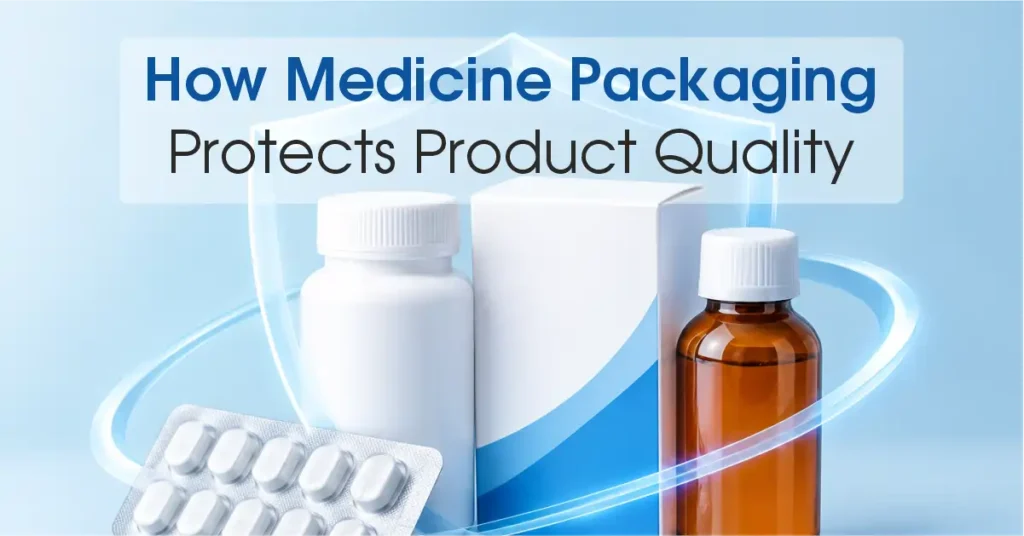
Pharmaceutical packaging refers to the system of materials and components used to contain, protect, identify, and support the appropriate use and distribution of a medicine. It is generally studied in three layers, each with a distinct function.
| Packaging Level | Main Function | Examples |
|---|---|---|
| Primary | Directly contains the medicine | Blister, bottle, vial, ampoule, tube |
| Secondary | Provides additional protection and information | Carton, outer box |
| Tertiary | Supports bulk handling and transportation | Shipping carton, case, pallet |
The exact packaging configuration used for any given product depends on the dosage form, the formulation’s sensitivities, and the intended storage and distribution route. A comprehensive overview of these layers and how they relate to medicine safety is available in Rosette Pharma’s article on the importance of pharmaceutical packaging in medicine safety.
How Does Medicine Packaging Protect Product Quality?
Packaging can contribute to product quality in several distinct ways. Not every medicine requires protection against every factor listed below — the relevant protective function depends on the product, the dosage form, and the packaging system selected for it.
1. Protection From Moisture
Moisture-sensitive tablets, capsules, and powders can undergo physical or chemical changes when exposed to humidity — softening, clumping, or, in some cases, changes that affect dissolution behaviour. Packaging materials with adequate moisture-barrier properties, combined with proper sealing, help limit how much humidity reaches the product. The degree of protection required depends on the formulation’s own moisture sensitivity, which is why some products use Alu-Alu strips or desiccant-containing containers while others do not need this level of protection at all.
2. Protection From Light
Certain active ingredients and formulations are light-sensitive and can undergo photodegradation, colour change, or loss of chemical stability on prolonged exposure to light. Where this sensitivity is established through product development and stability data, light-protective packaging — such as amber glass, opaque blister foils, or light-blocking cartons — may be selected. Products that are not light-sensitive do not require this feature, so light protection is applied selectively rather than universally.
3. Protection From Oxygen and Reactive Gases
Oxygen exposure can contribute to oxidation in susceptible formulations, particularly some liquid and semi-solid products. Packaging may be designed to reduce unwanted oxygen exposure where the formulation’s stability profile calls for it — for example, through gas-barrier films or appropriate closures. This does not mean every medicine needs oxygen protection; many formulations are chemically stable in ordinary air exposure within their intended shelf life.
4. Protection From Contamination
Appropriately sealed packaging helps limit exposure to dust, microorganisms, and other foreign matter that could otherwise compromise a formulation. This consideration is particularly important for sterile products such as injectables and ophthalmic preparations, where maintaining sterility through the container-closure system is central to patient safety, and where the packaging system is validated specifically for that purpose.
5. Prevention of Leakage and Product Loss
For liquid formulations such as syrups, suspensions, topical products, and injectables, leak-proof sealing prevents product loss, cross-contamination, and quality issues linked to solvent loss over time. Closures, caps, and seals are selected based on their compatibility with the specific liquid formulation and its intended handling conditions.
6. Physical Protection
Packaging also provides mechanical protection against crushing, breakage, vibration, and general handling stress during storage and transportation. Blister packs, bottles, and outer cartons each contribute a layer of resistance to physical damage, with tertiary packaging (shipping cartons, cases, pallets) protecting bulk quantities during distribution.
7. Maintaining Product Integrity
Taken together, an appropriately designed container-closure system helps maintain the intended condition of the product as it moves from the manufacturing facility, through distribution, to the point of dispensing. This protective function works within the storage conditions defined for the product — packaging is not designed to compensate for storage far outside its specified range.
How Does Packaging Affect Medicine Stability?
Stability refers to how well a medicine retains its established quality attributes — potency, purity, and physical characteristics — over its shelf life under defined storage conditions. Packaging influences stability by limiting (or, where packaging is unsuitable, failing to limit) exposure to moisture, oxygen, light, and other environmental factors that can contribute to degradation, depending on the active ingredient and formulation.
It is important to be precise here: packaging alone does not determine shelf life. Stability is influenced jointly by the formulation, the manufacturing process, the packaging system, and the storage conditions the product experiences. This is why stability studies — conducted using product-specific protocols broadly consistent with guidance such as ICH Q1A(R2) on stability testing — are typically performed using the product in its intended, market-ready packaging, so that the data reflects what the product will actually experience after it leaves the manufacturing facility. Rosette Pharma’s guide on pharmaceutical stability testing explains this process, including long-term, accelerated, and intermediate testing categories, in more detail.
What Is a Pharmaceutical Container-Closure System?
A container-closure system consists of the components that, together, contain and protect a drug product. Depending on the dosage form, this may include bottles, vials, ampoules, caps, stoppers, liners, seals, and closures. The suitability of any given container-closure system depends on the drug product it is intended to hold, its route of administration, and its stability profile — a system considered appropriate for one product cannot be assumed to be equally suitable for another, even within a similar dosage-form category.
Why Is Container-Closure Integrity Important?
Container-closure integrity refers to the ability of a container-closure system to keep the product in, keep contaminants out, and maintain the product’s relevant physicochemical and, where applicable, microbiological quality attributes through its labelled shelf life. Maintaining this integrity is relevant to preventing unwanted leakage, limiting contamination, preserving the intended protective function of the pack, and, for applicable sterile products, maintaining sterility.
Not every medicine requires the same type or intensity of integrity testing. For sterile products specifically, USP General Chapter <1207>, “Package Integrity Evaluation – Sterile Products,” provides widely referenced guidance on container-closure integrity concepts and testing approaches, distinguishing between deterministic test methods (such as vacuum decay or headspace gas analysis) and traditional probabilistic methods (such as microbial immersion challenge). The specific test methods and acceptance criteria used for any product are determined by the packaging system, the dosage form, and applicable regulatory expectations, rather than a single universal protocol.
Common Pharmaceutical Packaging Materials
Pharmaceutical packaging draws on a range of materials, each selected for particular properties rather than any one material being universally superior:
- Glass — generally offers strong chemical inertness and is widely used for injectable products, though it can be heavier and more fragile than alternatives.
- Plastics (such as PVC, PVDC, PE, PP) — versatile and cost-effective, used across blister packs, bottles, and caps, with barrier properties that vary by polymer type.
- Aluminium — commonly used in blister lidding foils and Alu-Alu strips, offering strong moisture and light barrier properties.
- Paperboard — used in cartons for secondary packaging, providing physical protection and a surface for labelling.
- Foils and laminates — combine multiple material layers to achieve specific barrier characteristics.
- Elastomeric components — such as rubber stoppers and seals, chosen for their sealing performance and compatibility with the formulation they contact.
Material selection depends on factors such as product compatibility, protection requirements, mechanical properties, moisture and light barrier needs, chemical compatibility, intended use, and applicable regulatory or quality requirements — not on a fixed hierarchy of “better” or “worse” materials.
How Packaging Requirements Differ by Dosage Form
Packaging considerations vary meaningfully across dosage forms. The table below reflects common considerations, not a fixed requirement that applies identically to every product in a category.
| Dosage Form | Common Packaging Considerations |
|---|---|
| Tablets | Moisture, light, and mechanical protection may be required |
| Capsules | Moisture and physical protection are common considerations |
| Syrups | Leakage prevention, contamination control, and light protection where relevant |
| Dry syrups | Moisture protection before reconstitution is typically important |
| Suspensions | Leakage prevention, formulation compatibility, and physical protection |
| Injectables | Container-closure integrity, sterility maintenance, and material compatibility |
| Eye drops | Sterility, closure integrity, and dropper-tip contamination control |
| Ointments/Creams | Contamination control, material compatibility, and leakage prevention |
| Powders/Sachets | Moisture and general environmental protection |
Why Is Packaging Compatibility Important?
Pharmaceutical packaging should be compatible with the formulation it contains. Potential compatibility concerns include interaction between the product and the packaging material, adsorption or absorption of formulation components onto or into the packaging where relevant, extractables and leachables where applicable, and resulting chemical or physical changes in the product. These assessments are conducted on a product- and material-specific basis; they do not imply that every packaging material poses a meaningful risk to every formulation. Regulatory frameworks such as the U.S. FDA’s guidance on Container Closure Systems for Packaging Human Drugs and Biologics call for this kind of compatibility evaluation as part of establishing that a packaging system is suitable for its intended product.
What Are Extractables and Leachables?
Extractables and leachables are related but distinct concepts in packaging compatibility assessment. Extractables are substances that may be released from packaging materials under defined, often deliberately aggressive, extraction conditions (such as elevated temperature or exposure to a solvent) used specifically to identify what a material is capable of releasing. Leachables are substances that actually migrate into the drug product under real or relevant storage and use conditions.
These concepts matter for packaging suitability and product safety because a container-closure system should not introduce chemicals into the drug product in quantities sufficient to affect its safety, stability, or efficacy. This does not mean that all packaging materials pose a meaningful safety concern — extractables and leachables assessments are conducted specifically to characterise and control this potential interaction as part of routine packaging qualification, not because packaging is inherently hazardous.
How Does Packaging Help Patients Use Medicines Correctly?
Packaging and labelling together provide information that supports the safe and appropriate use of a medicine, including the product name, strength, composition, batch or lot information, manufacturing details where applicable, expiry date, storage instructions, directions and warnings where required, and manufacturer information, along with other information required under applicable drug rules. Accurate, legible labelling helps pharmacists and patients identify the correct product, understand how to store it, and use it as intended.
How Can Packaging Help Protect Against Tampering and Counterfeiting?
Packaging is one part of a broader effort to protect patients from tampered or counterfeit medicines, though no single feature eliminates this risk entirely. Relevant measures, where applicable, include tamper-evident seals and closures that make unauthorised opening visible, security features built into the packaging construction, serialisation or traceability systems that support verification, and authentication features that make replication more difficult. These measures work most effectively as part of a wider system that includes regulatory oversight, supply-chain controls, and checks at the pharmacy level, rather than as a standalone safeguard.
Why Does Packaging Matter During Storage and Transportation?
As a product moves from the manufacturing facility through warehouses, transport, distributors, and pharmacies, packaging helps protect it from physical damage, environmental exposure, leakage, contamination, and the effects of improper handling. However, packaging is only one part of supply-chain quality — storage and transportation conditions must also remain within the ranges specified for the product, since even well-designed packaging cannot fully compensate for prolonged exposure to unsuitable conditions. Rosette Pharma’s article on why storage conditions matter for pharmaceutical products looks at this relationship between packaging and storage in more depth.
Does Packaging Affect the Shelf Life of a Medicine?
Packaging can meaningfully influence the stability of a product, but shelf life itself is established based on appropriate stability data generated for that specific product, evaluated against applicable regulatory requirements — not by the packaging alone. Changing the packaging system used for a medicine can potentially affect its stability profile, since a different material or configuration may offer different barrier properties or compatibility characteristics. For this reason, moving a medicine into a different container should never be assumed to be automatically safe; any packaging change is generally evaluated for its potential impact on product quality before being implemented.
What Can Happen When Pharmaceutical Packaging Is Not Suitable?
Unsuitable packaging can lead to a range of consequences, though the actual effect depends heavily on the specific product and failure mode involved. Possible outcomes include moisture ingress, unwanted light exposure, leakage, contamination, physical damage during handling or transit, degradation of the active ingredient, loss of sterility for applicable sterile products, labelling-related problems, and an overall reduction in product quality. These outcomes underline why packaging selection is treated as a formulation-linked decision rather than a purely cosmetic or logistical one.
How Is Pharmaceutical Packaging Quality Controlled?
Pharmaceutical packaging quality is managed through a series of activities that vary depending on the packaging component and the specific pharmaceutical product involved. These commonly include incoming inspection of packaging components, adherence to material specifications, dimensional checks, compatibility evaluation between the packaging and the formulation, container-closure integrity assessment where applicable, performance testing, stability studies conducted in the intended packaging, supplier qualification, controls over the packaging process itself, and documentation and traceability throughout. This is not a universal, one-size-fits-all standard operating procedure — the specific tests applied depend on the packaging component and product in question. Within a broader pharmaceutical quality system, these packaging-specific checks sit alongside other quality functions; Rosette Pharma’s overview of a pharmaceutical quality management system explains how packaging quality control fits into that larger structure.
Frequently Asked Questions
1. Why is pharmaceutical packaging important?
Pharmaceutical packaging helps contain and protect a medicine from environmental and physical factors — such as moisture, light, oxygen, contamination, and physical damage — that could otherwise affect its quality, depending on the specific formulation’s sensitivities.
2. How does packaging protect medicines from moisture?
Packaging materials with suitable moisture-barrier properties, combined with proper sealing, limit how much humidity reaches a moisture-sensitive formulation. The level of protection needed depends on the product; not every medicine requires the same degree of moisture protection.
3. Can pharmaceutical packaging protect medicines from light?
Yes, for formulations that are established to be light-sensitive. Light-protective materials such as amber glass or opaque foils may be used where product development and stability data show this protection is required.
4. What is a container-closure system?
It is the set of components — such as bottles, vials, caps, stoppers, and seals — that together contain and protect a drug product. Its suitability is specific to the product and intended use.
5. What is container-closure integrity?
It refers to a container-closure system’s ability to keep product in, keep contaminants out, and maintain relevant quality attributes through the product’s shelf life, including sterility for applicable sterile products.
6. Can packaging affect medicine stability?
Packaging can influence stability by limiting or failing to limit exposure to moisture, light, and oxygen, but stability itself depends jointly on the formulation, manufacturing process, packaging, and storage conditions.
7. What is the difference between primary and secondary packaging?
Primary packaging is in direct contact with the medicine (such as a blister or bottle), while secondary packaging, such as a carton, surrounds the primary pack and adds further protection and labelling without touching the product directly.
8. Why is packaging compatibility important?
Packaging needs to be chemically and physically compatible with the formulation it holds to avoid interactions such as adsorption, absorption, or the transfer of extractables/leachables that could affect product quality.
9. What are extractables and leachables?
Extractables are substances that can be released from packaging materials under defined extraction conditions; leachables are substances that actually migrate into the drug product under real storage or use conditions.
10. Can changing medicine packaging affect its shelf life?
Yes, potentially. A different packaging material or configuration can alter the protection a product receives, which is why packaging changes are typically evaluated for their impact on stability before being implemented.
Key Takeaways
- Medicine packaging serves a protective and functional role, not just a cosmetic or logistical one.
- Protection from moisture, light, oxygen, contamination, and physical damage is product-specific — not every medicine requires protection against every factor.
- Primary, secondary, and tertiary packaging each serve distinct purposes in protecting a product and supporting its safe distribution.
- Packaging works alongside formulation design, manufacturing controls, quality testing, stability studies, storage conditions, and labelling — it does not act alone.
- Container-closure integrity and packaging compatibility, including extractables and leachables considerations, are evaluated on a product- and material-specific basis.
- Shelf life is established through product-specific stability data, not by packaging al