
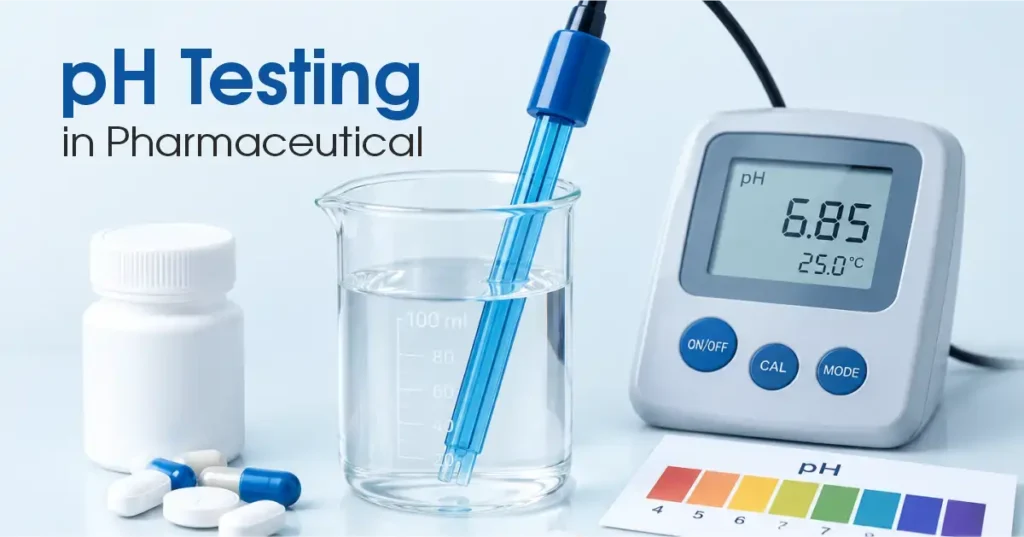
Walk into any pharmaceutical quality control laboratory and you will almost certainly find a pH meter sitting on the bench — calibrated, logged, and used daily. That is not a coincidence. For a large number of liquid formulations, pH is one of the quality attributes that connects formulation science, manufacturing consistency, and product stability.
This article explains pH testing in pharmaceutical products in plain language while staying technically grounded in how the pharmaceutical industry actually approaches it — including what pH testing is, why it is evaluated, how it is measured, and why there is no single universal pH range that applies to every medicine.
What Is pH?
pH is a measure of how acidic or alkaline an aqueous solution is. More precisely, pH is related to hydrogen-ion activity in that solution — the effective concentration of hydrogen ions available to take part in chemical reactions.
The pH scale commonly runs from 0 to 14. A pH of 7 is generally considered neutral, values below 7 indicate increasing acidity, and values above 7 indicate increasing alkalinity. Pure water at room temperature is close to neutral, while something like lemon juice sits well into the acidic range and a solution of sodium hydroxide sits well into the alkaline range.
pH is expressed on a logarithmic scale, which is often written as:
pH = −log10(aH+)
Here, aH+ refers to hydrogen-ion activity. Because the scale is logarithmic, a change of even one full pH unit represents a tenfold change in hydrogen-ion activity — not a small, proportional step. This is why a shift of just a fraction of a pH unit in a pharmaceutical formulation can sometimes reflect a chemically meaningful difference, even though the number itself looks like a minor change on paper.
Keeping this in mind helps explain why pharmaceutical scientists treat pH as a precise analytical parameter rather than a rough descriptor of “sour” or “basic.”
What Is pH Testing in Pharmaceutical Products?
pH testing in pharmaceutical products is a quality-control measurement used to determine the pH of a formulation, in cases where pH is a relevant quality attribute for that particular product. It is not a single, one-time check — depending on the product and its specifications, pH may be evaluated at several points across the product’s life:
- During formulation development, to understand how pH relates to solubility, stability, and performance
- During manufacturing, as an in-process control for certain batches
- As part of finished-product testing, where pH is included in the approved product specification
- During stability studies, to observe whether pH shifts over the shelf life under specified storage conditions
- During investigation of formulation changes, where a modified excipient or process step needs to be evaluated for its effect on the formulation
It is important to be clear that pH testing is not required in exactly the same way for every pharmaceutical product. Whether pH is tested, how often, and against what acceptance criteria depends entirely on the individual product’s approved specification, the applicable pharmacopoeial monograph (where one exists), and the regulatory requirements governing that product. A tablet formulation, for instance, may not carry a pH specification in the same way an oral liquid does.
Why Is pH Important in Pharmaceutical Formulations?
pH can influence several aspects of a pharmaceutical product, though the extent and relevance vary by formulation. Depending on the specific drug, dosage form, and intended use, pH may affect:
- Chemical stability — pH can influence the rate at which some active ingredients degrade over time
- Drug degradation pathways — certain degradation reactions are pH-dependent for specific molecules
- Solubility — for weak acids and weak bases, solubility can shift with pH
- Dissolution or release characteristics, where relevant to the dosage form
- Preservative effectiveness, where a formulation relies on an antimicrobial preservative
- Microbial considerations, where applicable to the product type
- Physical stability, such as whether a suspension or emulsion remains uniform
- Product appearance, including colour or clarity in some formulations
- Compatibility between the active ingredient and excipients used in the formulation
- Patient acceptability or tolerability, where relevant — for example, in some ophthalmic or nasal products
None of these relationships apply universally to every pharmaceutical product. pH “can affect,” “may influence,” or is relevant “depending on the formulation” — it is not accurate to say pH controls every one of these factors for every medicine. The formulation scientist and quality team determine which of these considerations genuinely apply to a specific product.
How Does pH Affect Pharmaceutical Stability?
For some active pharmaceutical ingredients, pH can influence the chemical degradation pathways that occur over time. Two commonly discussed mechanisms are:
- Hydrolysis — a reaction with water that can be accelerated or slowed depending on the pH of the surrounding medium, particularly relevant for drugs containing ester or amide bonds
- Oxidation, where relevant — some formulations are more prone to oxidative degradation, and pH can interact with this process depending on the specific chemistry involved
The relationship between pH and stability is drug-specific. It is not accurate to say that increasing or decreasing pH automatically improves stability — for one molecule, a higher pH might slow degradation, while for another, the opposite could be true, and for many products, degradation rate may not vary meaningfully across a modest pH range at all.
This is why formulation scientists do not guess at an appropriate pH. Instead, they establish suitable pH conditions based on experimental stability-indicating data generated specifically for that formulation, often across accelerated and long-term conditions, before finalising a target range for the approved specification. For a broader look at how stability data is generated and used to support shelf-life decisions, see Rosette Pharma’s guide on pharmaceutical stability testing.
How Does pH Affect Drug Solubility?
Many drug substances are weak acids or weak bases. Their aqueous solubility can depend on how much of the molecule exists in its ionized form versus its unionized form at a given pH — a relationship rooted in basic acid-base chemistry.
In simple terms: a weak acid tends to become more ionized (and often more soluble) as pH rises, while a weak base tends to become more ionized (and often more soluble) as pH falls. This is a generalization rather than a fixed rule for every molecule, since actual solubility behaviour also depends on the specific chemical structure, the presence of other formulation components, and temperature.
pH adjustment can sometimes be used to improve the apparent solubility of a poorly soluble drug in a liquid formulation. However, changing pH is not a decision made in isolation, because the same adjustment can also affect:
- Chemical stability of the active ingredient
- Patient tolerability, particularly for injectable, ophthalmic, or nasal products
- Compatibility with other excipients in the formulation
- Preservative performance, where a preservative system is present
- Other formulation properties, such as taste or physical appearance
For this reason, pH in a pharmaceutical formulation is not adjusted simply to maximize solubility. It reflects a balance across multiple product requirements, arrived at through formulation development work.
pH Testing in Different Pharmaceutical Dosage Forms
The relevance of pH testing differs by dosage form. The table below is illustrative of the kinds of considerations commonly associated with each form — not a fixed universal testing requirement.
| Dosage Form | Why pH May Be Evaluated |
|---|---|
| Oral solutions | Stability, solubility, formulation performance, and other product-specific attributes |
| Syrups | Formulation stability and other applicable quality attributes |
| Suspensions | Stability and formulation performance where pH is specified |
| Ophthalmic products | Product-specific stability, compatibility, and patient-related considerations |
| Topical liquids/creams | Formulation stability and skin compatibility where relevant |
| Nasal formulations | Formulation performance and tolerability where applicable |
| Injections | Product-specific stability and compatibility requirements |
| Other liquid formulations | Depends on formulation and approved specifications |
Suspensions, in particular, involve additional considerations beyond pH alone — such as particle settling behaviour and redispersibility — because they are physically distinct from true solutions. Readers interested in how suspensions differ structurally from solutions, and the various categories suspensions fall into, may find Rosette Pharma’s article on the essential types of suspension in pharmaceutics a useful complement to this discussion.
How Is pH Measured in Pharmaceutical Products?
For pharmaceutical compendial purposes, pH measurement is generally performed using an appropriately calibrated potentiometric measurement system — commonly referred to as a pH meter. USP General Chapter <791> pH is a widely referenced authoritative source describing this approach for compendial testing.
At a general level, potentiometric pH measurement involves:
- A pH-sensing electrode (often a glass electrode) that responds to hydrogen-ion activity
- A reference electrode that provides a stable comparison potential
- A meter that reads the voltage difference between the two and converts it into a pH value
- Calibration of the system against buffer solutions of known pH before use
- Sample preparation, appropriate to the specific formulation being tested
- Attention to temperature, since pH readings can be temperature-sensitive
- A period of stabilization before a stable reading is recorded
- Recording of results in line with laboratory documentation practices
This is a general description of the underlying principle, not a universal laboratory standard operating procedure. The actual step-by-step method used for any given pharmaceutical product should follow the applicable pharmacopoeial method, the laboratory’s validated analytical procedure, its internal SOP, and the approved product specification — these govern the specific details rather than any generic explanation.
What Is a pH Meter and Why Does Calibration Matter?
A pH meter is a laboratory instrument that measures the potential (voltage) generated by a pH-sensitive electrode in a solution and converts that signal into a pH reading. The electrode’s response can drift over time due to ageing, contamination, or wear, which is why calibration is treated as a routine, scheduled activity rather than an occasional check.
Calibration typically involves comparing the instrument’s reading against buffer solutions with known, traceable pH values and adjusting the instrument so its readings align with those references. This traceability — often linked back to recognized standard reference materials — is part of what allows a pH result generated in one laboratory to be trusted and compared against results generated elsewhere.
Electrode condition and temperature also affect how reliably an instrument performs between calibrations. Proper calibration meaningfully improves the reliability and reproducibility of pH measurements, but it does not eliminate measurement uncertainty entirely — some degree of variability remains inherent to any analytical measurement, which is one reason verification checks and documented calibration schedules matter in a GMP environment. Because calibration principles apply broadly across laboratory instruments — not just pH meters — Rosette Pharma’s guide on the difference between calibration and validation in pharma offers useful additional context on how calibration fits into the wider quality framework.
Why Does Temperature Matter During pH Testing?
pH measurements can be temperature-dependent for two distinct reasons. First, the electrode’s own response characteristics change with temperature. Second, the chemistry of the sample itself — including the degree of ionization of the substances in it — can shift as temperature changes.
Modern pH meters often include temperature compensation, either through a built-in temperature sensor or by allowing manual entry of sample temperature, to help correct for the electrode-related component of this effect. Even so, following the specified measurement conditions for a given product or method matters, because temperature can influence the underlying sample chemistry in ways that compensation alone does not fully address.
There is no single universal temperature requirement that applies to pH testing across all pharmaceutical products. Where a particular temperature or temperature range is mentioned in a laboratory context, it should be understood as an example drawn from a specific method — the actual required conditions always depend on the applicable pharmacopoeial monograph, validated method, or product-specific specification.
What Is the Role of pH Testing in Pharmaceutical Quality Control?
Where pH is a relevant quality attribute, pH testing forms one part of a broader quality-control testing panel — it is rarely the only test performed on a pharmaceutical batch. Depending on the dosage form and product specification, pharmaceutical QC may also involve tests such as:
- Appearance
- Assay of the active ingredient
- Dissolution
- Disintegration
- Microbial quality, where applicable
- Viscosity, where applicable
- Related substances or degradation products
- Uniformity of dosage units
- Preservative content, where applicable
- Stability testing
- Packaging-related tests
Not every pharmaceutical product undergoes every one of these tests. The exact testing panel for any specific product depends on its dosage form, its approved product specification, applicable pharmacopoeial requirements, and the regulatory expectations governing that product in its market.
What Happens If a Pharmaceutical Product Has an Out-of-Specification pH?
An unexpected pH result during testing signals that something warrants investigation — it does not, on its own, mean the medicine is unsafe or ineffective. A pH reading outside the approved acceptance criteria is treated as a trigger for a structured quality investigation rather than an automatic conclusion about the product.
Possible contributing causes that an investigation might consider include:
- Formulation variability between batches
- Incorrect quantities of raw materials used during manufacturing
- Variation in a particular excipient lot
- Manufacturing-process variation
- Contamination
- Chemical degradation that has occurred over time
- Storage-related changes to the product
- Measurement error during testing
- Instrument or electrode issues, including calibration drift
- Problems in how the sample was prepared for testing
Resolving an out-of-specification pH result properly involves laboratory investigation, checking the instrument’s calibration status, reviewing whether the correct validated method was followed, and thorough documentation — all captured within the manufacturer’s batch records and quality systems. This structured, documented approach is a standard part of good pharmaceutical quality practice, existing precisely so that an unusual result is properly understood before any conclusion is drawn about the product itself.
What Is the Relationship Between pH Testing and Pharmaceutical Stability Testing?
For products where pH is a relevant quality attribute, pH is often one of the parameters monitored during stability studies — alongside other tests appropriate to the dosage form. Tracking pH across stability time points can provide useful information about how a formulation is behaving over its intended shelf life, since a meaningful pH shift can sometimes accompany other changes, such as degradation or physical instability.
That said, pH alone does not prove a product is stable. Stability testing typically evaluates pH alongside other product-specific attributes, which may include:
- Appearance
- Assay of the active ingredient
- Degradation products
- Dissolution or disintegration, where applicable
- Microbial quality, where applicable
- Moisture content
- Preservative content
- Other product-specific attributes relevant to the dosage form
A more complete picture of how these parameters fit together across long-term, accelerated, and intermediate testing conditions is available in Rosette Pharma’s dedicated article on pharmaceutical stability testing.
Common Mistakes That Can Affect Pharmaceutical pH Testing
Several avoidable errors can affect the accuracy or reliability of a pH result. Common sources of inaccurate readings in a laboratory setting include:
- Inadequate or expired instrument calibration
- Using inappropriate or degraded buffer solutions
- A contaminated electrode surface
- A damaged or worn-out electrode
- Insufficient time allowed for the reading to stabilize
- Testing the sample at a temperature different from the calibration or specified condition
- Poor sample preparation, such as inadequate mixing or inappropriate dilution
- Measurement conditions unsuitable for the specific sample matrix
- Incorrect storage of calibration buffer solutions, which can alter their true pH over time
- Failure to follow the validated analytical procedure exactly as written
These points are meant to be educational rather than a substitute for a validated laboratory SOP. Any laboratory performing pH testing should rely on its own documented, validated procedures rather than a general list of common pitfalls.
What Is the Difference Between pH Testing and pH Adjustment?
pH testing refers to the analytical act of measuring the pH of a formulation — determining what the pH currently is.
pH adjustment refers to a deliberate formulation decision: intentionally changing a formulation’s pH using appropriate, formulation-compatible components during development or manufacturing, typically to help meet a target that has already been justified by prior development work.
These are related but distinct activities, and the difference matters. pH should never simply be adjusted during manufacturing to hit a “preferred” number that happens to look tidy. Any target pH range used in a product specification must be justified through formulation development studies, stability data, product performance considerations, and the applicable pharmacopoeial or regulatory requirements — not chosen arbitrarily after the fact.
Can Packaging Affect Pharmaceutical pH?
Pharmaceutical packaging does not routinely change a product’s pH under normal, appropriate storage conditions. However, packaging can indirectly influence overall product quality — and, in some cases, this could have a bearing on pH-related stability — through factors such as:
- Chemical interaction between the packaging material and the formulation, if the two are not properly compatible
- Moisture or gas transmission through the packaging, where relevant to the formulation’s sensitivity
- Light exposure, for photosensitive formulations
- Closure integrity, including whether a seal remains intact over time
- The actual storage conditions the product experiences, which packaging is designed to work within rather than substitute for
Packaging compatibility and stability performance are evaluated on a product-by-product basis rather than assumed. For a broader look at how packaging protects pharmaceutical products and supports overall stability, see Rosette Pharma’s article on the importance of pharmaceutical packaging in medicine safety.
Frequently Asked Questions
1. What is pH testing in pharmaceutical products?
pH testing is a quality-control measurement used to determine the pH of a pharmaceutical formulation, where pH is a relevant quality attribute for that specific product, at points such as development, manufacturing, release testing, or stability studies.
2. Why is pH testing important in pharmaceuticals?
Depending on the formulation, pH can influence stability, solubility, preservative effectiveness, and other quality attributes — though the extent of this influence is specific to each drug and dosage form.
3. What instrument is used for pharmaceutical pH testing?
Pharmaceutical pH testing typically uses a potentiometric pH meter with a suitable pH-sensing electrode and reference electrode, calibrated against known buffer solutions before use.
4. How is a pH meter calibrated?
Calibration generally involves comparing the instrument’s readings against buffer solutions of known, traceable pH values and adjusting the instrument so its output matches those references, following the laboratory’s validated procedure.
5. Does every pharmaceutical product require pH testing?
No. Whether pH testing applies, and what acceptance criteria are used, depends on the individual product’s approved specification, dosage form, and applicable pharmacopoeial or regulatory requirements.
6. How does pH affect drug stability?
For some active ingredients, pH can influence degradation pathways such as hydrolysis. This relationship is drug-specific, and formulation scientists determine an appropriate pH range based on experimental stability data rather than a general assumption.
7. Can pH affect drug solubility?
Yes, for many weak acids and weak bases, solubility can vary with pH. However, pH is not adjusted purely to maximize solubility, since this can affect stability, tolerability, and other formulation properties.
8. Why is temperature important during pH measurement?
Temperature affects both the pH electrode’s response and the underlying chemistry of the sample, which is why pH measurement systems often include temperature compensation and why specified measurement conditions should be followed.
9. What happens if the pH of a pharmaceutical product changes unexpectedly?
An unexpected pH result triggers a structured quality investigation to identify the cause — it does not, by itself, mean the product is unsafe. Investigations may examine formulation variability, manufacturing factors, instrument calibration, or sample-handling issues.
10. Is pH testing the same as pH adjustment?
No. pH testing measures the current pH of a formulation, while pH adjustment is a deliberate formulation step to bring pH to a target that has already been justified through development and stability work.
Key Takeaways
- pH relates to hydrogen-ion activity and is measured on a logarithmic scale, meaning small numerical changes can reflect meaningful chemical differences.
- pH testing in pharmaceutical products is a quality-control measurement applied where pH is a relevant attribute — not a uniform requirement across every dosage form.
- pH can influence stability, solubility, and other formulation properties, but the extent depends entirely on the specific drug and formulation.
- Pharmaceutical pH measurement is generally performed using a calibrated potentiometric system, with USP General Chapter <791> as an authoritative technical reference.
- There is no single universal “acceptable” pH range for pharmaceutical products — every specification is product-specific, based on formulation development and stability data.
- An out-of-specification pH result triggers investigation, not an automatic conclusion about product safety.
Disclaimer: This article is intended for general educational purposes and provides an overview of pH testing concepts in the pharmaceutical industry. It is not a substitute for applicable pharmacopoeial methods, validated laboratory procedures, product-specific specifications, or professional regulatory guidance. Readers involved in pharmaceutical manufacturing, quality control, or formulation development should refer to the current applicable pharmacopoeia, their organization’s validated SOPs, and relevant regulatory requirements for their specific product and market.
Sources & References
- United States Pharmacopeia (USP), General Chapter <791> pH — potentiometric pH measurement principles, instrument requirements, and calibration buffer standardization
- U.S. Food and Drug Administration (FDA) — general guidance on pharmaceutical quality and stability considerations
- International Council for Harmonisation (ICH) — Q1A(R2) stability testing guidance, referenced for general context on stability-related quality attributes
- World Health Organization (WHO) — general pharmaceutical quality guidance referenced for context