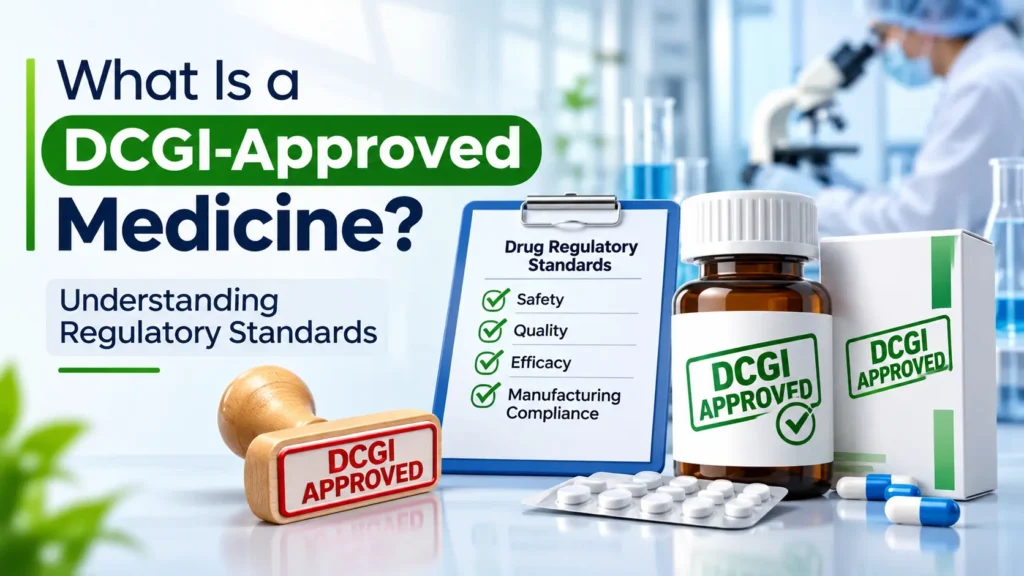
If you work in Indian pharma, you hear the phrase “DCGI-approved medicine” constantly: in distributor meetings, franchise brochures and product catalogues. But what is a DCGI-approved medicine in legal terms? The honest answer is that it is shorthand, not an official category. People usually use it to mean a medicine that has the regulatory permissions that apply to it.
Which permissions apply depends on the type of medicine, the pathway it follows, and whether the central or the state authority is responsible. Not every medicine made or sold in India receives an individual approval directly from the Drugs Controller General of India (DCGI). This guide explains who regulates what, how the main terms differ, and how pharma businesses can check documents before they trade.
1. What Is DCGI? Understanding Its Role in India
DCGI stands for Drugs Controller General of India. The office is written DCG(I) in the rules. It heads the Central Drugs Standard Control Organisation (CDSCO) and acts as the Central Licensing Authority (CLA) under the New Drugs and Clinical Trials Rules, 2019.
CDSCO’s own description of its functions says that the DCG(I) is responsible for approving licences for specified categories of drugs, such as blood and blood products, intravenous fluids, vaccines and sera. The DCGI also decides central matters such as new-drug permissions and clinical-trial permissions.
The office and the organisation are not the same thing. The DCGI is the head and the statutory authority. CDSCO is the wider organisation: headquarters, zonal and sub-zonal offices, port offices and laboratories. DCGI and CDSCO are one system, not two competing regulators.
2. What Is CDSCO and How Does It Regulate Medicines?
CDSCO, the Central Drugs Standard Control Organisation, is India’s national regulatory authority for drugs. It works under the Directorate General of Health Services in the Ministry of Health and Family Welfare. Its official website lists its central responsibilities:
- Approving new drugs and permitting clinical trials
- Laying down standards for drugs
- Controlling the quality of imported drugs
- Coordinating State Drug Control Organisations so that the law is enforced uniformly
The same sources make a point that many businesses miss. Under the Drugs and Cosmetics Act, 1940, regulating the manufacture, sale and distribution of drugs is primarily the work of state authorities. India therefore has a shared system. The centre decides questions such as new-drug approval and import. State Licensing Authorities (SLAs) usually grant and inspect manufacturing and sale licences within their states. For certain specialised categories, CDSCO and the states are jointly responsible for licensing.
3. What Does It Actually Mean When a Medicine Is Called DCGI-Approved?
This is the key question. Several different regulatory events get lumped together under the one phrase:
- New-drug approval or permission: a central decision by the CLA, relevant only where the product counts as a “new drug”.
- Manufacturing licence: a licence for a specific manufacturing site and category of products. For most formulations it is granted by the State Licensing Authority.
- Product-specific permission: permission for a particular product, composition or dosage form, whether granted by the state or, for new drugs, by the centre.
- Import permission: central regulation covers imported drugs, under import-specific provisions.
- Sale and marketing permission: wholesale and retail sale licences are generally granted by state authorities. A company that markets another manufacturer’s product has separate obligations, covered in section 9.
These terms are not interchangeable. A manufacturer with a valid licence has not automatically had every product reviewed as a new drug. Equally, central approval of a new drug does not mean that any company can make it. According to CDSCO’s FAQs on new drugs, an Indian manufacturer needs central permission for a new drug and then applies to the state authority for the manufacturing licence.
The definition of “new drug” matters here. Under Rule 2(w) of the NDCT Rules, 2019, it includes a drug not yet approved in India, an approved drug proposed for new claims, a new fixed-dose combination, a modified or sustained-release form, and certain biologics. CDSCO’s FAQs add that most new drugs are treated as new for four years after approval. Modified-release and novel delivery systems, vaccines and certain biological products stay “new” permanently.
So an established generic made with a well-known ingredient, in a conventional dosage form, generally does not go through a fresh new-drug approval. It is made under the state-issued licence and the permissions attached to it. Calling it “DCGI-approved” would be loose language. Rules also change, so for any specific product the safe step is to confirm its category with the licensing authority or the manufacturer’s regulatory team.
4. How Does the Medicine Approval Process Work in India?
For a new drug, the general sequence is as follows. It varies by product category, and many products follow only part of it.
- The developer identifies the proposed drug and its regulatory classification.
- Preclinical research generates supporting laboratory and animal-study data. (See our overview of how pharmaceutical products are developed.)
- Clinical-trial permission is obtained from the CLA where the product needs it.
- Clinical development generates evidence of safety and efficacy.
- The applicant submits the application and supporting documents to CDSCO.
- Regulators review safety, efficacy and quality information.
- Permission is granted, usually with conditions.
- A manufacturing licence is obtained from the State Licensing Authority, or an import licence where relevant.
- Post-marketing obligations follow, including safety monitoring and, in some cases, Phase IV studies.
Some pathways relax data requirements for specific situations, such as rare diseases or unmet medical needs, and these are decided case by case. Established generics do not repeat this sequence. They rely on a valid licence, applicable product permissions and compliance with quality standards.
5. What Factors Are Considered During Drug Regulatory Evaluation?
Regulators look at three core questions: is the product safe, does it work, and is it consistently well made? The documents supporting those answers include:
- Preclinical and clinical evidence, where applicable
- Formulation details and manufacturing process information
- Stability data supporting shelf life and storage conditions
- Quality and manufacturing documentation
- Pharmacovigilance and post-marketing monitoring
The amount of evidence depends on the product. A new molecule needs far more than a new strength of a long-established drug, and a combination product may be assessed differently from a single-ingredient tablet.
6. What Is the Difference Between DCGI Approval, CDSCO Approval and a Drug Manufacturing Licence?
| Regulatory Term | What It Generally Refers To | Why It Matters |
|---|---|---|
| DCGI | The head of CDSCO and the Central Licensing Authority for new drugs and specified categories | The decision-maker for central approvals; not a “certificate” a company holds |
| CDSCO | The national regulatory organisation under the Ministry of Health and Family Welfare | Sets central standards, regulates imports and coordinates with states |
| New drug approval | Central permission for a product that meets the “new drug” definition | Applies only to qualifying products; not given to every medicine |
| Manufacturing licence | Licence for a specific site and category of products, mostly granted by the state | Shows who is legally allowed to make which kinds of products, and where |
| Product-specific permission | Permission covering a particular product, composition or dosage form | A licence should not be assumed to cover every product |
| State drug licensing authority | The state body that grants and inspects manufacturing and sale licences | The usual place to confirm a licence’s status and scope |
7. What Are the Regulatory Standards for Medicine Manufacturing in India?
Good Manufacturing Practice (GMP) is the legal baseline for manufacturers. It is set out in Schedule M of the Drugs Rules, 1945. The revised Schedule M was notified in December 2023 (G.S.R. 922(E)) and is aligned more closely with international norms. Larger manufacturers had to comply first. Smaller manufacturers received a conditional extension to 31 December 2025, and CDSCO has since asked state regulators to inspect against the revised standards. Ask any manufacturer for its current compliance status instead of assuming it.
In practice, GMP covers:
- Quality assurance (the system) and quality control (the testing)
- Raw material testing, in-process checks and finished-product testing
- Batch manufacturing records, documentation and traceability
- Stability studies
- Appropriate storage and distribution practices
Compliance is ongoing. Licences are inspected, samples are drawn, and products found not of standard quality can trigger follow-up action. GMP also does not prove clinical efficacy. It shows that a product is made consistently and under control. Whether the medicine works is a separate question, answered by its evidence base.
8. How Can Pharmaceutical Businesses Verify a Medicine’s Regulatory Status?
There is no single public database that shows the complete regulatory history of every medicine. Verification is therefore a matter of asking for documents and confirming them with the right authority. For a product you plan to buy or promote, ask for and check:
- The manufacturing licence: number, premises, validity and the product categories it covers
- Product permissions, and central permission where the product is a new drug
- Manufacturer name and address as they appear on the label
- Composition, strength and label details that match the permission
- Batch number and manufacturing and expiry dates
- Certificate of Analysis and batch documentation, where your agreement provides for them
If something is unclear, write to the manufacturer first. If the doubt remains, contact the State Licensing Authority that issued the licence or the relevant CDSCO zonal office. Our guide to the documents required for third-party pharma manufacturing explains which papers come from which party.
9. Why Regulatory Compliance Matters for PCD Pharma Franchise and Third-Party Manufacturing
In a PCD franchise or a third-party arrangement, you often sell a product that someone else makes. That is why the manufacturer’s compliance becomes part of your business risk. Before choosing a partner, evaluate the licence, product permissions, quality documentation, batch consistency, traceability, complaint handling and recall procedures. A manufacturer that explains these clearly is easier to trust than one that relies on slogans.
Responsibilities differ by role:
- Manufacturer: holds the manufacturing licence and is responsible for production under GMP.
- Marketer or brand owner: since 1 March 2021, the Drugs Rules define a “marketer” as a person who adopts a drug made by another manufacturer and sells it under their own name. Notification G.S.R. 101(E) requires a written agreement and makes the marketer responsible, along with the manufacturer, for quality and regulatory compliance.
- Distributors and sellers: need the sale licences that apply to their activity and must handle stock properly.
Responsibility does not rest with one party alone. The exact allocation depends on the arrangement and the applicable law, and it should be written into the agreement. For the workflow, see how third-party manufacturing works in pharma.
10. Common Misconceptions About DCGI-Approved Medicines
- “Every medicine is individually approved by the DCGI.” No. Central approval applies to new drugs and specified categories. Most established formulations are made under state-issued licences.
- “A manufacturing licence and new-drug approval are the same.” They are separate. For a new drug, central permission comes first and the state licence follows.
- “CDSCO and DCGI are unrelated.” The DCGI heads CDSCO and is the Central Licensing Authority.
- “GMP compliance proves a medicine works.” GMP shows controlled, consistent manufacturing. Efficacy comes from clinical evidence.
- “All medicines follow the same approval process.” The route depends on whether the product is a new drug, an established generic, a biological, or another category.
- “A brand name tells you the regulatory status.” It does not. Status attaches to the product’s composition, dosage form and permissions.
- “A licence covers every possible product.” Licences cover specified premises and product categories.
- “Once approved, the obligations end.” Licences, inspections, labelling, safety reporting and quality compliance continue throughout the product’s life.
11. What Should You Check Before Selecting a Pharmaceutical Manufacturer?
Use this practical checklist, which reflects common industry good practice rather than a single statutory list:
- A valid manufacturing licence covering your dosage form
- Product permissions for your exact composition, including central permission for new drugs
- Current GMP compliance, including the scope of any WHO-GMP certificate
- Manufacturing capability and capacity for your product type
- Quality control systems and in-house testing
- Sample batch documentation and Certificates of Analysis
- Stability information for the product
- Complaint-handling and recall processes
- Clear, written communication on timelines and responsibilities
Request and review these documents instead of relying on marketing claims. Our guide to choosing a pharma manufacturing company adds further questions for the selection stage.
Conclusion: Understanding Regulatory Standards Builds Pharmaceutical Trust
“DCGI-approved medicine” is a convenient phrase, but regulation is more detailed. The DCGI heads CDSCO and decides central matters such as new drugs. State authorities license manufacturing and sale for most products. New-drug approval, manufacturing licences and product permissions are different things, and GMP and quality assurance keep a product consistent after approval. For pharma businesses, asking for documents and confirming them with the right authority is the most reliable protection.
If you are comparing partners, you can explore Rosette Pharma’s product divisions or learn about its PCD pharma franchise model. As with any company, ask for licence copies, product permissions and batch documentation for the specific products you are considering.
Frequently Asked Questions
What is a DCGI-approved medicine?
It is an informal phrase, not a legal category. It usually means a medicine with the regulatory permissions that apply to it. Only new drugs and specified categories need central approval from the DCGI. Most established medicines are made under state-issued licences.
What is the full form of DCGI?
DCGI stands for Drugs Controller General of India. The office is written DCG(I) in the rules and heads CDSCO.
What is the full form of CDSCO?
CDSCO stands for Central Drugs Standard Control Organisation. It is India’s national drug regulatory authority under the Ministry of Health and Family Welfare.
Is every medicine in India approved by the DCGI?
No. New drugs and certain specified categories need central permission. Many other formulations are manufactured under state-issued manufacturing licences and their product permissions.
Is a drug manufacturing licence the same as DCGI approval?
No. A manufacturing licence is generally granted by the State Licensing Authority for a specific site and product categories. For a new drug, central permission is required before the state licence can be granted.
Does GMP compliance guarantee that a medicine is effective?
No. GMP shows that the product is made consistently under controlled conditions. Effectiveness is established through the evidence supporting the medicine.
How can I verify a medicine’s regulatory status?
Ask the manufacturer for the licence and product permission, check the label against them, and confirm with the issuing State Licensing Authority or CDSCO where needed. No single database covers every product.