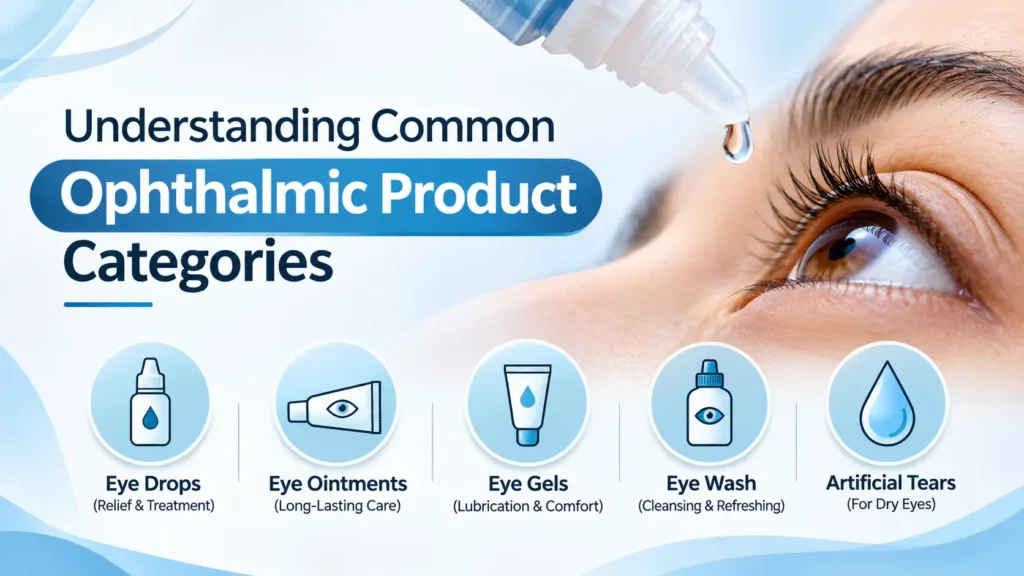
The eye-care shelf in a pharmacy can look simple: a row of small bottles and tubes. In reality, the common ophthalmic product categories include very different medicines, from lubricating drops to antibiotics, anti-allergic agents, corticosteroids, glaucoma medications, and dilating drops used in eye examinations. Each category has its own purpose, formulation, and precautions.
Ophthalmic products are sterile pharmaceutical preparations designed for use on or around the eye. This article explains the main types of ophthalmic medicines and ophthalmic formulations in plain but scientifically careful language, for pharmacy students, pharmacists, medical representatives, distributors, and entrepreneurs. It is educational only and does not replace an eye examination or advice from a qualified healthcare professional.
What Are Ophthalmic Products?
“Ophthalmic” means “relating to the eye.” A pharmaceutical product is an ophthalmic preparation when it is designed to be placed on the eye’s surface, inside the eye, or on the conjunctiva, most commonly as eye drops or eye ointments. The University of North Carolina’s ophthalmic compounding module states that every ophthalmic product must be sterile in its final container to prevent microbial contamination of the eye.
That requirement separates ophthalmic medicines from ordinary oral or skin formulations. Tablets and creams act through robust routes, whereas the eye is delicate and clears foreign material quickly through blinking and tear flow. Ophthalmic formulations therefore have to balance sterility, pH, tonicity, viscosity, preservation, and packaging. The same UNC resource notes that contaminated formulations can cause eye infections that may ultimately lead to blindness, which is why sterility is treated as an absolute requirement.
Requirements are not identical for every product. A preserved multi-dose bottle, a preservative-free single-dose unit, and a sterile ointment tube are formulated, packaged, and stored differently, and storage and in-use instructions depend on each product’s labelling.
Understanding the Main Types of Ophthalmic Formulations
A dosage form describes the physical form of a product, such as a solution or an ointment. A therapeutic category describes what the product is used for, such as an antibiotic or an anti-glaucoma agent. The same therapeutic category can appear in more than one dosage form, so the two should never be confused.
Ophthalmic Solutions
An ophthalmic solution is a sterile liquid in which the active ingredient is fully dissolved. Solutions are free from foreign particles and are usually supplied in dropper bottles. Lubricants, many antibiotics, mydriatics, and glaucoma medications such as dorzolamide are commonly available as solutions. Because a solution drains from the eye quickly, formulators may add viscosity-enhancing agents such as hydroxypropyl methylcellulose or polyvinyl alcohol to prolong contact time, as described in the UNC module.
Ophthalmic Suspensions
An ophthalmic suspension is an aqueous formulation containing solid drug particles that are not dissolved. The particles must be kept very small to avoid irritation; the UNC module cites a recommendation of under 10 microns. Some particles can adhere to the conjunctiva and dissolve as the drug is absorbed, creating a reservoir effect that may extend contact time compared with a solution. Because suspended particles can settle on standing, many suspension labels instruct users to shake the bottle before use, so the product’s own instructions should always be followed. Brinzolamide 1%, a glaucoma medication, is listed as a suspension in a state Medicaid class review of intraocular-pressure agents.
Ophthalmic Ointments
Ophthalmic ointments are sterile semisolid preparations. Most ophthalmic ointment bases combine mineral oil and white petrolatum, with a melting point close to body temperature. Compared with drops, they tend to stay on the eye longer, but they are applied from a small tube with a narrow tip rather than a dropper. The usual trade-off is temporary blurred vision, so ointments are often used at night or alongside drops, according to the UNC module, and patients are advised not to drive until vision clears.
Ophthalmic Gels
Gels and gel-forming solutions are thicker than conventional drops. Some are liquid in the container and thicken on contact with the eye; timolol maleate gel-forming solution, listed in the same class review, is an example. Higher viscosity can extend how long a product stays on the ocular surface, as a Review of Optometry article on artificial tears explains.
Ophthalmic Inserts and Other Specialized Preparations
Ocular inserts are sterile solid or semisolid devices placed in the space between the eyeball and the eyelid. Some dissolve in tear fluid; the UNC module cites Lacrisert, used for dry eye, as an example. Intraocular injections and implants are administered by specialists and fall outside this overview.
Common Therapeutic Categories of Ophthalmic Products
1. Lubricating Eye Drops and Artificial Tears
Lubricating eye drops are used to relieve the discomfort associated with dry eyes. Their typical ingredients are viscosity-enhancing polymers, most commonly carboxymethylcellulose (CMC) and hydroxypropyl methylcellulose (HPMC), which extend how long the drop stays on the eye. For example, Rosette Pharma’s Yeux Care range lists Roxy MC, a 10 ml eye drop with carboxymethylcellulose sodium 0.5%, as a CMC-based product.
A key formulation difference is preservation. Benzalkonium chloride (BAK) is the most widely used preservative in eye drops, but a peer-reviewed review in Clinical Ophthalmology summarizes evidence that it can irritate the ocular surface and describes alternative preservatives and preservative-free options. However, a systematic review found that evidence showing preservative-free tears to be more effective than preserved ones is lacking. Product choice therefore depends on the individual and professional advice.
2. Antibiotic Ophthalmic Products
Antibiotic eye drops and ointments are used for certain bacterial eye infections. Clinical references list fluoroquinolones and macrolides such as azithromycin among the topical antibiotics used in conjunctivitis (StatPearls). Gatifloxacin is one example: its prescribing information describes the 0.5% ophthalmic solution as a quinolone antimicrobial indicated for bacterial conjunctivitis. Rosette Pharma’s Yeux Care range lists Gatiroz, a 5 ml eye drop with gatifloxacin 0.3%.
Antibiotics act only on bacteria. They do not treat viral or fungal infections, and not every red or irritated eye needs one. The CDC notes that most acute infectious conjunctivitis in adults is viral and self-limited, and that bacterial conjunctivitis can be hard to tell apart from viral or allergic forms. Gatifloxacin labelling also warns that prolonged use may allow overgrowth of non-susceptible organisms, including fungi. Diagnosis and prescribing belong with a qualified professional.
3. Anti-Allergic Ophthalmic Products
Anti-allergic eye drops help manage the itching, redness, and watering of allergic conjunctivitis. The main groups are antihistamines, which block histamine receptors, and mast-cell stabilizers, which limit the release of histamine from mast cells. Dual-action agents combine both effects; olopatadine, azelastine, ketotifen, and epinastine are discussed in a review in Current Opinion in Allergy and Clinical Immunology.
A Cochrane systematic review found these drops reduce symptoms in the short term and appear well tolerated, but noted a lack of long-term data. Because allergic, viral, and bacterial conjunctivitis can look alike, identifying the cause comes first; allergic conjunctivitis, unlike infectious forms, is not contagious.
4. Anti-Inflammatory Ophthalmic Products
Ophthalmic anti-inflammatory medicines fall into two broad groups: corticosteroids and non-steroidal anti-inflammatory drugs (NSAIDs). Corticosteroids reduce intraocular inflammation, but a review in Ophthalmology and Therapy identifies steroid-induced ocular hypertension and glaucoma as leading drawbacks. FDA-hosted prescribing information for a topical ophthalmic corticosteroid also warns of cataract formation and secondary infection, and says steroids may mask or worsen infection. Corticosteroid eye drops therefore require medical supervision and must never be used for self-treatment.
NSAID eye drops work differently. Nepafenac, for instance, is described in its US prescribing information as an NSAID prodrug indicated for pain and inflammation after cataract surgery. Rosette Pharma’s Yeux Care range lists Visnac, a 5 ml eye drop with nepafenac 0.1%; its product page does not state indications, so approved labelling should be consulted.
5. Anti-Glaucoma Ophthalmic Products
Glaucoma is a group of conditions in which optic nerve damage can lead to vision loss. Raised intraocular pressure (IOP) is its main known risk factor, so treatment often aims to lower IOP. According to The Glaucoma Foundation, eye drops either reduce aqueous humor production or improve its drainage. The main classes are:
- Prostaglandin analogues: increase fluid outflow.
- Beta-blockers: decrease fluid production.
- Alpha agonists: decrease production and increase drainage.
- Carbonic anhydrase inhibitors: decrease production, available as drops and tablets.
- Rho kinase inhibitors: improve outflow through the trabecular meshwork.
Combination drops exist for patients who need more than one medicine. Treatment is individualized; no single medication suits every patient.
6. Mydriatic and Cycloplegic Eye Drops
Mydriasis is dilation of the pupil. Cycloplegia is relaxation of the ciliary muscle, which reduces focusing ability. The two effects are related but do not always match; a study in the Delhi Journal of Ophthalmology found that the cycloplegic effect was independent of the mydriatic effect and varied between individuals.
A paper in the Journal of Clinical and Diagnostic Research explains that dilation facilitates examination of the back of the eye. It describes tropicamide as a muscarinic antagonist producing short-term mydriasis and cycloplegia, and phenylephrine as a sympathomimetic that stimulates the iris dilator muscle, and notes that most commercially available drops in India combine tropicamide 0.8% with phenylephrine 5%. Rosette Pharma’s Yeux Care range lists Tropet Plus, a 5 ml eye drop with tropicamide 0.8%, phenylephrine 5%, and chlorbutol 0.5%. Such products belong in professional examination settings.
7. Antiviral and Antifungal Ophthalmic Products
Some serious eye infections are caused by viruses or fungi. The CDC notes that antiviral medication may be used for more serious forms of conjunctivitis, including those caused by herpes simplex or varicella-zoster virus. For infectious keratitis, a published review describes topical natamycin as a first-choice antifungal for filamentous fungal infection and amphotericin B for yeast, and notes ganciclovir as an antiviral used in herpes simplex keratitis. It stresses that delayed diagnosis can worsen outcomes.
These medicines are not interchangeable with antibiotic eye drops. The organism must be identified before treatment, and such infections usually need specialist management.
8. Miotic Ophthalmic Products and Other Specialized Categories
Miotics make the pupil contract. Pilocarpine is the classic example, and miotics (parasympathomimetics) appear among the classes in the IOP class review cited earlier. Ocular anesthetics and other specialized products are used in clinical settings under supervision rather than as everyday products.
Ophthalmic Solutions vs Suspensions vs Ointments: Key Differences
The examples below show active ingredients available in each form; they are not endorsements, so check each product’s approved labelling.
| Formulation | General Characteristics | Important Considerations | Common Examples |
|---|---|---|---|
| Solution | Sterile, clear, drug fully dissolved; free from foreign particles | Drains quickly; pH, tonicity, and preservation must be controlled | Dorzolamide 2% (anti-glaucoma); gatifloxacin 0.5% (antibiotic) |
| Suspension | Fine, undissolved drug particles in an aqueous vehicle | Small particle size needed to limit irritation; may need shaking per label; not filter-sterilized | Brinzolamide 1% (anti-glaucoma) |
| Ointment | Sterile semisolid, usually mineral oil and white petrolatum base | Longer contact; temporary blurred vision; tube tip must not touch the eye | Product-specific; check labelling |
| Gel / gel-forming solution | Thicker vehicle; some thicken on contact with the eye | Higher viscosity can prolong residence; follow label instructions | Timolol maleate gel-forming solution (anti-glaucoma) |
| Insert | Sterile solid or semisolid device placed under the eyelid | Specialized; may float or move on the eye | Lacrisert (dry eye) |
Note that brinzolamide and dorzolamide belong to the same therapeutic class yet appear as a suspension and a solution. Dosage form and therapeutic category are separate questions.
What Makes Ophthalmic Products Different From Other Medicines?
Several quality attributes distinguish ophthalmic products, and requirements vary with the formulation and applicable standards:
- Sterility: Aqueous solutions can be filter-sterilized, but suspensions should not be filtered, and ointments are made by sterilizing ingredients separately and combining them aseptically (UNC module).
- pH: Tears have a pH near 7.4. Ophthalmic solutions tolerate a wide range, but the useful range to avoid corneal damage is 6.5 to 8.5, and stability sometimes forces compromises.
- Tonicity: A 0.9% sodium chloride solution is iso-osmotic with tears, and the eye tolerates roughly 0.6% to 1.8% sodium chloride equivalent.
- Preservatives: They protect multi-dose products from contamination in use, but they do not make a product sterile and can cause sensitivity in some patients.
- Container and dropper design: Self-contained dropper bottles are less likely to be contaminated, though some plastics can react with certain solutions.
- Stability and storage: Conditions are product-specific and printed on the label.
- Quality control: Batch testing, documentation, and a functioning pharmaceutical quality management system support consistency across batches.
Important Factors to Consider When Evaluating Ophthalmic Pharmaceutical Products
For distributors, pharmacists, and pharma entrepreneurs, evaluating ophthalmic pharmaceutical products means looking past marketing descriptions, because product pages often use general wording and the real answers sit in documentation. Key checks include:
- Regulatory status: The Central Drugs Standard Control Organisation (CDSCO) is India’s national regulatory authority under the Drugs and Cosmetics Act, 1940 and Rules, 1945. Ask for approval and licensing details that match the exact product.
- Composition and dosage form: Confirm the active ingredient, strength, and dosage form against the label.
- Manufacturing and quality information: Request batch documentation, testing records, and manufacturing-site details.
- Packaging integrity: Eye drops depend on sterile bottles and dropper-tip contamination control, a point covered in this guide to pharmaceutical packaging and medicine safety.
- Storage and shelf life: Check storage conditions, shelf life, and any use-after-opening statement.
- Availability and supplier reliability: Consistent supply and responsive documentation support are part of a dependable partnership.
How to Choose the Right Ophthalmic Product Category for Different Needs
Selection is a clinical decision. It depends on the diagnosed eye condition, patient-specific factors such as age and contact lens use, the active ingredient and formulation, contraindications and precautions, professional recommendations, and the product’s instructions and regulatory status. Because the causes of red, itchy, or painful eyes overlap, no medicine should be matched to a symptom without a proper diagnosis. Dosing schedules and treatment protocols are deliberately omitted here; they belong in prescribing information and professional advice.
Safety Precautions When Using Ophthalmic Products
- Wash hands before application.
- Keep the dropper or tube tip from touching the eye, eyelid, fingers, or any surface.
- Do not share eye-drop bottles or tubes.
- Follow storage instructions and any use-after-opening guidance on the label.
- Do not use expired products, or solutions that have changed colour or contain particles.
- Follow the prescriber’s instructions rather than adjusting use independently.
- Seek professional evaluation for persistent pain, vision changes, significant redness, injury, or worsening symptoms.
Sudden vision loss, severe eye pain, or a serious eye injury needs urgent medical assessment. The CDC also advises that contact lens wearers with bacterial conjunctivitis remove their lenses and be evaluated promptly.
Frequently Asked Questions
1. What are ophthalmic products?
Sterile pharmaceutical preparations designed for use on or in the eye, such as drops, ointments, gels, and inserts.
2. What are the main categories of ophthalmic medicines?
Lubricants, antibiotics, anti-allergic agents, anti-inflammatory agents, anti-glaucoma medications, mydriatics and cycloplegics, antivirals and antifungals, and miotics.
3. What is the difference between ophthalmic solutions and suspensions?
In a solution the drug is fully dissolved. In a suspension, fine solid particles are dispersed in the liquid, so particle size is controlled and the label may require shaking.
4. What are lubricating eye drops used for?
Relieving dryness-related discomfort. Many contain polymers such as carboxymethylcellulose or hydroxypropyl methylcellulose.
5. What is the difference between antibiotic and anti-allergic eye drops?
Antibiotic drops act on bacteria; anti-allergic drops act on the allergic response through antihistamine or mast-cell stabilizing effects. They are not interchangeable, and identifying the cause comes first.
6. What are anti-glaucoma eye drops?
Medicines that lower intraocular pressure by reducing fluid production, improving drainage, or both. Several classes exist, and treatment is individualized.
7. Why do some eye drops require shaking before use?
Suspensions contain undissolved particles that can settle. Whether shaking is needed is stated on the product label.
8. Why is sterility important in ophthalmic products?
Contamination can cause serious eye infections, so every ophthalmic product must be sterile in its final container.
9. Can ophthalmic ointments and eye drops be used interchangeably?
No. They differ in consistency, contact time, and effect on vision, and each should be used only as directed by a healthcare professional.
10. What should pharmaceutical professionals check before selecting ophthalmic products?
Regulatory status, composition and strength, dosage form, manufacturing and quality documentation, packaging integrity, storage and shelf-life information, and supplier reliability.
Conclusion
The common ophthalmic product categories differ in composition, purpose, formulation, and precautions. Solutions, suspensions, ointments, gels, and inserts describe how a product is made; lubricants, antibiotics, anti-allergic and anti-inflammatory agents, glaucoma medications, mydriatics, antivirals, antifungals, and miotics describe what it is for. Sterility, quality, and professional guidance underpin all of them.
Pharmaceutical professionals who want to see how these categories appear in a real portfolio can explore the eye-drop range listed in Rosette Pharma’s Yeux Care division, and request product documentation directly from the company before making decisions.
This article is for educational purposes and is not medical advice. Diagnosis and treatment decisions should be made by a qualified healthcare professional.