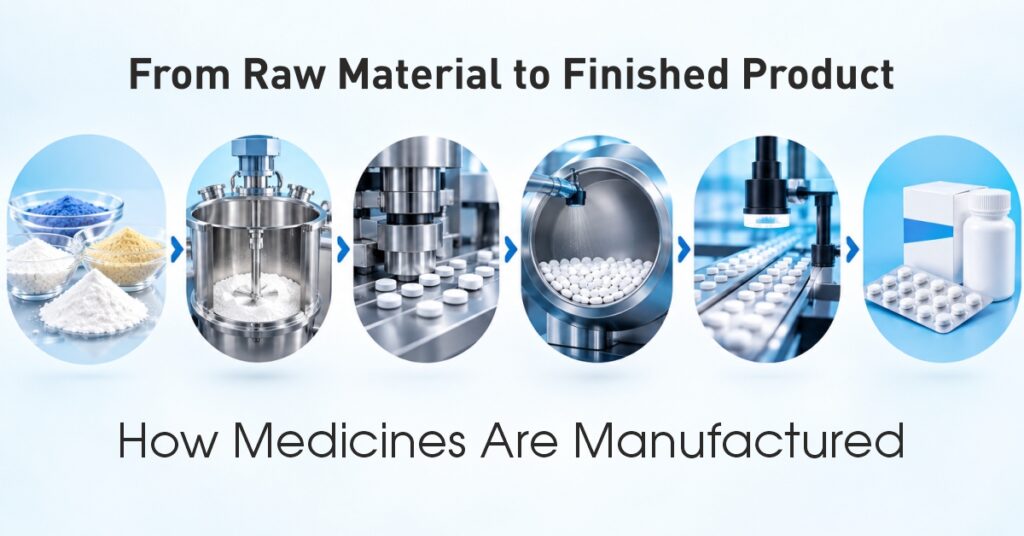
How medicines are manufactured: a medicine passes through a controlled sequence of stages. Raw materials are sourced and tested, weighed and dispensed against an authorized formula, processed into a dosage form, checked during production, tested as a finished product, packaged and labeled, and finally reviewed before a batch is released. The precise sequence varies with the medicine, the dosage form, the manufacturing process and the applicable regulatory requirements.
The journey can be summarized as: raw material sourcing → material quality testing → dispensing → formulation and processing → in-process checks → finished-product testing → packaging and labeling → batch review and release.
Pharmaceutical manufacturing is not simply mixing ingredients and putting them into a pack. It depends on controlled processes, trained personnel, written procedures and a quality system that documents what was done, by whom, with which materials and with what result. This guide walks through the pharmaceutical manufacturing process in plain language for students, professionals, distributors and anyone curious about what happens behind a tablet strip or syrup bottle.
What Is Pharmaceutical Manufacturing?
Pharmaceutical manufacturing is the set of activities that turns approved materials into finished medicines that meet defined quality requirements. The drug manufacturing process is designed so that every unit in a batch has the intended identity, strength, quality and purity, and so that every step can be traced.
API versus finished dosage form
The active pharmaceutical ingredient (API) is the component that produces the intended therapeutic effect. Patients rarely receive an API on its own. It is formulated into a finished dosage form such as a tablet, capsule, syrup, cream or injection, together with other ingredients called excipients.
Excipients are the non-active components. Depending on the product, they help with manufacturing, dose uniformity, stability, taste, appearance or the way the medicine is delivered.
API manufacturing versus finished product manufacturing
These are different activities, and they are often carried out by different companies at different sites.
- API manufacturing produces the active substance, typically through chemical synthesis, fermentation or extraction.
- Finished pharmaceutical product manufacturing takes purchased APIs and excipients and converts them into dosage forms and packaged products.
Some companies do both, many do only one, and some outsource parts of the chain. This article focuses mainly on finished pharmaceutical products.
Step 1 — Sourcing Pharmaceutical Raw Materials
Pharmaceutical raw materials include everything that goes into or around the product. Sourcing them properly is the foundation of quality.
Active Pharmaceutical Ingredients (APIs)
The API delivers the therapeutic action. Because the strength of the finished medicine depends on it, manufacturers purchase APIs against defined specifications and review supporting documentation before use.
Excipients
Common examples include diluents, binders, disintegrants, lubricants, sweeteners, preservatives, colorants, suspending agents and solvents. Each has a purpose linked to the formulation, and each must meet specifications suited to pharmaceutical use.
Packaging Materials
Packaging components are also materials that must be sourced and controlled. Examples include:
- Blister packaging materials
- Bottles
- Caps and closures
- Labels
- Cartons
- Foils
- Leaflets
These must be suitable for their intended purpose, such as protecting the product and identifying it correctly. For a deeper look at how packaging supports quality, see this guide to how medicine packaging protects product quality.
Supplier Qualification and Material Traceability
Manufacturers generally assess suppliers, set written specifications, review documentation and maintain records that link each material to the batches in which it was used. Approaches differ between companies and depend on risk and regulatory expectations, but the aim is constant: know what a material is, where it came from and where it went.
Step 2 — Raw Material Inspection and Quality Testing
When materials arrive, they are not simply sent to the production floor. Raw material testing in pharma typically follows a controlled sequence:
- Receipt and identification: checking that what arrived matches the order and documents.
- Quarantine or controlled status: holding materials until they are approved.
- Sampling: taking samples under written procedures.
- Testing: the quality control laboratory verifies the material against its specification.
- Documentation review: supplier documents, including the Certificate of Analysis, are reviewed.
- Approval or rejection: according to established procedures.
Depending on the material, testing can include identity, purity, assay, physical properties, moisture content and microbiological quality. Requirements vary by material, risk, specification and regulation, so not every material undergoes identical tests. Reputable references such as the Indian Pharmacopoeia and other pharmacopoeias provide standards used for many materials.
Step 3 — Weighing and Dispensing of Materials
Approved materials are measured and dispensed according to the authorized batch formula and manufacturing instructions. Good practice includes:
- Confirming the correct material and its approved status
- Recording batch and material traceability details
- Accurate weighing on suitable, calibrated equipment
- Clear labeling and status identification
- Preventing mix-ups between materials
- Documentation and independent checks where required
Errors at this stage can affect dosage consistency and product quality, which is why dispensing is closely controlled.
Step 4 — Formulation and Manufacturing
The pharmaceutical production process depends on the dosage form and the properties of the ingredients. The examples below describe general principles only and are not operating instructions; real processes are product-specific and validated.
How Are Tablets Manufactured?
The tablet manufacturing process generally includes some or all of the following:
- Dispensing and preparation of ingredients
- Blending
- Granulation, when required
- Drying and sizing, where applicable
- Final blending and lubrication
- Tablet compression
- Coating, if required
- In-process quality checks
Some tablets are made by direct compression, which skips granulation. Others need granulation to improve flow or compressibility, and only some are coated. There is no single process for all tablets.
How Are Capsules Manufactured?
The capsule manufacturing process involves filling a capsule shell with a suitable powder, granules, pellets or another formulation. Hard-shell capsules are typically filled with dry or semi-solid material, while soft capsules usually contain a liquid or semi-solid fill within a flexible shell. Key concerns include material preparation, consistent fill, capsule integrity and appropriate quality checks.
How Are Syrups and Oral Solutions Manufactured?
Not every liquid medicine is a syrup. A syrup is a specific type of oral liquid containing a sugar-based vehicle, and other oral solutions use different vehicles. The syrup manufacturing process and related solution processes usually involve:
- Pharmaceutical-grade ingredients and a suitable vehicle or solvent
- Dissolution and mixing
- pH adjustment where appropriate
- Filtration where appropriate
- Volume control
- Filling and closure
The exact method depends on the formulation and its quality requirements.
How Are Suspensions Manufactured?
In a solution, the drug is dissolved in the liquid. In a suspension, fine solid particles are dispersed but not dissolved, so they can settle and must be redispersed by shaking. Manufacturers therefore pay attention to particle properties, dispersion, suspending agents and mixing so that each dose is consistent. Processes differ between products. For classification and examples, see this explainer on the types of suspension in pharmaceutics.
How Are Creams, Ointments, and Gels Manufactured?
Topical products are prepared by combining components into a stable base. Typical considerations include:
- Preparing the appropriate phases or base
- Mixing and homogenization where applicable
- Adding and dispersing ingredients
- Controlling viscosity and consistency
- Filling and packaging, often into tubes or jars
The method depends on whether the product is an emulsion (cream), an ointment, a gel or another formulation.
What About Injections and Other Sterile Medicines?
Sterile products need specialized controls to prevent microbial contamination. At a high level, these include appropriate sterile manufacturing environments, suitable sterilization or aseptic processing strategies, environmental monitoring, sterility-related controls and careful container-closure considerations. The approach depends on the product and its validated process, so injectables are not all made the same way.
Step 5 — In-Process Quality Control
Quality checks happen during manufacturing, not only afterward. The tests chosen depend on the dosage form and process.
| Check | Purpose |
|---|---|
| Blend uniformity, where applicable | Helps assess distribution of ingredients |
| Tablet weight | Helps monitor dosage-unit consistency |
| Tablet hardness | Evaluates a relevant physical property |
| Friability | Assesses resistance to abrasion under specified test conditions |
| pH | Helps monitor acidity or alkalinity where relevant |
| Viscosity | Evaluates flow or consistency in suitable formulations |
| Fill volume | Helps verify filling consistency |
| Appearance | Identifies relevant visible defects |
For liquids, pH matters because it can influence stability and performance; this article on pH testing in pharmaceutical products explains why. In-process monitoring also covers equipment, environmental and process controls.
Step 6 — Finished Product Quality Testing
Pharmaceutical quality testing of the completed batch assesses it against established specifications before release. Depending on the product, tests may include:
- Identity
- Assay or strength
- Impurities
- Dissolution
- Disintegration
- Uniformity of dosage units
- Microbiological quality
- Sterility, for applicable products
- Physical characteristics
- pH or viscosity, where appropriate
- Packaging and labeling conformity
Not every medicine undergoes every test listed. Passing laboratory tests is essential, but quality also depends on compliant manufacturing, sound documentation and the wider quality management system. A broader overview is available in this guide on how pharmaceutical companies test medicine quality.
Step 7 — Pharmaceutical Packaging and Labeling
The pharmaceutical packaging process is part of manufacturing, not an afterthought. Packaging protects the product, identifies it and supports safe use.
- Primary packaging contacts the product, for example a blister pack, bottle or tube.
- Secondary packaging surrounds it, for example a carton with a leaflet.
Depending on the product, packaging may protect against moisture, light, oxygen and contamination. Tablets are often supplied in blister packs, oral liquids in bottles and topical products in tubes, chosen to suit the product’s characteristics and stability requirements.
Labels and cartons carry information such as product name, strength, batch number, manufacturing and expiry dates as applicable, storage instructions and, where required, a patient information leaflet. Packaging-line checks, including line clearance, are used to prevent product and label mix-ups.
Step 8 — Batch Documentation and Quality Assurance
In pharmaceuticals, if something is not documented, it cannot be demonstrated. Key records and processes include:
- Batch manufacturing records and batch packaging records
- Laboratory results
- Equipment and process records
- Deviations and investigations
- Change control
- Corrective and preventive actions (CAPA), where applicable
- Review of batch documentation and quality unit oversight
QC versus QA
| Aspect | Quality Control (QC) | Quality Assurance (QA) |
|---|---|---|
| Focus | Testing and evaluating materials and products against defined requirements | Broader systems and activities intended to ensure consistent quality |
| Examples | Laboratory testing, sampling, specifications | Procedures, documentation review, audits, change control, batch release oversight |
A batch should be released only after the required reviews and approvals are complete under the applicable quality system. A single passing test does not automatically authorize release.
Step 9 — Storage and Distribution of Finished Medicines
Quality must be maintained after release too. Storage and distribution practices typically address:
- Appropriate storage conditions, with temperature and humidity control where necessary
- Inventory management and stock rotation
- Batch traceability
- Transportation conditions
- Protection from damage or contamination
Storage requirements are product-specific. Many medicines are stored at controlled room temperature, some need protection from light or moisture and only some require refrigeration.
What Is GMP in Pharmaceutical Manufacturing?
GMP in pharmaceutical manufacturing refers to Good Manufacturing Practices, a set of quality principles that aim to ensure medicines are consistently produced and controlled according to applicable quality requirements. The World Health Organization describes GMP as covering production from receipt of materials through processing, packaging, labeling and completion of the finished product, and the U.S. FDA similarly emphasizes raw-material quality, manufacturing controls, reliable testing and quality systems.
In practice, GMP involves:
- Trained personnel
- Suitable premises and equipment
- Written procedures
- Material and process controls
- Sanitation and hygiene
- Documentation
- Quality control
- Prevention of contamination and mix-ups
- Investigations and corrective actions
GMP reduces risk; it is not a guarantee that errors can never occur. In India, companies must also comply with requirements set by the regulator, so readers should consult CDSCO and current Indian regulations for legal specifics.
What Is the Difference Between Pharmaceutical Manufacturing and Third-Party Manufacturing?
- Own manufacturing: a company produces its own products at its own facility.
- Third-party or contract manufacturing: a company engages a manufacturer to produce specified products under agreed responsibilities and applicable regulatory requirements. This is also called pharmaceutical contract manufacturing.
- Marketing company with a manufacturing partner: a brand owner focuses on marketing and distribution while a manufacturing partner produces the goods.
- PCD pharma franchise: a distribution arrangement in which a franchise partner promotes and sells a company’s products in an agreed territory.
Responsibilities, approvals, product ownership, quality agreements and regulatory obligations depend on the arrangement and jurisdiction. Because of this, buyers commonly evaluate a manufacturer’s capabilities, product specifications, documentation, quality systems and relevant authorizations before committing.
Rosette Pharma, based in Karnal, works in the PCD pharma franchise and third-party manufacturing space. For readers exploring the distribution side, its overview of a PCD pharma franchise for tablets shows how one product category is approached. Whatever the partner, verify licenses, approvals and quality documentation directly.
How Long Does It Take to Manufacture a Medicine?
There is no universal timeline. Time depends on the dosage form, batch size, material availability, process complexity, equipment scheduling, required processing time, quality testing, documentation review, packaging and batch release. Some tests, such as microbiological or sterility testing, add time before release.
Manufacturing a batch is also very different from bringing a new medicine to market, which involves years of research, development, clinical evaluation and regulatory review.
What Happens If a Batch Fails a Quality Check?
An unexpected or out-of-specification (OOS) result triggers a structured response rather than a quick retest:
- The result is documented.
- An investigation begins, assessing possible laboratory and manufacturing causes.
- Root-cause analysis is performed where warranted.
- Corrective and preventive actions are applied where appropriate.
- The quality unit reviews the outcome.
- The batch is dispositioned according to applicable procedures.
A failed test does not automatically mean the batch is destroyed, since outcomes depend on the investigation and procedures. Equally, a failing result cannot be ignored or retested repeatedly until it passes.
Frequently Asked Questions
1. How are medicines manufactured step by step?
Typically: raw material sourcing and testing, dispensing, formulation and processing, in-process checks, finished-product testing, packaging and labeling, and batch review and release. Details vary by product.
2. What raw materials are used to manufacture medicines?
APIs, excipients and packaging materials such as bottles, foils, labels and cartons.
3. How are pharmaceutical raw materials tested?
Materials are quarantined on receipt, sampled and tested against specifications, and their supplier documents are reviewed. Tests such as identity, purity, assay or microbiological quality apply depending on the material.
4. How are tablets manufactured in pharmaceutical companies?
Ingredients are blended, may be granulated, are compressed into tablets and are sometimes coated, with in-process checks throughout. Some tablets use direct compression instead.
5. How do pharmaceutical companies maintain medicine quality?
Through GMP, qualified materials and suppliers, controlled processes, QC testing, QA oversight, documentation and proper storage and distribution.
6. What is GMP in pharmaceutical manufacturing?
Good Manufacturing Practices are quality principles covering personnel, premises, equipment, procedures, materials, documentation and controls, aimed at consistent, controlled production.
7. What happens before a medicine batch is released?
Testing results and batch records are reviewed, deviations are resolved and the quality unit gives approval under the applicable quality system.
8. What is the difference between pharmaceutical manufacturing and third-party manufacturing?
In own manufacturing, a company produces its products itself. In third-party manufacturing, another company is contracted to produce them under agreed responsibilities and regulatory requirements.
Conclusion
The journey from raw material to finished product is a chain of controlled steps. Quality starts with suitable raw materials, and manufacturing follows product-specific procedures. In-process controls help maintain consistency, finished products undergo appropriate testing, and packaging and labeling protect and identify them. Documentation, QA, QC and GMP support quality throughout.
Understanding this chain helps students, professionals and business partners ask better questions about how any medicine is made. This article is general education and not a substitute for approved manufacturing instructions or regulatory guidance.