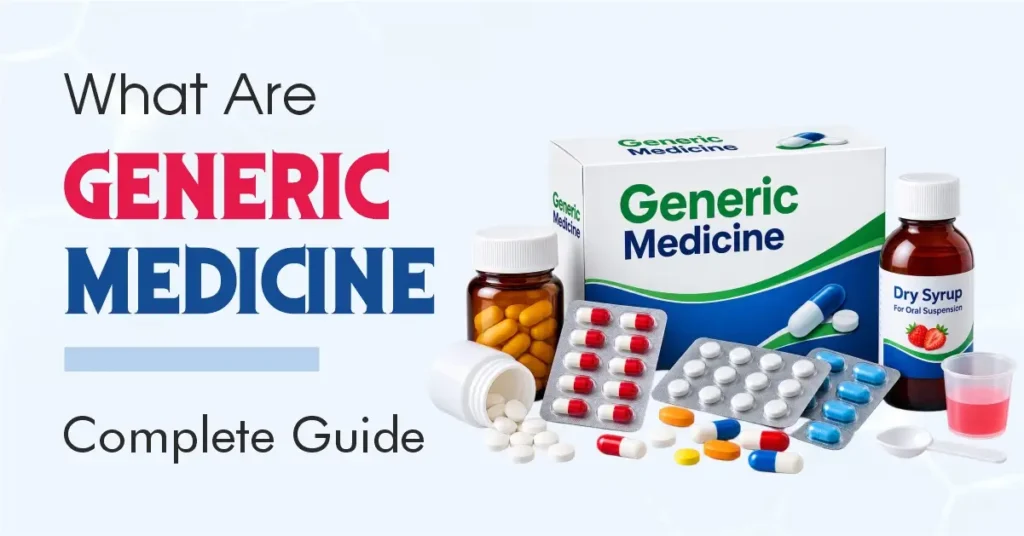
Walk into any pharmacy and you are often given a choice: a well-known branded medicine, or a lower-priced alternative described as a “generic.” Many patients — and even some newer pharma professionals — aren’t entirely sure what separates the two. Is a generic simply a cheaper copy? Is it weaker? Made in a less careful way?
In simple terms, a generic medicine is generally intended to work like an already-approved reference medicine, built around the same active ingredient, strength, dosage form, and intended use, subject to the applicable regulatory requirements of the country where it is sold. What can differ are things like inactive ingredients, colour, flavour, shape, brand name, and packaging. This guide covers what generic medicines are, how they’re developed and approved, what bioequivalence means, and what to check before buying one.
What Are Generic Medicines?
A generic medicine is generally understood as a medicine intended to be equivalent to an already approved reference (originator) medicine in relevant aspects such as active ingredient, strength, dosage form, route of administration, and intended use, subject to applicable regulatory requirements.
This is an important distinction: a generic medicine isn’t necessarily “exactly identical” to the branded version in every respect. The active ingredient and its intended therapeutic effect are the core focus, but inactive ingredients (excipients), colour, flavour, shape, tablet markings, and packaging can differ — between the generic and branded product, and even between different generic manufacturers of the same medicine.
What Is a Generic Drug?
“Generic drug” and “generic medicine” are generally used interchangeably. The term commonly describes a medicine marketed using its established, non-proprietary active-ingredient name rather than an original brand name coined by the innovator company.
How a “generic” is defined and labelled varies by country. In some markets, a generic is sold purely under its active-ingredient name (e.g., “Paracetamol 500 mg Tablets”); in others, including India, generic versions are also frequently sold under their own brand names — often called “branded generics.” Country-specific definitions are best confirmed with the relevant local regulatory authority.
How Are Generic Medicines Different From Branded Medicines?
| Feature | Generic Medicine | Branded Medicine |
|---|---|---|
| Active Ingredient | Same as the reference product, per applicable requirements | Original ingredient developed by the innovator |
| Therapeutic Purpose | Same condition(s) as the reference product | Original condition(s) it was developed for |
| Strength / Dosage Form | Generally matches the reference product | Defined by the innovator |
| Inactive Ingredients | May differ from the reference and between manufacturers | Specific to the original formulation |
| Appearance | Colour, shape, size may differ | Distinct, brand-associated appearance |
| Naming | Active-ingredient name or “branded generic,” by market | Trademarked brand name |
| Approval | Applicable pathway for equivalent products | Original new-drug pathway |
| Price | Often lower, though not guaranteed | Often reflects R&D and marketing costs; varies by market |
It’s inaccurate to claim every generic is cheaper than every branded medicine, or vice versa — pricing depends on the market, manufacturer, competition, and formulation involved.
Are Generic Medicines as Effective as Branded Medicines?
Approved generic medicines are generally expected to meet applicable quality requirements and to demonstrate relevant equivalence to the reference product, typically through bioequivalence (explained below). The purpose is to establish that the generic performs comparably to the reference product in relevant respects.
That said, no medicine — generic or branded — works identically for every person in every situation; individual response can vary with age, other conditions, and other medicines being taken. Any specific concerns about switching between a branded and generic version are best discussed with a doctor or pharmacist.
What Is Bioequivalence?
Bioequivalence is a central scientific concept behind generic medicine approval. Broadly, it means demonstrating that a generic medicine delivers its active ingredient into the bloodstream at a comparable rate and extent as the reference medicine, under similar conditions.
Regulators commonly assess two measurements: Cmax (the peak concentration of active ingredient reached in the blood) and AUC, or area under the curve (total exposure to the active ingredient over time). Bioequivalence studies compare these values between the generic and reference product.
This matters because, for many medicines, how much active ingredient reaches the bloodstream — and how quickly — affects whether the medicine works as intended. It’s one of several pieces of evidence, alongside pharmaceutical quality and manufacturing standards, that regulators weigh before approving a generic. Requirements can vary by medicine and dosage form.
How Are Generic Medicines Approved?
Specific procedures differ by country, but the general principles behind generic medicine approval tend to include:
- Pharmaceutical quality requirements — the finished product must meet defined specifications.
- Active ingredient requirements — the API used must meet applicable purity and quality standards.
- Manufacturing standards — production is expected to follow Good Manufacturing Practice (GMP) principles.
- Quality control testing — batches are tested before release.
- Stability requirements — the product must stay within specification for its shelf life.
- Bioequivalence or other applicable evidence, depending on the product.
- Regulatory review and marketing authorisation by the relevant authority.
In India, the Central Drugs Standard Control Organization (CDSCO), under the Ministry of Health and Family Welfare, along with State Licensing Authorities, forms the relevant regulatory framework for drug approval and oversight. Requirements are periodically updated, so readers wanting current procedural detail should refer directly to CDSCO rather than general summaries like this one.
Are Generic Medicines Safe?
Generic medicines with proper regulatory approval are generally expected to meet applicable quality and safety requirements, similar in principle to the reference product. This is supported by manufacturing controls, quality testing, stability testing, appropriate packaging, accurate labelling, and ongoing regulatory oversight of the manufacturing site.
That said, not every product sold anywhere as a “generic” is automatically safe — safety depends on the product genuinely being properly manufactured and obtained through a legitimate source. Buying from licensed pharmacies, checking packaging and labelling, and consulting a doctor or pharmacist when unsure all help.
Why Are Generic Medicines Often Less Expensive?
Several factors can contribute to lower pricing for many generics: competition among multiple manufacturers once a molecule is open to all; lower development costs, since generic makers generally don’t repeat the originator’s discovery research and large clinical trials; a wider base of manufacturers improving supply and pricing competition; and typically lower marketing and branding expenses.
It’s an oversimplification to say generics are cheap because they’re lower quality. A lower price doesn’t, by itself, indicate lower quality — approved generics are still expected to meet applicable quality standards. Pricing also varies considerably by product, manufacturer, and market.
Advantages of Generic Medicines
Where applicable regulatory standards are met, generic medicines can offer potential benefits: greater affordability for patients and health systems, wider access to established active ingredients, increased market competition, support for accessibility of chronic and long-term therapies, and business opportunities for manufacturers, distributors, and franchise partners. These are potential benefits, not guarantees that apply uniformly to every product.
Are There Any Differences Between Generic and Branded Medicines?
Yes. While the active ingredient and its therapeutic role are central to equivalence, other characteristics can differ — between a generic and its branded counterpart, or between different generics of the same medicine — including excipients (fillers, binders, preservatives), colour and flavour, shape and tablet markings, packaging, manufacturing site, and brand name. These differences don’t automatically make one product superior or inferior; they largely reflect formulation and branding choices within the boundaries of applicable regulatory requirements.
Generic Medicines and Different Dosage Forms
Generic medicines aren’t limited to tablets. Depending on the active ingredient, formulation, manufacturer capability, and market approval, generics may be available as tablets, capsules, syrups and suspensions, creams and ointments, injections, eye drops, and sachets. Not every active ingredient is available in every dosage form as a generic in every market — this depends on what has actually been approved and is being supplied there.
Common Myths About Generic Medicines
Myth 1: Generic medicines are low-quality. Fact: Approved generics are expected to meet applicable quality and regulatory requirements, similar in principle to the reference product.
Myth 2: Generics are copies with no testing. Fact: Generics generally undergo quality testing and, depending on the product, bioequivalence or other applicable evidence as part of approval.
Myth 3: All generics are exactly identical to branded medicines. Fact: The active ingredient and relevant equivalence requirements are central, but inactive ingredients and appearance may differ.
Myth 4: Every generic is cheaper than the branded version. Fact: Pricing varies by product, manufacturer, and market — this isn’t true in every case.
Myth 5: Generics are automatically unsafe. Fact: Safety depends on the specific product, manufacturing quality, regulatory status, and whether it’s obtained from a legitimate source.
What Should You Check Before Buying a Generic Medicine?
Whether buying an over-the-counter product or one that needs a prescription (see our guide on OTC vs prescription medicines for that distinction), it helps to check: medicine name and active ingredient, strength and dosage form, manufacturer name, batch number, manufacturing and expiry dates, storage instructions, packaging integrity, regulatory and labelling information, and that you’re buying from a licensed, legitimate pharmacy.
This checklist supports informed purchasing, not self-medication. If you’re unsure whether a generic medicine suits your condition, or whether it’s safe to switch from a branded product, speak with a doctor or pharmacist first.
Role of Pharmaceutical Manufacturers in Generic Medicine Quality
A generic medicine’s quality depends heavily on the manufacturer behind it — raw material and API quality, formulation development, in-process manufacturing controls, quality control and assurance testing, stability testing, appropriate packaging, accurate labelling, and thorough documentation all play a part. Manufacturing under recognised Good Manufacturing Practice (GMP) frameworks is generally considered an important link in the overall quality chain, alongside the regulatory approval process itself.
Generic Medicines and Third-Party Pharmaceutical Manufacturing
Third-party (contract) manufacturing is common in the pharmaceutical industry — one company manufactures a product on behalf of another, which then markets it under its own brand. This matters for generic and branded-generic products because it lets companies bring formulations to market without owning every stage of production themselves.
In a well-run arrangement, quality requirements, documentation, packaging specifications, batch consistency, and supply-chain reliability all need to be clearly defined and maintained. Manufacturing capabilities and quality systems vary between third-party manufacturers, so this is generally an important factor for businesses to evaluate beforehand.
Generic Medicines in India
Generic and branded-generic medicines play a significant role in India’s pharmaceutical ecosystem, supported by a large domestic manufacturing base and multiple distribution channels — retail pharmacies, hospitals, and government-backed initiatives.
One notable initiative is the Pradhan Mantri Bhartiya Janaushadhi Pariyojana (PMBJP), which runs dedicated Jan Aushadhi Kendra outlets selling generic medicines at lower prices than many branded equivalents. According to government data reported in mid-2026, over 20,000 Jan Aushadhi Kendras were operational across India, offering a basket of more than 2,000 medicines, with plans to expand the network further.
Beyond government schemes, generics also reach patients through commercial distribution models. One common structure in India is the PCD Pharma Franchise model, where a pharmaceutical company supplies approved products to franchise partners who handle local promotion and distribution within a defined area, supporting availability across urban and semi-urban markets.
How Rosette Pharma Fits Into the Pharmaceutical Industry
Rosette Pharma has operated in the Indian pharmaceutical sector since 2006, offering formulations including tablets, capsules, syrups, and ointments. The company supplies DCGI-approved products sourced from WHO-GMP-compliant manufacturing facilities and works with partners through PCD Pharma Franchise and third-party manufacturing arrangements spanning allopathic, dermatology, and herbal formulations.
As with any pharmaceutical supplier, patients and healthcare professionals should review a specific product’s information and regulatory status before use, and consult a qualified healthcare professional where needed.
Frequently Asked Questions About Generic Medicines
1. What are generic medicines? Medicines generally intended to be equivalent to an already approved reference medicine in active ingredient, strength, dosage form, and intended use, subject to applicable regulatory requirements.
2. Are generic medicines as effective as branded medicines? Approved generics are expected to meet applicable equivalence requirements, but individual response can vary, so specific concerns are best discussed with a doctor or pharmacist.
3. Are generic medicines safe? Generics that are properly approved, manufactured, and purchased from legitimate sources are generally expected to meet applicable safety and quality standards.
4. Why are generic medicines often cheaper? Lower development costs, competition among manufacturers, and reduced marketing expenses all contribute, though pricing still varies by product and market.
5. What’s the difference between a generic and branded medicine? Both are generally built around the same active ingredient and use, but can differ in inactive ingredients, appearance, brand name, and price.
6. What is bioequivalence? Demonstrating that a generic medicine delivers its active ingredient into the body at a comparable rate and extent as the reference medicine.
7. Can generic medicines have different inactive ingredients? Yes — fillers, binders, colours, and flavours can differ between a generic and its branded counterpart.
8. How can I identify a medicine’s active ingredient? It’s usually listed on the packaging and package insert; a pharmacist can also confirm it.
9. Are all generic medicines cheaper than branded ones? Not always — pricing depends on the specific product, manufacturer, competition, and market.
10. Can I switch between branded and generic medicines? This should be discussed with a doctor or pharmacist, especially where your physician has specific concerns for your condition.
Conclusion
Generic medicines are, broadly, medicines built around the same active ingredient, strength, dosage form, and intended use as an already approved reference medicine, developed and approved under applicable regulatory requirements. They aren’t necessarily identical to branded medicines in every respect — differences in inactive ingredients, appearance, and packaging are normal and expected.
What matters most is that a medicine, generic or branded, is manufactured to applicable quality standards, properly approved, and purchased through a legitimate source. A lower price doesn’t automatically mean lower quality, just as a familiar brand name doesn’t automatically guarantee superiority. Reading labels, checking expiry dates, and consulting a doctor or pharmacist when in doubt remain essential regardless of which type of medicine you choose. Quality-focused pharmaceutical manufacturing and sound regulatory oversight, together with informed purchasing decisions, support the goal generic medicines were designed for: helping more patients access the medicines they need.
Sources
- U.S. Food and Drug Administration (FDA) — Generic Drugs: Questions & Answers
- World Health Organization (WHO) — guidance on multisource (generic) pharmaceutical products and bioequivalence
- Central Drugs Standard Control Organization (CDSCO), Government of India
- Press Information Bureau / DD News, Government of India — PMBJP updates, 2026