Introduction
A medicine is any substance used to prevent, treat, or manage a health condition. Medicines can save lives, ease pain, and help the body heal. But not all medicines are treated the same way by health authorities.
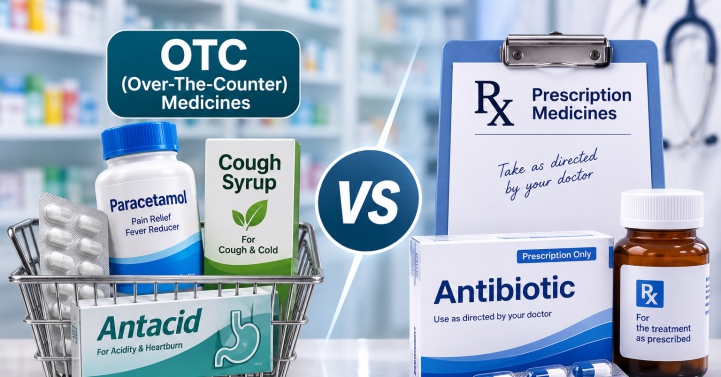
Some medicines are sold without a prescription. You can pick them up directly from a pharmacy shelf. Others require a doctor’s prescription before a pharmacist can give them to you.
Why the difference? It comes down to one thing: safety.
Medicines that are generally safe for short-term use, at fixed doses, for common and easily recognizable problems, are usually allowed to be sold over-the-counter (OTC). Medicines that are more powerful, carry a higher risk of side effects, need a proper diagnosis, or require monitoring are kept as prescription-only.
Understanding this difference helps you:
- Use medicines more safely
- Know when it’s okay to treat a minor symptom yourself
- Recognize when you truly need to see a doctor
- Avoid the dangers of incorrect self-medication
This guide explains OTC and prescription medicines in simple language, with comparison tables, safety checklists, myths vs facts, and answers to common questions. It also looks at some prescription medicine examples manufactured by Rosette Pharma, purely to illustrate what prescription medicines look like in practice.
Important: Medicine classification (OTC or prescription) varies from country to country and is decided by local drug regulatory authorities. A medicine that is OTC in one country may require a prescription in another. Always follow the rules and guidance applicable in your region.
How Medicines Work in the Body
Before comparing OTC and prescription medicines, it helps to understand, in simple terms, how any medicine actually works.
Once you take a medicine — whether swallowed, applied, or injected — it travels through the bloodstream to reach specific targets in the body, such as receptors, enzymes, or bacteria. This is often described in four simple steps:
- Absorption: The medicine enters the bloodstream, usually through the stomach and intestines after swallowing a tablet.
- Distribution: The bloodstream carries the medicine to the tissues or organs where it needs to act.
- Action: The medicine interacts with a specific target — for example, blocking a pain signal, reducing acid production, or stopping bacteria from multiplying.
- Elimination: The body breaks down and removes the medicine, mainly through the liver and kidneys.
This process explains why dose, timing, and individual health factors (like liver or kidney function, age, and other medicines being taken) matter so much. A dose that works well for one person may be too much — or too little — for another, depending on how their body absorbs, processes, and eliminates the medicine.
It also explains why some medicines need blood tests or monitoring: doctors are checking whether the medicine is being processed correctly and whether it’s reaching a safe, effective level in the body. This is one of the core reasons certain medicines are prescription-only rather than freely available.
Quick Facts Box
- No two people process medicines in exactly the same way.
- Factors like age, weight, kidney/liver health, and other medicines all affect how a medicine works in your body.
- This is why “it worked for someone else” is not a reliable reason to take a medicine yourself.
What Are OTC Medicines?
OTC stands for “Over-the-Counter.” These are medicines you can buy directly from a pharmacy or, in some countries, even from a general store, without needing a doctor’s prescription.
Why are they called “over-the-counter”?
The name comes from the way these medicines are sold — literally handed over the pharmacy counter to the customer, with no prescription paperwork needed.
Common categories of OTC medicines
Depending on local regulations, OTC medicines generally include general categories such as:
- Mild pain and fever relievers
- Antacids for occasional mild acidity
- Cough and cold symptom relief
- Basic allergy relief for mild symptoms
- Topical antiseptics and minor wound care products
- Basic vitamins and supplements
(Specific brand availability and OTC status vary by country.)
Benefits of OTC medicines
- Convenient — available without an appointment
- Fast access — useful for minor, self-limiting symptoms
- Generally well-studied — tested for a wide safety margin at labeled doses
- Cost-effective for minor ailments
Limitations of OTC medicines
- Meant only for mild, short-term, easily recognizable problems
- Not designed to treat underlying or serious conditions
- Can still cause side effects or interact with other medicines
- Not a substitute for diagnosis when symptoms are severe, unusual, or persistent
Quick Facts Box
- OTC does not mean “risk-free.”
- OTC medicines are studied for safety at specific doses for specific short-term uses.
- Overuse or misuse of OTC medicines can still cause harm.
What Are Prescription Medicines?
Prescription medicines are medicines that can only be legally dispensed by a pharmacist when a qualified healthcare professional (usually a licensed doctor) has written a prescription for a specific patient.
Why do doctors prescribe certain medicines only after examination?
Prescription-only status usually applies when a medicine:
- Is more potent or has a narrower safety margin
- Needs a confirmed diagnosis before starting (for example, confirming a bacterial infection before an antibiotic is given)
- Requires monitoring — blood tests, blood pressure checks, or follow-up visits
- Could cause serious side effects if used incorrectly
- Has a higher risk of interacting with other medicines or health conditions
- Needs dose adjustment based on age, weight, kidney or liver function, or other factors
Why monitoring matters
Some prescription medicines need periodic check-ups while you’re using them. This helps the doctor confirm that the medicine is working, adjust the dose if needed, and catch any side effects early — before they become serious.
Why diagnosis comes first
A doctor’s examination, combined with your medical history and sometimes lab tests, helps identify the actual cause of a symptom. Treating a symptom without knowing its cause can delay proper treatment or even hide a more serious underlying illness.
Doctor’s Advice Box “A prescription is not just a formality — it reflects a decision made after understanding your specific health condition, medical history, and current medicines. Never use someone else’s prescription, even if your symptoms seem similar.”
OTC vs Prescription Medicines: Comparison Table
| Feature | OTC Medicines | Prescription Medicines |
|---|---|---|
| Definition | Medicines sold without a doctor’s prescription | Medicines that legally require a doctor’s prescription |
| Doctor’s Prescription | Not required | Mandatory |
| Medical Supervision | Generally self-directed, per label instructions | Required, often with follow-up visits |
| Strength | Formulated for a wide safety margin at standard doses | Often stronger or requires precise, individualized dosing |
| Common Uses | Mild headache, mild fever, minor cold symptoms, mild acidity | Infections, chronic diseases, severe or complex conditions |
| Safety Monitoring | Minimal; based on following label instructions | Often needs lab tests, check-ups, or dose adjustments |
| Risk of Side Effects | Lower at recommended doses, but not zero | Can be higher; requires professional oversight |
| Risk of Drug Interactions | Present, especially with other medicines | Higher; needs careful review of all medicines being taken |
| Examples | General pain relievers, mild antacids, basic allergy relief | Antibiotics, strong pain-relief combinations, chronic disease medicines |
Key Takeaway: The core difference isn’t simply “strong vs weak.” It’s about how much medical judgment, diagnosis, and monitoring a medicine needs to be used safely.
Why Some Medicines Require a Prescription
Several factors decide whether a medicine needs a prescription:
1. Stronger formulations. Some medicines act more powerfully on the body and need precise dosing based on the individual patient.
2. Risk of side effects. Medicines with a higher chance of causing significant side effects need professional guidance to weigh benefits against risks.
3. Antibiotic resistance. Antibiotics are almost always prescription-only. Using them without proper diagnosis contributes to antibiotic resistance — a serious global health problem where bacteria evolve to survive medicines that once worked against them.
4. Drug interactions. Certain medicines interact with other drugs, foods, or existing health conditions in ways that aren’t always obvious to a non-medical person.
5. Monitoring during treatment. Some conditions need regular monitoring — such as blood sugar in diabetes or blood pressure in hypertension — to ensure the medicine is working safely.
6. Special populations. Children, pregnant or breastfeeding women, elderly patients, and people with kidney or liver conditions often need different doses or medicine choices, which only a qualified professional can assess properly.
Benefits of OTC Medicines
- Convenience: Available quickly, without waiting for a doctor’s appointment.
- Quick relief for minor conditions: Useful for short-term, mild symptoms like an occasional headache or mild seasonal sniffles.
- Cost-effectiveness: Generally more affordable for minor, self-limiting issues.
- Easy accessibility: Available at most pharmacies, making them practical for everyday minor complaints.
These benefits make OTC medicines a useful first-line option for mild symptoms — but they are not designed to replace medical care when something more serious is going on.
Risks of Self-Medication
Self-medication means treating yourself without professional medical advice. While it may seem harmless for small issues, it carries real risks:
| Risk | What It Means |
|---|---|
| Wrong diagnosis | Treating the wrong problem because the real cause was never identified |
| Delayed treatment | Losing valuable time before a serious condition is properly treated |
| Incorrect dosage | Taking too much or too little, reducing effectiveness or increasing danger |
| Drug interactions | Mixing medicines that shouldn’t be combined |
| Antibiotic misuse | Taking antibiotics unnecessarily, contributing to resistance |
| Masking serious illness | Temporarily hiding symptoms of a more serious underlying disease |
Key Takeaway: Never use self-medication as a substitute for professional diagnosis, especially for symptoms that are severe, unusual, or ongoing.
Common Conditions Where OTC Medicines May Be Used
For mild, short-lived symptoms, OTC options are sometimes appropriate as an initial step, such as:
- Mild, occasional headache
- Mild fever for a short duration
- Minor body aches from everyday activity
- Common seasonal cold symptoms (mild congestion, sneezing)
- Occasional mild acidity or indigestion
- Minor, seasonal allergy symptoms
However: if any symptom is severe, persistent, worsening, or recurring, it needs proper medical evaluation. OTC medicines are not designed for ongoing or complex health problems.
Conditions That Usually Require Prescription Medicines
Several conditions almost always need a doctor’s diagnosis and a prescribed treatment plan:
- Bacterial infections — need targeted antibiotics chosen based on the specific bacteria and patient factors
- Severe acid reflux (GERD) — may need stronger acid-suppressing medicines with monitoring
- Chronic allergies — long-term allergy management often needs a tailored treatment plan
- Hypertension (high blood pressure) — requires regular monitoring and often long-term medicine
- Diabetes — needs blood sugar monitoring and individualized dosing
- Asthma — requires proper diagnosis and often a combination of controller and reliever medicines
- Pneumonia — a serious lung infection needing prescribed antibiotics and medical supervision
- Severe pain — may need stronger, closely monitored pain-management medicines
Rosette Pharma Prescription Medicine Examples
To illustrate what prescription medicines look like in practice, here are examples from Rosette Pharma’s product range. These are prescription medicines in many regulatory settings and should only be used under the advice of a qualified healthcare professional, subject to local regulations. Their inclusion here is for educational reference only.
1. Sintop-40 (Pantoprazole 40 mg)
Pantoprazole belongs to a class of medicines called Proton Pump Inhibitors (PPIs), which reduce the amount of acid the stomach produces. It is generally a prescription medicine used for conditions like GERD (acid reflux), stomach ulcers, and related acid-related disorders, when prescribed by a doctor.
📄 Sintop-40 product page 📄 Learn more: How Pantoprazole works, uses, and side effects
2. LEZET Tablet (Levocetirizine 5 mg)
Levocetirizine is an antihistamine used to relieve allergy symptoms such as sneezing, itching, and hives. In many jurisdictions it is classified as a prescription antihistamine, used for conditions like allergic rhinitis (nasal allergies) and urticaria (hives) when advised by a doctor.
📄 LEZET product page 📄 Comprehensive guide to Levocetirizine
3. LEZET-MT (Levocetirizine + Montelukast)
This is a combination medicine pairing an antihistamine (Levocetirizine) with Montelukast, which helps manage allergic inflammation pathways. It is used for selected allergy conditions under medical supervision, as combination therapy needs a doctor’s assessment of suitability.
4. REFPO-CV (Cefpodoxime Proxetil + Potassium Clavulanate)
This is a prescription antibiotic combination, used only for bacterial infections that are confirmed or strongly suspected to be susceptible to it. Antibiotics like this should never be purchased or taken without proper medical advice — using antibiotics without a confirmed bacterial infection contributes to antibiotic resistance and does not help with viral illnesses like the common cold or flu.
5. ROZET-500 (Azithromycin 500 mg)
Azithromycin is a prescription macrolide antibiotic used for specific bacterial infections as determined by a doctor. It’s important to complete the full prescribed course, even if symptoms improve early, to reduce the risk of the infection returning or bacteria becoming resistant.
6. ACEDOL PLUS (Aceclofenac + Paracetamol)
This combination medicine is used for pain management and is generally a prescription medicine in many settings. Because it combines two active ingredients, it should be taken strictly according to medical advice, due to possible side effects and the risk of interaction with other medicines.
Doctor’s Advice Box: None of the medicines above should be started, stopped, or adjusted without consulting a qualified healthcare professional. Prescription status and availability depend on your country’s drug regulations.
How Doctors Decide Whether You Need a Prescription Medicine
Doctors typically follow a structured process before deciding on treatment:
- Symptoms: Understanding what you’re experiencing, how long it has lasted, and how severe it is.
- Physical examination: Checking relevant signs — such as throat, chest, or abdomen — depending on the complaint.
- Medical history: Reviewing past illnesses, allergies, current medicines, and any chronic conditions.
- Laboratory tests: Blood tests, urine tests, or cultures to confirm a diagnosis when needed.
- Imaging (when required): X-rays, ultrasounds, or scans for a clearer picture of what’s happening inside the body.
Only after this assessment does a doctor decide whether an OTC option is enough, or whether a prescription medicine — and possibly follow-up monitoring — is needed.
Can You Switch Between OTC and Prescription Medicines?
Switching between an OTC medicine and a prescription medicine (or vice versa) should only happen after consulting a healthcare professional. Even medicines that seem similar may differ in strength, formulation, or intended use.
Always read medicine labels carefully — including active ingredients, dosage instructions, and warnings — even when switching between products that appear similar, since combining medicines with the same active ingredient (from an OTC and a prescription product) can accidentally lead to an overdose.
Medicine Safety Tips (Checklist)
✔ Read labels carefully before taking any medicine ✔ Follow dosage instructions exactly as directed ✔ Never exceed the recommended dose ✔ Store medicines properly (cool, dry place, away from direct sunlight) ✔ Keep all medicines out of reach of children ✔ Do not share your medicines with others ✔ Complete the full antibiotic course when prescribed ✔ Check expiry dates before use, and discard expired medicines safely
Common Medicine Mistakes
- Taking antibiotics for viral infections — antibiotics don’t work against viruses like the common cold or flu
- Combining medicines without advice — increases the risk of unexpected interactions
- Skipping doses — can reduce effectiveness, especially with antibiotics or chronic disease medicines
- Double dosing — taking an extra dose “to catch up” can be dangerous
- Using expired medicines — reduced effectiveness or potential harm
- Using someone else’s prescription — doses and diagnoses are individual; what works for one person may not be safe for another
Myths vs Facts
Myth: OTC medicines are always completely safe. Fact: Even OTC medicines can cause side effects and interactions if used incorrectly or in excess.
Myth: Prescription medicines are stronger than OTC medicines in every case. Fact: Prescription status depends on several factors, including safety margin, monitoring needs, and local regulations — not strength alone.
Myth: Antibiotics should be kept at home “just in case.” Fact: Antibiotics should only be used when prescribed for a confirmed or suspected bacterial infection.
Myth: If a medicine worked for a friend with similar symptoms, it will work for me too. Fact: Similar symptoms can have different causes; only a doctor can confirm what’s appropriate for you.
Myth: Natural or herbal products are always safe to combine with medicines. Fact: Herbal products can interact with medicines and should be discussed with a healthcare professional.
Myth: Stopping a prescription medicine once you feel better is fine. Fact: Stopping early, especially with antibiotics, can lead to incomplete treatment or resistance.
Myth: Doubling the dose gives faster relief. Fact: Taking more than the recommended dose increases the risk of side effects without extra benefit.
Myth: Children can be given adult medicines in smaller amounts. Fact: Children often need specifically formulated medicines and doses; consult a doctor or pediatrician.
Myth: OTC pain relievers are safe to use daily long-term without medical advice. Fact: Regular long-term use of any medicine should be discussed with a healthcare professional.
Myth: Prescription-only status is the same in every country. Fact: Prescription requirements vary by country and are set by local drug regulatory authorities.
Myth: If symptoms go away, the underlying problem is definitely resolved. Fact: Symptom relief doesn’t always mean the underlying cause has been treated.
Myth: Expired medicines are fine to use if they “look normal.” Fact: Expired medicines can lose effectiveness or become unsafe and should be discarded properly.
Myth: More medicines mean faster recovery. Fact: Unnecessary combinations can increase the risk of side effects and interactions without improving recovery.
Myth: Prescription medicines from a previous illness can be reused for similar new symptoms. Fact: Each illness should be properly assessed; reusing old prescriptions can lead to incorrect treatment.
Myth: Only “serious” illnesses need a doctor’s visit. Fact: Persistent or unusual mild symptoms can sometimes signal a more serious underlying issue and deserve evaluation.
Frequently Asked Questions
1. What are OTC medicines? Medicines that can be bought without a doctor’s prescription, generally intended for mild, short-term conditions.
2. What are prescription medicines? Medicines that legally require a doctor’s prescription due to strength, monitoring needs, or safety considerations.
3. What is the difference between OTC and prescription drugs? The main difference is whether a doctor’s prescription and medical supervision are required, based on the medicine’s strength, risk profile, and intended use.
4. Can I buy antibiotics without a prescription? In most regulated markets, antibiotics require a prescription because they need a confirmed bacterial diagnosis.
5. Can I take painkillers without consulting a doctor? Mild, occasional pain relief with basic OTC options may be acceptable per label instructions, but persistent or severe pain needs medical evaluation.
6. Are allergy medicines OTC? It depends on the specific medicine, its strength, and the country’s regulations — some allergy medicines are OTC, others are prescription-only.
7. What is Pantoprazole used for? Pantoprazole is a Proton Pump Inhibitor used for acid-related conditions like GERD and ulcers, when prescribed by a doctor.
8. Can I stop prescription medicines on my own? No. Stopping a prescription medicine should always be discussed with your doctor first.
9. Why do doctors prescribe antibiotics only for certain infections? Because antibiotics work against bacteria, not viruses, and unnecessary use contributes to antibiotic resistance.
10. Can OTC medicines interact with prescription medicines? Yes. Always inform your doctor or pharmacist about all medicines you’re taking, including OTC ones.
11. When should I consult a doctor instead of self-treating? When symptoms are severe, persistent, recurring, or don’t improve within a few days of home care.
12. Is it safe to take expired medicines? No, expired medicines should be discarded, as they may lose effectiveness or become unsafe.
13. Can children take the same OTC medicines as adults? No, children often need specifically formulated products and doses; consult a doctor or pharmacist.
14. Do prescription medicines always have more side effects than OTC ones? Not necessarily — prescription status reflects the need for monitoring and diagnosis, not simply a higher side-effect risk.
15. What should I do if I miss a dose of a prescribed medicine? Follow your doctor’s or pharmacist’s specific instructions; don’t double the next dose unless advised.
16. Can pregnant women take OTC medicines freely? No, pregnant women should consult a doctor before taking any medicine, OTC or prescription.
17. Is it okay to share prescription medicines with a family member who has similar symptoms? No, prescriptions are individualized based on diagnosis, medical history, and other factors.
18. What does “antibiotic resistance” mean? It’s when bacteria evolve to survive antibiotics that previously could kill them, often due to overuse or misuse.
19. Can I combine two OTC medicines together? Only if you’ve checked that their active ingredients don’t overlap or interact; when unsure, ask a pharmacist.
20. How do I know if a medicine needs a prescription in my country? Check with a licensed pharmacist or refer to your country’s drug regulatory authority.
21. What is a Proton Pump Inhibitor (PPI)? A class of medicines that reduce stomach acid production, often used for acid reflux and ulcers.
22. Why does completing a full antibiotic course matter? Stopping early can leave some bacteria alive, potentially leading to relapse or resistance.
23. Can OTC cold medicines cure a cold? No, they only relieve symptoms; colds are usually caused by viruses and resolve on their own over time.
24. Is self-medication ever appropriate? Only for very mild, short-term, clearly recognizable symptoms, and strictly following label instructions.
25. What should I tell my doctor before starting a new medicine? All current medicines (including OTC and supplements), allergies, and existing health conditions.
26. Can OTC medicines mask serious symptoms? Yes, symptom relief from OTC medicines can sometimes delay recognition of a more serious underlying condition.
27. Do prescription medicines require follow-up visits? Often yes, especially for chronic conditions or medicines needing monitoring.
28. Is Levocetirizine an OTC or prescription medicine? This depends on the country; in many jurisdictions it is classified as a prescription antihistamine.
29. Why do some medicines require lab tests before starting treatment? To confirm the diagnosis and ensure the chosen medicine and dose are appropriate and safe.
30. What’s the safest approach to using any medicine? Always read the label, follow instructions exactly, and consult a healthcare professional whenever in doubt.
31. Can medicine regulations differ even within the same country over time? Yes, regulatory classifications can be updated by health authorities, so it’s good to check current guidance.
32. Should I keep a list of all medicines I take? Yes, this helps doctors and pharmacists check for interactions and avoid duplicate treatments.
Conclusion
OTC and prescription medicines both play an important role in healthcare — but they serve different purposes. OTC medicines are designed for mild, short-term, easily recognizable symptoms, offering convenience and accessibility. Prescription medicines are reserved for conditions that need proper diagnosis, professional judgment, and sometimes ongoing monitoring, because of their strength, risk profile, or complexity.
The biggest risk in medicine use isn’t the medicine category itself — it’s incorrect self-medication: wrong diagnosis, wrong dosage, unnecessary antibiotic use, or ignoring symptoms that need medical attention.
Companies like Rosette Pharma manufacture pharmaceutical formulations, including several prescription medicines referenced in this article, as part of the broader healthcare ecosystem. These examples are shared here purely for educational understanding of how prescription medicines function — not as a recommendation to use any specific product without medical advice.
Whatever medicine you’re considering — OTC or prescription — the safest approach is always the same: read the label, follow instructions, and consult a qualified healthcare professional whenever you’re unsure.
Disclaimer: This article is for educational purposes only and should not be considered medical advice. The availability of OTC and prescription medicines varies by country and local regulations. Always consult a qualified healthcare professional before starting, stopping, or changing any medication.