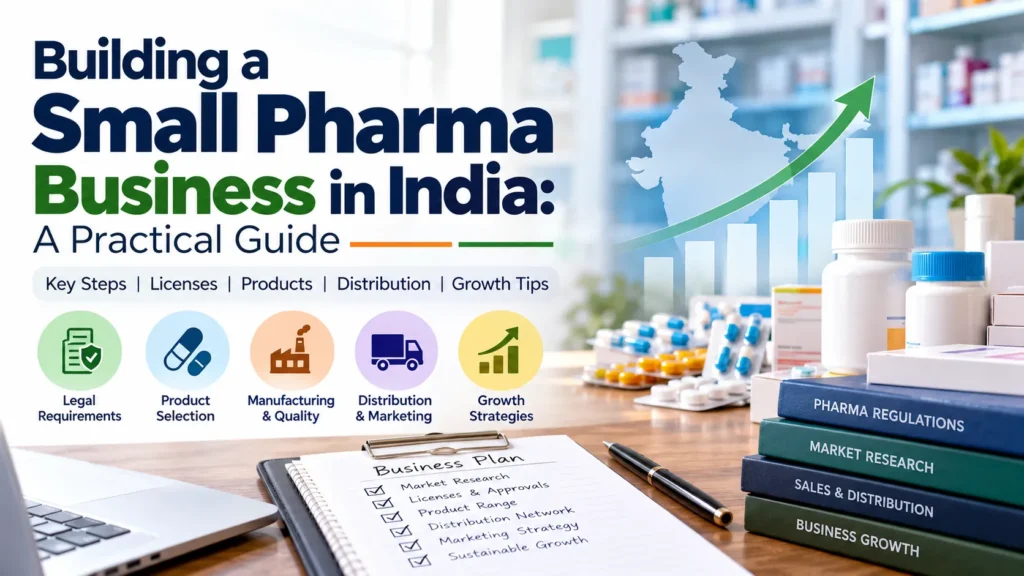
Many first-time entrepreneurs look at the pharmaceutical sector because medicines are an everyday healthcare need and the supply chain has room for smaller regional players. But entering the sector is not like opening an ordinary trading business. The model you choose decides which licences you need, how much stock you carry, and how much legal responsibility you take on.
This guide explains building a small pharma business in India without immediately setting up your own factory. It covers five decisions: which products to focus on; whether to manufacture, outsource manufacturing or distribute; which licences and registrations may apply; how to estimate working capital; and how to build a compliant distribution plan. It is general information, not legal, financial or regulatory advice, and no model here guarantees profit.
Understand the Different Pharma Business Models
Small entrants usually choose among four routes. Each splits brand ownership, manufacturing and selling differently.
PCD Pharma Franchise
In a PCD (Propaganda cum Distribution) pharma franchise, a pharmaceutical company gives a partner the right to promote and distribute its existing products in a defined area. The company supplies the products and brand, and the partner handles local promotion, customer development and order management. The partner does not manufacture.
Territory rights vary. Some companies offer district-wise exclusivity, others do not, and promotional wording is not a contract. Exclusivity usually covers only that company’s own brands, not competing medicines. If rights are offered, get them in writing, including the area, duration and conditions.
Advantages: a ready product range, no product development, and generally simpler operations. Limitations: you do not own the brand, your pricing and product choices are limited, and your income depends on the company’s supply reliability. Before joining, ask about product availability, minimum orders, payment terms, supply timelines, marketing support, renewal and termination conditions. Investment, product range and support differ widely between companies.
Third-Party Pharmaceutical Manufacturing
In third-party (contract) manufacturing, a brand owner or marketing company has its products made by an external manufacturer. The distinction matters: the brand owner markets and sells, while the manufacturing facility produces. Typical tasks include choosing products and formulations, evaluating manufacturers, agreeing quality documentation, designing labels and packaging, and planning supply.
The advantage is that you can build your own product portfolio without building a plant. The responsibilities are real, though. You face minimum order quantities, lead times, product permissions, inventory risk and quality oversight. Outsourcing production does not remove your applicable licences, permissions or legal responsibility as a marketer. For a process overview, see this guide on how third-party manufacturing works in pharma.
Pharmaceutical Distribution or Wholesale
A distributor buys from manufacturers or authorised suppliers and supplies chemists, hospitals or other customers. The business depends on customer relationships, coverage, working capital, credit cycles, storage, expiry management and supply reliability. A distributor sells other companies’ brands. Owning a pharmaceutical brand is a separate model with different obligations.
Setting Up Your Own Manufacturing Facility
Own manufacturing generally involves suitable premises, equipment, qualified technical staff, quality systems, capital expenditure and ongoing GMP compliance. Costs vary too widely by dosage form, scale and location for any universal estimate to be reliable, so this guide gives none.
Which Pharma Business Model Is Suitable for a Beginner?
No model is universally best. This table compares general characteristics; actual terms depend on the company, products and state.
| Factor | PCD Pharma Franchise | Third-Party Manufacturing | Wholesale Distribution | Own Manufacturing |
|---|---|---|---|---|
| Business activity | Promoting and distributing a company’s products in an area | Marketing products made by an external manufacturer | Buying and supplying others’ products | Making and selling medicines |
| Brand ownership | Usually the company’s | Usually yours | Manufacturers’ brands | Yours |
| Manufacturing responsibility | Company or its manufacturer | External manufacturer, with your oversight duties | None | Entirely yours |
| Regulatory considerations | Sale-licence and compliance needs depend on how you operate | Manufacturing, product, labelling and sale-licence issues; arrangement structure matters | Wholesale licence, competent person, premises | Manufacturing licence, GMP, technical staff |
| Initial cost drivers | Franchise terms, first stock, licences, promotion | Product development, batch minimums, packaging, licences | Stock, premises, licences, credit | Premises, equipment, staff, systems |
| Inventory exposure | Moderate, depends on order terms | Often high because of batch sizes | High, with expiry risk | High |
| Operational complexity | Lower to moderate | Moderate to high | Moderate | Highest |
| Main advantages | Ready range, simpler entry | Own portfolio, more control | Established products, wider customer base | Full control |
| Main risks | Supply dependence, unclear terms | Unsold batches, quality disputes | Credit losses, expiries, thin margins | Heavy capital and compliance burden |
Costs depend on scale, product range, licences, location, commercial terms and working capital. Treat any fixed investment ranking with caution.
Step 1 — Research Your Market and Choose a Business Focus
Start with a territory you understand. Then study:
- Local competition and who already supplies your target doctors and chemists.
- Which therapeutic categories local practitioners actually prescribe.
- Existing products, prices and distribution gaps.
- Likely customer credit expectations and reorder cycles.
Research lawfully and ethically: talk to chemists, visit clinics professionally, and review publicly available pricing. Do not choose products only because they are popular nationally. Also separate three ideas: disease prevalence (how common a condition is), medicine demand (how much is prescribed) and sales potential (what you can realistically sell against competition in your territory). A common condition can still be a poor opportunity in a crowded local market.
Step 2 — Select Your Products Carefully
Evaluate each product on:
- Therapeutic category and target customers.
- Quality and supporting documentation.
- Dosage form and storage conditions.
- Product permissions and regulatory classification.
- Pricing, margins, minimum order quantities and shelf life.
- Manufacturer reliability and replenishment lead times.
- Competition and differentiation.
- Labelling and permitted promotional claims.
Common categories such as antibiotics, analgesics, gastro products, dermatology or supplements are illustrations only, not a promise of profitability. Also note that allopathic medicines, Ayurvedic medicines, medical devices, cosmetics and food or nutraceutical products fall under different regulatory frameworks. Confirm which one applies before committing.
Step 3 — Understand Licences, Registrations and Compliance
There is no single licence list for every pharma startup. Requirements depend on your products, structure, activities, premises and state. In India, drugs are regulated under the Drugs and Cosmetics Act, 1940 and the Drugs Rules, 1945. CDSCO notes that responsibilities are shared between central and state regulators.
Investigate these categories according to your activities:
- Business entity and tax registrations, including GST registration where applicable.
- Sale licences. State licensing authorities issue separate retail and wholesale licences. For example, Delhi’s drugs department guidance lists distinct forms for wholesale and retail sale of allopathic drugs, requires a registered pharmacist for retail and a qualified competent person for wholesale, and sets minimum premises areas. Other states may differ.
- Manufacturing licences and product permissions. Manufacturing needs its own licence, and permitted products are listed on it.
- GMP and quality requirements. The Schedule M GMP provisions were revised in December 2023 with phased deadlines for manufacturers. Verify the current position with CDSCO and your State Licensing Authority rather than relying on older articles.
- Labelling, packaging, storage and record-keeping.
- Qualified personnel and suitable premises, where required.
- Promotion and advertising rules. The Department of Pharmaceuticals’ Uniform Code for Pharmaceutical Marketing Practices (UCPMP) 2024 requires promotion to match a drug’s marketing approval, and restricts gifts, travel, hospitality and cash benefits for healthcare professionals. It names distributors, wholesalers and retailers among a company’s agents.
Keep these distinctions clear:
- A PCD franchise agreement does not automatically give you a drug licence.
- A wholesale licence does not authorise manufacturing.
- A contract manufacturer’s licence does not automatically cover every product, brand or activity of the marketing company.
- Manufacturing permissions, product permissions, sale licences and GST registration are four different things.
Third-party arrangements are not all legally identical. One route is a loan licence. State guidance such as the Goa Drugs Authority’s manufacturing licence note describes it as manufacturing at another licensed manufacturer’s facility, and lists a wholesale licence and the facility’s consent letter among the documents. Other principal-to-principal contract models exist, and their legal treatment has been debated. Get written advice on how your chosen structure is regulated.
Because replacement legislation for the 1940 Act has been proposed, also check the current law before you begin. Always confirm requirements with your State Licensing Authority or a qualified regulatory professional before starting operations.
Step 4 — Decide Between Third-Party Manufacturing and PCD Franchise
Third-party manufacturing may be relevant when you want to develop your own brand, can evaluate manufacturers and product requirements, can plan quality oversight, inventory and distribution, and understand that outsourcing does not end your own obligations as a marketer.
A PCD franchise may be relevant when you want to work with an established company’s existing range, prefer assessing available products over building a portfolio from scratch, the company offers suitable territory terms and support, and you understand the agreement, supply terms, investment and local promotion responsibilities.
Neither is universally better. The right choice depends on capital, experience, product strategy, compliance capacity and risk tolerance. For another side-by-side view, see this comparison of PCD pharma franchise vs third-party manufacturing.
Step 5 — Estimate Investment and Working Capital
The cash that goes in goes beyond the first order. Include inventory, registrations and licences, premises and storage, transport, compliant promotion, customer credit and payment delays, staff or professional support, expired or slow-moving stock, and taxes.
| Cost Category | What to Include | How to Estimate It |
|---|---|---|
| Initial inventory | First order, minimum batch or order quantities | Quotes in writing, divided by expected monthly sales |
| Registrations and licences | Entity setup, sale or manufacturing licences, GST, professional fees | Current official fee schedules of your state and authority |
| Storage and logistics | Rent, shelving, temperature needs, courier and freight | Local quotes for your expected volume |
| Marketing and sales | Visual aids, samples where permitted, travel, digital promotion | Monthly plan per territory, compliant with UCPMP |
| Working capital | Credit given, stock held, payment delays | Monthly sales × average credit days ÷ 30, plus stock cover |
| Contingency reserve | Expiries, returns, delays, compliance surprises | Set a percentage of the total and review it quarterly |
Hypothetical example (assumptions, not a benchmark): if you expect monthly sales of ₹5 lakh and allow customers 45 days of credit, roughly ₹7.5 lakh (₹5 lakh × 45 ÷ 30) could sit in receivables at any time, before counting stock. Credit terms alone can change your cash need sharply.
To model price-to-retailer and price-to-stockist, you can use this PTS and PTR calculator. Use real product pricing and current tax rates, not the sample figures on any page.
Step 6 — Choose Reliable Manufacturers and Suppliers
Request and check:
- Manufacturing licences and product permissions relevant to your products.
- GMP and quality documentation, checked for scope, validity and relevance.
- Product specifications, batch records and, where relevant, Certificates of Analysis (CoA).
- Batch traceability and complaint-handling processes.
- Stability and storage information.
- Capacity, lead times and minimum order quantities.
- Pricing and payment conditions.
- A quality agreement that allocates responsibilities, with recall and defective-product procedures.
- Contract terms and dispute resolution.
One certificate does not prove that every product or every batch is compliant. Verify documents rather than accepting claims, and visit the facility or arrange an audit where possible.
Step 7 — Build a Practical Distribution Strategy
- Define your territory and target customers.
- Build legitimate relationships with distributors, chemists and healthcare professionals.
- Plan stock to local demand, not to supplier targets.
- Track orders, repeat purchases, expiry dates and slow movers.
- Keep pricing and payment terms transparent.
- Give accurate product information and follow medicine-promotion rules.
- Use digital marketing without misleading medical claims.
- Run a simple monthly sales and cash-flow review.
Avoid inducements to doctors, misleading claims and any promotion inconsistent with a product’s approval. These practices invite regulatory and reputational damage.
Step 8 — Manage Risks and Scale Gradually
Common mistakes include investing heavily before validating demand, choosing suppliers on price alone, ignoring documentation, accepting verbal promises, over-ordering, offering too much credit, confusing turnover with profit, missing expiry dates, depending on a single product or customer, and assuming a franchise or manufacturing arrangement guarantees success.
Pre-launch checklist:
- Confirm which licences your exact activity needs, in writing, from the authority.
- Check supplier or manufacturer licences, product permissions and documents.
- Get territory, pricing, supply and termination terms in a written agreement.
- Calculate working capital including credit and a contingency reserve.
- Start with a limited range and a first order you can sell before expiry.
- Set up record-keeping, stock and expiry tracking.
- Review the promotion rules with everyone who will represent you.
How Rosette Pharma’s PCD Franchise and Third-Party Manufacturing May Fit
Rosette Pharma, based in Karnal, Haryana, describes itself as a pharma company established in 2006. Its website lists two relevant routes. We reviewed its public pages; the points below reflect what those pages state, not an independent audit.
PCD Pharma Franchise. The website describes a district-wise model in which one partner handles one area, with marketing support and a wide product range across four divisions (Rosette Pharmaceuticals, Admetus Pharma, Yeux Care and Rosette Organics). It states that the partner does not manufacture. Territory rights and support are described on the site, but only a signed agreement fixes them. Investment figures appear differently on different pages, so confirm the package, area and terms in writing. Details are on the PCD pharma franchise page.
Third-Party Manufacturing. The homepage says Rosette offers third-party manufacturing for allopathic, derma and herbal formulations, with support from product development to packaging. It lists forms such as tablets, capsules, syrups, dry syrups, injectables, ointments, drops and sachets. We could not verify a dedicated service page, licence numbers, certificates, minimum order quantities, timelines or the identity of the manufacturing site, so ask for these directly. In particular, ask who holds the manufacturing licence and which products it covers.
The two are different routes. One generally means working with a company’s existing products under a franchise agreement. The other may mean developing or marketing products made by an external manufacturer. Actual responsibilities depend on the agreement and applicable law.
Frequently Asked Questions
1. How can I start a small pharma business in India?
Choose a model (PCD franchise, third-party manufacturing, distribution or own manufacturing), research your territory, confirm licences with your State Licensing Authority, select products and suppliers, estimate working capital, and start with a limited range.
2. Which licences may be required for a pharmaceutical business?
It depends on your activity, products and state. Sale needs retail or wholesale licences from the State Licensing Authority; manufacturing needs a manufacturing licence; GST registration may apply. There is no single list for every startup.
3. Can I start a pharma business without owning a manufacturing plant?
Yes, through franchising, distribution or third-party manufacturing. You will still have licence, quality and legal responsibilities that depend on the model. Confirm them with the licensing authority.
4. What is the difference between a PCD pharma franchise and third-party manufacturing?
A PCD franchise generally means promoting and distributing an existing company’s products in an area. Third-party manufacturing means getting products made by an external manufacturer, usually under your own brand, which brings brand, quality and inventory responsibilities.
5. Does a third-party manufacturer handle all regulatory responsibilities?
No. The manufacturer holds manufacturing-side obligations, but the marketing company has its own duties, such as sale licences, labelling, promotion compliance and complaint handling. How responsibility is split depends on the legal structure and agreement.
6. How should I estimate my initial investment and working capital?
List first inventory, licences, storage, logistics, promotion, credit given and a contingency reserve. Use written quotes and current fee schedules. Credit terms and unsold stock often matter more than set-up costs.
7. How do I choose products for a small pharma startup?
Match products to local prescribing patterns, check permissions, documentation, storage needs, shelf life, pricing and competition, and prefer a manageable range over a long catalogue.
8. What should I check before selecting a pharmaceutical manufacturer?
Check licences and product permissions, GMP documents and their scope, batch records and CoAs, capacity, lead times, minimum orders, quality and recall terms, and the contract’s dispute-resolution provisions.
9. Can a PCD franchise partner receive exclusive territory rights?
Some companies offer them, many do not, and terms vary. Exclusivity normally covers only that company’s brands. Insist on written territory, duration and conditions.
10. How can I evaluate Rosette Pharma’s franchise or manufacturing offerings?
Review the published pages, then ask the company in writing for package terms, territory, licence and certificate copies, product permissions, minimum orders and timelines, and have a qualified professional review the agreement.
Conclusion
Building a small pharma business in India comes down to a few disciplined steps: choose a model that suits your capital and experience, research local demand, verify compliance with the relevant authority, select products and suppliers on documents rather than promises, plan working capital, and distribute responsibly. A PCD pharma franchise and third-party manufacturing are two possible entry routes, and neither is risk-free or guaranteed to be profitable.
If you want to compare these routes with a specific company, review the published information and contact Rosette Pharma to confirm current terms before you commit.