
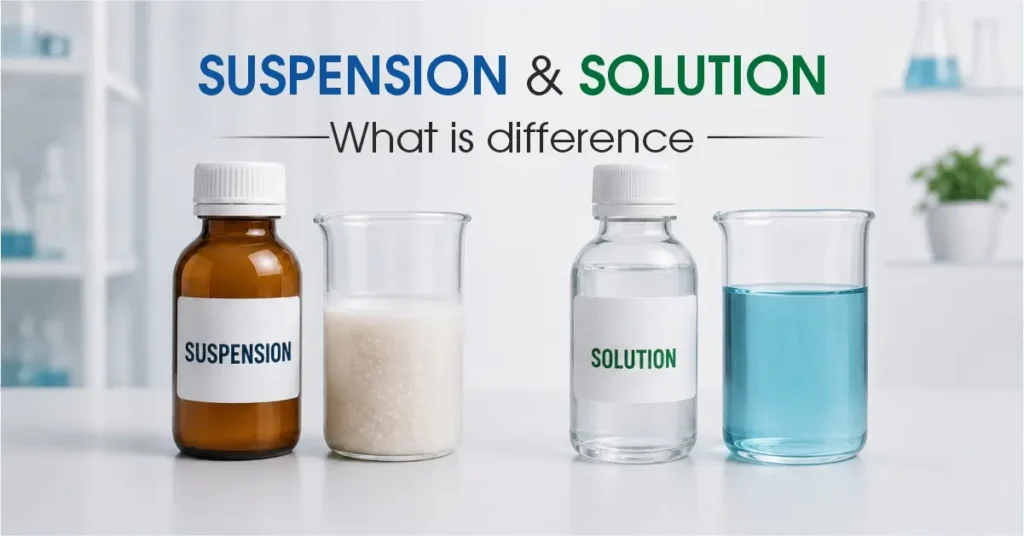
Pick up two bottles of liquid medicine at a pharmacy. One pours out perfectly clear. The other looks slightly cloudy and carries a label that says “shake well before use.” To a patient, both are simply “liquid medicine.” At the formulation level, though, they may belong to entirely different pharmaceutical dosage forms: a solution and a suspension.
The core difference comes down to what happens to the active pharmaceutical ingredient (API) once it is added to the liquid. In a solution, the drug dissolves completely and becomes molecularly dispersed. In a suspension, the drug does not dissolve — fine solid particles remain dispersed throughout the vehicle instead. This single distinction shapes appearance, physical stability, dosing accuracy, manufacturing, storage, and how a patient is expected to use the product. This article explains how pharmaceutical suspensions and solutions compare, and why formulators choose one over the other.
What Is a Pharmaceutical Solution?
A pharmaceutical solution is a homogeneous liquid dosage form in which the active ingredient is dissolved — molecularly dispersed — in a suitable solvent or vehicle. Because the drug is fully dissolved, a properly prepared solution has uniform composition throughout, with no visible undissolved particles.
If an active ingredient dissolves completely and stays dissolved under normal storage conditions, it can often be formulated as a solution. Purified water is a common vehicle for oral, topical, and parenteral solutions, but not the only one — depending on solubility and the intended route, formulators may also use co-solvents, alcohols, glycols, or oils to achieve complete, stable dissolution.
What Is a Pharmaceutical Suspension?
A pharmaceutical suspension is a heterogeneous liquid dosage form containing finely divided, insoluble or poorly soluble solid drug particles dispersed throughout a liquid vehicle. Unlike a solution, the drug does not dissolve — it remains as discrete solid particles suspended in the liquid.
Because these particles are denser than the vehicle, they can settle toward the bottom of the container over time under gravity. This is a normal physical characteristic, not necessarily a defect. Suspensions are therefore formulated with careful attention to physical stability and redispersibility — the settled particles must be capable of being evenly redistributed, typically by shaking, before the dose is measured.
Suspension vs Solution: Key Difference at a Glance
| Feature | Pharmaceutical Solution | Pharmaceutical Suspension |
|---|---|---|
| System | Homogeneous | Heterogeneous |
| Drug state | Dissolved | Undissolved solid particles dispersed in liquid |
| Particle visibility | Generally no drug particles visible | May appear cloudy or opaque |
| Sedimentation | No settling of dissolved drug | Particles may settle over time |
| Shaking | Usually not required for drug distribution | Often required before use, as stated on the label |
| Solubility | Drug is sufficiently soluble in the vehicle | Drug has limited solubility and remains dispersed |
| Physical stability focus | Depends on formulation (precipitation, degradation) | Requires control of sedimentation and redispersibility |
| Appearance | Usually clear, though not every solution is perfectly clear | Usually cloudy or opaque |
| Dosing consideration | Drug is molecularly and uniformly dissolved | Uniform redispersion before dosing is important |
| Formulation challenges | Solubility, chemical stability, precipitation | Particle size, sedimentation, caking, viscosity, redispersibility |
Why Does Drug Solubility Matter?
Solubility describes how much of a substance can dissolve in a given solvent under specific conditions. Some active ingredients are highly water-soluble and dissolve readily, making them straightforward candidates for a solution. Others have poor aqueous solubility because of their chemical structure, crystal form, or molecular weight, and dissolving them completely at the required dose may be difficult or impractical.
When a drug cannot be sufficiently dissolved, a suspension is one option, since the solid particles do not need to dissolve in the vehicle. But poor solubility does not automatically mean a suspension is the only path — formulators also weigh dose, chemical stability, route of administration, bioavailability goals, patient population, and manufacturing feasibility. Approaches such as co-solvency, pH adjustment, or solubilising excipients can sometimes still allow a solution to be developed.
Why Do Suspensions Settle?
Sedimentation is governed largely by gravity acting on particles denser than the surrounding liquid. The rate and extent of settling depend on particle size, the density difference between solid and vehicle, and vehicle viscosity — smaller particles and a more viscous vehicle generally slow settling, while larger particles and thinner vehicles allow faster sedimentation.
Formulators manage this deliberately. Suspending agents, viscosity modifiers, and controlled particle-size reduction help keep particles distributed longer and ensure any sediment can be easily redispersed. This property — redispersibility — is a key quality attribute: a well-designed suspension should return to uniformity with gentle, labelled shaking rather than forming a hard, caked layer.
Why Do Some Suspensions Need to Be Shaken Before Use?
When solid particles settle, drug concentration near the top of the liquid can become lower than near the bottom. A dose measured from an unshaken bottle could therefore contain more or less active ingredient than intended. Shaking redistributes the settled particles evenly, restoring uniform concentration before the dose is measured. Shaking does not dissolve the drug — the particles remain solid and undissolved; it simply redisperses them. Shaking technique and duration vary between products, so patients and caregivers should follow the specific instructions on the label rather than assume a universal rule.
Why Don’t Solutions Need Shaking?
Because the active ingredient in a solution is already dissolved and molecularly distributed, there are no undissolved particles that need redistributing before dosing — the core reason most solutions carry no “shake before use” instruction. Some solutions may still carry other handling instructions, such as storage temperature or protection from light. A clear appearance alone should not be used to assume a liquid is automatically a solution, since certain specially formulated products can appear clear while behaving differently at the formulation level.
How Do Solutions and Suspensions Look Different?
A pharmaceutical solution is typically clear and visually uniform, without visible undissolved particles, because the drug is dissolved at the molecular level. A pharmaceutical suspension is typically cloudy or opaque because of the dispersed solid particles, and may show visible sediment during storage.
Appearance alone, however, should not be used to judge whether a medicine is safe or fit for use. A liquid that looks different than expected — unusually discoloured, unusually thick, or showing sediment that will not redisperse — should be checked against the labelled instructions, or a pharmacist should be consulted.
How Are Solutions and Suspensions Different in Stability?
Both dosage forms face their own characteristic stability challenges, and neither can be broadly labelled “more stable” — actual shelf life depends heavily on the specific formulation, API, and packaging. Solutions can encounter precipitation if solubility conditions change, chemical degradation from pH, oxidation, or light, and drug–solvent interactions. Suspensions can encounter sedimentation, caking, particle aggregation, crystal growth of the suspended solid, and chemical degradation of the API. Learn more about how these factors are formally assessed in our guide to pharmaceutical stability testing.
Examples of Pharmaceutical Solutions
Pharmaceutical solutions are used across multiple routes of administration:
- Oral solutions — dissolved-drug liquids taken by mouth, often for flexible or precise dosing.
- Ophthalmic solutions — sterile, dissolved-drug preparations instilled into the eye.
- Nasal solutions — dissolved-drug preparations delivered to the nasal passages.
- Topical solutions — dissolved-drug liquids applied to the skin.
- Injectable solutions — sterile, dissolved-drug preparations administered parenterally.
The same active ingredient may be formulated differently across routes, so the classification of any specific branded product should be confirmed from its official product information.
Examples of Pharmaceutical Suspensions
Pharmaceutical suspensions are similarly used across several routes:
- Oral suspensions — common for pediatric and geriatric patients who have difficulty swallowing tablets.
- Topical suspensions — applied to the skin, such as certain lotions containing dispersed solids.
- Ophthalmic suspensions — sterile preparations containing dispersed, poorly soluble particles for ocular use.
- Injectable suspensions — certain long-acting parenteral formulations rely on suspended drug particles.
Not every formulation of a given drug is necessarily a suspension — the same molecule may be available as a solution, suspension, or solid dosage form depending on the brand. For a closer look at how suspensions are further categorised, see our article on the essential types of suspension in pharmaceutics.
Oral Solution vs Oral Suspension
| Feature | Oral Solution | Oral Suspension |
|---|---|---|
| Drug state | Dissolved | Undissolved particles dispersed |
| Appearance | Usually clear | Usually cloudy or opaque |
| Sedimentation | No | Possible over time |
| Shaking | Usually not needed | Often required, per label |
| Dose uniformity | Depends on formulation and accurate measurement | Depends on adequate redispersion and accurate measurement |
| Solubility | Drug dissolves in the vehicle | Drug remains dispersed, undissolved |
Both forms are frequently used for patients — particularly children and older adults — who find it difficult to swallow tablets or capsules. Neither is universally superior; the right choice depends on the drug’s solubility, required dose, taste-masking needs, and stability considerations.
Advantages of Pharmaceutical Solutions
- Uniform, dissolved distribution of the active ingredient throughout the liquid
- Generally straightforward and convenient to administer
- No sedimentation of the dissolved drug to manage
- Can suit patients who are unable to take solid oral dosage forms
Absorption should not be assumed to always be faster for solutions; it depends on the specific drug and physiological factors at the site of administration.
Advantages of Pharmaceutical Suspensions
- A practical route to formulating drugs with poor aqueous solubility as a liquid dosage form
- Can be suitable for pediatric or geriatric patients when appropriately designed
- Allows delivery of actives that are difficult to keep fully dissolved in a vehicle
- In certain cases, can be developed to support specific release characteristics
Suspensions should not be assumed to always provide slower or longer-lasting action; release and absorption depend on the specific formulation.
Limitations of Pharmaceutical Solutions
- Limited by the drug’s inherent solubility in the chosen vehicle
- Risk of precipitation if solubility conditions change during storage
- Susceptibility to chemical degradation pathways
- Palatability challenges with certain dissolved actives
- Preservation and packaging requirements, where applicable
Limitations of Pharmaceutical Suspensions
- Sedimentation and, in some cases, caking of settled particles
- Risk of poor redispersibility if not properly formulated
- Dose-uniformity concerns if the product is not adequately shaken before use
- General physical instability requiring careful formulation controls
To manage these challenges, formulation scientists carefully control particle size, vehicle viscosity, wetting, choice of suspending agents, flocculation behaviour, and the density difference between the solid and liquid phases.
How Are Pharmaceutical Suspensions and Solutions Manufactured?
At a high level, manufacturing a pharmaceutical solution typically involves selecting a suitable solvent, dissolving the active ingredient completely, mixing to achieve homogeneity, adjusting pH where relevant, filtering to remove particulates where appropriate, then filling, packaging, and quality testing.
Manufacturing a pharmaceutical suspension typically involves particle-size reduction of the API where needed, wetting the particles for even dispersion, incorporating suspending or stabilising ingredients, homogenising to achieve uniformity, and again filling, packaging, and quality testing. These are general industry concepts rather than an operational recipe — actual processes vary by product, equipment, and site.
Quality Control Tests for Solutions and Suspensions
Quality attributes for solutions can include appearance, assay (potency), pH, clarity, microbial quality where applicable, fill volume, and ongoing stability. For suspensions, attributes can additionally include particle size, sedimentation behaviour, redispersibility, and viscosity. Not every product undergoes an identical battery of tests — requirements depend on the dosage form, route, product specifications, and applicable pharmacopoeial and regulatory standards.
Which Is Better: Suspension or Solution?
Neither dosage form is universally “better.” The right choice depends on the drug’s solubility, chemical stability, required dose, route of administration, desired release characteristics, target patient population, palatability, manufacturing feasibility, and applicable regulatory requirements. Formulators select the dosage form that best matches the specific drug and its intended clinical use — not a one-size-fits-all rule.
Suspension vs Solution: Common Misconceptions
Myth: Every cloudy medicine is a suspension.
Fact: Appearance alone does not establish dosage-form classification.
Myth: Every clear liquid medicine is a solution.
Fact: A clear appearance alone is not sufficient to determine formulation type.
Myth: Suspensions are lower quality because they settle.
Fact: Sedimentation is an expected behaviour controlled through formulation design.
Myth: Solutions always work faster than suspensions.
Fact: Absorption depends on many formulation-specific and physiological factors, not the dosage form alone.
Myth: A suspension is just a solution that wasn’t mixed properly.
Fact: A suspension is intentionally formulated with undissolved particles dispersed in a liquid.
Myth: If a suspension has settled, it is spoiled.
Fact: Sedimentation can occur normally; labelled instructions determine correct handling.
How Packaging and Labelling Differ for Solutions and Suspensions
Packaging and labelling play an important role in the safe use of both dosage forms. Labels typically communicate product identification, storage instructions, shake-before-use directions where applicable, dosage and expiry information, reconstitution instructions for dry powders, and container-related guidance. Not every suspension requires refrigeration, and not every solution has identical storage requirements — these details are specific to each formulation, so patients should always follow the instructions on the individual product. For more on this, see our article on why storage conditions matter for pharmaceutical products.
Role of Pharmaceutical Manufacturers in Developing Liquid Dosage Forms
Developing a reliable liquid dosage form — solution or suspension — draws on several areas of pharmaceutical expertise: appropriate API and excipient selection, formulation development, defined process controls, quality assurance and control, stability evaluation, suitable packaging, and accurate labelling. Excipient choice plays a central role in solubility, taste, and physical stability; readers interested in this can explore our guide on active and inactive ingredients.
How Rosette Pharma Fits Into Pharmaceutical Manufacturing
Rosette Pharma offers a wide range of product forms, including tablets, capsules, syrups, dry syrups, and drops and suspensions, alongside PCD Pharma Franchise and third-party manufacturing services. As with any manufacturer working across multiple liquid dosage categories, whether a given product is developed as a solution or a suspension depends on the properties of the specific active ingredient and its intended clinical use. Understanding this difference is useful not only for patients and healthcare professionals, but also for franchise and business partners evaluating a diverse product portfolio.
Frequently Asked Questions
1. What is a pharmaceutical solution?
A homogeneous liquid dosage form in which the active ingredient is fully dissolved in a suitable solvent or vehicle.
2. What is a pharmaceutical suspension?
A heterogeneous liquid dosage form containing finely divided, insoluble drug particles dispersed throughout a liquid vehicle.
3. What is the main difference between suspension and solution?
In a solution, the drug is dissolved and molecularly dispersed. In a suspension, it remains as undissolved solid particles.
4. Why do suspensions settle?
Suspended particles are generally denser than the vehicle, so gravity causes them to settle unless the formulation is designed to slow this.
5. Why do some suspensions need to be shaken before use?
Shaking redistributes settled particles evenly so each dose delivers the intended, uniform amount of drug.
6. Are solutions always clear?
Most are, but a clear appearance alone should not be used to assume a liquid is a solution, since other formulation types can also appear clear.
7. Which is better, a suspension or a solution?
Neither is universally better. The right choice depends on solubility, stability, required dose, route, and patient needs.
8. Can a poorly soluble drug be formulated as a solution?
Sometimes, using co-solvents or solubilising excipients — but not always. A suspension or another dosage form may be more practical.
9. Are oral solutions and oral suspensions the same?
No. Both are liquid oral dosage forms, but the drug is dissolved in an oral solution and undissolved, dispersed particles in an oral suspension.
10. Why are some medicines available as suspensions instead of tablets?
Suspensions can be easier for children, older adults, or patients with swallowing difficulties, and allow certain poorly soluble drugs to be delivered as a liquid.
Conclusion
The distinction between a pharmaceutical solution and a pharmaceutical suspension comes down to drug state: dissolved versus undissolved. A solution is a homogeneous system where the active ingredient is molecularly dispersed in the vehicle; a suspension is a heterogeneous system where solid drug particles remain dispersed but undissolved, and may settle over time.
The choice between them is guided by solubility, stability, dose requirements, route of administration, patient needs, and manufacturing considerations — not by which form is inherently “better.” Understanding this difference helps patients use liquid medicines correctly, supports healthcare professionals in patient counselling, and gives pharmaceutical businesses a clearer picture of how liquid dosage forms are developed and quality-controlled.
Sources & References
- United States Pharmacopeia, General Chapter <1151> Pharmaceutical Dosage Forms
- U.S. Food and Drug Administration, Inspection Technical Guide: Oral Solutions and Suspensions
- World Health Organization, guidance on pharmaceutical quality and liquid dosage forms
- National Center for Biotechnology Information (NCBI), pharmaceutical formulation literature


