
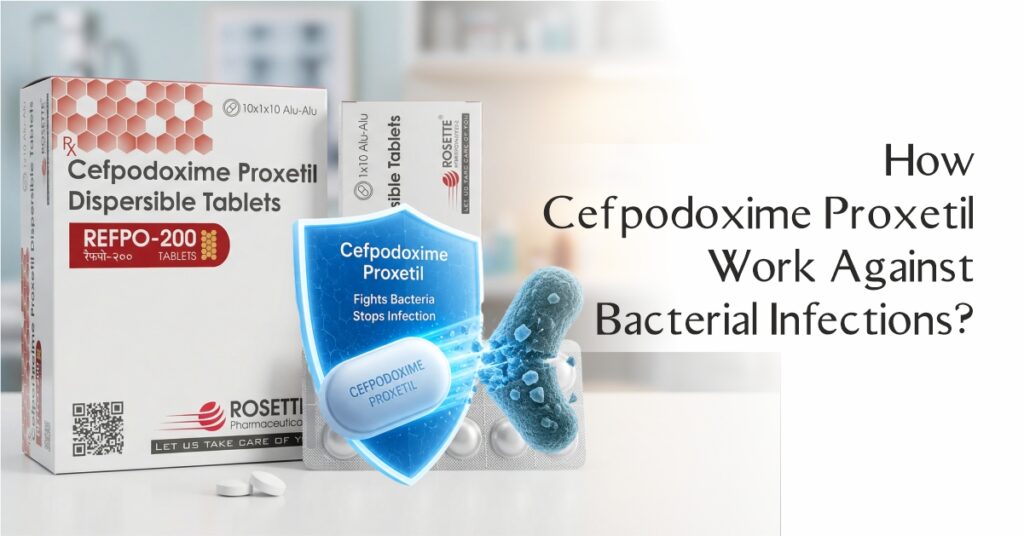
When a doctor prescribes an antibiotic, most patients want to know one thing: will it work? But the more useful question — and the one this article answers — is how does cefpodoxime proxetil work. Understanding the mechanism behind an antibiotic like Cefpodoxime Proxetil helps patients, caregivers, and healthcare professionals appreciate why antibiotics must be used correctly, why they only work against certain bacteria, and why they never work against viruses.
Cefpodoxime Proxetil is an orally administered third-generation cephalosporin, a type of beta-lactam antibiotic. Once absorbed into the body, it is converted into its active form, Cefpodoxime, which interferes with the machinery bacteria use to build their protective cell wall. This disruption weakens susceptible bacteria and can lead to their destruction — a bactericidal effect. This article explains that process step by step, in plain language, without turning into a general uses-and-dosage guide.
What Is Cefpodoxime Proxetil?
Cefpodoxime Proxetil belongs to the cephalosporin group of beta-lactam antibiotics, specifically the third generation of this class. It is formulated for oral use — as tablets, dispersible tablets, or an oral suspension — and is not itself the molecule that kills bacteria. Instead, it is an inactive precursor that the body converts into the active antibacterial compound, Cefpodoxime, after absorption from the gastrointestinal tract.
Why Is Cefpodoxime Proxetil Called a Prodrug?
A prodrug is a compound that is not biologically active in the form it is administered, but is transformed inside the body into an active drug. Cefpodoxime Proxetil is described this way in official prescribing information, which states plainly that it “is a prodrug; its active metabolite is cefpodoxime.”
Think of it like a sealed capsule of medicine that only “opens” once it reaches the right environment. The proxetil ester allows the compound to be absorbed through the gut wall in oral form; the body’s own enzymes then remove this ester group, releasing free, active Cefpodoxime into the bloodstream. Until that conversion happens, the prodrug form is not yet exerting antibacterial action.
What Happens After You Take Cefpodoxime Proxetil?
At a high level, the sequence looks like this:
- Oral administration — the tablet or suspension is swallowed.
- Absorption — Cefpodoxime Proxetil is absorbed from the gastrointestinal tract.
- Conversion (de-esterification) — intestinal enzymes convert the prodrug into active Cefpodoxime.
- Distribution — active Cefpodoxime circulates through the bloodstream to body tissues and fluids.
- Arrival at susceptible bacterial sites — the drug reaches locations where susceptible bacteria may be present.
- Interaction with penicillin-binding proteins (PBPs) — Cefpodoxime binds to specific bacterial proteins involved in cell-wall construction.
- Inhibition of cell-wall synthesis — this binding blocks a key step in building the bacterial cell wall.
- Damage to susceptible bacterial cells — the weakened wall can no longer protect the bacterium, and the cell is damaged.
This article focuses on steps 6 through 8, since that is where the actual antibacterial action takes place.
What Is the Bacterial Cell Wall?
Most bacteria are surrounded by a rigid outer layer called the cell wall, built largely from a mesh-like polymer called peptidoglycan. This structure gives the bacterium its shape and, importantly, allows it to withstand internal pressure. Bacterial cells are often under considerable internal osmotic pressure, and without an intact cell wall, they cannot hold themselves together.
Human cells do not have this kind of peptidoglycan cell wall at all — human cell membranes are built very differently. This fundamental structural difference is precisely why beta-lactam antibiotics such as Cefpodoxime can selectively target bacterial cell-wall construction. That said, this selectivity is not absolute: antibiotics can still affect the body in other ways, including disturbing the natural balance of bacteria that live in the gut (the microbiome), which is why gastrointestinal side effects are among the more commonly reported issues with this drug class.
How Does Cefpodoxime Interfere With Bacterial Cell-Wall Synthesis?
This is the core of how Cefpodoxime works. According to its official microbiology labelling, Cefpodoxime is a bactericidal agent that acts by inhibition of bacterial cell wall synthesis.
Bacteria build and continuously repair their cell walls using a family of enzymes called penicillin-binding proteins (PBPs). Despite the name, PBPs are not unique to penicillin — they are the target of the entire beta-lactam class, including cephalosporins like Cefpodoxime. PBPs carry out the final “stitching together” step of peptidoglycan construction, known as cross-linking, in which individual peptidoglycan strands are chemically bonded to one another to form a strong, continuous mesh.
Cefpodoxime’s beta-lactam ring structurally resembles the natural building block that PBPs normally act on. Because of this resemblance, Cefpodoxime can bind to susceptible PBPs and occupy the site where cross-linking would normally occur. With the PBP effectively blocked, the bacterium can no longer complete this cross-linking step in the final stages of peptidoglycan synthesis.
You can picture the cell wall as scaffolding that a construction crew is continuously repairing and reinforcing. Cefpodoxime does not tear the scaffolding down directly — it disables the tool the crew relies on to bolt new sections into place. As the bacterium continues trying to grow and divide, the wall is left with weak points that are never properly reinforced.
The result is a structurally compromised cell wall that can no longer withstand the bacterium’s own internal pressure. In susceptible bacteria, this weakening can lead to cell damage and lysis (rupture), reducing the population of viable bacteria at the site of infection.
Simplified sequence:
Cefpodoxime Proxetil (oral prodrug)
↓
Absorbed and converted to active Cefpodoxime
↓
Circulates and reaches susceptible bacteria
↓
Binds to penicillin-binding proteins (PBPs)
↓
Blocks peptidoglycan cross-linking
↓
Bacterial cell wall is weakened
↓
Susceptible bacterial cells are damaged
Why Is Cefpodoxime Considered Bactericidal?
Antibiotics are broadly grouped as bactericidal (they kill bacteria) or bacteriostatic (they stop bacteria from multiplying, relying more on the immune system to clear the remaining bacteria). Cefpodoxime’s official labelling classifies it as bactericidal because its interference with cell-wall synthesis directly damages susceptible bacterial cells rather than merely pausing their growth.
It is worth noting that bactericidal action is not automatically “superior” to bacteriostatic action — both approaches are used successfully across medicine, and the right choice of antibiotic depends on the specific infection, the bacteria involved, and the patient’s clinical situation, which is a decision made by a qualified healthcare professional.
Which Bacteria Can Cefpodoxime Act Against?
According to official prescribing information, Cefpodoxime has been shown to be active against most isolates of certain bacteria, including:
- Gram-positive bacteria: Staphylococcus aureus (methicillin-susceptible strains, including penicillinase-producing strains), Staphylococcus saprophyticus, Streptococcus pneumoniae (excluding penicillin-resistant isolates), and Streptococcus pyogenes.
- Gram-negative bacteria: Escherichia coli, Klebsiella pneumoniae, Proteus mirabilis, and Haemophilus influenzae (including beta-lactamase-producing strains).
This is not an exhaustive or universal list, and susceptibility can vary by strain, region, and individual case. Cefpodoxime does not act against every Gram-positive or Gram-negative organism, and it is not effective against methicillin-resistant Staphylococcus aureus (MRSA) or penicillin-resistant strains of Streptococcus pneumoniae. Whether a particular infection is caused by a susceptible organism is something only a healthcare professional, often supported by laboratory testing, can determine.
Why Doesn’t Cefpodoxime Work Against Viral Infections?
Cefpodoxime’s entire mechanism depends on the existence of a peptidoglycan cell wall and penicillin-binding proteins — structures that are specific to bacteria. Viruses have a completely different biology: they lack a bacterial cell wall, lack PBPs, and instead rely on hijacking a host cell’s own machinery to replicate. Because there is no peptidoglycan target for Cefpodoxime to act on, it has no mechanism by which to affect a virus.
This is why antibiotics, including Cefpodoxime Proxetil, are not effective against illnesses that are typically viral in origin, such as the common cold, influenza, or many cases of viral cough and sore throat. Official prescribing information counsels that antibacterial drugs “should only be used to treat bacterial infections” and “do not treat viral infections.” That said, some respiratory illnesses that begin as viral infections can develop secondary bacterial complications, so only a qualified healthcare professional can determine whether antibiotic treatment is appropriate in a given case.
How Does Cefpodoxime Reach the Bacteria Causing Infection?
Cefpodoxime does not travel directly to an infection site the way a targeted delivery system might. After absorption and conversion from the prodrug, active Cefpodoxime enters the bloodstream and circulates throughout the body, reaching various tissues and body fluids. Wherever susceptible bacteria happen to be present in sufficient concentration, the circulating drug can act against them — a general pharmacological distribution process, not a directed or “smart” targeting mechanism.
What Happens to the Bacteria After Cell-Wall Synthesis Is Blocked?
Once penicillin-binding proteins are occupied and cross-linking is disrupted, several things can follow in susceptible bacteria:
- The structural integrity of the cell wall is reduced.
- The bacterium becomes more vulnerable to osmotic stress it would normally withstand.
- Cell damage and lysis can occur in bacteria that are susceptible to the drug.
- The viable bacterial population at the site of infection is reduced over time.
Importantly, this does not mean every bacterium is eliminated instantly or that clinical recovery follows a fixed timeline. Actual outcomes depend on several factors working together, including the susceptibility of the specific organism, the site of infection, the level of drug exposure achieved at that site, the patient’s own immune response, and whether the treatment is taken exactly as prescribed.
Can Bacteria Become Resistant to Cefpodoxime?
Yes. Bacteria can develop or acquire resistance mechanisms that reduce or eliminate a drug’s effectiveness. According to official labelling, resistance to Cefpodoxime occurs primarily through three mechanisms:
- Beta-lactamase production: certain bacteria produce enzymes (beta-lactamases) that can break down the beta-lactam ring, inactivating the drug before it can act.
- Altered penicillin-binding proteins: some bacteria carry modified PBPs that bind the drug far less effectively, reducing its ability to block cross-linking.
- Decreased permeability: changes to the bacterial outer membrane can limit how much drug reaches its target inside the cell.
Cefpodoxime retains activity against some — but not all — beta-lactamases, including certain penicillinases and cephalosporinases. This is not universal resistance protection, and bacterial resistance patterns can change over time and by region.
Cefpodoxime Proxetil vs Cefpodoxime + Clavulanate
Rosette Pharma also offers formulations that combine Cefpodoxime Proxetil with Potassium Clavulanate, such as REFPO-CV. The distinction is straightforward:
- Cefpodoxime Proxetil alone provides the prodrug that is converted to active Cefpodoxime, which acts on bacterial cell-wall synthesis as described above.
- Cefpodoxime + Clavulanate combines this cephalosporin with Clavulanate, a beta-lactamase inhibitor. Clavulanate can inhibit certain beta-lactamase enzymes produced by some resistant bacteria, potentially helping protect the cephalosporin component from being broken down by those specific enzymes.
This does not mean the combination overcomes every resistance mechanism — Clavulanate is effective against particular classes of beta-lactamase enzymes, not all of them. Whether a plain Cefpodoxime Proxetil formulation or a Clavulanate combination is appropriate for a given infection is a clinical decision for a qualified healthcare professional, not a self-directed choice.
Factors That Influence Whether Cefpodoxime Can Work
Several variables determine whether Cefpodoxime is likely to be effective in a given case:
- Whether the causative bacteria are actually susceptible to Cefpodoxime.
- Whether resistance mechanisms are present in that particular strain.
- The site of infection and how well the drug reaches that tissue.
- The level and duration of drug exposure achieved.
- Individual patient factors, including kidney function and overall health.
- Accurate diagnosis of a bacterial (versus viral) cause.
- Correct and consistent use of the medication as prescribed.
Why Antibiotic Use Must Be Appropriate
Understanding the mechanism of Cefpodoxime also explains why antibiotic stewardship matters. Prescribing an antibiotic in the absence of a proven or strongly suspected bacterial infection offers no benefit and increases the risk that drug-resistant bacteria will develop. In practical terms, this means:
- Do not self-medicate with antibiotics.
- Do not use leftover antibiotics from a previous illness.
- Do not share prescription antibiotics with another person.
- Use antibiotics only when prescribed or recommended by a qualified healthcare professional.
- Follow the prescriber’s instructions on how the medicine should be taken, and do not independently stop or change the treatment without medical guidance.
Common Misconceptions About Cefpodoxime
| Myth | Fact |
|---|---|
| Cefpodoxime kills every type of bacteria. | It acts only against bacteria that are susceptible to it, within its verified antibacterial spectrum. |
| Cefpodoxime can treat a common cold. | Colds are generally caused by viruses, and antibiotics have no effect on viral infections. |
| A higher dose means faster recovery. | Dosing must be determined and adjusted only by a qualified healthcare professional, not by the patient. |
| Cefpodoxime destroys every bacterium immediately. | Its effect depends on bacterial susceptibility, drug exposure, infection site, and other clinical factors, and it works over the course of treatment. |
| All cephalosporins work against exactly the same bacteria. | Antibacterial spectra differ between individual cephalosporins, even within the same generation. |
| Adding Clavulanate makes Cefpodoxime effective against all resistant bacteria. | Clavulanate inhibits certain beta-lactamases, but bacterial resistance mechanisms vary and are not all addressed by Clavulanate. |
Frequently Asked Questions About Cefpodoxime Proxetil
1. How does Cefpodoxime Proxetil work against bacteria?
It is absorbed and converted to active Cefpodoxime, which binds to bacterial penicillin-binding proteins and blocks the final cross-linking step of peptidoglycan (cell wall) synthesis, damaging susceptible bacteria.
2. Is Cefpodoxime Proxetil bactericidal or bacteriostatic?
Active Cefpodoxime is classified as bactericidal, meaning it can lead to the death of susceptible bacterial cells rather than only halting their growth.
3. What does Cefpodoxime Proxetil do to the bacterial cell wall?
It interferes with the enzymes responsible for cross-linking peptidoglycan strands, leaving the cell wall structurally weak and unable to withstand internal pressure.
4. What are penicillin-binding proteins?
They are bacterial enzymes involved in constructing and maintaining the peptidoglycan cell wall. Beta-lactam antibiotics, including Cefpodoxime, bind to these proteins to block their function.
5. Why is Cefpodoxime Proxetil called a prodrug?
Because it is not active in the form it is taken. It must first be absorbed and de-esterified in the body to release active Cefpodoxime.
6. Does Cefpodoxime work against viruses?
No. Viruses do not have a peptidoglycan cell wall or penicillin-binding proteins, so Cefpodoxime has no target to act on in a viral infection.
7. What types of bacteria can Cefpodoxime affect?
Certain susceptible Gram-positive bacteria (such as some strains of Staphylococcus aureus and Streptococcus species) and Gram-negative bacteria (such as E. coli, Klebsiella pneumoniae, and Haemophilus influenzae), as documented in official prescribing information — not every bacterial species or strain.
8. Can bacteria become resistant to Cefpodoxime?
Yes, primarily through beta-lactamase production, altered penicillin-binding proteins, or reduced bacterial cell permeability.
9. What is the difference between Cefpodoxime and Cefpodoxime + Clavulanate?
Cefpodoxime alone relies solely on its own activity against susceptible bacteria. The Clavulanate combination adds a beta-lactamase inhibitor that can help protect the cephalosporin from certain resistance enzymes.
10. Should Cefpodoxime be taken without a prescription?
No. It is a prescription antibiotic and should only be used under the guidance of a qualified healthcare professional, based on a confirmed or strongly suspected bacterial infection.
Role of Pharmaceutical Manufacturers in Antibiotic Quality
The reliability of any antibiotic depends not only on its mechanism of action but also on how consistently and safely it is manufactured. Pharmaceutical manufacturers contribute to medicine quality through several interconnected processes, including sourcing and testing the active pharmaceutical ingredient (API), selecting appropriate excipients, controlling the formulation process, applying in-process quality assurance and quality control checks, conducting stability testing to confirm shelf life, and ensuring accurate packaging and labelling supported by proper documentation. These controls exist to help ensure that every dose delivers the intended amount of active medicine consistently.
Cefpodoxime Products Available from Rosette Pharma
Rosette Pharmaceuticals, a division of Rosette Pharma, currently lists the following Cefpodoxime Proxetil-based formulations:
- REFPO-CV — Cefpodoxime Proxetil 200mg + Potassium Clavulanate 125mg Tablet
- REFPO-200 DT — Cefpodoxime Proxetil 200mg Dispersible Tablet
- Refpo-CV Suspension — Cefpodoxime Proxetil 50mg + Potassium Clavulanate (Dry Syrup)
- Refpo-50 D/S — Cefpodoxime Proxetil 50mg (Dry Syrup)
- Refpo-100 D/S — Cefpodoxime Proxetil 100mg (Dry Syrup)
For full product details, composition, and availability, visit the REFPO-CV product page on Rosette Pharma’s website. As with any prescription antibiotic, product selection and use should always be guided by a qualified healthcare professional.
This article is for educational purposes only and does not replace medical advice. Cefpodoxime Proxetil should be used only under the guidance of a qualified healthcare professional.
Sources & References
- DailyMed (U.S. National Library of Medicine) — Cefpodoxime Proxetil Tablets, USP, Prescribing Information (Microbiology, Mechanism of Action, Mechanism of Resistance, Indications and Usage sections)
- DailyMed — Cefpodoxime Proxetil for Oral Suspension, USP, Prescribing Information
- Hoefler DC, et al. “Cefpodoxime proxetil: a review of its antibacterial activity, pharmacokinetic properties and therapeutic potential.” Drugs (via PubMed, National Library of Medicine)
- NCBI Bookshelf (StatPearls) — general beta-lactam / cephalosporin mechanism-of-action reference