
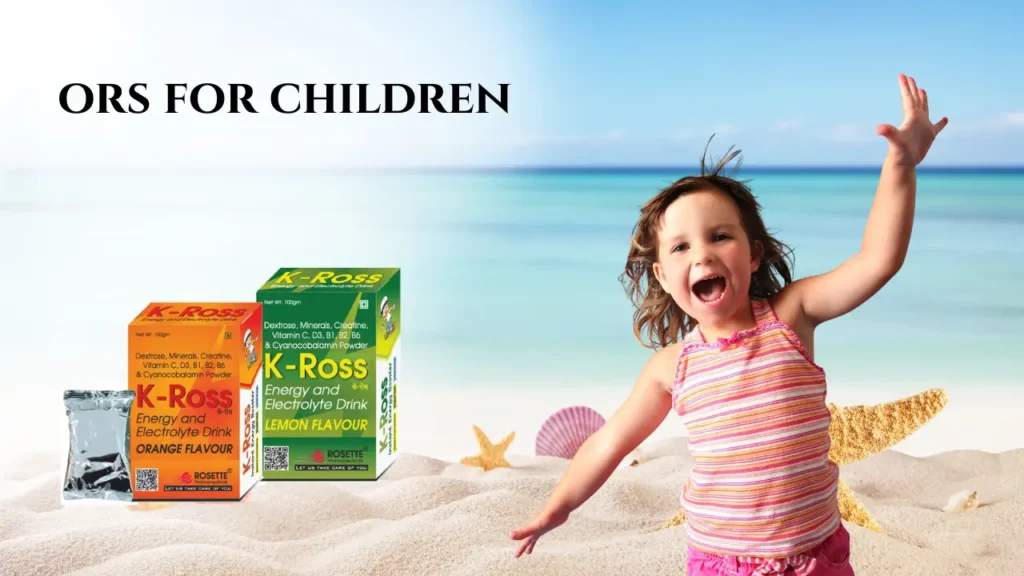
ORS for children is one of the most important things every parent should know. Diarrhea is the third leading cause of death among children under five, contributing to 13% of childhood deaths worldwide. Most of these deaths happen simply because the child lost too much fluid and did not get the right help in time.
The good news is that oral rehydration solution for kids is simple, affordable, and works quickly. According to medical research, ORS saves millions of children’s lives every year. This guide covers when to give ORS, how much to give based on your child’s age, and how to prepare and use it correctly so your child recovers fast and safely.
What Is ORS and Why Do Children Need It More Than Adults
ORS stands for Oral Rehydration Solution. It is a precise mix of glucose, sodium, potassium, and water that works together to restore fluids lost during diarrhea, vomiting, or fever. The way it works is simple: glucose helps sodium get absorbed in the intestine, and sodium then pulls water back into the body.
This process restores electrolyte balance faster than drinking plain water ever could. For more on how oral rehydration therapy works, read Oral Rehydration Benefits, Dosage, and Side Effects.
Children dehydrate far faster than adults, and here is why:
- An infant’s body is made up of up to 75% water compared to around 60% in adults, which means even a small fluid loss hits them harder. (WHO Oral Rehydration Manual)
- Children have a higher metabolic rate, so they lose fluids much faster during diarrhea and fever than adults do.
- Babies and young children cannot tell you they are thirsty, which means dehydration can become serious before anyone notices. This is why ORS for babies needs to be given at the first sign of fluid loss, without waiting.
Signs of Dehydration in Children by Age Group
Dehydration in children does not always look obvious. The signs vary depending on how old your child is, and catching them early makes a big difference. Here is what to look for at each age.
Signs in Infants (0 to 12 months)
- Sunken fontanelle, which is the soft spot on the top of the head.
- No tears when crying.
- Fewer than 6 wet diapers in 24 hours.
- Dry mouth and lips.
- Unusual drowsiness or limpness.
Signs in Toddlers (1 to 5 years)
- Dark yellow or strong-smelling urine.
- No urination for more than 8 hours.
- Dry or sticky mouth.
- Sunken eyes.
- Extreme thirst or flat out refusing to drink anything.
Signs in Older Children (5 years and above)
- Headache and dizziness.
- Decreased urine output.
- Fatigue and irritability.
- Dry skin that does not bounce back when pinched, which doctors call the skin turgor test.
When Should You Give ORS for Children
Most parents reach for ORS only when their child has diarrhea. But ORS for children is recommended for any situation where the body is losing more fluid than it is taking in. WHO and UNICEF recommend ORS as the first-line treatment for any child with mild to moderate dehydration, regardless of the cause.
If your child is losing fluids for any of the following reasons, ORS is the right first step:
- Acute watery diarrhea, which is the most common reason ORS is used.
- Vomiting, give ORS in small sips in between vomiting episodes rather than waiting for it to stop completely.
- High fever, because children lose fluids rapidly through sweating and faster breathing.
- Heat exhaustion or excessive sweating during hot weather.
- Reduced fluid intake during illness such as a sore throat or mouth ulcers, where the child simply refuses to drink enough.
ORS Dosage for Children by Age
The right amount of ORS depends on your child’s age, weight, and how severe the dehydration is. As a general rule, for mild to moderate dehydration, the WHO standard guideline recommends 50 to 100 mL per kg of body weight over 2 to 4 hours. Knowing how much ORS to give a child upfront prevents both under-hydration and overloading the stomach, which can trigger more vomiting.
| Age Group | Amount After Each Loose Stool | Amount for Rehydration (2 to 4 hours) | Source |
|---|---|---|---|
| Under 6 months (ORS for babies) | 1 to 2 teaspoons (5 to 10 mL) every 2 to 3 minutes | Consult doctor — do not self-administer | UNICEF ORS Guidelines |
| 6 months to 2 years | One-quarter to half cup (50 to 100 mL) after each stool | 200 to 400 mL over 4 hours | WHO/UNICEF 2006 |
| 2 years to 5 years | Half to one cup (100 to 200 mL) after each stool | 400 to 600 mL over 4 hours | WHO/UNICEF 2006 |
| 5 years and above | One to two cups (200 to 400 mL) after each stool | 600 mL to 1 L over 4 hours | WHO ORT Manual |
If your child refuses to drink plain ORS due to taste, a lemon-flavored option like K-Ross Lemon ORS with Zinc or orange-flavored K-Ross Orange ORS can make it easier for children to drink without compromising the formula.
Disclaimer: This is for general information purposes only. Always consult a qualified healthcare professional or pediatrician before giving ORS to your child, especially for infants under 6 months. Do not use this as a substitute for medical advice.
How to Prepare and Give ORS to a Child — Step by Step
Getting oral rehydration solution right comes down to two things — preparing it correctly and giving it the right way. Both matter equally.
How to Prepare ORS Correctly
- Wash your hands with soap and water before you start.
- Pour exactly 1 liter of clean drinking water into a clean container. Boiled and cooled water is the safest option.
- Empty the entire contents of one ORS sachet into the water. Never use half a packet. Using the wrong concentration can cause salt toxicity, also known as hypernatremia, which is dangerous for children.
To avoid this risk, use a pre-measured WHO-approved sachet like Roselyte ORS which gives the correct electrolyte balance every time.
- Stir well until the powder is completely dissolved and no grains are visible.
- Use the prepared solution within 24 hours. Discard anything left over after 24 hours and prepare a fresh batch if needed.
How to Give ORS to Your Child
- Use a spoon or a small cup to give ORS. Do not use a feeding bottle as the nipple makes it difficult to control how much the child is drinking at a time.
- Give small sips frequently rather than a large amount at once. This is easier on the stomach and reduces the chance of vomiting.
- If your child vomits after drinking ORS, wait 10 minutes and then start again slowly. Do not stop giving ORS completely just because of one vomiting episode.
- If your child is an infant, continue breastfeeding alongside ORS. Oral rehydration solution does not replace breastmilk — both should continue together.
- Never mix ORS with juice, milk, soup, or any other liquid. It must always be dissolved in plain water only.
FAQs
Q1: At what age can a child take ORS?
Ans: ORS can be given to children of all ages, including infants. However, for babies under 6 months, always consult a doctor before giving ORS as the dosage needs to be carefully calculated based on body weight.
Q2: Is ORS safe for a 2 year old?
Ans: Yes, ORS is completely safe for a 2 year old. Give half to one cup after each loose stool and continue until your child shows signs of normal hydration.
Q3: Is ORS drink good for children?
Ans: Yes, ORS is one of the safest and most effective treatments for dehydration in children. WHO and UNICEF recommend it as the first-line treatment for fluid loss caused by diarrhea, vomiting, or fever.
Q4: Who should avoid ORS?
Ans: Children with kidney disease, severe vomiting where nothing stays down, or signs of severe dehydration should not rely on ORS alone and must be taken to a doctor immediately for IV fluid treatment.
Q5: Does ORS stop loose motion?
Ans: ORS does not stop loose motion directly. It replaces the fluids and electrolytes lost during loose motion to prevent dehydration. The loose stools continue until the underlying infection resolves on its own.
Q6: How many ORS per loose stool?
Ans: Give one quarter to half a cup for children under 2 years and half to one cup for children above 2 years after each loose stool, as per WHO guidelines.
Q7: What stops diarrhea quickly in children?
Ans: ORS manages dehydration but does not stop diarrhea quickly. Most cases of acute watery diarrhea in children resolve on their own within 3 to 5 days. If diarrhea persists beyond this, consult a doctor.


