Fungal skin infections are far more common than most people realize. As of 2021, there were over 1.7 billion cases recorded globally — and that number has grown by 68% since 1990. Walk into any pharmacy today and there are two main options sitting on the shelf — an antifungal cream and an antifungal powder.
Both contain the same active ingredient in many cases. Both claim to treat the same infections. So the question is simple — which one actually works better?
The answer is not as straightforward as picking one over the other. The right choice depends on where the infection is, what the skin looks like, and how much moisture is involved. This guide breaks down both options — how they work, where each one performs better, and when using both together makes the most sense.
It Is Not Just About the Medicine, The Form Matters Too
Most people focus on the active ingredient like clotrimazole, miconazole, or terbinafine and assume the form does not matter much. But that assumption is where most treatment decisions go wrong. Research shows that the vehicle, meaning whether the medicine comes in a cream or a powder, significantly influences how the drug behaves on the skin, how deep it reaches, and how long it stays active.
Think of it this way, the same driver in two different vehicles will have a completely different experience on the same road. A cream carries the drug deep into the skin layers. A powder sits on the surface and changes the skin environment itself. Same medicine, very different journeys.
| Factor | Cream | Powder |
|---|---|---|
| Physical Form | Semisolid | Dry particulate |
| Main Action | Deep penetration into skin | Absorbs moisture from skin surface |
| Best Environment | Dry, scaly, or thick skin | Moist, sweaty, or skin fold areas |
How Antifungal Cream Works
A cream is an oil-in-water emulsion, which simply means it has a smooth, semisolid base that allows the active antifungal ingredient to be carried deep into the skin layers. When applied to the skin, the oily component of the cream helps dissolve the drug and push it through the outer skin barrier, reaching the area where the fungus is actually living and growing.
This deeper penetration is what makes creams particularly effective for infections where the skin has become thick, scaly, or visibly irritated. The American Academy of Dermatology (AAD) and the British Association of Dermatologists (BAD) both recommend antifungal cream as the first choice for treating body ringworm, with most lesions clearing within 2 to 4 weeks of consistent use.
Creams work best in these situations:
- When the infected skin is dry, flaky, or has visible scaly patches.
- When treating ringworm on the body, face, or hands where skin tends to be thicker.
- When the skin is cracked or inflamed and needs both treatment and soothing hydration.
- When the infection is in its early active stage and needs direct pharmacological action to stop fungal growth.
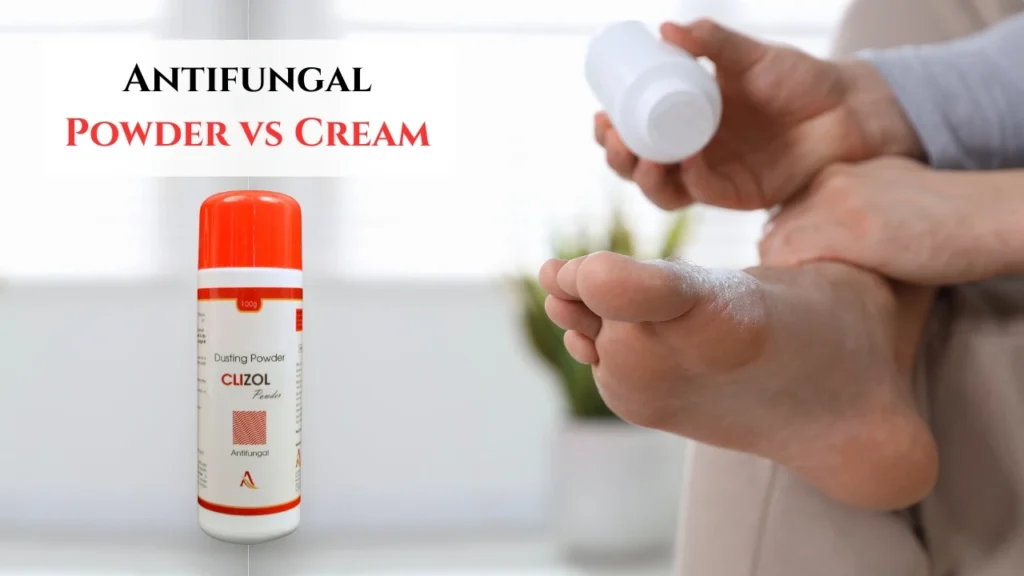
How Antifungal Powder Works
A powder works very differently from a cream. Instead of pushing the drug deeper into the skin, it works on the surface and changes the skin environment itself. Fungi, particularly dermatophytes and Candida species, need moisture and warmth to grow and spread.
A powder is hygroscopic by nature, meaning it actively absorbs excess sweat and moisture from the skin surface, making it very difficult for fungi to survive and multiply. This process of destroying the environment fungi need is called environmental modification, and research confirms it is one of the most effective ways to manage infections in moist areas of the body. For a complete breakdown of clotrimazole dusting powder uses, this guide covers everything in detail.
Powders work best in these situations:
- When the infected area is consistently sweaty or moist, such as the groin, underarms, or between the toes.
- When skin folds are involved and friction between skin surfaces is making the infection worse.
- When there is a risk of maceration, which is when skin becomes soft and breaks down from too much moisture exposure.
- When the goal is long term prevention after the active infection has cleared, particularly inside shoes or on high risk skin areas.
Antifungal Powder vs Cream — A Direct Comparison
Choosing between a cream and a powder is not a matter of one being universally better than the other. It comes down to matching the right form to the right condition. A clinical trial published on PubMed found that clotrimazole powder monotherapy achieved an 85.7% clinical cure rate in jock itch cases compared to 76.5% with cream, showing that in the right conditions, powder can actually outperform cream.
| Factor | Cream | Powder |
|---|---|---|
| Skin Penetration | Deep layers | Surface level |
| Best For | Dry, scaly, thick skin | Moist, sweaty, skin folds |
| Ringworm | First choice | Not recommended |
| Athlete’s Foot (Dry) | Effective | Limited |
| Athlete’s Foot (Moist) | Can worsen | Best choice |
| Jock Itch | Works | Works better |
| Skin Folds / Groin | Maceration risk | Ideal |
| Sweat Control | No | Yes |
| Recurrence Prevention | Limited | Strong |
| Ease of Use | High | Moderate |
Which One to Choose Based on the Infection
Ringworm (Tinea Corporis)
Ringworm on the body appears as circular, scaly, red patches on the skin. The skin in these areas tends to be dry and the infection sits in the deeper layers of the outer skin. This is exactly why cream is the recommended choice here.
The American Academy of Dermatology confirms that topical antifungal cream is the gold standard treatment for body ringworm, with consistent improvement seen within 2 to 4 weeks of use. Powder is not effective for ringworm as it cannot penetrate deep enough to reach the infection.
Athlete’s Foot (Tinea Pedis)
Athlete’s foot is one condition where both forms have a role, but at different stages. When the skin between the toes is soggy, white, and macerated, powder is the better starting point as it dries the area and stops the fungus from spreading further.
Once the skin normalises, cream can be used to clear the remaining infection. Mayo Clinic specifically recommends using antifungal powder inside shoes to prevent athlete’s foot from coming back after treatment.
Jock Itch (Tinea Cruris)
The groin is one of the warmest and sweatiest areas of the body, which makes it a breeding ground for fungal infections. In this environment, powder has a clear clinical advantage. A randomized trial found that antifungal powder was significantly more effective at reducing sweat in the groin area compared to cream, with a statistical significance of p=0.006. Cream works for jock itch, but powder addresses the root cause more effectively by keeping the area dry throughout the day.
Skin Folds (Underarms, Under Breasts)
Skin folds are areas where two skin surfaces press against each other constantly. This creates heat, friction, and trapped moisture, which are exactly the conditions fungi need to thrive. Applying cream in these areas can actually make things worse by adding more moisture to an already damp environment.
Research confirms that in intertriginous areas, powders are the preferred choice as they reduce friction, absorb moisture, and prevent maceration, which is the primary entry point for fungal pathogens in these regions.
Why Most People Do Not Get Better — And How to Fix It
The medicine is rarely the problem. The real issue is stopping too soon. Most people see the redness fade and the itching reduce after a week or two and immediately assume the infection is gone. It is not. The fungus is still present in the skin, just no longer visible.
Stopping treatment at this point is the single biggest reason fungal infections come back, often worse than before. Research confirms that only 50 to 60% of patients stay consistent with their topical antifungal treatment beyond 8 weeks, and early discontinuation is identified as the primary cause of recurrence.
FAQs
Q1: Are Antifungal Creams or Powders Better?
Ans: Neither is universally better. Cream works best for dry, scaly infections like ringworm, while powder performs better in moist, sweaty areas like the groin and skin folds. The right choice depends entirely on the type and location of the infection.
Q2: Can Antifungal Cream and Powder Be Used Together?
Ans: Yes, and using both together actually produces better results. Clinical research confirms that combining cream with powder increases the complete cure rate within the first four weeks compared to using cream alone.
Q3:Should Antifungal Cream or Powder Be Applied First?
Ans: Cream should always be applied first. Allow it to absorb into the skin fully, then dust the powder over and around the area to control moisture.
Q4: Is Clotrimazole Powder as Effective as Clotrimazole Cream?
Ans: Yes. A 2024 randomized clinical trial found that clotrimazole powder achieved an 85.7% cure rate for jock itch compared to 76.5% with cream, making powder a highly effective standalone treatment in moist conditions.
Q5:How Long Does Antifungal Treatment Take to Work?
Ans: Initial improvement is usually visible within one to two weeks, but full mycological cure takes between four to eight weeks depending on the severity of the infection.
Conclusion
Cream is the pharmacological workhorse. It penetrates deep and kills the fungus directly. Powder is the environmental manager. It absorbs moisture, reduces friction, and makes the skin an inhospitable place for fungi to survive. One treats the infection. The other makes sure it does not come back.
Used together, they cover everything. That combination is what most dermatologists consider the gold standard approach to managing fungal skin infections. The goal was never just to treat — it is to make sure the infection stays gone. Looking for a clotrimazole 1% antifungal dusting powder? Explore this formulation.