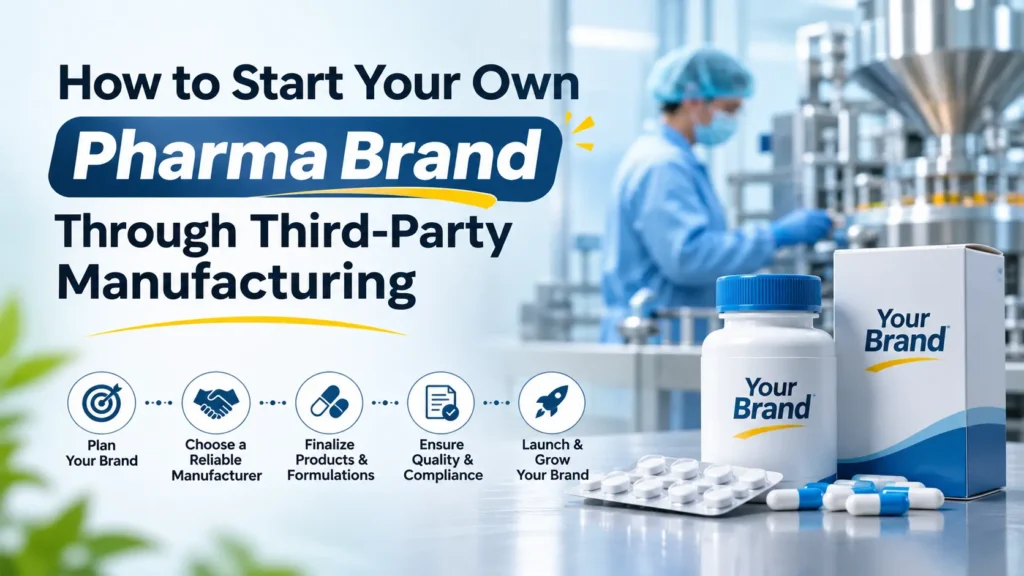
Entrepreneurs, distributors, pharmacists and medical representatives often ask the same question: can I launch my own medicine brand without building a factory? In India the answer is yes, but the route you choose decides which licences, agreements and responsibilities apply to you. This guide walks through the full process, from market research to launch, and keeps legal requirements separate from business advice.
Third-party manufacturing means a licensed manufacturer produces medicines that carry your brand. You get access to existing plant, equipment and technical staff, you avoid the capital cost of a factory, and you can concentrate on branding, distribution and sales. What you do not get is freedom from responsibility. Under the Drugs Rules, 1945, a company that puts its name on a drug made by another manufacturer is a “marketer”, and the Rules make the marketer responsible for the drug’s quality and other regulatory compliance along with the manufacturer. Requirements vary by product category and arrangement, so use this article for planning and not as legal advice.
1. What Is Third-Party Pharmaceutical Manufacturing?
In a third-party arrangement, one company owns the brand and sells the product, while another company that holds the manufacturing licence makes it. Indian drug law supports this in more than one way:
- Manufacturer’s licence, you as marketer: the factory makes the product under its own licence and your name and address appear on the label. Since 1 March 2021, a written agreement is required before a marketer adopts another manufacturer’s drug (Rule 84D).
- Loan licence: you apply for a loan licence to use a licensed unit’s facilities. Form 25A covers drugs other than those in Schedules C, C(1) and X, and Form 28A covers Schedule C and C(1) drugs other than Schedule X. State guidance, such as Goa’s, mentions a consent letter from the host manufacturer and a wholesale licence.
- Private label: you put your brand on a formulation the manufacturer already makes. This is a commercial description, not a separate licence category.
Do not confuse brand ownership with a PCD pharma franchise. In a franchise you promote another company’s brands in an assigned area. In your own brand, you own the name, the artwork and the commercial risk. Our separate explainer on how third-party manufacturing works in pharma covers the production workflow in more detail.
Who does what?
| Area | Manufacturer | Brand owner (marketer) |
|---|---|---|
| Licences | Holds the manufacturing licence and product permissions | Holds licences for its own activities, such as a sale or loan licence and GST registration |
| Quality | Production, in-process checks, finished-product testing, batch records | Oversight, complaint handling and shared legal responsibility under Rule 84E |
| Product | Manufactures to agreed specifications | Chooses products, brand name, specifications and artwork |
| Labelling | Prints labels as agreed | Marketer name and address on the label, artwork approval, correct MRP |
| Commercial | Supply and lead times | Sales, distribution, inventory, promotion and pricing |
The process at a glance
- Business planning
- Product selection
- Manufacturer selection
- Documentation and agreement
- Product development and approval
- Manufacturing
- Quality checks
- Distribution and marketing
The exact regulatory steps depend on the product category, the licence structure and current law.
2. Decide What Type of Pharma Brand You Want to Launch
Common directions include general medicine, dermatology, paediatric, orthopaedic, cardiac and diabetic ranges, Ayurvedic or herbal products, and other specialised therapeutic categories. No category is automatically profitable. Demand differs by region, prescriber habits and competition, so judge each option against these points:
- Your target customers and the prescribers or chemists you can actually reach
- Your existing distribution network
- How well you understand the products
- Competing brands and what would make yours different
- Regulatory requirements for the category
- Whether your manufacturer can make the dosage forms you need
Frameworks differ by product type. Ayurvedic, Siddha and Unani medicines fall under separate provisions of the Drugs and Cosmetics Act and Rules, including their own loan licence (Form 25E). Cosmetics are governed by the Cosmetics Rules, 2020, and health supplements and nutraceuticals typically by FSSAI under the Food Safety and Standards Act, 2006. Confirm your product’s classification before you plan anything else.
3. Conduct Market Research Before Selecting Products
Start with the customer, not the manufacturer’s catalogue. Talk to doctors, chemists and stockists in your target area, study competing brands, look for gaps, and consult qualified healthcare and pharmaceutical professionals. Learn how prescriptions and distribution actually work locally, confirm that suitable manufacturers exist, and estimate your costs and working capital. We have not quoted market-size figures here because they change quickly and vary by region. Collect local evidence instead.
Product-selection checklist
- Who will prescribe, dispense or buy this product, and why would they choose your brand?
- How many established brands offer the same composition and strength?
- Is the composition approved? Check every combination product (see section 4).
- Can your manufacturer show permission to make this exact product and dosage form?
- What are the shelf life, storage and transport needs?
- Will the MRP stay competitive after GST and distribution margins?
- Can you afford the minimum order quantity (MOQ)?
- Can you reach the doctors and chemists who matter for this product?
4. Select the Right Pharmaceutical Products
Weigh the therapeutic category, dosage form, composition, applicable approvals, the manufacturer’s capabilities, quality requirements, shelf life and stability, storage conditions and expected distribution channel. Tablets, capsules, syrups, suspensions, creams and ointments are only examples. Not every manufacturer can make every dosage form, and sterile products such as injectables and eye drops need specialised facilities and permissions. Ask for the permission that covers each specific product.
Check approval status early. Under Rule 2(1)(w) of the New Drugs and Clinical Trials Rules, 2019, a fixed-dose combination of two or more drugs approved separately, when combined for the first time, is a “new drug” that needs central approval. In 2026 the Delhi High Court upheld CDSCO’s power to review state-issued approvals for such combinations. Ask for proof of approval for every combination you shortlist.
A focused portfolio is usually easier to manage than a long list. Every extra product adds stock, expiry risk and promotional effort, so many new brands begin with a few products in one category and expand after reviewing real sales.
5. How to Find and Select a Reliable Third-Party Pharma Manufacturer
This is the most important decision in the process. Verify each point below in writing, and ask for copies instead of relying on marketing claims:
- Valid manufacturing licence, and permission covering each product you want
- Current GMP compliance status, including the scope of any certificate (site, dosage forms, validity dates)
- Manufacturing infrastructure suited to your dosage form
- Experience with that dosage form
- Quality control and quality assurance systems
- Raw material sourcing and testing
- Batch documentation you will receive
- Stability data where applicable
- Production capacity and delivery timelines
- Communication and complaint handling
- Willingness to be transparent, including facility visits or audit reports
Revised Schedule M, the GMP standard in the Drugs Rules, was notified on 28 December 2023. Smaller units received a conditional extension to 31 December 2025, and reports indicate CDSCO has since asked state drug controllers to inspect units against the revised standard. Ask every manufacturer for its current status. No single certificate guarantees the quality of every product, and the lowest quotation should never be the only deciding factor. Unusually cheap pricing can signal compromises elsewhere. Our buyer’s guide to choosing a pharma manufacturing company lists further questions and red flags.
6. Documents and Licences Required to Start Your Pharma Brand
Not every document applies to every business. What you need depends on the product classification, your role, the manufacturing arrangement, the licence structure and current law. This table separates the four kinds of document:
| Type | Examples | Notes |
|---|---|---|
| Required by law (varies by model) | Business registration and PAN; GST registration where required; licences for your own activities, such as a wholesale licence from the State Licensing Authority or a loan licence; a written marketing agreement with the manufacturer (Rule 84D); compliant labelling and MRP | Not every brand owner needs the same licence. Confirm with your State Drug Control authority. |
| Required from the manufacturer | Manufacturing licence; product-specific permission; GMP compliance status; batch manufacturing records and Certificates of Analysis for supplied batches | A licence does not make a product legally marketable unless it covers that product. |
| Commonly requested for business and quality assurance | Product specifications; stability data; sample Certificates of Analysis; facility audit report; written quotation; purchase orders and invoices | Good practice, not always a statutory requirement. |
| Recommended for brand protection | Trade mark search and application; confidentiality terms; written ownership of artwork and brand | See sections 7 and 8. |
Drugs, cosmetics, nutraceuticals and Ayurvedic products sit under different frameworks, so do not apply a drug checklist to every product type.
7. Product Development, Formulation and Brand Name Selection
Product development usually follows this order: select the composition, review the manufacturer’s product permissions, confirm the formulation suits the dosage form, agree specifications against a recognised standard or reference product, review stability and quality requirements, then develop the label and artwork.
Choose a brand name carefully before you spend on packaging. India’s Trade Marks Act, 1999 is administered through the Controller General of Patents, Designs and Trade Marks, and its public search lets you look for identical or similar marks. Pharmaceutical products are generally filed in Class 5. Generic or international non-proprietary names cannot be registered as trade marks, and sound-alike names risk confusion between medicines. A free domain name or social media handle gives you no rights in a brand name. Consider advice from an IP professional, and note that a clear search is a starting point, not a guarantee.
8. Understand the Third-Party Manufacturing Agreement
A written agreement protects both sides and, for marketers, is required by Rule 84D. Typical points to cover:
- Scope of manufacturing and product specifications
- Quality responsibilities and applicable licences and permissions
- Batch testing and release documentation
- Manufacturing timelines and minimum order quantities
- Pricing and payment terms
- Packaging and artwork responsibilities
- Confidentiality
- Ownership of the brand and artwork
- Handling of defective or rejected batches
- Product complaints and recalls
- Termination and dispute resolution
Have a qualified legal professional review the agreement before you sign. Courts and regulators have scrutinised arrangements where a company’s name is on the label without the right licence or agreement structure, which is one more reason to take advice on how your arrangement is set up.
9. Packaging, Labelling and Regulatory Compliance
Labelling rules are detailed and depend on the product category. For allopathic medicines, Rule 96 of the Drugs Rules, 1945 sets out what labels must show, and common items include:
- Product name, composition and strength
- Dosage form and pack details
- Batch number, manufacturing date and expiry date
- Manufacturer’s name, address and licence details
- Marketer’s name and address, where the drug is marketed by a marketer
- Storage conditions
- Applicable statutory warnings and schedule markings
- Maximum Retail Price (MRP)
Some products also need a bar code or QR code under Schedule H2. It first covered the top 300 brands, and a June 2026 amendment extended it to all vaccines, antimicrobials, anti-cancer drugs and narcotic and psychotropic drugs. Check the notified timelines for your products. We have deliberately not given a label template, because no single template is legally sufficient for every medicine. Ayurvedic products, cosmetics and supplements follow their own labelling rules. Ask the manufacturer’s regulatory team to review your artwork, but remember that you remain responsible as marketer.
10. Understand Manufacturing Costs and Initial Investment
We do not quote fixed investment figures, because costs depend on your products, quantities and quotations. Use this framework and replace each line with a written quotation:
| Cost component | What drives it |
|---|---|
| Product development and documentation | Ready formulation or custom development |
| Manufacturing charges and raw materials | Product, dosage form and batch size |
| Packaging materials | Cartons, foils, labels, inserts |
| Testing and quality requirements | What the manufacturer includes and what is charged separately |
| Artwork and brand development | Design and trade mark costs |
| Regulatory and professional fees | Licences, legal review, accountant |
| Transport and logistics | Distance, storage conditions |
| Marketing and distribution | Team, travel, printed material, credit terms |
| Working capital | Stock held, credit given and time to reorder |
The MOQ is often the biggest early cash commitment, because it fixes how much stock you must buy before you have sold anything. A large MOQ also raises expiry risk. Illustrative example only, not an industry quotation: if a written quote shows a minimum batch of 10,000 units at ₹8 per unit, one product needs ₹80,000 of stock before packaging, testing or fees, and three products need ₹2.4 lakh for goods alone. That cash stays in inventory until distributors reorder.
11. How to Price and Position Your Pharma Brand
Work through these elements together:
- Manufacturing cost: the landed cost per unit from the manufacturer’s quotation.
- Taxes: since 22 September 2025 most medicines attract 5% GST, with nil rates for notified life-saving drugs. Confirm each product’s classification with your accountant.
- Distribution margins and trade pricing: stockist and retailer margins vary, and there is no standard percentage.
- MRP: the MRP on the pack includes taxes. At 5% GST, an MRP of ₹100 contains ₹95.24 before tax.
- Price control: under the Drugs (Prices Control) Order, 2013, scheduled formulations have ceiling prices fixed by NPPA, and for non-scheduled formulations the MRP cannot rise by more than 10% of the MRP in the preceding 12 months. Marketers are covered along with manufacturers.
- Competitor positioning: compare pack size, strength and price with brands the same prescribers already use.
You can test margin scenarios with the PTS and PTR calculator, and you should enter the current GST rate yourself. Pricing also decides working capital and inventory planning, so settle it before you place your first order. No margin is guaranteed, and profitability depends on your costs, sales and collections.
12. Launching and Marketing Your Own Pharma Brand
After manufacturing and compliance are in place, launch in a small, trackable way:
- Choose a distribution strategy and test it in one area first
- Build a distributor and retailer network, and confirm who holds the licence for storing and selling stock
- Engage qualified medical representatives where appropriate
- Prepare accurate product information materials
- Set up a company website with correct business and licence details
- Plan inventory and repeat orders from early sales data
- Support distributors with timely supply and complaint handling
Promotion must be lawful and evidence-based. The Drugs and Magic Remedies (Objectionable Advertisements) Act, 1954 prohibits misleading drug advertisements, and prescription medicines cannot be advertised to the public. The Department of Pharmaceuticals issued the Uniform Code for Pharmaceutical Marketing Practices (UCPMP) 2024 in March 2024. It covers gifts, travel, samples and medical representatives and asks company heads for an annual self-declaration. Treat it as a compliance baseline even though its legal force has been debated.
13. Common Mistakes to Avoid When Starting a Pharma Brand
| Mistake | Practical fix |
|---|---|
| Selecting products without market research | Speak to prescribers, chemists and stockists first |
| Choosing a manufacturer on price alone | Compare licences, quality systems, documentation and delivery |
| Ignoring product permissions | Get written proof of permission for each product and combination |
| Skipping the agreement | Sign a written agreement reviewed by a legal professional |
| Using an unverified brand name | Search the trade mark register before artwork is printed |
| Launching too many products | Start with a focused range and expand on real sales |
| Ignoring stability and quality | Ask for stability data and batch Certificates of Analysis |
| Miscalculating working capital | Build a cash-flow plan around MOQ, credit periods and expiry |
| Underestimating distribution costs | Budget for sales staff, travel, freight and credit |
| Making unsupported claims | Use only accurate, approved and lawful product information |
| Ignoring pricing and promotion rules | Check DPCO, labelling and UCPMP requirements before printing material |
14. Is Third-Party Manufacturing Right for Your Pharma Business?
It suits entrepreneurs who want brand ownership and have a market, a distribution plan and the discipline to manage compliance, but do not want to run a plant. Own manufacturing suits well-funded promoters with technical teams. If you are weighing the second route, see this overview of how to start a pharmaceutical company in India.
| Factor | Third-Party Manufacturing | Own Manufacturing Facility |
|---|---|---|
| Infrastructure | Uses the manufacturer’s existing plant | You build, equip and maintain the plant |
| Initial capital requirements | Mainly stock, packaging, registrations and working capital | Land, building, equipment, staff and approvals, generally far higher |
| Manufacturing control | Shared, and depends on the agreement and the partner | Direct control over production and quality |
| Operational responsibility | Sales, quality oversight, inventory, supplier management | Production, staffing, utilities and maintenance, plus sales |
| Regulatory responsibilities | Marketer responsibilities remain, including shared quality and compliance responsibility | Full manufacturing licence and GMP obligations |
| Production flexibility | Limited by partner capacity and schedules | Greater flexibility once the plant is running |
| Business focus | Brand, distribution and customers | Production and compliance, then brand |
Frequently Asked Questions
Do I need my own factory to start a pharma brand in India?
No. You can have products made by a licensed manufacturer, either as a marketer under a written agreement or through a loan licence. The right route depends on your products and your State Drug Control authority.
What is the difference between a marketer and a loan licensee?
A marketer sells a drug made by another manufacturer under its own licence, with the marketer’s name on the label. A loan licensee holds a loan licence and uses a licensed unit’s facilities. Both carry legal responsibilities, so confirm which structure applies to you.
Which licences and registrations may I need?
It depends on your model. Typical items include business registration, PAN, GST where required, a wholesale licence if you store or sell drugs, a loan licence if you choose that route, and product permissions held through the manufacturer. There is no single list for every business.
Is a written agreement with the manufacturer mandatory?
For marketers, yes. Rule 84D of the Drugs Rules, 1945 bars a marketer from adopting another manufacturer’s drug for marketing without an agreement.
How much does it cost to start a pharma brand?
There is no standard figure. Costs depend on the number of products, MOQs, packaging, fees, sales effort and working capital. Build your estimate from written quotations.
Can I use any brand name I like?
No. Search the trade mark register first, avoid generic names and confusingly similar names, and consider professional advice. Domain or social handle availability does not give you rights in the name.
Does third-party manufacturing remove my responsibility for quality?
No. A marketer is responsible for the quality of the drug and for other regulatory compliance along with the manufacturer, so you should oversee quality, labelling, complaints and recalls.
Conclusion: Build Your Pharma Brand with the Right Manufacturing Partner
The path is straightforward, even if each step needs care. Research the market, select a focused set of products, verify the manufacturer’s licences and permissions, complete the documentation that applies to your model, protect your brand name, plan costs and distribution, and keep product quality and compliance in view after launch.
According to its website, Rosette Pharma, based in Karnal, Haryana and operating since 2006, offers third-party manufacturing for allopathic, derma and herbal formulations, with support from product development to packaging. As with any manufacturer, ask for licences, product permissions, certificate copies, MOQs, lead times and terms in writing before you commit. To discuss your requirements, contact the Rosette Pharma team.
This article is for general information only and is not legal, regulatory or financial advice. Consult qualified professionals and your State Drug Control authority before making decisions.