Choosing a pharma export manufacturer is not a decision you make on price alone. The manufacturer you select decides whether your shipments clear customs without delay, whether your product batches stay consistent order after order, and whether your brand builds a reputation for reliability in the markets you serve.
International buyers, importers, and private-label brands look at India for pharmaceutical sourcing because the country has a large base of manufacturers producing tablets, capsules, syrups, ointments, and other formulations across a wide range of therapeutic categories. But manufacturing capability alone does not make a company export-ready. Documentation, quality systems, regulatory awareness, and communication matter just as much as the product itself.
This guide is written for international distributors, importers, private-label brands, and pharma entrepreneurs who are evaluating pharmaceutical manufacturers for export or cross-border sourcing. You will learn what a pharma export manufacturer actually does, what to check before placing an order, the documentation typically involved, common mistakes buyers make, and the questions worth asking before you commit to a manufacturing partner.
Table of Contents
- What Is a Pharma Export Manufacturer?
- Why Choose an Indian Pharmaceutical Manufacturer for Export?
- What Should You Look for in a Pharma Export Manufacturer?
- Quality Standards in Pharmaceutical Export Manufacturing
- Pharmaceutical Export Documentation: What Buyers Should Know
- Regulatory Compliance for Pharmaceutical Exports
- How to Evaluate a Pharmaceutical Manufacturer Before Placing an Order
- Third-Party Pharmaceutical Manufacturing for International Markets
- Common Mistakes When Choosing a Pharma Export Manufacturer
- Questions to Ask a Pharma Export Manufacturer Before Starting
- Why Quality Matters More Than Price in Pharmaceutical Exports
- Why Choose Rosette Pharmaceutical?
- How to Start Working With a Pharma Manufacturer
- Frequently Asked Questions
What Is a Pharma Export Manufacturer?
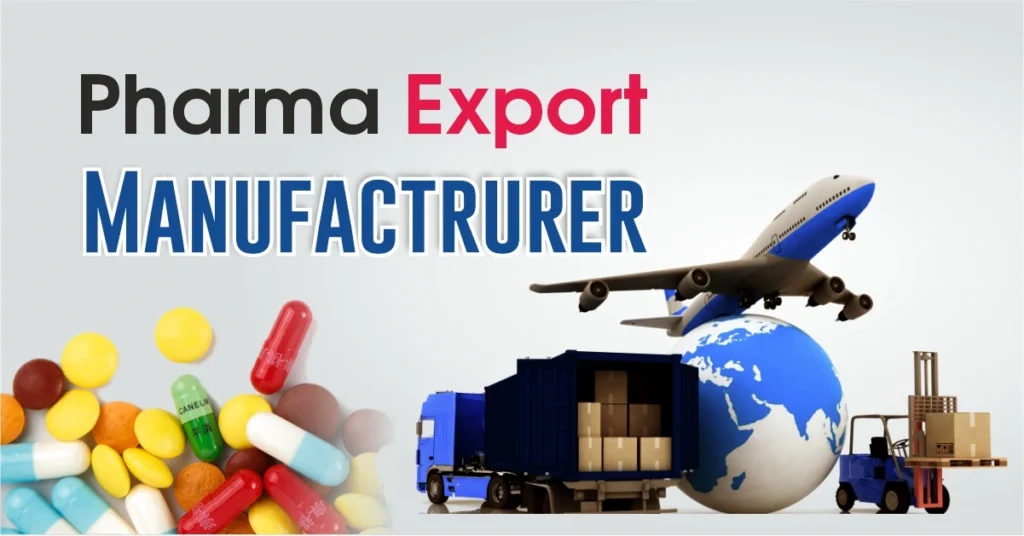
A pharma export manufacturer is a company that produces pharmaceutical formulations — tablets, capsules, syrups, injectables, ointments, and similar dosage forms — with the systems, documentation, and quality controls needed to supply buyers outside its home country.
It helps to understand how this role differs from others in the supply chain:
- Manufacturer: Produces the medicine, controls the formulation, and is responsible for batch quality, testing, and documentation.
- Exporter: Handles the cross-border movement of goods — shipping, customs clearance, and export documentation. A manufacturer may export directly, or work with a separate export/logistics partner.
- Distributor: Buys finished product and moves it through a market, usually without owning the manufacturing process.
- Importer: The buyer’s side of the transaction, responsible for bringing the product into the destination country and meeting that country’s import and regulatory requirements.
A manufacturer that also understands export requirements can support international buyers directly — providing the technical documents, batch records, and product specifications that an importer needs on their end. This is different from a purely domestic manufacturer, whose systems and paperwork may be built only around local (in this case, Indian) regulatory requirements.
Manufacturing quality matters more in export markets because the buyer is often not physically present to inspect the facility or verify a batch before it ships. Every claim about the product — its composition, its stability, its testing — has to be backed by documentation the buyer can rely on and, where required, that the destination country’s regulator will accept.
Why Choose an Indian Pharmaceutical Manufacturer for Export?
India has one of the largest pharmaceutical manufacturing bases in the world, producing a wide range of generic formulations, active pharmaceutical ingredients, and finished dosage forms. According to Invest India, the national investment promotion agency, the country’s pharmaceutical sector is built on a large manufacturing ecosystem, a skilled scientific workforce, and a long history of generic drug production. We are not citing specific export figures or country rankings here — for current statistics, buyers should refer directly to Invest India’s sector page or the Pharmaceuticals Export Promotion Council of India (Pharmexcil), the official body that supports and monitors Indian pharmaceutical exports.
A few genuine reasons international buyers consider Indian manufacturers:
Manufacturing ecosystem. India has a dense network of formulation manufacturers, raw material suppliers, packaging vendors, and testing laboratories concentrated in pharma manufacturing hubs. This makes it possible to source a wide range of dosage forms without depending on a single supplier for everything.
Product development experience. Many Indian manufacturers have decades of experience formulating generic versions of established molecules, which shortens the time needed to bring a private-label or third-party product to market.
Cost considerations. Manufacturing costs in India are often lower than in several Western markets, partly due to scale and a large skilled workforce. Buyers should still request formal quotations rather than relying on general cost assumptions, since pricing depends on the product, order volume, and specifications.
Product diversity. Indian manufacturers commonly produce across multiple dosage forms — tablets, capsules, syrups, dry syrups, ointments, drops, and injectables — which helps buyers building a multi-product portfolio work with fewer suppliers.
Contract and private-label manufacturing. Third-party and contract manufacturing arrangements are common in India, allowing brands to have products manufactured under their own label without owning a factory.
None of this means every Indian manufacturer is export-ready or holds international certifications. Buyers still need to verify each manufacturer’s specific quality systems, certifications, and export documentation capability individually, which is the focus of the next section.
What Should You Look for in a Pharma Export Manufacturer?
Use this checklist as a starting point when evaluating any pharmaceutical manufacturer for export or cross-border supply:
- Product Quality — Consistent formulation, correct active ingredient content, and stable performance across batches.
- Manufacturing Standards — Facilities operating under Good Manufacturing Practices (GMP), with documented processes for production and hygiene.
- Quality Assurance (QA) — A formal QA function that reviews processes and documentation before a batch is released.
- Quality Control (QC) — In-house or contracted testing of raw materials and finished products against defined specifications.
- Regulatory Compliance — Awareness of both Indian regulatory requirements and the requirements of your destination country.
- Documentation — Ability to provide Certificates of Analysis, product specifications, and manufacturing records on request.
- Product Testing — Clear testing protocols for raw materials, in-process checks, and finished goods.
- Packaging — Packaging formats (blister, strip, bottle, sachet, vial) suited to your product and shipping conditions.
- Labeling Requirements — Willingness to accommodate destination-market labeling, which varies by country and product category.
- Batch Consistency — A track record of producing uniform quality across repeat orders, not just a single sample batch.
- Supply Reliability — Realistic production timelines and a history of meeting them.
- Product Portfolio — A range that matches your target market’s needs, whether that’s a few core products or a wide catalogue.
- Manufacturing Capacity — Enough capacity to fulfil your order volumes without compromising quality or timelines.
- Communication — Responsive, clear communication, ideally with a dedicated point of contact.
- Commercial Terms — Transparent pricing, MOQ (minimum order quantity), and payment terms agreed in writing.
- Regulatory Support — Willingness to assist with documents your import-country registration process may require.
- Export Documentation — Experience preparing the commercial and shipping documents international trade requires.
- After-Sales Support — A process for handling queries, complaints, or documentation requests after delivery.
Not every manufacturer will score well on all eighteen points, and that is fine — the goal is to know where a manufacturer stands on each before you commit to an order, not to assume.
Quality Standards in Pharmaceutical Export Manufacturing
Quality systems are what separate a pharmaceutical manufacturer from a general contract producer. A few components matter consistently across markets:
Good Manufacturing Practices (GMP). GMP covers the systems and controls used during production — from raw material handling to finished product release — to ensure products are made consistently and to appropriate quality standards. The World Health Organization (WHO) publishes GMP guidance that many countries reference when setting their own pharmaceutical manufacturing standards.
Quality Assurance and Quality Control. QA is the broader system of policies and procedures that ensures quality is built into every stage of production. QC is the testing function — verifying that raw materials and finished products actually meet their specifications.
Raw material testing. Incoming active ingredients and excipients should be tested for identity, purity, and quality before being used in production.
Finished product testing. Completed batches are tested against defined specifications — potency, dissolution, microbial limits, and other parameters relevant to the dosage form.
Batch documentation. Every batch should have a corresponding batch manufacturing record and Certificate of Analysis, so quality can be traced back to a specific production run.
Stability considerations. Pharmaceutical products need to remain within specification for their intended shelf life, under specified storage conditions. This is particularly relevant for products that will travel long distances or sit in warehouses before reaching the end market.
Packaging controls. Packaging is tested for its ability to protect the product from moisture, light, and physical damage during transit and storage.
Storage conditions. Correct storage — temperature, humidity, and handling — at every stage of the supply chain protects product integrity from the factory to the final point of sale.
Buyers should ask manufacturers directly which of these systems they have in place and request supporting documentation rather than relying on general assurances. For Indian regulatory standards specifically, the Central Drugs Standard Control Organisation (CDSCO) is the national regulatory authority, and the Indian Pharmacopoeia Commission sets official quality standards and testing methods for drugs manufactured in India.
Pharmaceutical Export Documentation: What Buyers Should Know
Pharmaceutical exports involve more documentation than most other product categories, because both the exporting and importing countries regulate medicines closely. The exact list of documents required depends on the destination country, the product category, and the applicable regulations at the time of shipment — so treat the list below as an overview, not a checklist you can rely on universally.
Common documents involved in pharmaceutical export transactions include:
- Commercial Invoice — States the value, quantity, and description of goods being shipped, used for customs and payment purposes.
- Packing List — Details how the shipment is packed, including quantities, weights, and dimensions per package.
- Certificate of Analysis (CoA) — Confirms that a specific batch meets its defined quality specifications, based on testing.
- Certificate of Origin — Confirms the country where the goods were manufactured, sometimes required for customs or trade-agreement purposes.
- Shipping Documents — Bill of lading or airway bill, and other transport-related paperwork depending on the mode of shipment.
- Product Specifications — Technical details of the formulation, often required for import registration.
- Manufacturing-Related Documents — Batch manufacturing records, manufacturing licences, and facility-related certificates as applicable.
- Regulatory Documents — Documents such as a Certificate of Pharmaceutical Product (CoPP), where required by the importing country.
- Import-Country Requirements — Any additional registration, labeling, or documentation the destination country’s health authority requires before the product can be sold there.
In India, the Directorate General of Foreign Trade (DGFT) governs export policy and procedures, including the Importer-Exporter Code (IEC) that businesses need to export goods from India. Buyers working with an Indian manufacturer or exporter should confirm which entity holds the relevant export registrations and licences for the shipment.
Because documentation requirements differ so widely by destination country and product type, buyers should always confirm current requirements with their own country’s import or health authority before finalising an order, rather than assuming the same paperwork applies everywhere.
Regulatory Compliance for Pharmaceutical Exports
Pharmaceutical export compliance sits at the intersection of at least four sets of rules:
- India’s regulatory framework — governed nationally by the Ministry of Health & Family Welfare and the CDSCO, which oversee drug manufacturing, licensing, and quality standards within India.
- The destination country’s regulations — every country has its own process for approving, registering, and permitting the sale of pharmaceutical products, and these processes vary significantly in scope and timeline.
- The importing authority — the specific health or customs authority responsible for clearing the shipment and, where applicable, registering the product before sale.
- The product category — regulatory requirements can differ for prescription medicines, over-the-counter products, herbal or ayurvedic formulations, and medical devices, even within the same country.
Because these rules change and vary by jurisdiction, this article cannot serve as legal or regulatory advice, and it should not be treated as a universal rule for any specific country or product. Both the manufacturer and the buyer share responsibility for confirming current requirements with the relevant official regulatory authorities before finalising a purchase or shipment. When in doubt, buyers should consult their own country’s drug regulatory authority directly, or a qualified regulatory affairs professional familiar with that market.
How to Evaluate a Pharmaceutical Manufacturer Before Placing an Order
A structured evaluation process reduces the risk of costly surprises later. Here is a practical sequence to follow:
Step 1 — Verify the company. Confirm the manufacturer’s legal registration, manufacturing licence, and business address. Check that the company you are corresponding with is the entity actually named on official documents.
Step 2 — Review product portfolio. Look at the range of products, dosage forms, and therapeutic categories the manufacturer produces, and confirm they can supply what you actually need.
Step 3 — Check quality systems. Ask about their QA/QC processes, testing protocols, and how batch quality is documented and released.
Step 4 — Verify certifications. Request copies of any certifications claimed (GMP, ISO, WHO-GMP, or others) and confirm they are current and applicable to the specific facility producing your order.
Step 5 — Ask for product documentation. Request Certificates of Analysis, product specifications, and stability data for the specific products you are interested in.
Step 6 — Understand packaging and labeling. Confirm what packaging formats are available and whether the manufacturer can accommodate your destination market’s labeling requirements.
Step 7 — Confirm destination-market requirements. Independently verify what your own country requires for import and registration — do not rely solely on the manufacturer’s assurances.
Step 8 — Discuss MOQ and commercial terms. Clarify minimum order quantities, pricing, and payment terms in writing before proceeding.
Step 9 — Confirm production timelines. Ask for realistic lead times and how they handle delays, so you can plan your own supply chain accordingly.
Step 10 — Clarify shipping and export responsibilities. Establish who is responsible for export documentation, freight arrangements, and customs clearance on the exporting side.
Step 11 — Review samples where appropriate. Where feasible, request samples to independently verify product quality before committing to a full order.
Step 12 — Establish communication and support. Confirm you will have a consistent point of contact and understand how post-delivery queries or issues will be handled.
Third-Party Pharmaceutical Manufacturing for International Markets
Third-party manufacturing — sometimes called contract manufacturing — is an arrangement where a brand outsources production to an existing manufacturer instead of building its own facility. This is common in the pharmaceutical industry because setting up compliant manufacturing infrastructure is capital-intensive and takes years to establish.
Private-label manufacturing is a related model where the manufacturer produces a product that is then sold under the buyer’s own brand name and packaging, rather than the manufacturer’s brand.
Contract manufacturing more broadly can also include the manufacturer producing a buyer’s own formulation, following the buyer’s specifications, using the manufacturer’s facility and expertise.
For international brands, this model offers a few practical benefits:
- Faster market entry, since the brand does not need to build or acquire manufacturing infrastructure.
- Lower upfront capital investment compared to owning a facility.
- Access to existing manufacturing expertise and, where relevant, existing product formulations that can be adapted.
Product customization is often possible within limits — the manufacturer’s existing formulations, dosage forms, and production capabilities set the boundaries of what can realistically be customized for a specific brand.
Packaging and labeling for third-party arrangements should be discussed early, since destination-market requirements may need packaging or labeling changes from the manufacturer’s standard format.
Regulatory compliance remains essential in a third-party arrangement — the brand commissioning the product is still responsible for ensuring it meets the requirements of the market where it will be sold, even though the manufacturer produces it.
Buyers evaluating a third-party manufacturing partner for international markets specifically should confirm, in writing, whether the manufacturer has direct experience supporting export shipments and documentation, since domestic third-party manufacturing and export-ready third-party manufacturing are not always the same capability.
Common Mistakes When Choosing a Pharma Export Manufacturer
International buyers repeatedly run into a similar set of avoidable problems:
- Choosing only on price, without weighing quality, documentation, and reliability.
- Not verifying certifications, and instead accepting claims at face value without requesting proof.
- Ignoring destination-country regulations, assuming that what is approved in India will automatically be accepted elsewhere.
- Not checking product documentation before placing a bulk order.
- Not discussing MOQ upfront, leading to mismatched expectations on order size.
- Ignoring packaging requirements specific to the destination market, discovering the mismatch only after shipment.
- Failing to clarify lead times, resulting in supply chain gaps on the buyer’s side.
- Not checking product quality through samples or independent verification before a large order.
- Assuming all manufacturers support exports, when many are set up primarily for domestic supply.
- Not establishing clear commercial terms in writing, leading to disputes over pricing, payment, or delivery later.
- Overlooking after-sales support, and having no clear process when a documentation query or product issue arises post-delivery.
- Skipping legal or regulatory verification on the buyer’s own side, and relying entirely on the manufacturer’s representations.
Avoiding these mistakes usually comes down to one habit: putting expectations in writing and verifying claims independently, rather than assuming.
Questions to Ask a Pharma Export Manufacturer Before Starting
Use these questions as a starting checklist during your initial conversations with any pharmaceutical manufacturer:
- What is your manufacturing licence number, and which authority issued it?
- Which certifications does your facility currently hold, and can you share copies?
- Can you provide a Certificate of Analysis for the specific product I’m interested in?
- What is your minimum order quantity for this product?
- What are your standard production and delivery timelines?
- Do you have direct experience preparing export documentation and shipments?
- Who is responsible for export documentation and customs clearance — you or a third party?
- What packaging formats and sizes are available for this product?
- Can packaging and labeling be adjusted for my destination market’s requirements?
- What is your process for quality testing, and can I see sample test reports?
- Do you provide stability data for the product?
- What are your payment terms, and do you require advance payment?
- Can I request product samples before placing a full order?
- How do you handle product complaints or documentation queries after delivery?
- Who will be my point of contact throughout the order process?
- Have you previously shipped products to my country or region?
- What is your policy if a batch does not meet agreed specifications?
Why Quality Matters More Than Price in Pharmaceutical Exports
It is tempting to make sourcing decisions primarily on unit price, especially when margins matter and competition is high. But pharmaceutical products carry risks that most other product categories do not.
Patient safety is the most direct concern — a substandard medicine can cause real harm, and there is no acceptable margin for error on product quality.
Product consistency protects your reputation with the doctors, pharmacies, or distributors who repeat-purchase your products. Inconsistent batches erode trust quickly, even if early shipments were fine.
Regulatory compliance failures can result in shipments being held at customs, product recalls, or loss of market access — all of which cost far more than any savings from a lower unit price.
Brand reputation in pharmaceuticals is built over years and can be damaged by a single quality failure that reaches the market.
Long-term business relationships depend on reliability. Buyers who source only on price tend to switch suppliers frequently, which prevents the kind of long-term partnership that leads to better terms, priority production slots, and smoother communication over time.
Returns and recalls are expensive, disruptive, and — in pharmaceuticals — carry regulatory and reputational consequences beyond the direct financial cost.
Market access itself depends on compliance. A product that fails to meet a destination country’s requirements simply cannot be sold there, regardless of how competitively it was priced.
Price still matters, and buyers are right to compare it. But in pharmaceutical sourcing, price should be evaluated alongside quality systems and compliance — not instead of them.
Why Choose Rosette Pharmaceutical?
Rosette Pharmaceutical is a pharmaceutical company established in 2006 and based in Karnal, Haryana. Its verified business, as described on rosettepharma.com, is built around two core services within India: PCD Pharma Franchise partnerships and third-party (contract) manufacturing.
Based on information published on the company’s website, Rosette Pharma’s verified profile includes:
- A product portfolio of 500+ formulations across major therapeutic segments, manufactured as tablets, capsules, syrups, dry syrups, injectables, ointments, softgel capsules, sachets, drops and suspensions, and ear, eye, and nasal drops, among other dosage forms.
- DCGI-approved products, manufactured to comply with Indian regulatory standards.
- Products sourced from WHO-GMP–compliant manufacturing facilities, as stated on the company’s website.
- Four operating divisions — Rosette Pharmaceuticals, Admetus Pharma (orthopedics, dermatology, and derma-cosmetics), Yeux Care (ophthalmic range), and Rosette Organics (herbal and natural formulations) — covering a range of therapeutic and product categories.
- A PCD Pharma Franchise model offering district and state-level monopoly rights to franchise partners across India, including a dedicated Ayurvedic PCD Pharma Franchise line.
- Third-party manufacturing services for allopathic, derma, and herbal formulations, with support described as spanning product development through packaging.
It’s worth being direct here: based on the current content of rosettepharma.com, Rosette Pharmaceutical’s published business is oriented toward the Indian domestic market — PCD franchise partnerships and third-party manufacturing for brands and partners operating within India. The website does not, at this time, publish information about export markets, international shipments, or country-specific regulatory approvals outside India.
If you are an Indian business looking for a manufacturing partner for a private-label brand or a PCD franchise opportunity, the profile above is directly relevant, and you can review the About Us page or Divisions page for more detail, or reach out through the Contact Us page. If your interest is specifically in exporting from India or sourcing for an international market, the most reliable approach is to contact Rosette Pharmaceutical directly to confirm current export capability, certifications, and destination-market experience before proceeding — rather than assuming it based on this article or general industry patterns.
How to Start Working With a Pharma Manufacturer
The exact process varies by manufacturer, product, and destination market, but most manufacturing partnerships — domestic or export — follow a broadly similar sequence:
- Initial enquiry — You reach out with your product interest and business requirements.
- Requirement discussion — The manufacturer discusses your product needs, order volumes, and timelines.
- Product selection — You finalise which products or formulations you want to source.
- Documentation review — Both sides review the documentation available and what will be required.
- Sample or product evaluation — Where appropriate, samples are reviewed before commitment.
- Commercial discussion — Pricing, MOQ, and payment terms are agreed in writing.
- Regulatory review — Any registration or compliance requirements relevant to your market are identified.
- Packaging and labeling — Packaging formats and labeling are finalised to match your requirements.
- Production — The manufacturer produces the order according to agreed specifications.
- Quality checks — Batches are tested and verified against specifications before release.
- Documentation — Certificates of Analysis, invoices, and other required paperwork are prepared.
- Dispatch or shipping — The order is packed and shipped, with export documentation handled where applicable.
Every step can look different depending on whether you’re sourcing domestically or arranging a cross-border shipment, so it’s worth confirming each stage explicitly with your chosen manufacturer rather than assuming a standard process applies.
Frequently Asked Questions
What is a pharma export manufacturer? A pharma export manufacturer is a pharmaceutical company that produces medicines with the quality systems and documentation needed to supply buyers in other countries, in addition to or instead of its domestic market.
How do I choose a pharmaceutical manufacturer in India? Verify the company’s registration and manufacturing licence, review its product portfolio and quality systems, request documentation such as Certificates of Analysis, and confirm commercial terms in writing before placing an order.
What documents are required for pharmaceutical exports? Common documents include a commercial invoice, packing list, Certificate of Analysis, Certificate of Origin, and shipping documents, but the exact requirements depend on the destination country and product category. Always confirm current requirements with your local import authority.
What certifications should a pharma manufacturer have? This depends on your destination market’s requirements. Common certifications discussed in the industry include GMP, WHO-GMP, and ISO, but buyers should request and verify specific certificates directly from the manufacturer rather than assuming based on general industry claims.
Can a pharma manufacturer provide private-label products? Many manufacturers offer private-label or third-party manufacturing, where products are made under the buyer’s own brand. Availability and terms vary by manufacturer, so confirm directly.
What is third-party pharmaceutical manufacturing? It’s an arrangement where a brand outsources production to an existing manufacturer instead of building its own facility, allowing faster market entry with lower upfront capital investment.
How do I verify a pharmaceutical manufacturer’s quality? Request copies of certifications, Certificates of Analysis, and testing protocols, and where possible, review product samples independently before committing to a large order.
Can pharmaceutical products be exported to every country? No. Every country has its own regulatory requirements for importing pharmaceutical products, and some products may require registration or approval before they can be legally sold in a given market.
Who handles import-country registration? This varies by arrangement. In some cases, the importer or local distributor handles registration; in others, the manufacturer provides supporting documentation. Clarify this explicitly before starting.
How important is product packaging for exports? Very important. Packaging needs to protect the product during transit and storage and often needs to meet the destination country’s specific labeling and packaging regulations.
What should international buyers ask a pharma manufacturer? Buyers should ask about certifications, documentation, MOQ, production timelines, export experience, and after-sales support — see the full question checklist above for a more complete list.
How can I contact a pharmaceutical manufacturer? Most manufacturers, including Rosette Pharmaceutical, list direct contact details on their website. You can reach Rosette Pharmaceutical through its Contact Us page.
Conclusion
Choosing the right pharmaceutical manufacturing partner comes down to a consistent set of factors: verified quality systems, complete and accurate documentation, genuine regulatory compliance, clear communication, real manufacturing capability, and — for cross-border sourcing — a clear understanding of destination-country requirements before you commit to an order.
None of these can be assumed. Each one needs to be checked, documented, and confirmed directly with the manufacturer you’re evaluating, whether you’re sourcing for the Indian market or for export.
If you’re exploring a PCD Pharma Franchise opportunity or a third-party manufacturing partnership within India, Rosette Pharmaceutical’s verified product range and manufacturing services may be worth a direct conversation. You can review the company’s product divisions or get in touch through the Contact Us page to discuss your specific requirements.