Introduction: What Are Dermatology Products?
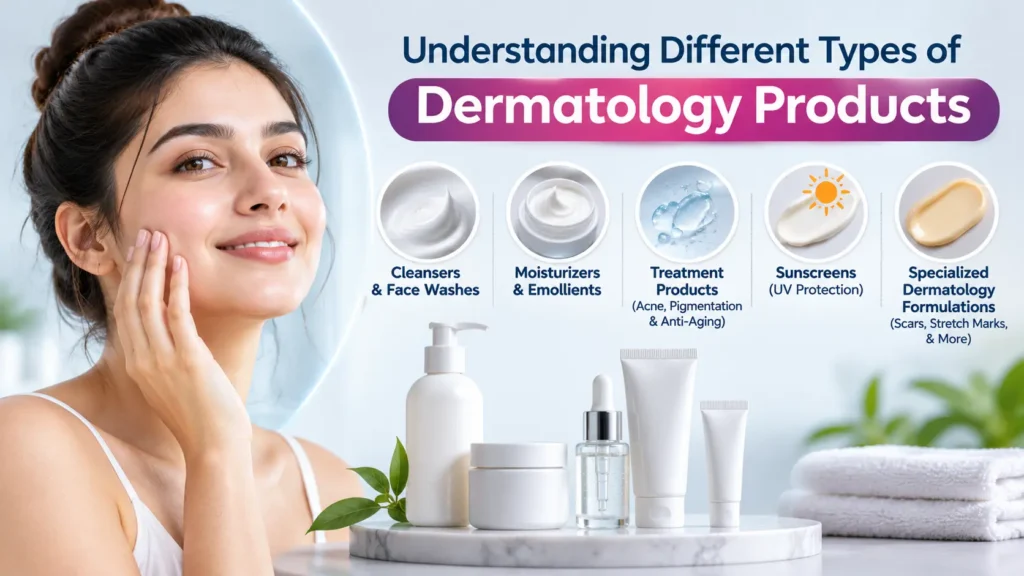
Dermatology products are preparations applied to the skin, scalp, hair or nails to cleanse, protect, moisturise or help manage a skin condition. It includes prescription topical medicines, over-the-counter (OTC) preparations and cosmetic skin-care products, and these are not all regulated in the same way.
Whether a product is a drug or a cosmetic depends on its composition, intended use, label claims and the applicable law. In India, the Drugs and Cosmetics Act, 1940 defines a cosmetic as an article applied to the body for cleansing, beautifying, promoting attractiveness or altering the appearance, as explained on CDSCO’s cosmetics page. A product that claims to diagnose, treat, mitigate or prevent a disease is generally dealt with as a drug. The Cosmetics Rules, 2020 also prohibit cosmetics from carrying false or misleading claims.
This guide covers the main types of dermatology products, their formulation differences and quality factors. It is written for pharmacy students, pharmacists, healthcare professionals, distributors and PCD franchise partners. It is educational and does not recommend any medicine for self-treatment.
1. Understanding the Main Categories of Dermatology Products
In everyday language these dermatology product categories overlap, but they are not necessarily regulated in the same way. The same dosage form, such as a cream, can be a medicine in one product and a moisturiser in another.
- Topical pharmaceutical medicines: creams, ointments, gels, lotions and solutions that contain an active drug, such as an antifungal or a corticosteroid, and are made under a drug manufacturing licence.
- Medicated skin-care products: items such as medicated soaps and washes that contain an active ingredient. Their regulatory status depends on the ingredient and the claim made.
- Dermatological cleansing products: mild cleansers and washes for sensitive skin.
- Hair and scalp preparations: medicated shampoos, solutions and serums.
- Nail-related preparations: lacquers, solutions and creams applied to the nails and surrounding skin.
- Cosmetic skin-care products: cleansers, moisturisers and similar products meant for cleansing, beautifying or maintaining appearance, regulated under the Cosmetics Rules, 2020.
Product catalogues often mix these groups. Rosette Pharma’s website, for example, places many of its derma items in one skin and haircare category, where antifungal items, moisturising products and hair-care items appear together.
2. Dermatology Creams
Creams are semisolid emulsions of oil and water. The MSD Manual describes them as the most commonly used topical vehicle. They tend to vanish when rubbed into the skin. Because they contain water, creams need an effective preservative system, and an emulsion must stay uniform through its shelf life without separating, thickening or thinning.
There are two basic emulsion types. In an oil-in-water (O/W) cream, fine oil droplets are dispersed in water. These creams feel light, spread easily and wash off readily. In a water-in-oil (W/O) cream, water droplets are dispersed in oil. These feel richer and leave more of an oily film.
Creams are made in several therapeutic areas. Moisturising, antifungal, anti-inflammatory and antibacterial preparations are all available as creams, but suitability depends on the active ingredient and the condition, and many products need a prescription. The best form also depends on the body site. For moist skin folds, a powder is sometimes preferred, as discussed in our comparison of antifungal powder and cream.
3. Dermatology Ointments
Ointments are semisolid preparations with an oil-based base, often a hydrocarbon such as petrolatum, and little or no water. The MSD Manual describes them as occlusive: they form a film that holds moisture in the skin and can increase how much medicine penetrates. They are also typically less irritating than creams on eroded skin.
Compared with creams, ointments are greasier and thicker, contain far less water and are harder to wash off. Because they are occlusive, they are often considered for dry, scaly or thickened skin. A 2021 review of topical vehicles notes that ointments need fewer preservatives because they contain little water. The same drug at the same strength can behave differently in an ointment and a cream, so the two should not be treated as interchangeable.
Quality points include even dispersion of the active ingredient, absence of gritty particles and suitable softening behaviour at storage temperatures. Suitability always depends on the product, the active ingredient and the medical condition. Rosette Pharma’s ointment product category also lists items sold as creams and gels, so reading the label for the actual dosage form is important.
4. Dermatology Gels
Gels are semisolid systems in which a liquid is thickened with a gelling agent, usually a polymer such as carbomer or a cellulose derivative. Water-based gels (hydrogels) are typically clear and non-greasy. Oleogels use a thickened oil and feel greasier. Gels containing alcohol can feel drying or cause stinging, especially on broken skin.
Gels are often used on the scalp, on hair-bearing skin and in acne care, where a light, non-greasy feel is useful. Acne-related, anti-inflammatory or pain-relief and some antifungal preparations are sold as gels, but each gel depends on its polymer, solvent and active ingredient.
Stability and usability are the main formulation concerns. Gel viscosity can change with pH, electrolytes or temperature. Gels may dry out in a poorly sealed tube or release a little liquid on standing. Water-based gels need a suitable preservative, and alcohol content affects both the skin feel and the choice of packaging.
5. Dermatology Lotions
Lotions are pourable preparations. Many are water-based emulsions, while others, such as calamine lotion, are suspensions that must be shaken before use. Compared with creams and ointments, lotions are thinner, contain more water and are less occlusive. The MSD Manual notes that they spread easily over hairy skin and are used to cool and dry acute weeping lesions. They usually moisturise less than creams or ointments. Calamine lotion is a familiar suspension-type example, and our calamine lotion guide explains its ingredients and use.
For formulation, spreadability and consistency are important. A lotion should pour and spread evenly and, if it is a suspension, redisperse easily after shaking. Emulsion lotions should not separate. Stability checks should cover temperature changes, closure integrity and preservative effectiveness.
6. Dermatological Solutions and Sprays
A topical solution is a clear, single-phase liquid in which the active ingredient is fully dissolved in a solvent such as water, alcohol, glycerine or propylene glycol. The MSD Manual notes that solutions are convenient to apply, especially on the scalp, but tend to be drying.
Solutions differ from other liquids. In a suspension, solid particles are dispersed but not dissolved, so the product must be shaken. In an emulsion, two liquids that do not mix are dispersed in each other, as in many lotions.
Topical sprays deliver a solution or suspension as a mist through a pump or pressurised container. They can be useful on large, hairy or hard-to-reach areas and avoid hand contact with the skin. Practical points include an even spray pattern, consistent dose delivery, the flammability of alcohol-based products and keeping sprays away from the eyes and from inhalation.
Packaging and stability need particular attention. Solvents can evaporate, some actives are sensitive to light, and the container, closure or pump must not react with or absorb the formulation. Stability studies should be done on the final pack.
7. Medicated Shampoos and Scalp Preparations
Medicated shampoos are surfactant-based cleansing preparations that contain an active ingredient for a defined scalp purpose. Ordinary cosmetic shampoos clean and condition the hair and should make only cosmetic claims. Scalp-care categories include antidandruff shampoos, keratolytic or tar-based products, minoxidil solutions and hair-care serums.
The choice of active ingredient matters. The MSD Manual describes zinc pyrithione as an antifungal that is a common ingredient in shampoos for dandruff linked to psoriasis or seborrhoeic dermatitis. Other active classes include azole antifungals such as ketoconazole, salicylic acid and coal tar. Whether a shampoo is a drug or a cosmetic depends on its active ingredient, strength and claims. Response varies between individuals.
Formulation requires balancing several factors. The active must stay stable and compatible with the surfactants and preservatives. The pH should suit the scalp, which is mildly acidic, and the viscosity and foam should suit the user. Rosette Pharma lists a ketoconazole and zinc pyrithione shampoo on its website. As with any medicated product, rely on the approved label and a clinician’s advice for use.
8. Dermatology Products by Therapeutic Category
This section describes general purposes and ingredient classes. It is not treatment advice. No category suits every skin condition, many of these preparations are prescription medicines, and a correct diagnosis should come first.
- Antifungal preparations: ingredient classes include azoles (such as clotrimazole, miconazole and luliconazole) and allylamines (such as terbinafine). They are made as creams, powders, lotions, solutions and shampoos.
- Antibacterial preparations: these include topical antibiotics (such as fusidic acid, mupirocin and clindamycin) and antiseptics such as povidone-iodine. Their use is generally selective because of resistance concerns.
- Anti-inflammatory preparations: topical corticosteroids range from mild to super-potent, and potency depends on the drug, its concentration and the base. Misuse can cause skin thinning and other local effects, so these are prescription-guided medicines.
- Acne-related preparations: ingredient classes include benzoyl peroxide, topical retinoids, salicylic acid, azelaic acid and topical antibiotics, often in gels, creams, lotions or washes. Some washes are cosmetic, while others carry drug claims.
- Moisturisers and emollients: these use humectants such as glycerin and urea and occlusives such as petrolatum and mineral oil. Many are cosmetic or general-care products, and some stronger ones also contain urea or lactic acid.
- Anti-allergy and antipruritic preparations: topical options include calamine, camphor, menthol and pramoxine. The MSD Manual describes calamine lotion as more soothing than antipruritic.
- Keratolytic preparations: salicylic acid and urea soften and loosen thickened skin. They can irritate and are not generally suited to large skin areas or to young children without medical advice.
- Pigmentation-related preparations: ingredient examples include hydroquinone, kojic acid, azelaic acid and vitamin C derivatives. The Cosmetics Rules include skin-lightening products among cosmetic categories, but a product that claims to treat a pigmentary disorder, or contains a drug-active ingredient, may be treated as a drug. Classification depends on composition and claims.
- Hair and scalp treatments: these include antidandruff shampoos and minoxidil solutions or foams. Hair-care serums and shampoos with conditioning or nutritive ingredients are generally cosmetic-type products and should not be presented as medicines.
A cosmetic must not be presented as a medicine, and a drug product needs the appropriate licence and permissions. Check the label, claims and licence category before stocking any product.
9. Difference Between Creams, Ointments, Gels and Lotions
The table below summarises how these four topical forms differ. The MSD Manual orders them by decreasing oil content: ointments, creams, lotions and gels.
| Product Type | General Formulation | Texture | Common Characteristics | Important Considerations |
|---|---|---|---|---|
| Cream | Semisolid oil-and-water emulsion (O/W or W/O) | Smooth; O/W feels light, W/O feels richer | Spreads and absorbs easily; washes off more readily than ointment | Needs preservation and emulsion stability; may sting on broken skin |
| Ointment | Semisolid, oil-based, with little or no water | Thick and greasy | Occlusive; holds moisture on the skin; often needs fewer preservatives | Feels heavy and is harder to wash off; base can soften in heat |
| Gel | Liquid thickened with a gelling agent; water, alcohol or oil based | Clear or translucent; usually non-greasy | Spreads easily and dries quickly; common on the scalp and hair-bearing skin | Alcohol-based gels can dry or sting; viscosity depends on polymer and pH |
| Lotion | Pourable emulsion or suspension, high in water | Thin and fluid | Covers large or hair-bearing areas easily; less occlusive | Suspensions need shaking; must stay uniform; usually moisturises less |
No form is universally better. The right choice depends on the active ingredient, the skin site, the condition and the prescriber’s advice.
10. Important Quality Factors in Dermatology Products
Dermatology products are applied repeatedly, often to skin that is already inflamed or broken. Small variations in strength, preservation or stability can affect both safety and performance. Key factors include:
- Ingredient identity and purity: actives and excipients should meet recognised specifications. The Indian Pharmacopoeia is the official book of standards for drugs under the Drugs and Cosmetics Act.
- Correct active concentration: assay results should match the label claim within accepted limits.
- Formulation uniformity: the active should be evenly distributed in every tube or bottle.
- pH, where relevant: important for water-containing products, shampoos and washes, and for pH-sensitive actives.
- Physical and chemical stability: no phase separation, crystal growth or large viscosity change, and active content staying within limits.
- Microbiological quality: water-containing creams, lotions, gels and shampoos need adequate preservation and microbial control.
- Packaging compatibility: tubes, bottles, pumps and closures must protect the product without interacting with it.
- Shelf life and storage conditions: these should rest on stability data. A Government reply in Parliament notes that applicants must submit evidence of stability and excipient safety before a manufacturing licence is granted.
- Batch consistency, quality assurance and quality control: validated processes, batch records and a working pharmaceutical quality system under good manufacturing practice (GMP). See the WHO GMP main principles. India notified revised Schedule M (G.S.R. 922(E)) on 28 December 2023, and our note on a WHO GMP pharma franchise company explains the terms.
These factors matter to everyone in the chain. Manufacturers face licence and enforcement risk if quality fails. Since 1 March 2021, a marketer who sells or distributes a drug shares responsibility for its quality and regulatory compliance with the manufacturer, as the same parliamentary reply states.
11. How to Choose a Reliable Dermatology Product Manufacturer
For pharma businesses and PCD franchise partners, it helps to separate what the law requires from what good practice suggests. Request documents in writing and, where possible, confirm them with the licensing authority.
Legal and regulatory requirements to verify
- Valid manufacturing licence: issued by the State Licensing Authority for the relevant category, which means a drug licence for medicines or a licence under the Cosmetics Rules, 2020 for cosmetics.
- Product permissions: approvals that cover the specific products and dosage forms you plan to sell, not a general claim that all products are approved.
- GMP compliance: the site’s current status against revised Schedule M, with the scope and validity of any GMP certificate.
- Packaging and labelling compliance: labels that carry the particulars required for the product category, such as batch number, manufacturing and expiry details and licence number.
Good supplier-evaluation practices
- Quality control procedures: raw-material, in-process and finished-product testing, with sample certificates of analysis.
- Raw material sourcing: a vendor qualification process rather than purchases from any available source.
- Testing and stability documentation: stability data for each formulation and pack type.
- Manufacturing capabilities: suitable equipment for emulsions, gels, solutions and shampoos, such as mixing, homogenisation and filling lines.
- Traceability, complaints and supply: clear batch records, a recall procedure and written terms for complaints, returns and dispatch.
For wider commercial questions such as territory terms, agreements and costs, read our guide on how to choose the right pharma franchise company.
12. Role of Dermatology Products in the Pharmaceutical Industry
Dermatology is an established therapeutic area with a wide spread of dosage forms. One company may handle creams, ointments, gels, lotions, solutions, sprays, powders, soaps and shampoos, each needing different processing and control. Reliable manufacturing is therefore a real differentiator in dermatology product manufacturing.
Distributors should select products by dosage form, licence category, documentation and fit with local prescribers and chemists, rather than assume that every manufacturer offers every category. When evaluating a dermatology PCD pharma franchise, ask which products are available now, who manufactures each one, what the written territory terms are and how supply is handled. Our article on PCD pharma franchise versus third-party manufacturing explains how the two models differ.
Rosette Pharma states that it was established in 2006. Its website lists a PCD pharma franchise and third-party manufacturing for allopathic, derma and herbal formulations, and describes its Admetus Pharma division as focused on orthopaedics, dermatology and derma-cosmetics. The site also states that its products are sourced from WHO-GMP-compliant facilities. As with any supplier, ask which licensed site makes each product, and request that site’s licences, GMP documents and product permissions.
Conclusion: Understanding Dermatology Products and Their Applications
Dermatology products span creams, ointments, gels, lotions, solutions, sprays and shampoos, and they serve very different purposes, from moisturising to antifungal or anti-inflammatory care. What matters is the match between formulation, active ingredient, skin site and medical need, along with consistent quality and honest labelling.
If you work in pharmaceutical distribution or are considering a franchise, verify licences, product permissions and quality documents before you decide. Readers interested in pharmaceutical products or PCD pharma franchise opportunities can explore Rosette Pharma’s verified product information and request the documents they need.
This article is for general education only. It does not replace professional medical, pharmaceutical or legal advice, and it does not recommend any medicine for self-treatment.