Starting a pharma franchise business means putting your money, your relationships with doctors and chemists, and your reputation behind another company’s products. That is why knowing how to choose the right pharma franchise company is the most important decision you will make. Product quality, applicable regulatory compliance, product availability, transparent commercial terms, territory policies and ongoing support all affect whether the business can last.
The short answer: check the company’s documentation, product portfolio, commercial terms, distribution arrangements and ability to support your business, and get everything that matters in writing before you pay. This guide gives you a checklist, red flags and questions you can use with any company, including Rosette Pharma.
What Is a Pharma Franchise Company?
A PCD (Propaganda Cum Distribution) pharma franchise company allows an individual or firm to promote and distribute its products in an agreed area, usually under the company’s own brand. Typically, the company arranges manufacturing or sourcing, quality control and supply. The franchise partner handles local sales, relationships with doctors and chemists, ordering and local distribution. Marketing material may be supplied by the company. The exact split of duties differs from one contract to another.
This differs from ordinary distribution, where a distributor often buys from several companies and may hold no territory rights. Our comparison of pharma franchise vs distributorship explains this in detail. It also differs from third-party pharma manufacturing, where medicines are made under your own brand and you take on the responsibilities of a brand owner. See PCD pharma franchise vs third-party manufacturing for that difference. Whatever the label, your rights and responsibilities are defined by the written agreement, not by the name of the model.
10 Things to Check Before Choosing a Pharma Franchise Company
1. Verify the Company’s Legal and Regulatory Documentation
Begin with the basics: the company’s registered name, address, GST details and its actual role. A manufacturer, a marketer and a distributor face different requirements, so ask which one you are dealing with. Manufacturing needs a licence from the State Licensing Authority, and the Drugs Rules provide for joint inspection by central and state drug inspectors before it is granted, as a Government reply in Parliament explains. A wholesale supplier typically needs a wholesale drug licence (Forms 20B and 21B) from the State authority. One state’s checklist shows how this works, but documents vary by state.
Note also that since 1 March 2021, the Drugs Rules make a marketer who sells or distributes a drug responsible for its quality and other regulatory compliances, together with the manufacturer. Whether this applies to your position depends on your licence and contract, so take qualified advice. Ask for copies of documents and confirm them with the licensing authority when in doubt. A website statement or a single certificate does not prove that every product is compliant. The legal framework itself is the Drugs and Cosmetics Act, 1940 and the rules made under it.
2. Evaluate Product Quality and Manufacturing Arrangements
Verify quality from documents, not marketing language. Ask for:
- The manufacturing licence and product permissions for the specific formulations you plan to sell, with the manufacturing site’s address.
- GMP certification, including its scope and validity. India’s revised Schedule M (G.S.R. 922(E), December 2023) raised GMP requirements. An extended deadline of 31 December 2025 was granted to eligible small and medium manufacturers, so ask for the site’s current compliance status.
- Product-specific quality documents, such as certificates of analysis, and how batches are numbered and traced.
- Storage requirements, shelf-life and expiry management.
- Complaint-handling and recall procedures.
You can also check whether a company or product appears in CDSCO’s Drug Alert lists. Drugs declared Not of Standard Quality or spurious are published there. To understand GMP terms better, read our guide to a WHO GMP pharma franchise company.
3. Check the Product Range and Relevant Categories
Look at therapeutic categories, dosage forms (tablets, capsules, syrups, injectables, ointments and so on), strengths and whether they suit local prescribing habits and your own sales network. Ask whether the products in the catalogue are currently in stock and permitted for sale.
A large catalogue alone does not guarantee a successful franchise. A smaller, consistently supplied range matched to your doctors and chemists can serve you better than hundreds of products you cannot sell. Be cautious about any claim that one category is “the most profitable” unless it is backed by credible data.
4. Understand Investment and Commercial Terms
Pharma franchise investment is not the same everywhere, and no standard figure applies to all companies. Ask for the following in writing:
- Initial order requirement and minimum order quantities.
- Product pricing and applicable taxes.
- Payment terms and any credit terms offered.
- Freight and delivery charges.
- Policy on expiry and damaged stock, and reorder requirements.
- Any additional charges or commitments.
Request a written quotation and a draft agreement before making any payment. Our guide to the investment required for a pharma franchise business explains the cost heads to budget for.
5. Check Territory Rights and Exclusivity Terms
Territory allocation means the area (often a district) in which you may promote and sell the company’s products. A verbal promise of territory is not the same as a written contractual term. Monopoly or exclusivity rights usually mean the company will not appoint another partner for the same products in your territory, but the exact meaning depends on the agreement. It does not stop other companies selling similar medicines, and not every company offers it.
Check that the agreement defines the territory, duration, exceptions and conditions, such as minimum orders. Also check what happens if either side fails to meet them. For background, see our article on monopoly pharma franchise benefits for distributors, and confirm any restrictions before signing.
6. Evaluate Marketing and Promotional Support
Possible support includes product information materials, visual aids, promotional literature, product lists and catalogues, business enquiry assistance, digital marketing resources and sales or product training. Support differs by company, so confirm what you will actually receive, and when, in writing. Promotion to doctors is also governed by ethics rules. The Department of Pharmaceuticals issued the Uniform Code for Pharmaceutical Marketing Practices (UCPMP) 2024, so ask how the company’s promotional material and practices align with it.
7. Check Product Availability and Delivery Reliability
Ask about order processing and dispatch arrangements, stock availability, reorder planning and how out-of-stock products are handled. Also ask about expiry management, transport and storage requirements, and how delays or supply disruptions are communicated. Do not accept guarantees of “zero stock-outs” or fixed dispatch times unless they are written into the agreement.
8. Assess the Company’s Communication and Partner Support
Clear communication matters when you need to resolve an order issue, request documents or check availability. Ask:
- Who handles partner enquiries?
- How are order problems resolved?
- How can product documentation be requested?
- What support is available after the first order?
- How are changes in product availability communicated?
Judge the answers by how specific and consistent they are during your own enquiry.
9. Research the Company’s Reputation and Track Record
Do basic due diligence. Verify the company’s identity and contact details, and look for business information that stays consistent across its website, documents and listings. Request references where appropriate and speak to existing distributors about supply and communication. Read online feedback critically, since reviews can be one-sided. Be careful with unrealistic profit promises or pressure to pay immediately.
10. Read the Agreement Before Making a Commitment
Review every clause, including:
- Pricing and ordering conditions.
- Territory rights and any exclusivity.
- Payment and credit terms.
- Product quality responsibilities.
- Delivery and supply obligations.
- Returns, damaged products and expiry policies.
- Termination and renewal conditions.
- Dispute resolution and applicable law.
Where the stakes justify it, get qualified legal or regulatory advice before signing.
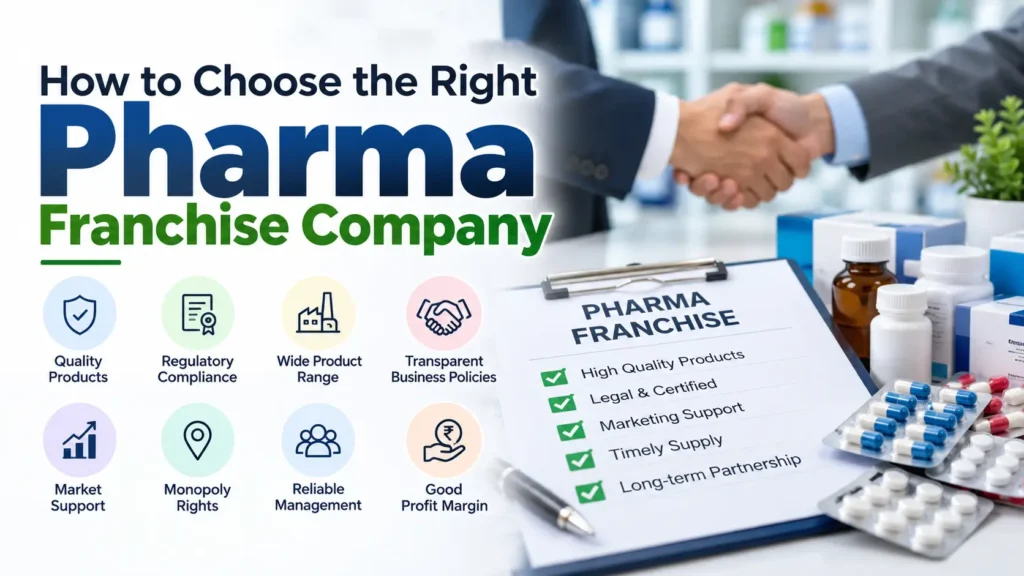
Pharma Franchise Company Comparison Checklist
Use this pharma franchise company checklist during your research.
| Evaluation Factor | Questions to Ask | Documents or Evidence to Request | Warning Signs |
|---|---|---|---|
| Company documentation | Who is the legal entity, and is it the manufacturer or a marketer? | Registration, GST details, relevant licences | Unclear identity, reluctance to share documents |
| Manufacturing and quality | Which site makes each product? Is GMP current for that site? | Manufacturing licence, GMP certificate with scope, certificates of analysis | Vague or contradictory manufacturing claims |
| Product range | Which categories and dosage forms are available now? | Current product list with strengths | Catalogue size used as the only selling point |
| Product permissions | What approvals apply to the products I will sell? | Product-specific permissions | Blanket claims such as “all products approved” |
| Commercial terms | What are the initial order, pricing, taxes, freight and payment terms? | Written quotation | Pressure to pay before written terms |
| Territory | Is the territory defined? Is exclusivity offered, and on what conditions? | Written territory clause | Verbal or vague promises |
| Supply and delivery | How are orders dispatched and stock-outs handled? | Written supply and dispatch terms | Guarantees with no written basis |
| Partner support | What marketing material and training will I receive? | Written list of support | Support described only in general terms |
| Returns and expiry | What happens to damaged or near-expiry stock? | Written returns policy | No clear policy |
| Agreement | What are the termination, renewal and dispute terms? | Full draft agreement | Refusal to share the draft before payment |
Red Flags to Avoid When Choosing a Pharma Franchise Company
- Pressure to pay before you receive clear written terms.
- Guaranteed profits or income promises.
- Unclear company identity or contact details.
- Unwillingness to provide relevant documentation.
- Vague territory or exclusivity promises.
- Unclear expiry and return policies.
- Unusually attractive offers without transparent conditions.
- Unsupported product claims.
- Confusing or contradictory information about manufacturing and compliance.
One warning sign does not prove misconduct. Treat it as a prompt to verify further before you decide. For a shorter overview, see our quick guide to choosing a PCD pharma company.
Questions to Ask a Pharma Franchise Company Before Investing
- Which product categories and dosage forms are available?
- What documentation can you provide for the relevant products?
- What are the initial order and minimum reorder requirements?
- What are the payment and delivery terms?
- Is any territory protection offered, and what are its written conditions?
- What happens if a product is unavailable?
- What are your policies for damaged, defective or near-expiry stock?
- What marketing or partner support is available?
- Who handles order-related and product-related queries?
- What are the renewal and termination terms?
How to Compare Two or More Pharma Franchise Companies
Use one evidence-based method for every company. Ask each for the same documents and a written quotation for the same product basket. Then compare them on regulatory documentation, product suitability, product quality evidence, total commercial cost, territory agreement, supply reliability, partner support and written contract conditions. Fill the table below from documents, not impressions. To see how MRP, GST and margins turn into trade prices, you can try the PTS and PTR calculator for pharma, but always rely on each company’s actual quotation.
| Factor | Company A | Company B | Company C |
|---|---|---|---|
| Licences and documents received | To be filled | To be filled | To be filled |
| Quality evidence for my products | To be filled | To be filled | To be filled |
| Product fit for my market | To be filled | To be filled | To be filled |
| Total commercial cost (quoted) | To be filled | To be filled | To be filled |
| Written territory terms | To be filled | To be filled | To be filled |
| Supply and dispatch terms | To be filled | To be filled | To be filled |
| Partner support in writing | To be filled | To be filled | To be filled |
| Agreement conditions | To be filled | To be filled | To be filled |
Base your final choice on verifiable information and your own market needs, not only on the lowest price or the largest product catalogue.
Is Rosette Pharma Worth Considering for a Pharma Franchise?
Rosette Pharma describes itself as a pharma company established in 2006, based in Karnal, Haryana (see About Us). Its website offers PCD pharma franchise opportunities and third-party manufacturing. It lists four divisions: Rosette Pharmaceuticals, Admetus Pharma, Yeux Care and Rosette Organics. The product forms it lists include tablets, capsules, syrups, dry syrups, injectables, ointments, drops and dental products. You can browse the Rosette Pharmaceuticals product list to judge range and dosage forms yourself. Its PCD pharma franchise page describes district-level monopoly rights and marketing support. The website also states that its products are DCGI-approved and sourced from WHO-GMP-compliant facilities.
Treat these statements as claims to verify, using the same criteria as above. Before committing, ask which licensed site manufactures each product you want to sell. Request that site’s licence and GMP documents, the product-specific permissions, a written quotation, written confirmation of your district and its conditions, and the full draft agreement. Ask what support you will receive and what the policy is on expiry and returns. Nothing here guarantees sales, profits or business success. Results depend on your territory, product choices and effort. Review the information, then contact the company with your questions.
Step-by-Step Checklist Before Finalizing Your Pharma Franchise Partner
- Define your target market and business goals.
- Shortlist relevant pharma franchise companies.
- Verify company identity and relevant documentation.
- Review product quality evidence and product suitability.
- Compare quotations and total commercial costs.
- Ask about product availability and supply arrangements.
- Clarify territory terms and any exclusivity.
- Review support and communication processes.
- Read the full written agreement.
- Seek professional advice where required.
- Decide based on verified evidence rather than promises.
Frequently Asked Questions
1. How do I choose the right pharma franchise company?
Verify the company’s identity and licences, check product quality documents, compare total costs and territory terms in writing, test supply and support, and read the full agreement before paying.
2. What should I check before starting a PCD pharma franchise?
Check your own licence and registration requirements under your state’s rules, and the company’s documents. Also check product suitability, the written quotation, territory terms, expiry and return policy, and the agreement.
3. How can I verify a pharma franchise company’s credibility?
Cross-check its name, address and registration details, and request licences and quality documents. Confirm with the licensing authority where possible, and speak to existing partners. Be wary of pressure to pay quickly and of guaranteed profits.
4. Why are product quality and regulatory documentation important?
Medicines affect patient safety, and regulators can act against licences. Depending on your role, the Drugs Rules also hold marketers responsible for quality alongside the manufacturer. Poor quality damages trust with doctors and chemists.
5. What are monopoly rights in a pharma franchise agreement?
Usually, a promise that the company will not appoint another partner for the same products in your defined territory. It is a contractual term, not a legal monopoly. The scope, duration and conditions depend on the written agreement.
6. What questions should I ask before investing in a pharma franchise?
Ask about documents, initial and reorder quantities, payment and delivery terms, territory conditions, out-of-stock handling, expiry and returns, support, and termination. The full list is above.
7. Is the company with the largest product range always the best choice?
No. A range matters only if the products are licensed, available and suited to your market. Quality, supply reliability and clear terms usually matter more than catalogue size.
8. What should I check in a pharma franchise agreement?
Check pricing and ordering terms, territory and exclusivity, payment and credit terms, quality responsibilities, supply obligations, returns and expiry, termination and renewal, and dispute resolution.
9. How can I compare the commercial terms of different companies?
Ask each company for a written quotation for the same product basket. Compare total cost, including taxes, freight, minimum orders, payment terms and expiry policy, in one table.
10. How can I evaluate Rosette Pharma as a potential franchise partner?
Apply the same checklist. Review its website, request manufacturing-site and product documents, a written quotation, written territory confirmation and the draft agreement, then compare the result with other companies.
Conclusion
Knowing how to choose the right pharma franchise company comes down to evidence. Check relevant documentation, product quality, a suitable product range, transparent pricing, written territory terms, supply reliability, partner support and a clear agreement. Do this due diligence before you invest, and treat any company’s claims, including ours, as things to verify. If Rosette Pharma fits your market, you are welcome to review its information and contact the team with your questions.