A tablet, syrup or injection looks the same whether it was made under tight controls or not. The difference is only visible in the systems behind it: how materials were checked, how the batch was made and tested, and how records were kept. That is why manufacturing standards matter so much in medicines.
Medicines must meet appropriate quality requirements at every stage: manufacturing, testing, storage and distribution. Good Manufacturing Practices (GMP) are the framework meant to make that consistent. You will often see the term WHO-GMP pharma manufacturing used in marketing, and not always precisely. If you are choosing a pharma franchise company or a third-party manufacturing partner, understanding what the term does and does not prove will help you ask better questions.
This guide explains what WHO-GMP means, how assessment and certification work in the Indian context, how it differs from Schedule M, and how to verify a claim before you commit.
What Is WHO-GMP Pharma Manufacturing?
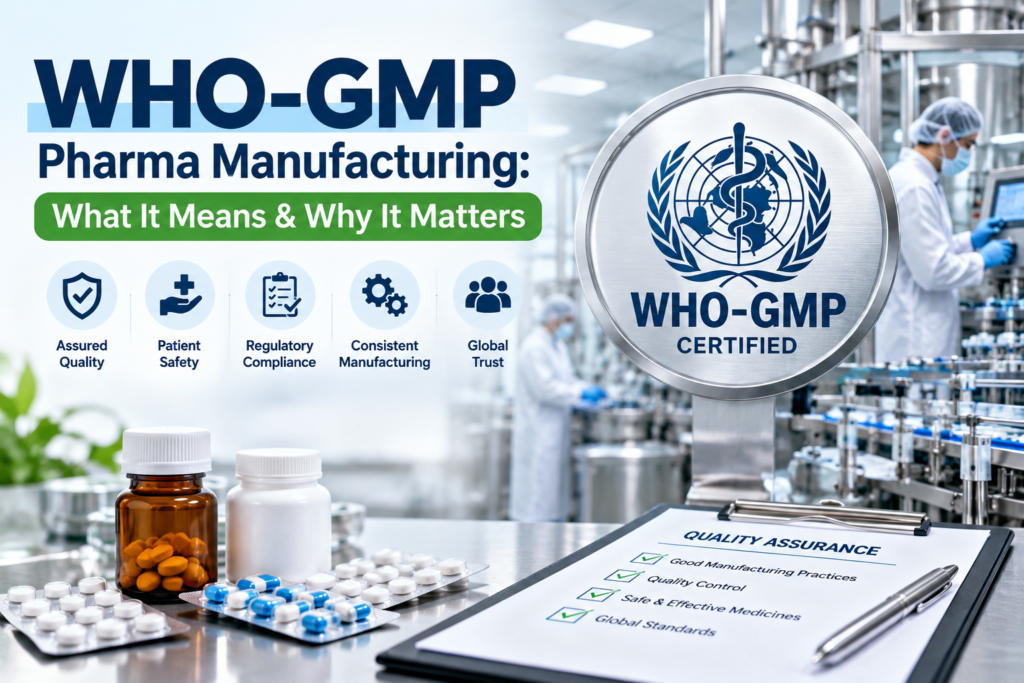
WHO-GMP stands for World Health Organization Good Manufacturing Practices. In simple terms, it refers to manufacturing practices that follow GMP guidance published by the World Health Organization (WHO).
What are Good Manufacturing Practices?
GMP is a system of controls that helps ensure medicines are consistently produced and checked against quality standards suited to their intended use. It covers premises, equipment, personnel, raw materials, production, testing, documentation and product handling. Its main concern is repeatable, documented control of the process. A company’s reputation, or a good result on one batch, does not substitute for that.
Two terms appear throughout GMP:
- Quality assurance (QA): the overall system, including procedures, training, audits and change control, that builds quality into the process.
- Quality control (QC): the laboratory side, which tests materials and products against specifications.
Who certifies what?
This is where many people get confused. WHO publishes GMP guidance. Its main-principles text is in WHO Technical Report Series 986, Annex 2. WHO also maintains a broader set of GMP guidelines for areas such as sterile products, herbal medicines and water systems. WHO’s guidance describes GMP as one element of the WHO Certification Scheme on the quality of pharmaceutical products moving in international commerce.
That is not the same as WHO inspecting and certifying every factory. In practice, a document that mentions WHO-GMP is usually issued by a national or state regulatory authority, under that country’s procedure, for a specific site and, often, specific products. What the document actually covers depends on who issued it and under which scheme.
What Are the Main Principles of WHO-GMP?
The exact requirements vary with the applicable GMP framework, dosage form, product type and regulation. A sterile injectable needs far tighter environmental control than an oral tablet, for example. These are the core areas in plain language.
Quality Management System
A quality management system is the set of documented procedures and responsibilities that keep manufacturing under control. It includes investigation of deviations (departures from an approved procedure), corrective and preventive actions (CAPA), change control and continual improvement. Our guide to the pharmaceutical quality management system goes deeper into how these elements connect.
Trained Personnel and Hygiene
Staff must be trained for their tasks and follow hygiene and gowning rules suited to the product. The aim is to prevent contamination of products by people and materials.
Premises, Equipment and Environmental Controls
Facilities should be designed, cleaned and maintained to suit the product and process. Equipment needs to be calibrated (checked against a known standard) and maintained, and environmental controls such as air quality should match the risk of the product.
Raw Material and Supplier Control
Quality begins with inputs. Good practice includes qualifying suppliers, checking materials on receipt, sampling and testing, clear identification, correct storage and a formal release decision before use.
Controlled Manufacturing Processes
Production follows approved procedures and is recorded in batch records. In-process checks and process controls help detect problems early, and segregation and labelling controls help prevent mix-ups and cross-contamination.
Quality Control and Laboratory Testing
Validated or suitable test methods and defined specifications are used to evaluate raw materials, intermediates and finished medicines. This is the heart of pharmaceutical quality control. Testing is one safeguard among several, and it cannot replace a controlled process.
Documentation and Traceability
If something is not recorded, it is hard to show it was done correctly. Batch manufacturing records, laboratory records, equipment logs and deviation reports allow a batch to be traced from materials through to distribution.
Storage, Packaging and Product Distribution
Suitable storage conditions, product identification, packaging and labelling controls, and distribution records help protect product integrity after manufacture and make recalls possible if needed.
How Does WHO-GMP Assessment or Certification Work?
There is no single worldwide procedure. Certificate names, eligibility, application steps, inspection arrangements, validity and issuing authorities differ by country, certificate type, product category and intended market. In general terms, the process tends to follow these stages:
- Identify the applicable standard and regulatory pathway, including the purpose, such as domestic compliance or supporting an export registration.
- Review licences and documentation: manufacturing licence, facility details, product categories and supporting files.
- Assess the site: premises, equipment, quality systems, personnel, procedures and operations.
- Review records that show compliance in practice, not just on paper.
- Inspection by the competent authority or an authorised inspection body, where applicable.
- Address deficiencies: observations are documented and the manufacturer responds with corrective actions.
- Regulatory review and issue of a certificate or other approval when requirements are met.
- Maintain compliance through continuing oversight, records and further inspections as applicable.
The Indian context
In India, drug manufacturing is regulated through the Drugs and Cosmetics Act, 1940 and the Drugs Rules, 1945. State Licensing Authorities grant manufacturing licences, and manufacturers must comply with GMP requirements under Schedule M as a licence condition. Separately, a WHO-GMP-related certificate, such as a WHO-GMP Certificate of Pharmaceutical Product (CoPP), is a different document. It is generally sought to support registration in importing countries. CDSCO procedures described in published circulars involve review of an application and, where required, a joint inspection by CDSCO and state officials, followed by issue of the certificate. Procedures can change, so check current CDSCO guidance.
Two points follow from this:
- A domestic manufacturing licence does not automatically show that a facility holds every form of WHO-GMP certificate.
- A facility described as “GMP-compliant” does not necessarily hold the same certificate as another facility using similar words.
WHO-GMP vs GMP vs Schedule M: What Is the Difference?
These terms are often used as if they were interchangeable. They are not.
| Term | What It Means | Purpose | What Readers Should Verify |
|---|---|---|---|
| GMP | The general concept of Good Manufacturing Practices: controlled, documented manufacturing and testing. | To help ensure medicines are consistently made to quality standards suited to their use. | Which specific GMP standard the company is following and how it demonstrates this. |
| WHO GMP guidance or applicable WHO-GMP framework | GMP guidance published by WHO, used by regulators and in some procurement contexts. | To provide an internationally referenced benchmark for manufacturing practice. | Which WHO text or framework is actually being applied, and by whom it was assessed. |
| WHO-GMP-related certificate, where applicable | A document issued by a competent authority, such as a CoPP in India, under a defined procedure. | Typically to support product registration or supply in other markets. | Issuing authority, site, products or dosage forms covered, date and current validity. |
| Schedule M in India | The part of the Drugs Rules, 1945 that sets GMP and requirements for premises, plant and equipment for pharmaceutical manufacturing. | To set the legal GMP baseline for licensed manufacturers in India. | Valid manufacturing licence and the site’s compliance with the current (revised) Schedule M. |
The Government of India revised Schedule M through G.S.R. 922(E) dated 28 December 2023. The revision added stronger requirements around the pharmaceutical quality system, quality risk management, validation, complaints handling and production under loan licence or contract. Timelines were staged by company size, and the MSME deadline was later extended. News reports indicate that revised Schedule M is now expected of all units from 1 January 2026. Because this area has moved quickly, verify the current position with CDSCO or the relevant State Licensing Authority.
No blanket rule says WHO-GMP is “higher” than Schedule M, or that holding one proves compliance with the other. They serve different purposes and should be checked as separate documents.
Why WHO-GMP Pharma Manufacturing Matters for Medicine Quality and Patient Safety
Many quality failures begin as small process failures, such as a mislabelled container, an unrecorded change or a cleaning step that was skipped. GMP systems are designed to catch these early. Well-run GMP systems help to:
- reduce the risk of contamination and mix-ups;
- keep manufacturing processes controlled and repeatable;
- support correct identity, strength, quality and purity of products;
- improve consistency between batches;
- provide documentation and traceability;
- help investigate complaints, deviations and quality problems; and
- protect product integrity during handling and storage.
GMP helps control risk. It does not guarantee that every batch will be free of defects, or that every patient will have a particular clinical outcome.
Why Manufacturing Standards Matter for Pharma Franchise Partners
In a PCD (Propaganda cum Distribution) arrangement, you promote and sell products that someone else makes. Your name, and your relationships with doctors and chemists, sit on top of a quality system you do not run. So it is reasonable to look at what sits behind the brand. A good pharma franchise company should be able to explain it clearly. Useful areas to examine:
- Sourcing and due diligence: who manufactures the products you will sell, and where.
- Documentation: batch numbers, availability of relevant product documents and traceability.
- Product-specific licences: permissions that apply to the exact products you will stock.
- Storage conditions and complaint handling: what happens if a chemist reports a problem.
- Verification: quality claims should be checked, not accepted on marketing material alone.
A manufacturer’s certification does not remove your own responsibility to comply with applicable laws, licensing conditions and commercial obligations as a distributor or stockist.
Why WHO-GMP Matters in Third-Party Pharmaceutical Manufacturing
Pharmaceutical third-party manufacturing means a licensed manufacturer produces medicines for another business’s brand. Here, the manufacturer’s quality system effectively becomes part of your own supply chain. Before committing, consider:
- Site capability: does the site actually handle your dosage forms (tablets, syrups, injectables, ointments and so on)?
- Quality agreement: who is responsible for what, in writing.
- Specifications and testing: what is tested, against which specifications, and how results are shared.
- Batch documentation and release: how each batch is reviewed and released.
- Complaints, deviations and recalls: how problems are investigated and communicated.
- Regulatory responsibilities: who holds product permissions and who is responsible for labelling, where applicable.
- Commercial fit: capacity, lead times, product availability and communication.
The right partner is the one whose capability, quality systems and regulatory documents you have verified and whose commercial terms suit you. Certification wording alone is not enough. For a wider evaluation framework, see our guide to choosing a pharma manufacturing company.
How to Verify a WHO-GMP Claim Before Choosing a Pharma Company
If you are wondering how to verify WHO-GMP certification, start by asking for specifics. A WHO-GMP certified pharmaceutical company should be able to share the following, subject to legitimate confidentiality limits:
- The relevant certificate or official supporting document.
- The legal name and address of the manufacturing site.
- The name of the issuing authority.
- The date, validity and current status of the certificate, where applicable.
- The dosage forms or product categories it covers.
- Confirmation that it relates to the actual site that makes the products you will buy.
- Applicable manufacturing licences and product permissions.
- Relevant quality documentation.
- How batch testing and product release are handled.
- How complaints, deviations and recalls are managed.
A logo, a website statement or a brochure line is not, by itself, proof of a certificate’s current validity and scope. If you need confirmation, you can contact the issuing or relevant regulatory authority directly. Do not publish confidential documents you receive, and do not bypass official verification channels.
Common Misconceptions About WHO-GMP Manufacturing
“WHO directly certifies every pharmaceutical manufacturer.”
No. WHO publishes GMP guidance and runs a certification scheme framework, but certificates for manufacturing sites are generally issued by national or state regulatory authorities under their own procedures.
“GMP compliance guarantees every medicine is perfect.”
No. GMP reduces risk through controls and documentation. It does not remove all risk.
“A company’s GMP claim covers every product and every site.”
Not necessarily. Scope can be limited to particular sites, dosage forms or products.
“A WHO-GMP certificate and an Indian manufacturing licence mean the same thing.”
They do not. A licence authorises manufacture under the Drugs Rules, with GMP under Schedule M as a condition. A WHO-GMP-related certificate is a separate document issued for a defined purpose.
“A certificate removes the need for batch testing and ongoing quality management.”
No. Each batch still needs testing and release, and quality management must continue between inspections.
“A certified manufacturer guarantees commercial success for a franchise partner.”
No. Quality systems support product reliability, but sales depend on territory, product selection, relationships and execution.
Rosette Pharma’s Approach to Manufacturing Quality
Rosette Pharma is a pharmaceutical company based in Karnal, Haryana. According to its website, it has operated since 2006 and offers both a PCD pharma franchise model with district-level monopoly rights and third-party manufacturing for allopathic, derma and herbal formulations. Its listed product forms include tablets, capsules, syrups, dry syrups, injectables, ointments, softgel capsules, drops and suspensions, sachets and dental products, and its range is organised under divisions such as Rosette Pharmaceuticals, Admetus Pharma, Yeux Care and Rosette Organics.
On quality, the website describes a manufacturing network and states that products are sourced from WHO-GMP-compliant facilities. This article treats that as the company’s own statement. It has not independently verified a specific certificate, issuing authority, validity date, site or product scope, and none of these is published on the pages reviewed.
For that reason, we suggest the same approach we recommend for any supplier. Before ordering, a prospective franchise or manufacturing client should confirm:
- which site will actually manufacture the products they intend to order;
- the relevant product permissions for those products; and
- the quality documentation that applies to that site and those products.
Rosette Pharma’s team can be contacted through its website to request product and manufacturing information.
Questions to Ask Before Selecting a Pharma Franchise or Third-Party Manufacturer
- Which facility will manufacture my products?
- What manufacturing licence and relevant GMP documentation apply to that facility?
- Which product categories and dosage forms are covered?
- What quality testing is performed, and how is batch release documented?
- What product permissions and labelling requirements apply?
- How are deviations, complaints and recalls handled?
- What are the minimum order quantities and lead times?
- What documentation can you provide before an order?
- What quality and supply responsibilities will the agreement define?
Weigh the answers together with commercial terms, reliability, supply capability and regulatory suitability. No single answer settles the decision.
Frequently Asked Questions
1. What does WHO-GMP stand for?
It stands for World Health Organization Good Manufacturing Practices.
2. What is WHO-GMP pharma manufacturing?
It is pharmaceutical manufacturing carried out under GMP controls consistent with WHO guidance, covering premises, personnel, materials, production, testing and documentation. How the claim is evidenced depends on the certificate or assessment behind it.
3. Does WHO directly certify pharmaceutical manufacturing facilities?
Generally, no. WHO publishes the guidance and the certification scheme framework. Site certificates are usually issued by national or state regulatory authorities, such as CDSCO working with state authorities in India.
4. What is the difference between GMP and WHO-GMP?
GMP is the general concept. WHO-GMP refers to GMP as set out in WHO guidance, or to a related certificate issued under an applicable scheme.
5. What is the difference between WHO-GMP and Schedule M in India?
Schedule M is the legal GMP requirement under India’s Drugs Rules, 1945. A WHO-GMP-related certificate is a separate document issued for a defined purpose, commonly export registration. Neither automatically proves the other.
6. How does the WHO-GMP assessment or certification process work?
Typically, a manufacturer applies, documents are reviewed, the site may be inspected, deficiencies are addressed, and the authority issues a certificate if satisfied. Details differ by country, certificate type and market.
7. Does WHO-GMP certification guarantee medicine quality?
No. It indicates that systems were assessed at a point in time. Continuous compliance, batch testing and oversight are still needed.
8. How can I verify a manufacturer’s WHO-GMP claim?
Ask for the certificate, site address, issuing authority, validity and product scope, and check the licence and product permissions. You can contact the issuing or regulatory authority if you need confirmation.
9. Why should pharma franchise partners check manufacturing standards?
Because the quality system behind the products affects supply reliability, customer confidence and complaint handling, all of which affect your reputation.
10. Why is GMP documentation important for third-party pharmaceutical manufacturing?
Batch records, test results and release documents show how your product was made and checked, and they support investigations and recalls.
11. Can one certificate cover every product made by a company?
Not necessarily. A certificate may be limited to a particular site, dosage forms or listed products.
12. What should I ask Rosette Pharma before choosing a manufacturing or franchise arrangement?
Ask which site will manufacture your products, what licences, permissions and GMP documents apply to that site, which dosage forms are covered, how batches are tested and released, how complaints and recalls are handled, and what the minimum order quantities and lead times are.
Conclusion
GMP is the foundation of controlled pharmaceutical manufacturing, covering documentation, testing and quality management. A WHO-GMP pharma manufacturing claim should always be read in context: the certificate or document, the issuing authority, the site, the product categories and the applicable regulatory framework all matter. Treat it as a starting point for due diligence, not the end of it.
If you are considering a PCD pharma franchise or third-party manufacturing, you are welcome to contact Rosette Pharma to discuss its services and to request product and manufacturing documentation for your review.