When most people look at a medicine label, their attention goes straight to the active ingredient — the substance that is supposed to treat the cough, lower the fever, or fight the infection. But a tablet, capsule, or syrup is rarely made from the active ingredient alone. Alongside it sit several other ingredients that help turn that active substance into a medicine that can actually be manufactured, swallowed, stored, and used safely.
These supporting ingredients are called excipients, and understanding what are excipients in medicines is a useful starting point for anyone curious about how pharmaceutical products are actually put together — whether you are a patient reading a label, a pharmacy student, a healthcare professional, or someone exploring pharmaceutical manufacturing and PCD franchise opportunities.
In simple terms, excipients can help with:
- Manufacturing the dosage form
- Stability of the product over its shelf life
- Texture and appearance
- Taste and patient acceptability
- Preservation, where applicable
- Controlling how and when the drug is released
- Overall dosage-form performance
- Handling, packaging, and storage
This article breaks down what excipients are, why they are added to medicines, the main types you will come across, how they function in different dosage forms, and how their safety and quality are assessed.
What Is an Excipient?
To understand excipients, it helps to first separate them from the active pharmaceutical ingredient (API).
Active Pharmaceutical Ingredient (API): This is the component of a medicine that is intended to produce the primary therapeutic effect — for example, the substance responsible for reducing pain, lowering blood pressure, or clearing an infection.
Excipient: This is any other ingredient, intentionally added to the formulation, that supports the manufacturing, stability, delivery, appearance, taste, or overall performance of the pharmaceutical product. Excipients are not intended to provide the medicine’s main therapeutic effect.
According to U.S. Food and Drug Administration (FDA) regulations, an inactive ingredient is defined as any component of a drug product other than the active ingredient, while an active ingredient is any component intended to furnish pharmacological activity or another direct effect in the diagnosis, cure, mitigation, treatment, or prevention of disease. The FDA maintains a public Inactive Ingredient Database (IID) that lists excipients used in FDA-approved drug products, organized by ingredient, route of administration, and dosage form. The term “inactive ingredient” is widely used on regulatory documentation and some product labeling, but it is important not to read “inactive” as meaning “completely inert” or “without any physical or chemical effect.” An excipient may not be intended to treat the condition the medicine addresses, yet it can still influence how a tablet dissolves, how a suspension behaves on the shelf, or how comfortably a cream spreads on the skin. The U.S. Pharmacopeia (USP) notes that excipient functions range from helping to guarantee the stability and bioavailability of the API to the drug product’s manufacturability to its texture and taste, reflecting how central these ingredients are to a finished product’s real-world performance.
Why Are Excipients Added to Medicines?
Manufacturers include excipients for several practical and scientific reasons. Some of the most common include:
- Helping manufacture the dosage form — Many active ingredients are needed in very small doses and cannot, by themselves, be compressed into a tablet or filled into a capsule. Excipients provide the necessary bulk and flow properties.
- Improving stability — Certain excipients help protect the API from moisture, light, oxidation, or degradation during storage.
- Supporting drug delivery — Excipients can help the API reach the intended site of action in a usable form.
- Controlling drug release — Some formulations use excipients specifically designed to release the API gradually or at a particular location in the body.
- Improving taste — Sweeteners and flavoring agents make oral liquids and chewable products more acceptable, especially for children.
- Improving appearance — Colors and coatings can help with product identification and visual appeal.
- Helping maintain consistency — Excipients help ensure that each tablet, capsule, or dose of liquid medicine is uniform.
- Protecting the active ingredient — Coatings and certain formulation aids can shield the API from the environment or from the digestive tract until the right moment.
- Supporting preservation, where applicable — Some liquid and multi-dose products require preservatives to control microbial growth after the container is opened.
- Improving patient acceptability — Texture, smell, and ease of swallowing all affect whether patients take their medicine as prescribed.
- Achieving required physical properties — Viscosity, hardness, and other physical characteristics are often adjusted using excipients.
- Supporting appropriate storage characteristics — Some excipients help a product tolerate temperature or humidity variations during transport and storage.
Active Ingredients vs Excipients
| Feature | Active Ingredient | Excipient |
|---|---|---|
| Primary purpose | Provides the intended therapeutic effect | Supports formulation, delivery, stability, manufacturing, or other product functions |
| Amount | Usually present at a pharmacologically relevant level | Varies depending on the formulation |
| Examples | Paracetamol, amoxicillin, cefpodoxime, etc. | Lactose, starch, cellulose derivatives, magnesium stearate, flavors, colors, etc. |
| Therapeutic role | Main therapeutic component | Generally not intended to provide the primary therapeutic effect |
| Importance | Determines the intended pharmacological action | Helps make the medicine manufacturable, stable, usable, and acceptable |
The exact classification of an ingredient can depend on the specific formulation and regulatory context. For instance, an ingredient that is inactive in one product could, in a different formulation or at a different concentration, be classified differently.
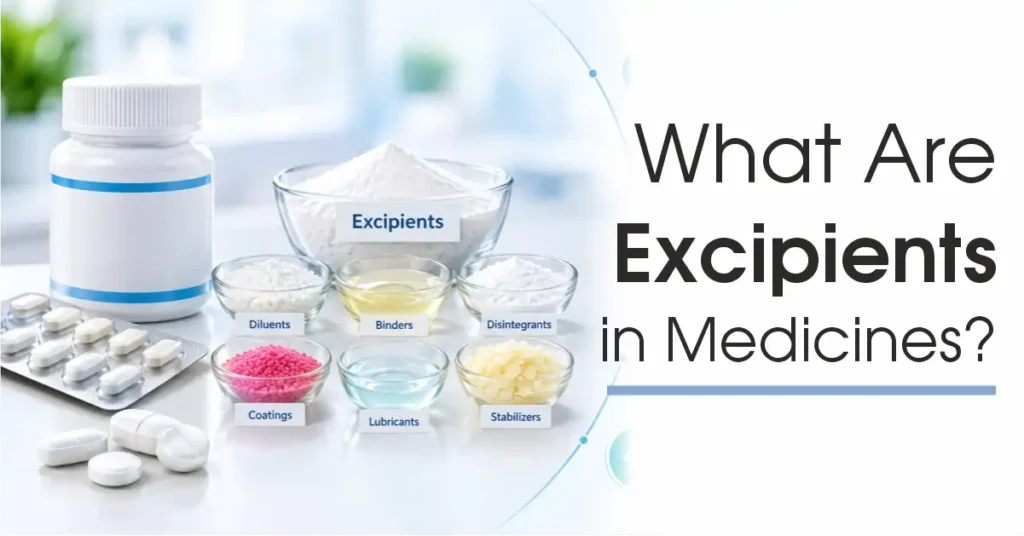
What Are the Different Types of Pharmaceutical Excipients?
Excipients are generally classified according to the function they perform in a formulation. The same chemical substance can sometimes serve different functions in different products, depending on its grade and concentration.
Binders
Binders help powder particles adhere to one another so that a tablet holds its shape after compression. Common examples include povidone, starch, hydroxypropyl cellulose, and hypromellose. Not every tablet uses the same binder — the choice depends on the manufacturing process and the properties of the API.
Fillers / Diluents
When the API dose is very small, fillers add bulk so the tablet or capsule is a practical, handleable size. Common fillers include lactose, microcrystalline cellulose, and calcium phosphate.
Disintegrants
Disintegrants help a tablet break apart after it is swallowed, allowing the API to be released and absorbed. Examples include sodium starch glycolate, croscarmellose sodium, and crospovidone.
Lubricants
Lubricants, most commonly magnesium stearate, reduce friction between powder particles and manufacturing equipment during tablet compression. The concentration and selection of a lubricant matter, since using too much or an unsuitable lubricant can affect how well a tablet compresses or disintegrates.
Glidants
Glidants, such as colloidal silicon dioxide, improve the flow of powder blends during manufacturing, helping ensure consistent tablet weight and content.
Coating Agents
Tablets are sometimes coated for reasons that may include protection from moisture or light, improved appearance, taste masking, easier handling, or a specifically designed modified-release profile. Coating materials may include hypromellose or polymers formulated for enteric or modified-release purposes, depending on the intended function.
Preservatives
In suitable liquid or multi-dose formulations where microbial control is needed after the container has been opened, preservatives such as sodium benzoate or parabens may be used, subject to the specific formulation and applicable regulatory limits. Not every liquid or syrup formulation requires a preservative — this depends on the product design and packaging.
Sweeteners and Flavouring Agents
Oral liquids and chewable formulations often include sweeteners (such as sucrose, sorbitol, or saccharin derivatives) and permitted flavoring agents to improve palatability, which can be particularly important for pediatric and geriatric patients.
Colours
Pharmaceutical colors may be used for product identification, visual appeal, or to help distinguish between different strengths of the same product. Not all medicines contain added colors.
Suspending Agents
In suspensions, where the API does not fully dissolve, suspending agents such as sodium carboxymethylcellulose or xanthan gum help keep particles evenly dispersed and slow down settling.
Solvents and Vehicles
Liquid formulations require a solvent or vehicle — commonly purified water or another suitable pharmaceutical liquid — in which the API and other excipients are dissolved or dispersed.
Surfactants / Wetting Agents
Surfactants can assist with wetting, dispersion, or solubilization of an API, particularly for substances that are poorly soluble in water. Their use depends on the specific formulation requirements.
Common Excipients Used in Different Medicines
| Excipient | Common Function | Possible Dosage Forms |
|---|---|---|
| Lactose | Diluent/filler | Tablets/capsules |
| Microcrystalline cellulose | Diluent/binder | Tablets/capsules |
| Magnesium stearate | Lubricant | Tablets/capsules |
| Povidone | Binder/other formulation functions | Tablets/liquid formulations depending on grade |
| Sodium starch glycolate | Disintegrant | Tablets |
| Croscarmellose sodium | Disintegrant | Tablets |
| Hypromellose | Binder/coating/controlled-release polymer depending on grade | Tablets/capsules |
| Colloidal silicon dioxide | Glidant | Solid dosage forms |
| Xanthan gum | Thickener/suspending agent | Liquid formulations |
| Sodium benzoate | Preservative depending on formulation | Certain liquid products |
This table is illustrative, not a universal formulation guide. An excipient’s actual role can vary based on its grade, concentration, the specific API it is combined with, and the overall formulation design.
What Do Excipients Do in Tablets?
Tablets are one of the most common dosage forms, and their manufacturing relies heavily on excipients working together. A typical general sequence looks like this:
powder preparation → blending → granulation (where applicable) → compression → coating (where applicable)
At each stage, different excipients play supporting roles. Fillers provide adequate bulk, binders hold the powder together during compression, disintegrants allow the tablet to break apart after swallowing, lubricants reduce friction on the manufacturing equipment, and glidants keep the powder flowing evenly into the tablet press. Coatings, when used, can protect the tablet, mask taste, or in some specifically engineered formulations, control the rate of drug release. The combination and quantity of these excipients can meaningfully influence how manufacturable the tablet is and how it ultimately performs once taken by the patient.
What Do Excipients Do in Capsules?
Capsule formulations rely on excipients to support powder flow into the capsule shell, ensure uniform fill weight, and maintain content uniformity from capsule to capsule. Depending on the formulation, excipients such as lubricants, glidants, and fillers may be used inside the capsule to aid manufacturing and support consistent drug release once the capsule shell dissolves. Because capsule formulations vary considerably depending on the API’s properties and the intended release profile, the specific excipients used in one capsule product may differ substantially from another.
What Do Excipients Do in Syrups and Oral Liquids?
Oral liquid medicines depend on a different set of excipient functions compared with solid dosage forms. Common roles include:
- Solvents/vehicles — typically purified water, providing the liquid base
- Sweeteners — improving taste, especially important for pediatric formulations
- Flavors — masking unpleasant tastes from the API
- Preservatives, where applicable — controlling microbial growth in multi-dose liquid containers
- Viscosity modifiers — achieving a suitable, pourable consistency
- Buffers — helping maintain an appropriate pH for stability
- Suspending agents — used specifically in suspensions to keep undissolved particles evenly dispersed
- Stabilizers — supporting the chemical or physical stability of the formulation over its shelf life
It is worth distinguishing between a solution and a suspension. In a solution, the API is completely dissolved in the vehicle, producing a clear, uniform liquid. In a suspension, the API does not fully dissolve and instead remains as fine particles dispersed throughout the liquid, which is why suspensions typically need to be shaken before use. The excipients chosen — particularly suspending agents, wetting agents, and viscosity modifiers — differ accordingly between the two dosage forms.
What Do Excipients Do in Creams, Ointments and Gels?
Topical formulations rely on excipients to achieve the right consistency, spreadability, and skin feel while supporting the stability and performance of the product. Depending on the formulation type, these may include:
- Bases — the primary vehicle (oil-based, water-based, or a combination) that carries the API
- Emulsifiers — helping combine oil and water phases into a stable cream
- Gelling agents — giving gels their characteristic texture and viscosity
- Humectants — helping retain moisture and improve skin feel
- Preservatives — protecting suitable formulations from microbial contamination
These excipients influence not only how the product looks and feels on application, but also how well the API can be released and absorbed through the skin, and how stable the formulation remains over its shelf life.
Are Excipients Safe?
Excipient safety is a nuanced topic, and it deserves an objective, balanced answer rather than a simple yes or no.
Excipients used in approved pharmaceutical products are selected with safety considerations in mind for their intended route of administration, dosage form, and level of use. The FDA’s Inactive Ingredient Database, for instance, records the excipients and maximum levels used in already-approved products, which can serve as a reference point during new drug development. Regulatory bodies and pharmacopoeial organizations such as USP also maintain quality standards that excipients are expected to meet.
That said, safety is not an absolute, one-size-fits-all property. It depends on the specific substance, the amount used, the route of administration, the dosage form, and individual patient factors. Calling an ingredient “inactive” does not automatically mean every person will tolerate it equally well. Some individuals may have allergies, intolerances, sensitivities, or dietary or religious restrictions related to specific excipients.
In short: excipients used in properly manufactured, approved medicines are generally considered acceptable for their intended use, but this does not mean every excipient is universally harmless for every person, nor does it mean excipients are inherently risky. The reality sits between those two extremes and depends on the specifics of the product and the individual.
Can Excipients Cause Allergies or Side Effects?
Yes, in some cases. While most people tolerate common excipients without any issue, certain individuals may react to specific ingredients found in medicines. Examples that can be clinically relevant for particular patients include:
- Certain dyes, in individuals sensitive to specific colorants
- Lactose, in people with lactose intolerance, depending on the amount present
- Gelatin, relevant for people with certain dietary restrictions or specific allergies
- Specific preservatives, in individuals sensitive to particular preservative classes
- Certain sweeteners, for patients managing specific dietary or metabolic conditions
Not every adverse reaction to a medicine is caused by an excipient — it could also relate to the active ingredient itself or to other factors. This article cannot diagnose an allergy or intolerance. People with known allergies, intolerances, dietary restrictions, or other specific concerns should check the product’s official ingredient information and speak with a doctor or pharmacist if they have questions about a particular medicine.
Why Can Two Medicines With the Same Active Ingredient Have Different Excipients?
It’s common to see two products containing the same API — one branded, one generic, or simply two different manufacturers’ versions — that list different excipients. This happens for several legitimate reasons:
- Manufacturer formulation choices — each company develops its own formulation approach
- Dosage form differences — a tablet, capsule, and syrup of the same API will naturally use different excipients
- Manufacturing process — different equipment and processes may call for different excipient properties
- Taste and patient acceptability — flavoring and sweetening choices vary by manufacturer
- Stability considerations — some excipients protect certain APIs better than others
- Release characteristics — a modified-release product will use different excipients than an immediate-release one
- Color and coating choices — often used for product identification
- Excipient availability and formulation technology — supply chains and available technology can vary by manufacturer and region
Generic and brand-name products may therefore differ in their excipients while still being required to meet the applicable regulatory and quality requirements for their category. A difference in excipients does not, by itself, mean one product is inferior to another — it usually reflects a different formulation approach to the same therapeutic goal.
How Are Excipients Selected During Drug Formulation?
Choosing the right excipients is a core part of pharmaceutical formulation development. Formulators typically consider:
- Compatibility with the API (chemical and physical)
- Stability requirements over the product’s intended shelf life
- The intended dosage form
- Route of administration
- The desired drug release profile
- Manufacturability at commercial scale
- Physical properties, such as flow, compressibility, or viscosity
- Safety for the intended patient population and route
- Patient acceptability, including taste and ease of use
- Regulatory considerations and precedent of use
- Storage conditions the product will be exposed to
- Packaging compatibility
Excipient selection is rarely a matter of picking a single “best” ingredient — it usually involves balancing multiple, sometimes competing, formulation requirements to arrive at a workable, stable, and patient-friendly product.
How Are Pharmaceutical Excipients Tested for Quality?
Excipients themselves are subject to quality control, since a poor-quality excipient can compromise an otherwise well-designed formulation. Depending on the specific excipient and its applicable specification, relevant quality checks can include:
- Identity — confirming the substance is what it is labeled as
- Purity — checking for unwanted impurities
- Assay, where applicable — confirming the content of the excipient meets specification
- Moisture/water content — relevant for hygroscopic or moisture-sensitive excipients
- Microbial quality, where applicable — particularly for excipients used in liquid or topical products
- Physical characteristics — such as particle size or viscosity, for relevant excipients
- Supplier qualification — verifying that the excipient source meets quality expectations
- Specification compliance and Certificates of Analysis — documentation confirming each batch meets defined criteria
Pharmacopoeial standards, such as those published in USP–NF, provide monographs with specifications and analytical procedures for many excipients. According to USP, because excipients can make up a substantial share of a finished medicine by mass, their quality is critical for a drug to be safe and effective, and documentary standards exist to help establish the identity, purity, and quality of these ingredients. Not every excipient undergoes every test listed above — the applicable testing depends on the specific excipient, its intended use, and the relevant specification.
What Is the Difference Between an Excipient and an API?
To put it simply:
API = the primary therapeutic ingredient. It is responsible for the medicine’s intended pharmacological action.
Excipient = a supporting pharmaceutical ingredient. It helps formulate, manufacture, stabilize, deliver, or otherwise support the finished product.
Consider a hypothetical tablet: it might contain an API responsible for the therapeutic effect, while excipients provide bulk, help the tablet hold together, allow it to break apart appropriately after swallowing, and improve the overall manufacturing process. Neither component works in isolation — the finished medicine depends on both the right API and a well-designed set of supporting excipients.
Do Excipients Affect How a Medicine Works?
Although excipients are generally not intended to provide a medicine’s primary therapeutic effect, they can still influence several aspects of how a medicine performs, including:
- Dissolution rate
- Drug release profile
- Chemical and physical stability
- Absorption
- Bioavailability
- Physical properties relevant to use
- Patient acceptability, which can affect adherence
FDA-supported research has recognized that excipients can, in certain circumstances, affect drug absorption or interact with biological transport mechanisms, which is one reason excipient selection is taken seriously during drug development rather than treated as an afterthought. This does not mean every excipient changes how a drug is absorbed — the effect, if any, depends heavily on the specific excipient, its concentration, and the formulation as a whole.
Why Excipients Matter in Pharmaceutical Manufacturing
For anyone involved in or exploring pharmaceutical manufacturing — including third-party manufacturing and PCD franchise operations — excipients are far more than a technical footnote. They influence:
- Production efficiency — the right excipients can make a formulation easier and faster to manufacture at scale
- Tablet compression — binders, lubricants, and glidants directly affect how well a formulation compresses
- Powder flow — consistent flow properties reduce weight variation and manufacturing downtime
- Dosage-form consistency — uniform excipient distribution supports consistent dosing from unit to unit
- Product stability — appropriate excipient choices extend shelf life and reduce degradation risk
- Packaging and storage — some excipients affect how a product tolerates temperature, humidity, or light during distribution
- Patient acceptability — taste, texture, and appearance affect whether patients use the product as intended
- Final product performance — ultimately, the combined effect of API and excipients determines whether the finished product meets its intended quality standards
A sound understanding of excipient function is therefore an important part of pharmaceutical quality — not just for formulation scientists, but for anyone working across the manufacturing and distribution chain.
Frequently Asked Questions About Excipients
1. What are excipients in medicines?
Excipients are ingredients intentionally included in a medicine, other than the active pharmaceutical ingredient, that support manufacturing, stability, delivery, appearance, taste, or overall dosage-form performance.
2. Are excipients the same as inactive ingredients?
The term “inactive ingredient” is commonly used to describe excipients on regulatory documentation, but “inactive” refers to the intent that the ingredient does not provide the primary therapeutic effect — it does not mean the ingredient has zero physical, chemical, or formulation impact.
3. What is the difference between an API and an excipient?
The API is the ingredient responsible for the medicine’s intended therapeutic effect. An excipient is a supporting ingredient that helps formulate, manufacture, or deliver the product.
4. Why are excipients added to tablets?
Tablets typically need fillers for bulk, binders to hold particles together, disintegrants to allow the tablet to break apart, lubricants and glidants to aid manufacturing, and sometimes coatings for protection or appearance.
5. What are common examples of pharmaceutical excipients?
Common examples include lactose, microcrystalline cellulose, magnesium stearate, povidone, sodium starch glycolate, croscarmellose sodium, and colloidal silicon dioxide, among many others.
6. Are pharmaceutical excipients safe?
Excipients used in approved products are selected with safety considerations for their intended use, but safety depends on the specific substance, amount, route, and individual patient factors. They are neither universally harmless nor inherently dangerous.
7. Can excipients cause allergies?
Yes, some people may have allergies, intolerances, or sensitivities to specific excipients such as certain dyes, preservatives, or sweeteners. Patients with known concerns should check product labeling and consult a doctor or pharmacist.
8. Can two medicines with the same active ingredient have different excipients?
Yes. Different manufacturers may choose different excipients based on their formulation approach, dosage form, manufacturing process, and other factors, while still meeting applicable quality and regulatory requirements.
9. Do excipients affect drug absorption?
Some excipients can influence dissolution, absorption, or bioavailability, but this is not true of every excipient in every formulation — the effect depends on the specific excipient and the overall formulation.
10. How are pharmaceutical excipients tested?
Depending on the specific excipient, testing may include checks on identity, purity, moisture content, microbial quality, and physical characteristics, often against pharmacopoeial standards such as USP–NF monographs.
Conclusion
Excipients are the ingredients in a medicine that work alongside the active pharmaceutical ingredient without being intended to provide its main therapeutic effect. They help formulate, manufacture, stabilize, and deliver medicines in a form that patients can actually use — from the binders and disintegrants that shape a tablet, to the suspending agents and flavors that make a syrup pleasant and consistent, to the bases and emulsifiers that give a cream its texture.
While excipients are commonly labeled “inactive,” that description refers to their intended therapeutic role, not to whether they have any physical or chemical influence on a formulation. Excipient selection, quality testing, and regulatory oversight all exist because these ingredients genuinely matter to how a medicine performs, how stable it remains, and how comfortably a patient can use it. Understanding excipients — their types, functions, and the care that goes into selecting and testing them — offers a clearer picture of what actually goes into the medicines people rely on every day, and why formulation science remains such an important part of pharmaceutical manufacturing.
Medical Disclaimer: The ingredients and formulations of medicines vary by product and manufacturer. This article is intended for general educational purposes and is not a substitute for professional medical or pharmaceutical advice. Readers with allergies, intolerances, dietary restrictions, or concerns about a particular medicine’s ingredients should consult a doctor or pharmacist and check the product’s official labeling.