Every medicine on a pharmacy shelf — a tablet for fever, an antibiotic capsule, or an injectable for a hospital ward — represents the end point of a long chain of scientific, clinical, regulatory, and manufacturing work. Long before a strip of tablets reaches a chemist’s counter, a molecule has been studied in laboratories, tested for safety, evaluated in human volunteers, reviewed by regulators, and manufactured under strict quality controls.
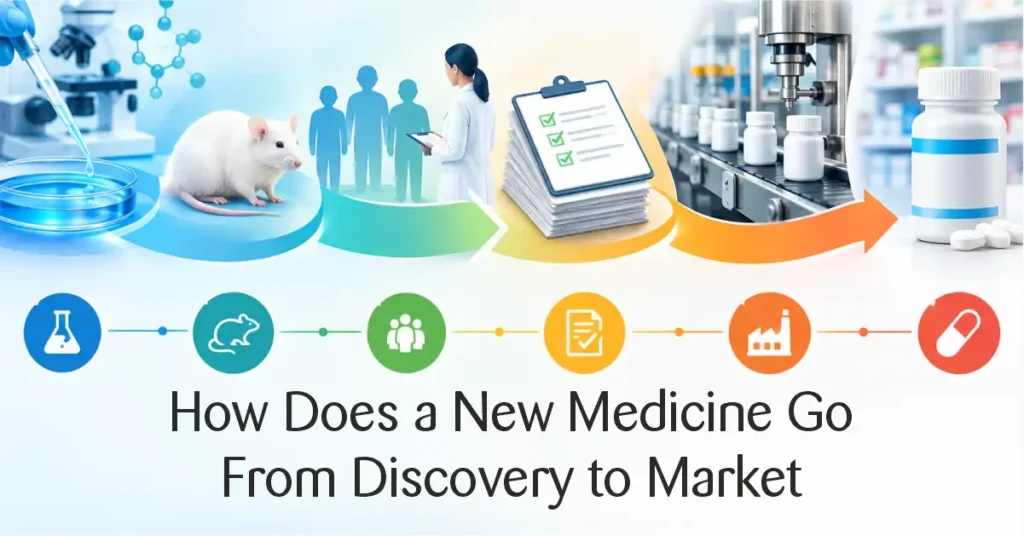
This journey of how does a new medicine go from discovery to market is often summarised as: Discovery → Preclinical Research → Clinical Trials → Regulatory Review → Manufacturing & Quality → Market Launch → Post-Market Monitoring. It is important to understand that not every medicine follows an identical path. Timelines, study designs, and regulatory routes can differ depending on the type of medicine, the disease it targets, and the country where it is being developed. This article explains the general scientific and regulatory journey of a new medicine, with specific reference to the United States (FDA) and India (CDSCO) as two well-documented — but different — regulatory systems.
What Is Drug Discovery?
Drug discovery is the earliest scientific stage of the drug discovery process. Here, researchers try to understand a disease or a biological problem well enough to identify a way to influence it favourably. This typically involves:
- Understanding the biology of a disease and the body processes involved
- Identifying potential biological “targets” (such as a protein or enzyme) linked to the disease
- Finding or designing candidate molecules that may interact with that target
- Screening large numbers of compounds for useful biological activity
- Studying how candidate molecules behave in laboratory systems
- Selecting a small number of promising candidates for further study
During this stage, scientists may investigate several kinds of candidates: small-molecule chemical compounds, biologics (medicines derived from living cells), existing approved compounds being studied for new potential uses (known as repurposing), or entirely new approaches to a biological target. Discovery research is exploratory in nature — most of the compounds studied at this stage will not eventually become an approved medicine.
How Scientists Identify a Potential Drug Candidate
Once discovery research points toward a promising area, scientists work to narrow a broad scientific idea into a specific drug candidate. This transition generally includes:
- Target identification — pinpointing the biological molecule the medicine is meant to act on
- Target validation — confirming that acting on this target is likely to have a meaningful effect on the disease
- Lead discovery and screening — testing many compounds to find ones that interact with the target
- Lead optimisation — chemically refining promising compounds to improve their activity and reduce unwanted effects
Throughout this process, researchers evaluate a candidate’s pharmacological activity (how strongly and specifically it acts on the target), its selectivity (whether it avoids unwanted interactions with other biological structures), early indications of toxicity, and its likely pharmacokinetic properties — in simple terms, how the body is expected to absorb, distribute, break down, and eliminate the compound. Only candidates that perform reasonably well across these considerations move forward.
What Happens During Preclinical Research?
A promising candidate cannot simply be given to a person. Before any human testing, researchers conduct preclinical drug development studies to evaluate potential risks. These generally include:
- In vitro studies — experiments conducted outside a living organism, such as in cell cultures
- In vivo studies — experiments conducted in living biological systems, most often laboratory animals, under strict ethical and welfare oversight
- Studies of pharmacology (how the compound produces its effects) and toxicology (what harmful effects may occur, and at what exposure)
- Studies of absorption, distribution, metabolism, and excretion (ADME)
- Assessment of dose-related toxicity and possible adverse effects
Preclinical research helps researchers evaluate potential risks before human testing and helps regulators decide whether there is enough evidence to justify moving into clinical trials. It is important to be precise about what this stage can and cannot show: preclinical studies provide an early risk assessment, but animal and laboratory data do not prove that a medicine is completely safe for humans. Human biology can differ from that of laboratory models, which is one reason clinical trials remain essential.
Why Good Laboratory Practices Matter
Because decisions about human safety may eventually rest on nonclinical study data, quality and standardisation matter a great deal. Good Laboratory Practice (GLP) is a formal quality system that governs how certain nonclinical safety studies are planned, performed, monitored, recorded, and reported. It covers areas such as:
- Detailed, pre-approved study protocols
- Accurate and traceable documentation
- Data integrity and record-keeping
- Independent quality assurance oversight
- Reproducibility of results across facilities
It is worth noting that not every early, exploratory laboratory experiment in the discovery phase is conducted under formal GLP conditions. GLP requirements typically become important for the nonclinical safety studies that are submitted to regulators to support human testing, since regulators rely on this data to judge whether a study’s results can be trusted.
When Does a Candidate Enter Human Clinical Trials?
Before any human testing can begin, a regulator must authorise it. This authorisation step differs by country, and it is important not to assume the terminology is identical everywhere.
In the United States, a sponsor (a company, research institution, or other organisation) submits an Investigational New Drug (IND) application to the Food and Drug Administration (FDA). The IND includes preclinical data, manufacturing information, and the proposed clinical protocol. Clinical trials in humans can begin only after the IND has been reviewed by the FDA and by a local Institutional Review Board (IRB).
In India, human clinical trials are governed by the New Drugs and Clinical Trials (NDCT) Rules, 2019, administered by the Central Drugs Standard Control Organization (CDSCO). Under these rules, a sponsor must apply to the Central Licensing Authority (headed by the Drugs Controller General of India, or DCGI) using Form CT-04, along with the study protocol, investigator’s brochure, and other supporting documents specified in the rules. The application must also be reviewed and approved by a registered Ethics Committee before enrolment can begin. The CDSCO is generally required to decide on a standard clinical trial application within a specified working-day period set out in the rules, and shorter timeframes apply in certain circumstances defined by the rules, such as for drugs discovered and developed in India.
The underlying principle is the same in both systems: regulators and ethics bodies review the available evidence before allowing a new compound to be tested in people. The specific forms, authorities, and timeframes, however, are jurisdiction-specific and should not be assumed to be interchangeable.
What Are Clinical Trials?
According to the World Health Organization (WHO), a clinical trial is any research study that prospectively assigns human participants to one or more health-related interventions in order to evaluate the effects on health outcomes. This definition covers Phase 1 through Phase 4 studies and includes trials of drugs, biological products, and other interventions.
Clinical trials exist to answer questions that laboratory and animal studies cannot fully answer: How does this candidate behave in the human body? Is it reasonably safe at the doses being studied? Does it produce a meaningful clinical benefit? Because these questions involve real people, clinical trials are:
- Carefully designed in advance, with a written protocol describing objectives, procedures, and safety monitoring
- Reviewed by an independent ethics committee or institutional review board before they can start
- Conducted only after participants have given informed consent — a process where prospective participants are told about the purpose, procedures, possible risks, and their right to withdraw
- Registered on a recognised clinical trials registry, in line with WHO’s position that registration of all interventional trials is a scientific, ethical, and transparency obligation
Volunteers and patients take part in clinical trials for varied reasons, including access to new treatment options and a wish to contribute to medical knowledge. Trial design — the number of participants, the comparison group used, and the duration — varies considerably depending on the disease and the specific scientific questions being asked.
What Happens in Phase 1 Clinical Trials?
Phase 1 is usually the first time a candidate is given to humans. Its main purposes are to assess:
- Safety and tolerability at increasing dose levels
- Pharmacokinetics — how the human body absorbs, distributes, metabolises, and eliminates the compound
- A preliminary safe dose range for further study
- Any adverse effects that appear even at low exposure
Phase 1 studies are generally smaller than later-phase trials and are often conducted in healthy volunteers, although some Phase 1 studies — for example, in oncology — are conducted directly in patients. It is not accurate to present a single fixed number of participants as a universal rule; study size depends on the specific drug, disease area, and study design.
What Happens in Phase 2 Clinical Trials?
Phase 2 trials are conducted in people who have the condition the medicine is intended to treat. This phase focuses on:
- Gathering initial evidence of effectiveness
- Continuing to evaluate safety in a larger and more relevant population
- Helping researchers select an appropriate dose for later studies
- Refining the understanding of the medicine’s benefit-risk profile
Phase 2 trials are generally larger than Phase 1 trials, but exact study size and duration vary widely depending on the disease being studied, the number of doses being compared, and other design factors.
What Happens in Phase 3 Clinical Trials?
Phase 3 trials are typically larger, often multi-centre studies intended to generate confirmatory evidence of safety and effectiveness. Depending on the disease and available treatment options, these trials may compare the new medicine with a placebo, an existing standard treatment, or both, and may be conducted across different populations or clinical settings to better understand how the medicine performs more broadly. Safety monitoring continues throughout. Phase 3 data commonly forms a major part of the evidence submitted to regulators for marketing authorisation, although not every medicine necessarily follows an identical, linear Phase 1 → 2 → 3 sequence; some development programmes use adapted or combined designs depending on the disease and regulatory pathway involved.
Clinical Trial Phases at a Glance
| Phase | Main Purpose | Typical Focus | General Study Population |
|---|---|---|---|
| Phase 1 | First human exposure | Safety, tolerability, dose range, pharmacokinetics | Small group, often healthy volunteers (varies by disease area) |
| Phase 2 | Early evidence of effect | Effectiveness signals, dose selection, continued safety review | Patients with the target condition; larger than Phase 1 |
| Phase 3 | Confirmatory evidence | Larger-scale safety and effectiveness, comparison with existing treatment or placebo where appropriate | Larger, often multi-centre patient populations |
| Phase 4 / Post-market | Real-world monitoring | Long-term safety, rare adverse effects, use in wider populations | Patients using the medicine after approval, in routine care |
Note: Study size, design, and duration vary by disease, medicine type, and regulatory requirement. The figures above describe general patterns, not fixed or universal requirements.
How Is a New Medicine Submitted for Regulatory Approval?
Once a sponsor has collected sufficient nonclinical and clinical evidence, it submits a formal marketing application to the relevant regulator.
In the United States, this is generally done through a New Drug Application (NDA) submitted to the FDA’s Center for Drug Evaluation and Research (CDER). An NDA compiles evidence of safety and effectiveness, proposed product labelling, and detailed chemistry, manufacturing, and control (CMC) information, along with the clinical and nonclinical data generated during development.
In India, applications for permission to manufacture and market a new drug are made to the Central Licensing Authority under the CDSCO, under the framework of the New Drugs and Clinical Trials Rules, 2019, and the Drugs and Cosmetics Act, 1940. The specific forms and documentation required under Indian rules are distinct from the FDA’s NDA process, even though both systems are built around the same underlying goal: demonstrating that a medicine’s benefits outweigh its risks and that it can be manufactured to a consistent quality standard. Readers should not assume that FDA terminology such as “NDA” describes India’s process, or vice versa — each regulator has its own legal framework, forms, and evidentiary requirements.
What Do Regulators Actually Review?
A common misconception is that regulatory approval is only about whether a medicine “works.” In practice, regulators such as the FDA and CDSCO assess a much broader set of factors, including:
- Safety — the nature, frequency, and severity of observed adverse effects
- Efficacy or effectiveness — whether the medicine produces the intended clinical benefit
- Benefit-risk balance — whether the benefits reasonably outweigh the known risks for the intended population
- Proposed labelling — whether prescribing information, dosing instructions, and warnings are appropriate and clear
- Manufacturing processes and quality controls — whether the medicine can be produced consistently
- Identity, strength, purity, and stability of the finished product
- Batch-to-batch consistency
- Where applicable, a risk management plan for monitoring or minimising known risks after launch
In other words, a medicine that appears to “work” in trials will not be approved unless it can also be manufactured reliably, labelled accurately, and shown to have a favourable benefit-risk profile for its intended use.
Why Pharmaceutical Manufacturing Matters Before Approval
Manufacturing is not a separate activity that begins only after approval — it is an integral part of pharmaceutical development, and it is an area with direct, everyday relevance to companies engaged in third-party pharmaceutical manufacturing in India. Key elements include:
- Formulation development — converting an active ingredient into a usable, stable product
- Selection and characterisation of the active pharmaceutical ingredient (API) and excipients (the other ingredients that support delivery, stability, or manufacturability)
- Choice of dosage form and development of a reproducible manufacturing process
- Process controls to keep each batch within defined specifications
- Quality control testing at various stages of production
- Stability testing to determine shelf life under specified storage conditions
- Appropriate packaging to protect the product and support correct use
- Batch consistency and thorough documentation for regulatory traceability
A promising molecule identified in the laboratory is not yet a finished medicine. It has to be developed into a formulation that can be manufactured consistently, batch after batch, to the quality standards regulators expect. This is a core reason why manufacturing partners with strong, verifiable quality systems — such as Rosette Pharma’s third-party manufacturing and PCD pharma franchise services — play an important supporting role in the broader pharmaceutical ecosystem, working within manufacturing specifications and regulatory frameworks set by brand owners and regulators rather than setting them independently.
From Drug Candidate to Finished Dosage Form
An active ingredient can eventually be developed into several different dosage forms, including tablets, capsules, dry syrups, suspensions, injections, creams, ointments, and topical solutions. The choice of dosage form is not arbitrary — formulation scientists consider factors such as:
- Chemical stability of the active ingredient in a given formulation
- Solubility and how this affects absorption
- Bioavailability — the proportion of the active ingredient that reaches systemic circulation in an active form
- Patient usability, including ease of administration for different age groups or conditions
- Manufacturing feasibility at a commercial scale
- Packaging requirements needed to maintain stability and safety
Not every drug can be manufactured in every dosage form; some molecules are chemically unstable in certain formulations, while others cannot be absorbed effectively if given orally and must instead be formulated as injectables. This is one reason product categories perform differently across therapeutic segments and formats, a pattern explored in more detail in this overview of how different pharmaceutical product categories perform in the Indian market.
Why Quality Control and Quality Assurance Are Important
Quality Control (QC) refers to the testing and evaluation of raw materials, in-process samples, and finished products against defined specifications. Quality Assurance (QA) is the broader system of procedures, documentation, and oversight designed to ensure that manufacturing processes consistently produce products that meet the required quality standards.
Together, QC and QA typically cover:
- Testing of incoming raw materials
- In-process testing during manufacturing
- Finished-product testing before release
- Defined specifications for identity, strength, and purity
- Stability testing under controlled storage conditions
- Formal batch release procedures
- Deviation management and, where needed, Corrective and Preventive Action (CAPA) processes
It is worth being clear that no single certification, by itself, guarantees the overall quality of every batch a facility produces. Quality is maintained through the ongoing, day-to-day operation of these systems rather than through a one-time certificate.
What Happens After Regulatory Approval?
Regulatory approval is not the end of a medicine’s lifecycle — it marks the beginning of commercial use. After approval, activities typically include:
- Scaling up to commercial manufacturing
- Distribution to pharmacies, hospitals, and healthcare providers
- Market launch, supported by accurate product information for prescribers and patients
- Ongoing pharmacovigilance and adverse-event monitoring
- Post-market studies, where regulators require them
- Periodic regulatory updates, such as label changes as new information emerges
Continued monitoring matters because clinical trials, however well designed, involve limited numbers of people over a limited period of time, and real-world use often reveals information that trials could not capture.
What Is Post-Market Safety Monitoring?
Clinical trials cannot identify every possible safety issue before a medicine reaches the market. Trials typically involve selected populations, controlled conditions, and limited duration, whereas real-world use involves far larger and more diverse populations, over longer periods, often alongside other medicines and health conditions. This is why pharmacovigilance — the science and activities related to detecting, assessing, understanding, and preventing adverse effects — continues after approval.
In the United States, the FDA operates the FDA Adverse Event Reporting System (FAERS), which receives voluntary reports from healthcare professionals and consumers through the MedWatch programme, as well as mandatory reports from manufacturers. The FDA’s Division of Pharmacovigilance analyses these reports to detect safety signals, which can lead to labelling changes, additional studies, or other regulatory action.
In India, the Pharmacovigilance Programme of India (PvPI), coordinated by the Indian Pharmacopoeia Commission (IPC) under the Ministry of Health and Family Welfare, collects, collates, and analyses adverse drug reaction reports from a national network of ADR Monitoring Centres. PvPI sends its recommendations to the CDSCO, which can then take regulatory action such as updating a product label or issuing a drug safety alert. The IPC has also been recognised by the WHO as a Collaborating Centre for Pharmacovigilance in Public Health Programmes and Regulatory Services.
Approval should not be understood as confirmation that every possible risk of a medicine is known. Safety information continues to accumulate throughout a product’s time on the market, which is precisely why post-market monitoring systems exist.
How Long Does It Take to Develop a New Medicine?
There is no single, universal timeline for developing a new medicine, and figures quoted without context should be treated with caution. Development timelines can vary substantially depending on factors such as:
- The type of drug (small molecule, biologic, vaccine, and so on)
- The disease being targeted and how quickly patients can be recruited for trials
- The complexity of the clinical trial design
- Whether unexpected safety findings require additional study
- The regulatory pathway used, including any applicable accelerated or priority review pathways
- How long manufacturing and formulation development take to finalise
- Interruptions or delays during any stage of development
Because so many variables are involved, this article does not present a fixed number of years or months as a general rule. Anyone citing a specific timeline statistic should be able to point to its source and the methodology behind it, since figures published by different organisations can vary considerably depending on how they define the start and end points of “development.”
Why Do Many Drug Candidates Never Reach the Market?
It is common, and scientifically normal, for most drug candidates identified during discovery to fail to reach approval. Reasons for this include:
- Lack of sufficient efficacy in later-stage human studies
- Safety concerns or unacceptable toxicity identified during preclinical or clinical testing
- Unfavourable pharmacokinetic properties, such as poor absorption
- Manufacturing challenges that make a formulation impractical to produce consistently
- An overall unfavourable benefit-risk balance compared with existing treatments
- Difficulties in recruiting enough trial participants
- Commercial or strategic decisions by the developing organisation
Failure at any stage does not necessarily mean the underlying scientific research was wasted. Findings from unsuccessful candidates often inform future research, refine understanding of a disease target, or rule out approaches that would otherwise have been pursued elsewhere.
Discovery vs Development vs Manufacturing
| Stage | Main Question |
|---|---|
| Discovery | Could this scientific idea lead to a useful treatment? |
| Preclinical Development | Is the candidate suitable for human testing? |
| Clinical Development | Does it provide evidence of safety and benefit in people? |
| Regulatory Review | Do the available data support authorisation? |
| Manufacturing | Can the medicine be consistently produced at the required quality? |
| Post-Market Monitoring | What do we learn about safety and use after wider exposure? |
How Technology Is Changing Drug Development
Several technologies are increasingly used to support pharmaceutical research and development, including:
- Artificial intelligence and computational drug discovery, used to help identify potential targets or predict compound behaviour
- Biomarker research, which can help identify patients likely to respond to a treatment
- High-throughput screening, allowing many compounds to be tested quickly
- Precision medicine approaches that consider individual patient or disease characteristics
- Advanced formulation technologies, supporting new dosage forms or delivery methods
- Digital tools in clinical trials, such as electronic data capture and remote monitoring
These technologies can meaningfully support and accelerate parts of the research process, but they do not remove the need for laboratory research, human clinical evidence, independent regulatory review, or manufacturing quality controls. Claims that AI alone can “discover” a safe, ready-to-use medicine are not an accurate description of how drug development or regulatory approval currently works; computational tools narrow down possibilities that must still be tested and confirmed through the established scientific and regulatory process.
What Happens When a Medicine Reaches Patients?
The final transition — from evidence to everyday use — depends on the coordinated roles of several stakeholders:
- Pharmaceutical companies, who develop, register, and market the medicine
- Regulators, who review evidence and authorise marketing
- Manufacturers, who produce the medicine to approved specifications
- Healthcare professionals, who prescribe or recommend the medicine appropriately
- Pharmacists, who dispense the medicine and counsel patients on correct use
- Distributors, who ensure the medicine reaches pharmacies and hospitals
- Patients, who use the medicine as directed
This sequence — Research → Evidence → Approval → Manufacturing → Distribution → Patient Use → Monitoring — reflects how many different functions must work together for a single medicine to be available, safe, and used correctly.
Frequently Asked Questions
How long does it take to develop a new medicine?
There is no single fixed timeline. Development duration depends on the type of drug, the disease being studied, trial design, recruitment speed, regulatory pathway, and manufacturing development, among other factors.
What is the first step in drug development?
The first step is drug discovery — understanding a disease and identifying a potential biological target, followed by finding or designing candidate molecules that may act on it.
What happens before a medicine is tested in humans?
Before human testing, a candidate undergoes preclinical research, including in vitro and in vivo studies, to help evaluate its pharmacology, toxicology, and potential risks.
What are Phase 1, Phase 2, and Phase 3 clinical trials?
Phase 1 primarily assesses safety and dosing in a small group; Phase 2 gathers early evidence of effectiveness in patients with the target condition; Phase 3 gathers larger-scale confirmatory evidence of safety and effectiveness, often compared with existing treatment or placebo.
How does a medicine get regulatory approval?
A sponsor submits a marketing application (such as an NDA to the FDA in the United States, or an application to the CDSCO in India) containing clinical, nonclinical, manufacturing, and labelling data. Regulators review this evidence before authorising the medicine for sale.
Does regulatory approval mean a medicine is completely risk-free?
No. Approval means regulators have assessed that a medicine’s benefits reasonably outweigh its known risks for its intended use, based on available evidence. It does not mean every possible risk has already been identified.
Why is pharmaceutical manufacturing part of drug development?
A medicine must be formulated and manufactured consistently at commercial scale before it can be approved and used safely. Manufacturing quality, stability, and process controls are directly reviewed by regulators as part of the approval process.
What happens after a medicine reaches the market?
After launch, activities include commercial manufacturing, distribution, ongoing pharmacovigilance, adverse-event monitoring, and, where required, additional post-market studies.
Why do some drug candidates fail during development?
Candidates can fail due to insufficient efficacy, safety concerns, poor pharmacokinetic properties, manufacturing challenges, an unfavourable benefit-risk balance, or difficulties recruiting trial participants.
What is pharmacovigilance?
Pharmacovigilance is the science and set of activities involved in detecting, assessing, understanding, and preventing adverse effects or other drug-related problems, both before and after a medicine reaches the market.
How does AI help in drug discovery?
AI and computational tools can help identify potential drug targets, predict how compounds might behave, and support faster screening. They support, but do not replace, laboratory research, clinical trials, and regulatory review.
Can a medicine be changed after it reaches the market?
Yes. Manufacturers may update labelling, dosing information, or safety warnings, or conduct additional studies, based on new safety or efficacy information gathered through post-market monitoring.
Disclaimer
This article is intended for general educational purposes only and does not constitute medical, legal, or regulatory advice. Drug development processes, timelines, and regulatory requirements vary by product, disease area, and jurisdiction, and are subject to change. This article does not provide guidance on the use of any specific medicine. Medicines should always be used strictly according to their approved labelling and the advice of a qualified healthcare professional.