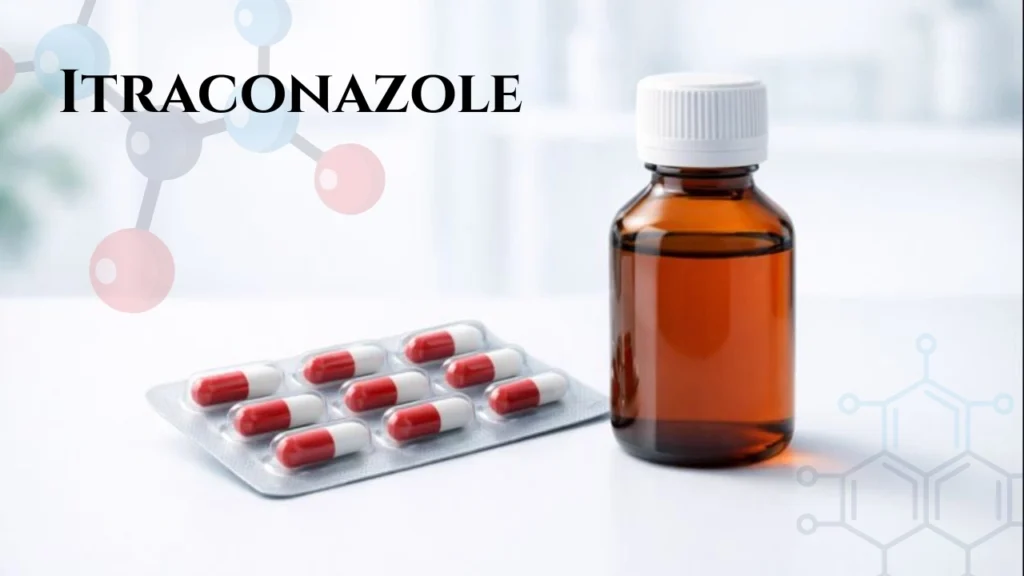
Itraconazole belongs to the triazole class of antifungal medicines, a group of drugs doctors use to treat fungal infections that do not clear on their own. Medicines in this class are designed to stop fungi from growing and spreading inside the body.
Itraconazole works by blocking the production of ergosterol, an essential component of the fungal cell membrane. Without ergosterol, the fungal cell becomes weak and cannot survive. This action helps control the infection and prevents it from getting worse.
Doctors commonly prescribe itraconazole for nail fungus (onychomycosis), where infections affect fingernails or toenails and are difficult to treat with topical medicines alone. It is also used for skin fungal infections, such as those that spread over large areas or keep coming back. In more serious cases, itraconazole may be prescribed for lung or other systemic fungal infections, where fungi affect internal organs and require oral antifungal treatment to manage the condition effectively.
The Absorption Secret (Capsules vs Oral Solution)
Itraconazole is a lipophilic (fat-loving) drug, which means its absorption depends strongly on how and when you take it. The body does not absorb itraconazole the same way in every form. Food, stomach acid, and the dosage form all play a major role.
If itraconazole is taken incorrectly, its absorption can drop by more than 50%, which may reduce its effectiveness even if the dose is correct. This is why doctors and pharmacists pay close attention to whether itraconazole is prescribed as a capsule or an oral solution.
Capsules vs Oral Solution: Absorption Comparison
| Factor | Itraconazole Capsules | Itraconazole Oral Solution |
|---|---|---|
| When to take | Immediately after a full meal | On an empty stomach |
| Food required | Yes (fat improves absorption) | No |
| Stomach acid needed | Yes | No |
| Bioavailability | ~55% | ~80% |
| Affected by antacids / PPIs | Yes (absorption drops 64–66%) | No |
| Used for oral thrush | Not effective | FDA-approved |
The “Cola” & Antacid Factor
- Itraconazole capsules need enough stomach acid to dissolve properly and release the medicine so the body can absorb it.
- Acid-reducing medicines, such as PPIs (proton pump inhibitors) and H2-blockers, lower stomach acid levels.
- When stomach acid is reduced, itraconazole absorption drops significantly, which can make the treatment less effective even if the dose is correct.
Patient-Friendly Steps
If you are taking PPIs or H2-blockers:
- Take itraconazole capsules 2 hours before or 4 hours after these medicines, so stomach acid can return to a usable level.
If spacing medicines is difficult:
- Take itraconazole capsules with non-diet cola, which helps increase stomach acidity and improves absorption.
- Avoid grapefruit juice and orange juice with capsules, as they can interfere with drug absorption and metabolism.
If you are using itraconazole oral solution:
- Its absorption is not affected by antacids, PPIs, or H2-blockers.
- Cola is not required, because this form does not depend on stomach acid.
Safety & Red Flags
Boxed Warning Overview
- Itraconazole carries serious safety warnings related to liver toxicity and heart failure (CHF).
- These risks are uncommon but important, which is why doctors monitor symptoms closely during treatment.
Liver Red Flag Symptoms (Hepatotoxicity)
- Yellowing of the skin or eyes (jaundice)
- Dark or cola-colored urine
- Pale or clay-colored stools
- Severe fatigue or unusual weakness
- Nausea, vomiting, or loss of appetite
- Persistent itching without a rash
Heart Red Flag Symptoms (CHF Risk)
- Shortness of breath, even at rest
- Swelling in the feet, ankles, legs, or face
- Sudden and unexplained weight gain
- Irregular or fast heartbeat
- Chest tightness or discomfort
Note: Stop the medicine and contact a doctor immediately if any of the above symptoms appear.
Drug Interactions
Why This Matters
Itraconazole is a strong CYP3A4 inhibitor, which means it can block an important liver enzyme that helps the body break down many medicines. When this enzyme is inhibited, certain drugs can build up to dangerous levels in the blood. Some combinations are contraindicated and may lead to serious or life-threatening reactions, even at normal doses.
High-Risk Interaction Table
| Category | Medicine Name | Why Dangerous |
|---|---|---|
| Cardiac drugs | Quinidine, Dofetilide | Can cause fatal heart rhythm problems |
| Statins | Simvastatin, Lovastatin | Risk of severe muscle breakdown |
| Sedatives | Midazolam, Triazolam | Can lead to dangerous breathing suppression |
| Ergot drugs | Ergotamine | Risk of stroke or heart attack |
| Calcium channel blockers | Felodipine | May worsen heart failure |
| ED drugs | Avanafil | Can cause a dangerous drop in blood pressure |
FAQs
Q1: What if I miss a dose?
Ans: Take it as soon as you remember. If it’s almost time for the next dose, skip the missed one—don’t double dose.
Q2: Can I drink alcohol while taking itraconazole?
Ans: Avoid alcohol, as it can increase the risk of liver-related side effects.
Q3: Can I stop early if I feel better?
Ans: No. Complete the prescribed course to prevent the infection from returning.
Q4. Can capsules and solution be switched at the same dose?
Ans: No. Capsules and oral solution are absorbed differently and are not interchangeable at the same dose.