Starting a PCD pharma franchise looks simple on the surface. You pick a company, choose your products, and start selling in your territory. But before any of that happens, there is one step that decides whether your business gets off the ground smoothly or gets stuck in delays — paperwork.
Every pharma company, including a reputed manufacturer like Rosette Pharma, verifies certain legal documents before signing a franchise agreement. This is not bureaucracy for the sake of it. Pharmaceuticals are a regulated product category in India, and both the franchisor and the franchisee are legally accountable for what gets sold in the market.
If you are researching the documents required for a PCD Pharma Franchise, this guide covers everything — from mandatory licenses to optional paperwork, common mistakes, and a ready checklist you can use before you apply.

Why Documentation Matters So Much in Pharma Franchising
Unlike FMCG or retail franchising, pharma products directly affect human health. That’s why the government has built a documentation-first system around this industry.
Here’s why proper documents are non-negotiable:
- Legal compliance: The Drugs and Cosmetics Act, 1940, and GST law both require specific registrations before you can legally sell, stock, or distribute medicines.
- Trust building: A pharma company hands over its brand name, product range, and sometimes monopoly rights to a franchise partner. Verified documents reassure the company that it is dealing with a genuine, accountable business.
- Smooth banking and taxation: GST registration, PAN, and a business bank account make invoicing, tax filing, and payments transparent for both parties.
- Protection for the franchisee: Proper paperwork protects you too — it becomes proof of ownership, transaction history, and legal standing if any dispute arises later.
Who needs these documents? Anyone planning to start a PCD pharma franchise — whether it’s a medical representative starting solo, a pharmacist, a small distributor, or a partnership firm looking to expand into pharma marketing and distribution.
If you’re exploring options, Rosette Pharma’s PCD Pharma Franchise page is a good starting point to understand the franchise model before you begin collecting paperwork.
Documents Required for a PCD Pharma Franchise — Quick Overview
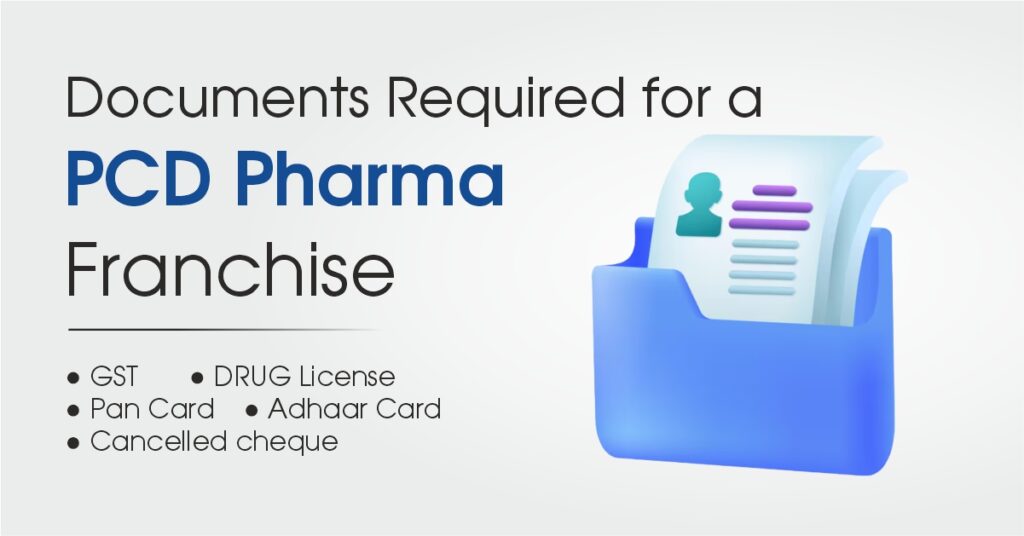
| Document | Mandatory | Purpose |
|---|---|---|
| Drug License (Retail/Wholesale) | Yes | Legal permission to sell/distribute drugs |
| GST Registration | Usually Yes | Tax compliance and invoicing |
| PAN Card | Yes | Identity and financial verification |
| Aadhaar Card | Yes | Identity and address verification |
| Firm/Business Registration | Yes | Legal identity of the business entity |
| Partnership Deed | Only for partnerships | Defines partner roles and profit-sharing |
| Company Incorporation Certificate | Only for Pvt Ltd/LLP | Proof of company’s legal existence |
| Bank Account Details | Yes | Payments and transaction records |
| Cancelled Cheque | Yes | Bank account verification |
| Passport Size Photographs | Yes | Franchise agreement and license forms |
| Address Proof (Residential) | Yes | Applicant identity verification |
| Business Address Proof | Yes | Verifying warehouse/office location |
| Rental Agreement/Ownership Papers | Yes | Proof of business premises |
| Experience Certificate | No (recommended) | Demonstrates industry background |
| Pharmacist Registration/Appointment | Only for certain license types | Regulatory requirement for drug handling |
| FSSAI License | Only if dealing in supplements | Food safety compliance |
Now let’s look at each of these documents in detail.
1. Drug License
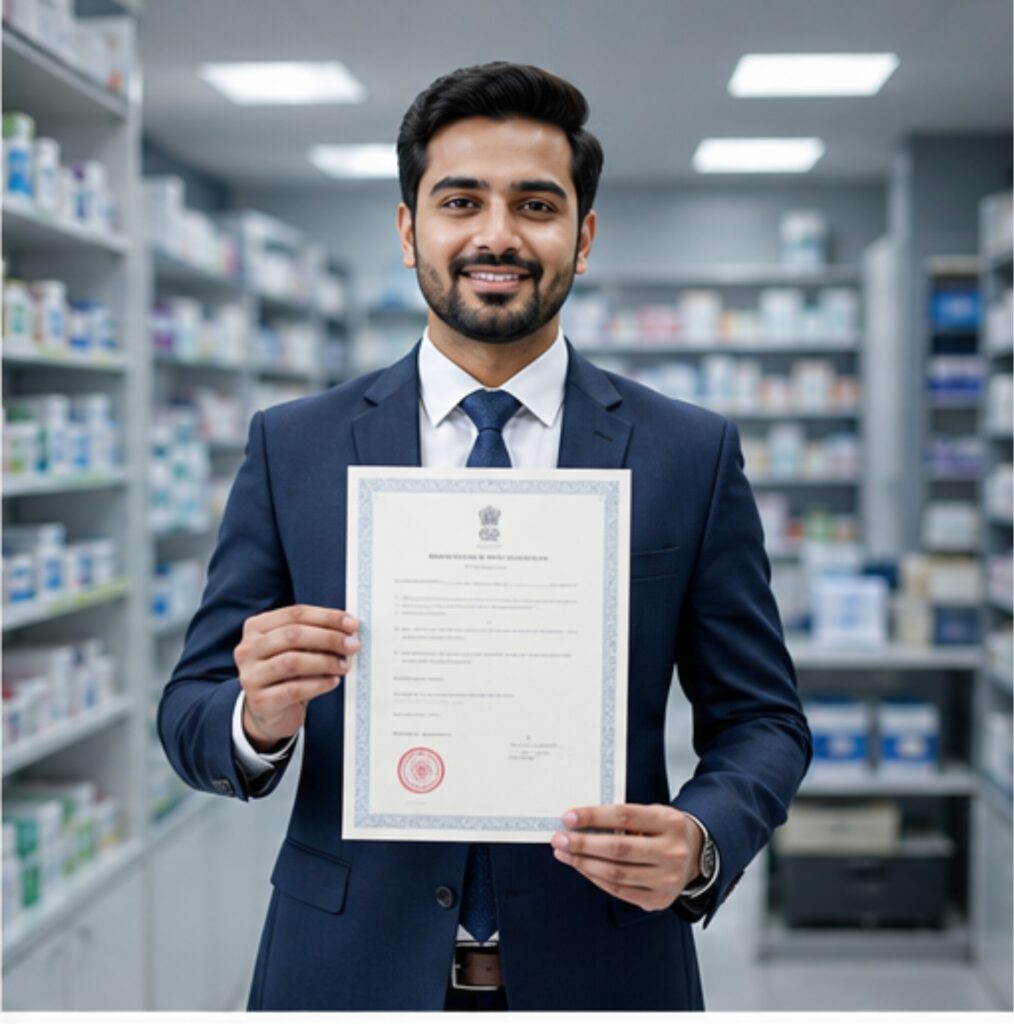
A drug license is the single most important document in this list. Without it, you cannot legally sell, stock, distribute, or market pharmaceutical products anywhere in India.
Retail vs Wholesale Drug License
There are two main categories, and choosing the right one depends on how you plan to operate:
- Retail Drug License (Form 20 & 21): Required if you plan to sell directly to end consumers, such as running a pharmacy or medical store.
- Wholesale Drug License (Form 20B & 21B): Required if you plan to supply medicines to retailers, hospitals, clinics, or other stockists — which is exactly how most PCD pharma franchise businesses operate.
Which One Do You Need?
Most PCD franchise partners function as distributors or stockists rather than direct-to-consumer sellers. In that case, a wholesale drug license is the relevant document. If your business model also includes retail sales, you may need both licenses.
Issuing Authority
Drug licenses are issued by the State Drug Control Department under the respective State Licensing Authority, with overall regulatory oversight from the Central Drugs Standard Control Organisation (CDSCO). Applications are typically processed through your state’s online drug licensing portal.
Validity
Following a 2024 amendment to Rule 63 of the Drugs and Cosmetics Rules, 1945, drug licenses are now valid in perpetuity, subject to a license retention fee payable every five years. This replaced the earlier system of a fixed five-year expiry with mandatory renewal.
2. GST Registration
Why It’s Needed
GST registration gives your business a GSTIN (GST Identification Number), which is essential for issuing valid tax invoices, claiming Input Tax Credit, and staying compliant with Indian tax law.
Technically, GST registration becomes compulsory once your annual turnover crosses ₹40 lakh for goods (₹20 lakh in some special category states). However, most PCD pharma franchise businesses involve interstate purchase of medicines from the franchisor’s warehouse — and GST registration is mandatory for interstate supply regardless of turnover. This is why pharma companies almost always ask for GST registration during onboarding, even for new franchise partners.
Benefits
- Enables legal invoicing between you and the pharma company
- Builds credibility with doctors, retailers, and stockists
- Allows you to claim input tax credit on purchases
- Keeps your books audit-ready
3. PAN Card
A PAN card is required for identity verification, GST registration, opening a current bank account, and income tax filing. If you’re applying as a company or partnership firm, the firm’s PAN is required in addition to the individual PAN of the proprietor or partners.
4. Aadhaar Card
Aadhaar serves as both identity and address proof and is commonly requested during drug license and GST applications for individual applicants and proprietors.
5. Firm Registration
Your business needs a recognised legal structure before a pharma company can enter into a franchise agreement with you. The common options are:
- Proprietorship: Simplest structure, suited for individuals starting out; requires minimal registration.
- Partnership: Two or more people running the business together under a partnership deed.
- LLP (Limited Liability Partnership): Offers limited liability while retaining partnership flexibility.
- Private Limited Company: A more formal structure, often chosen by those planning larger-scale distribution operations.
6. Partnership Deed (If Applicable)
If you’re operating as a partnership firm, a registered partnership deed is mandatory. It defines each partner’s investment, profit-sharing ratio, responsibilities, and decision-making authority. Pharma companies typically ask for this to confirm who is legally authorised to sign the franchise agreement.
7. Company Incorporation Certificate
Applicable only if you’re registered as an LLP or Private Limited Company. This certificate, issued by the Ministry of Corporate Affairs (MCA), is proof that your company legally exists and is authorised to conduct business.
8. Bank Account Details
A current account in the business or firm’s name is generally preferred over a savings account, since it’s designed for regular business transactions, invoicing, and higher transaction volumes.
9. Cancelled Cheque
A cancelled cheque is used to verify your bank account details — account number, IFSC code, and account holder name — during GST registration and while setting up payment arrangements with the pharma company.
10. Passport Size Photographs
Standard passport-size photographs of the proprietor, partners, or authorised signatory are required for license applications and the franchise agreement paperwork.
11. Address Proof
Personal address proof — such as Aadhaar, voter ID, driving license, or utility bills — is required to confirm the identity and residence of the applicant.
12. Business Address Proof
Separate from personal address proof, this confirms the location where you’ll operate your business — office, warehouse, or godown. Utility bills, property tax receipts, or a registered lease agreement are commonly accepted.
13. Rental Agreement or Ownership Documents
If you’re operating from a rented premises, a registered rental or lease agreement is required. If the property is owned, ownership documents such as a sale deed or property tax receipt work instead. This is a key requirement for drug license approval, since inspectors verify storage conditions at the registered address.

14. Experience — Is It Compulsory?
No, prior pharma industry experience is not a legal requirement to start a PCD pharma franchise. Many successful franchise partners come from backgrounds like medical representation, retail pharmacy, or even unrelated sales industries.
That said, relevant experience — as a medical representative, pharmacist, or distributor — can help you understand the market faster and is viewed favourably by pharma companies while finalising monopoly territories.
15. Pharmacist Requirement
A registered pharmacist or a “competent person” (someone with a recognised pharmacy qualification or relevant experience under the Drugs and Cosmetics Rules) is required to be associated with certain drug license categories, particularly where the license covers Schedule H, H1, or C/C1 drugs. This person’s details need to be submitted during the license application process. If you don’t personally hold this qualification, you can appoint a qualified pharmacist for this purpose.
16. Additional Documents Some Pharma Companies May Ask For
Depending on the company’s internal policy, you may also be asked for:
- A signed PCD franchise/distribution agreement
- Security deposit or minimum order commitment proof
- FSSAI license (only if dealing in nutraceuticals or dietary supplements)
- Trade license from the local municipal corporation for the warehouse
- A brief business profile or previous distribution experience letter
Common Mistakes People Make While Preparing Documents
- Submitting blurry or unreadable scanned copies — this is one of the most common reasons for rejection or delay.
- Mismatch between PAN name and firm name — even a small spelling difference can cause GST or bank account issues.
- Applying for the wrong type of drug license — choosing retail when wholesale was needed, or vice versa.
- Using an unregistered rental agreement as business address proof.
- Delaying pharmacist appointment until the last stage of the license application.
- Not keeping digital backups of all documents, causing repeated visits to authorities for reprints.
- Ignoring GST implications of interstate purchase, assuming registration isn’t needed below the turnover limit.
How to Speed Up the Approval Process
- Keep scanned copies of every document in PDF format, properly labelled, before you start any application.
- Finalise your business premises and rental agreement early — this is often the biggest bottleneck.
- Appoint your pharmacist or competent person before applying for the drug license, not after.
- Double-check that your PAN, Aadhaar, and firm registration details match exactly across all documents.
- Apply for GST registration in parallel with your drug license application rather than sequentially, to save time.
- Work with a consultant or the pharma company’s onboarding team if you’re unfamiliar with state-specific portals.
Documents Rosette Pharma May Require During Onboarding
While core requirements like a drug license, GST registration, and identity proof are fairly standard across the industry, exact document requirements can vary from one pharma company to another based on internal policy, product category, and state-specific rules.
Generally, applicants reaching out for a franchise with Rosette Pharma should be prepared with:
- A valid drug license (wholesale, in most cases)
- GST registration certificate
- PAN and Aadhaar of the proprietor/partners
- Firm registration proof or incorporation certificate
- Bank account details with a cancelled cheque
We recommend confirming the exact and updated document list directly with the Rosette Pharma team at the time of enquiry, since requirements may be revised periodically in line with regulatory updates.
Mandatory Documents vs Optional Documents
| Mandatory Documents | Optional Documents |
|---|---|
| Drug License (Retail/Wholesale) | Experience Certificate |
| GST Registration | Trade License (varies by state) |
| PAN Card | Business Profile/Portfolio |
| Aadhaar Card | FSSAI License (only for supplements) |
| Firm/Company Registration | Additional Insurance Documents |
| Bank Account & Cancelled Cheque | Reference Letters |
| Business Address Proof | GMP/ISO documents of your own facility (not applicable for franchise partners) |
Individual vs Company Documents
| For Individual Applicants | For Company/Firm Applicants |
|---|---|
| PAN Card (individual) | PAN Card (firm/company) |
| Aadhaar Card | Incorporation Certificate / Partnership Deed |
| Personal Address Proof | Registered Office Address Proof |
| Passport Size Photograph | Photographs of all partners/directors |
| Individual Bank Account (proprietorship) | Current Account in Firm’s Name |
| Drug License in individual’s name | Drug License in firm’s name |
Can You Start a PCD Pharma Franchise Without a Drug License?
No. This is a common misconception among first-time entrants, and it’s important to be clear about it.
Under the Drugs and Cosmetics Act, 1940, selling, stocking, distributing, or exhibiting for sale any drug without a valid license is a punishable offence. This applies to PCD pharma franchise partners as well, since they are legally involved in the distribution and marketing of medicines, even if they don’t manufacture anything themselves.
Some early-stage aspirants believe that since a PCD franchise doesn’t involve manufacturing, licensing rules are lighter — this is incorrect. Whether you’re a manufacturer, wholesaler, or franchise-based distributor, a drug license remains a legal prerequisite before you can begin operations.
If you don’t yet hold a drug license, the practical path is to apply for one through your State Drug Control Department while your franchise agreement discussions are ongoing, so both processes move forward together rather than one delaying the other.
Checklist Before Applying for a PCD Pharma Franchise
Use this as a quick self-check before you approach any pharma company, including Rosette Pharma:
- Drug License (Retail or Wholesale, as applicable)
- GST Registration Certificate
- PAN Card (individual and/or firm)
- Aadhaar Card
- Firm Registration / Incorporation Certificate
- Partnership Deed (if applicable)
- Business Bank Account with Cancelled Cheque
- Passport Size Photographs
- Personal Address Proof
- Business/Warehouse Address Proof
- Rental Agreement or Ownership Documents
- Pharmacist/Competent Person Details (if required for your license category)
- FSSAI License (only if applicable to your product range)
Once this checklist is complete, you’re in a strong position to move forward with confidence, rather than scrambling for paperwork mid-process.
Conclusion
Documentation might feel like the least exciting part of starting a PCD pharma franchise, but it’s the foundation everything else is built on. A drug license keeps you legally compliant. GST registration keeps your finances transparent. Proper business registration protects both you and your franchise partner.
Getting these basics right from day one saves you from delays, rejected applications, and avoidable disputes later. It also signals to any pharma company that you’re a serious, credible partner worth investing in.
At Rosette Pharma, we work with franchise partners across India and understand that documentation can feel overwhelming for first-time applicants. Our team is happy to guide you through what’s needed, discuss monopoly rights in your preferred territory, share our product catalogue, and walk you through the entire franchise process step by step.
Explore our PCD Pharma Franchise opportunities, browse more insights on our PCD Franchise blog, or visit the Rosette Pharma homepage to get started today.
Ready to begin your pharma franchise journey? Reach out to Rosette Pharma for personalised guidance on documentation, monopoly rights, and our complete product range.
Frequently Asked Questions
1. Is GST registration compulsory for a PCD pharma franchise? In most cases, yes. While GST registration is technically required only above certain turnover limits, it becomes mandatory regardless of turnover if you’re purchasing medicines from another state, which applies to almost all PCD franchise businesses. Most pharma companies also require it as standard onboarding practice.
2. Can an individual apply for a PCD pharma franchise? Yes. Individuals can apply as sole proprietors, provided they hold the required drug license, GST registration, and other identity documents in their own name.
3. Is a Drug License mandatory for a PCD pharma franchise? Yes, absolutely. A drug license is a legal requirement under the Drugs and Cosmetics Act, 1940, for anyone involved in selling, stocking, or distributing pharmaceutical products, including franchise partners.
4. How long does the approval process take? Drug license approval typically takes a few weeks to a couple of months, depending on the state and completeness of your application. GST registration is usually quicker, often within a week if documents are in order.
5. Can I start a PCD pharma franchise from home? It depends on your state’s drug control regulations and the nature of your operations. Some states allow home-based storage under specific conditions, but many require a dedicated commercial space that meets storage and inspection standards, especially for a wholesale drug license.
6. Can I use my residential address as business address proof? In some cases, yes, if your state’s drug licensing authority permits it and the space meets storage requirements. However, many applicants prefer a separate commercial address to avoid complications during inspection.
7. What is the minimum investment required to start a PCD pharma franchise? Investment varies widely depending on the company, product range, and territory, and can range from a modest amount for small-scale operations to a larger sum for broader product portfolios. It’s best to discuss specific figures directly with the pharma company you’re partnering with.
8. What documents are needed for GST registration in a pharma franchise? Typically, you’ll need PAN card, Aadhaar card, business address proof, bank account details, a cancelled cheque, photographs, and firm registration or incorporation documents, depending on your business structure.
9. Can I apply for a PCD pharma franchise before completing company registration? You can begin initial discussions and product/territory selection before finalising registration, but most pharma companies require your firm registration, GST, and drug license to be in place before signing the final franchise agreement.
10. Does Rosette Pharma help with documentation for franchise partners? Rosette Pharma guides prospective franchise partners on the general documentation required for onboarding. Since exact requirements can vary based on state regulations and product categories, we recommend connecting with our team directly for the most accurate, updated guidance.
11. Is FSSAI registration required for a pharma franchise? FSSAI registration is only required if your product portfolio includes nutraceuticals, dietary supplements, or health food products that fall under food safety regulations. It’s not required for standard pharmaceutical drug distribution.