
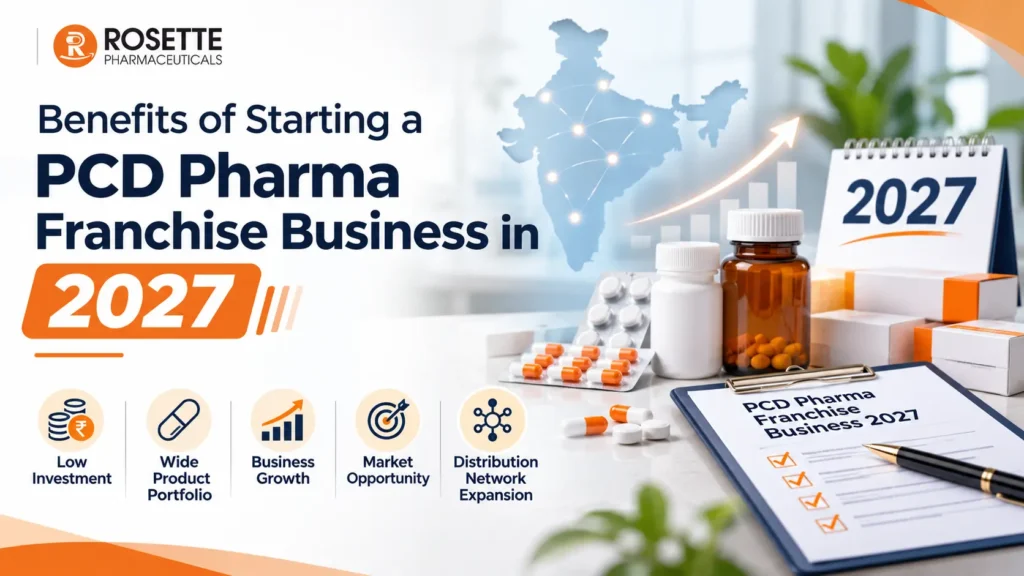
A PCD pharma franchise is an arrangement where a pharmaceutical company allows a partner to promote and distribute its products in an agreed area. Before understanding the benefits of starting a PCD Pharma Franchise business in 2027, it is important to understand what PCD means. PCD stands for Propaganda Cum Distribution. For many first-time entrepreneurs, medical representatives and distributors, it looks like a practical way into pharmaceutical distribution without setting up a manufacturing plant.
So what are the potential benefits of this model, and what should you evaluate before starting in 2027? In short, the model may give you access to an existing product portfolio and supplier, let you focus on sales and distribution, and allow gradual expansion. Whether you actually get those benefits depends on your market research, product suitability, written commercial terms, compliance, supply reliability and working capital. This guide treats each benefit as a possibility to test, not a promise.
A note on 2027: No source we reviewed forecasts the performance of PCD franchises specifically in 2027. Where this article refers to the future, it flags the point as a projection or a planning consideration.
What Is a PCD Pharma Franchise Business?
In a PCD arrangement, the pharma company typically supplies the products, and the franchise partner promotes them to doctors and chemists and handles local distribution and sales in an agreed territory. Exact responsibilities (who manages promotion, who bears stock risk, what marketing material is supplied) vary by company and must be set out in a written agreement.
How it differs from other models
- Conventional distributorship: A distributor buys from one or more manufacturers and supplies retailers or institutions, often handling several brands. A PCD partner usually works with one company’s brands and does field promotion. For a detailed comparison, see Rosette Pharma’s guide to pharma franchise vs distributorship.
- Third-party manufacturing: Here you have products made under your own brand or an agreed arrangement, so you carry branding, product-selection and marketing responsibility. In a PCD franchise you typically sell the company’s own brands. Rosette Pharma explains the contrast in PCD pharma franchise vs third-party manufacturing.
- Own manufacturing unit: This needs premises, machinery, technical staff and manufacturing licences. A PCD partner generally does not do this.
Why Consider a PCD Pharma Franchise Business in 2027?
The model is worth evaluating because it may let you:
- Work with an existing product portfolio instead of developing products yourself.
- Rely on an established supplier for manufacturing and product documentation.
- Concentrate on sales, service and local relationships.
- Develop a defined local market, if the company grants territory protection in writing.
- Add products over time as your business grows.
These benefits are conditional. A company with an inconsistent supply record, vague territory terms or poor documentation can turn each of them into a problem. As for the wider market, the India Brand Equity Foundation (IBEF) projects that the Indian pharmaceutical industry could reach about US$130 billion by 2030. That is a long-range industry projection, not a forecast for 2027, and it does not tell you whether a franchise in your district will succeed. Local demand and competition matter far more to your results.
10 Potential Benefits of Starting a PCD Pharma Franchise Business in 2027
1. Access to an Existing Product Portfolio
You may be able to choose from products the company already offers, rather than developing each one. Before relying on this, check the actual range, product documentation, availability and fit with your target doctors and chemists. A long product list is not the same as a useful one.
2. No Need to Build Your Own Manufacturing Facility
A franchise partner generally concentrates on distribution and commercial activity, not running a plant. This does not remove your own responsibilities. Licensing, storage, record-keeping and tax compliance still apply to you. It also differs from third-party manufacturing, where you arrange production under your own brand.
3. Potentially More Manageable Entry Than Owning a Factory
Skipping a plant can reduce infrastructure and operating requirements. It does not make the business universally low-cost. Opening stock, licences, storage, transport, sales activity and working capital can still add up, and the amounts vary by company. Treat any claim of a “standard” small investment with caution and ask for a written quotation.
4. Opportunity to Focus on Sales and Distribution
If the company handles production, you can spend your time on customer relationships, order management, delivery and local market development. Sales skills, product knowledge, reliable service and disciplined collections remain decisive.
5. Potential to Develop a Defined Territory
Some companies allocate a territory and offer exclusivity, often called “monopoly rights”. The meaning varies. It usually restricts the same company from appointing other partners for those products in your area, but it does not stop other companies from selling similar medicines. Confirm the territory boundaries, duration, exceptions, renewal conditions and your obligations in writing. Rosette Pharma discusses this model in its article on monopoly pharma franchise benefits. Exclusivity does not guarantee sales.
6. Opportunity to Build Long-Term Customer Relationships
Reliable supply, accurate product information, prompt communication and professional service can help you earn repeat business over time. There are no verified repeat-order or retention statistics to rely on here, so judge this by your own tracking of orders and customer feedback.
7. Flexibility in Product Selection
You may be able to select products from the company’s range, subject to commercial and regulatory conditions. Choose based on local prescribing patterns and chemist demand, not on the size of the catalogue. Ordering a wide range without evidence of demand ties up capital and raises expiry risk.
8. Potential to Expand Gradually
Once demand, working capital and your operational capacity support it, you can add products, customers or coverage. Expansion does not automatically raise profit. It also raises inventory, staffing and collection pressure.
9. Opportunity for Existing Pharma Professionals
Medical representatives, distributors and wholesalers may be able to use their product knowledge and relationships. That experience helps, but it does not replace required licences, documentation, capital or an operational plan.
10. Potential Support From the Pharma Company
Companies may provide product information, promotional material, order assistance and partner communication. Support differs widely, so list exactly what you expect and get it confirmed in writing.
Is a PCD Pharma Franchise Business Profitable in 2027?
It can be, but there is no verified industry-average margin or payback period, and none is quoted here. Profitability depends on:
- Purchase prices and your selling prices.
- Sales volume and product mix.
- Local demand and competition.
- Inventory movement and expiry losses.
- Freight and operating costs.
- Credit periods and delayed collections.
- Working capital and the company’s commercial terms.
- Distribution efficiency and customer relationships.
It helps to separate four measures. Sales revenue is the total value you invoice. Gross margin is revenue minus the cost of the goods sold. Operating expenses are costs such as transport, salaries, promotion and storage. Net profit is what remains after all costs, including expiry write-offs and taxes.
Illustrative example only (not a market average, and not a Rosette Pharma quotation): Suppose you sell goods worth ₹1,00,000 that cost you ₹82,000. Gross margin is ₹18,000. If operating expenses are ₹9,000 and expired stock worth ₹2,000 is written off, net profit is ₹7,000 before tax. Change any assumption (a delayed payment, a larger write-off) and the result changes sharply.
What Investment Factors Should You Consider Before Starting?
There is no universal investment figure for 2027, and any number quoted without context should be treated cautiously. Entry requirements differ by company, products and territory. Rosette Pharma has published a separate guide on investment required for a pharma franchise business. Treat its figures as indicative only, and confirm the current requirement and exactly what it covers in a written quotation.
| Cost Factor | Why It Matters | What to Verify Before Investing |
|---|---|---|
| Initial inventory or order requirement | Usually a major upfront outlay and a source of expiry risk | Minimum order terms, product mix, returns and replacement policy |
| Licences and business setup | Distribution generally needs the appropriate licence, and tax registration may apply | Licence type, fees and timelines with your State Licensing Authority |
| Storage and transport | Medicines need suitable storage, and delivery has a recurring cost | Premises requirements, storage conditions, freight terms |
| Sales and promotion | Doctor and chemist coverage takes time and money | What promotional material the company supplies and what you must fund |
| Staff or representatives | Salaries are a fixed monthly cost | Whether you can start solo and hire only when volumes justify it |
| Working capital and payment cycles | Stock is paid for before it is sold and collected | Credit terms offered to you and your own collection cycle |
| Reorders and expiry | Slow-moving stock can become a loss | Expiry, near-expiry and return terms in writing |
| Accounting, taxes and professional fees | Compliance has ongoing costs | GST registration requirements and advice from a qualified accountant |
PCD Pharma Franchise vs Distributorship vs Third-Party Manufacturing
The three models differ in control, branding, inventory commitment and responsibility. None is better for everyone, and no cost estimates are given here because they vary too much.
| Business Model | How It Works | Main Responsibilities | Investment Considerations | Regulatory Considerations | Who May Find It Suitable |
|---|---|---|---|---|---|
| PCD pharma franchise | Promote and distribute a company’s brands in an agreed area | Local sales, promotion, distribution, collections | Opening stock, working capital, promotion; varies by company | Appropriate distribution licence and records; check company’s manufacturing credentials | Those with sales skills who want to use an existing portfolio |
| Distributorship | Buy from manufacturers and supply retailers or institutions, often across brands | Logistics, stock holding, credit management | Larger stock and credit exposure is possible | Wholesale licence, storage and record-keeping | Traders with logistics and an existing chemist network |
| Third-party manufacturing | A manufacturer produces products under your agreed brand or arrangement | Brand, product selection, marketing, selling, quality oversight | Batch commitments, packaging and brand building | Brand and product-level requirements; confirm who holds which licence | Entrepreneurs who want their own brand and can fund and market it |
How to Choose the Right Pharma Franchise Company in 2027
Compare more than price. Use this checklist, and ask for written answers:
- Verifiable company identity and documentation.
- Product quality information and applicable permissions for each product.
- Product range and its relevance to your territory.
- Transparent pricing and order terms.
- Product availability and supply consistency.
- Territory arrangements and exclusivity terms in the written agreement.
- Marketing and partner support actually offered.
- Expiry, return, complaint and recall policies.
- Payment conditions and working capital requirements.
- Clarity and fairness of the agreement itself.
On quality, ask which manufacturing site makes each product and request the relevant licence and certificate details. India’s revised Schedule M (good manufacturing practices) was notified in December 2023, and small and medium manufacturers received an extension to 31 December 2025. Ask the company to confirm its current compliance status. Rosette Pharma also covers selection criteria in How to Choose the Right PCD Pharma Company. Rely on written terms and documents, not promotional promises.
Risks and Challenges You Should Understand Before Starting
- Competition from established brands and distributors.
- Slow-moving stock and expiry, which turn inventory into losses.
- Cash-flow and collection problems when customers pay late.
- Supply dependence, where stock-outs hurt your credibility.
- Territory and contract disputes where terms were verbal or vague.
- Regulatory and storage duties that stay with you.
- Overestimating local demand.
- Choosing a supplier on price alone.
- Assuming marketing support guarantees sales.
Market research, cautious stock planning, written agreements and regular monitoring of sales, collections and expiry can reduce these risks. They cannot eliminate them.
Common Mistakes to Avoid in 2027
- Starting without market research.
- Ordering too many products too early.
- Ignoring applicable licensing requirements.
- Not verifying product documentation.
- Accepting verbal territory promises.
- Underestimating working capital.
- Relying on unsupported profit projections.
- Neglecting expiry management.
- Not understanding payment and return policies.
- Choosing a company without examining its real supply and support record.
How Rosette Pharma May Fit Into Your PCD Pharma Franchise Plan
Rosette Pharma’s website states that the company was established in 2006 and is based in Karnal, Haryana (see its About Us page). It describes both PCD franchise and third-party manufacturing services. It lists several product divisions and dosage forms, including tablets, capsules, syrups, injectables, ointments and drops, and mentions district-level territory arrangements and


