
Introduction
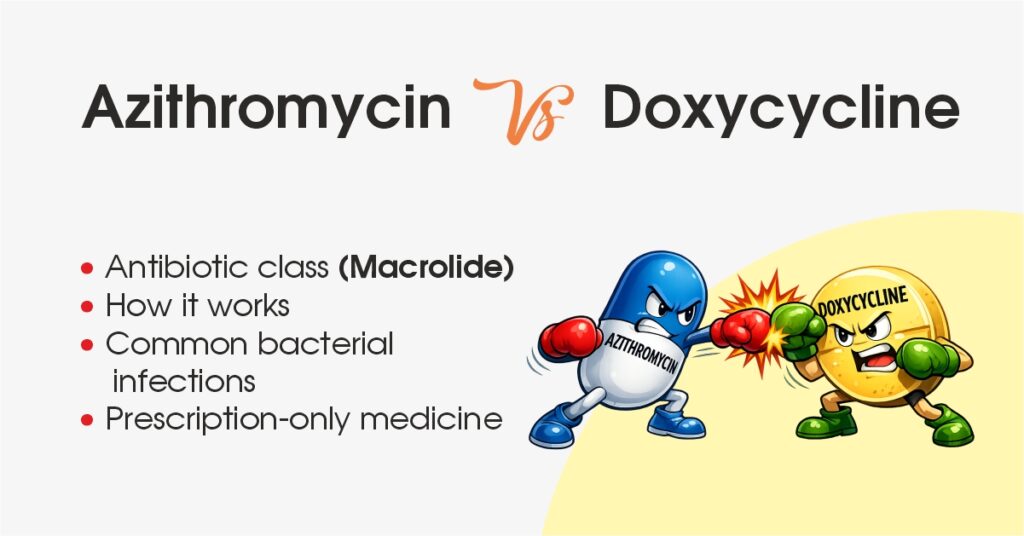
Azithromycin and Doxycycline are two of the most commonly prescribed antibiotics in India and around the world. Doctors often compare them because they treat some overlapping infections, yet they belong to completely different drug families, work in different ways, and suit different patients.
People search for “Azithromycin vs Doxycycline” hoping for a simple answer about which one is “better.” The honest answer is that neither antibiotic is universally better than the other. The right choice depends on:
- The type of infection and the bacteria causing it
- Local antibiotic resistance patterns in your area
- Your age, weight, and general health
- Any known drug allergies
- Whether you are pregnant or breastfeeding
- Your kidney and liver function
- Other medicines you may already be taking
This guide explains both antibiotics in simple language so you can have a more informed conversation with your doctor. It is not meant to help you choose your own antibiotic or dose.
Key Takeaway: Azithromycin and Doxycycline are both prescription-only antibiotics. Only a qualified healthcare professional can decide which one, if any, is right for your infection.
What Is Azithromycin?
Azithromycin belongs to a group of antibiotics called macrolides.
How it works: Azithromycin attaches to a part of the bacterial cell called the ribosome. This is the “protein factory” inside bacteria. By blocking this factory, Azithromycin stops bacteria from making the proteins they need to grow and multiply. Over time, the bacterial population shrinks and the immune system clears the rest.
Common bacterial infections it may be used for:
- Respiratory tract infections, including certain types of bronchitis and pneumonia
- Ear, nose, and throat infections such as tonsillitis and sinusitis
- Some skin and soft-tissue infections
- Certain sexually transmitted bacterial infections, when appropriate
Azithromycin is popular partly because it usually needs to be taken once a day, and treatment courses are often short (commonly 3 to 5 days, depending on the infection). This can make it easier for patients to finish the full course correctly.
Azithromycin is a prescription-only medicine. It should never be bought or taken without a valid prescription from a registered doctor.
What Is Doxycycline?
Doxycycline belongs to a different antibiotic family called tetracyclines.
How it works: Like Azithromycin, Doxycycline also blocks bacterial protein production, but it attaches to a different part of the bacterial ribosome. This different mechanism means Doxycycline can be effective against some bacteria that don’t respond well to macrolides, and vice versa.
Common bacterial infections it may be used for:
- Moderate to severe acne (as part of a longer-term treatment plan)
- Tick-borne diseases, such as those spread by tick bites
- Certain respiratory tract infections
- Some skin infections
- Certain sexually transmitted bacterial infections
- Other bacterial infections where the organism is known to be susceptible
Doxycycline is usually taken twice a day for infections, though acne treatment plans often run for several weeks under a dermatologist’s supervision.
Doxycycline is also a prescription-only medicine and should only be used under medical guidance.
Doctor’s Note: Two antibiotics can share some overlapping uses and still not be interchangeable. A doctor selects the antibiotic based on the exact bacteria suspected, the site of infection, and your personal health profile — not just the general “category” of infection.
Azithromycin vs Doxycycline: Quick Comparison
| Parameter | Azithromycin | Doxycycline |
|---|---|---|
| Medicine Class | Macrolide antibiotic | Tetracycline antibiotic |
| Mechanism of Action | Binds to the 50S ribosomal subunit, blocking bacterial protein synthesis | Binds to the 30S ribosomal subunit, blocking bacterial protein synthesis |
| Common Uses | Respiratory, ENT, skin infections; some STIs | Acne, tick-borne illness, respiratory and skin infections; some STIs |
| Available Dosage Forms | Tablets, oral suspension (where available) | Capsules, tablets, oral suspension (where available) |
| Typical Treatment Duration | Often 3–5 days (varies by infection and physician advice) | Often 7–14 days for infections; weeks for acne (varies by physician advice) |
| Common Side Effects | Nausea, diarrhea, abdominal pain | Nausea, vomiting, sun sensitivity |
| Food Instructions | Can generally be taken with or without food, as advised | Usually taken with food and a full glass of water; avoid lying down right after |
| Use in Pregnancy | Only if physician determines benefit outweighs risk | Generally avoided; physician-guided decision only |
| Use in Children | May be used under pediatric dosing guidance | Often avoided in young children; physician-guided decision only |
| Drug Interactions | Antacids, warfarin, certain heart-rhythm medicines | Antacids, iron, calcium, warfarin |
| Photosensitivity Risk | Low | Higher — sun protection advised |
Key Takeaway: The two medicines differ in drug class, typical course length, and precautions around sun exposure, pregnancy, and use in young children. A side-by-side table is useful for discussion, but it cannot replace a doctor’s assessment of your specific case.
How Do They Work?
Both antibiotics are usually described as bacteriostatic, meaning they generally stop bacteria from multiplying rather than killing them outright. This gives the body’s own immune system time to clear the remaining bacteria.
Here is a simplified step-by-step view of the shared mechanism, with the key difference highlighted:
| Step | What Happens |
|---|---|
| 1. Absorption | The medicine is absorbed from the gut into the bloodstream after oral intake |
| 2. Distribution | It travels through the blood to the site of infection |
| 3. Entry into bacteria | The drug enters the bacterial cell |
| 4. Ribosome binding | Azithromycin binds the 50S ribosomal subunit; Doxycycline binds the 30S ribosomal subunit |
| 5. Protein synthesis blocked | The bacteria can no longer produce proteins needed for growth |
| 6. Bacterial growth halted | Bacterial numbers stop increasing |
| 7. Immune clearance | The body’s immune system clears the weakened bacteria over the following days |
Because they act on different parts of the bacterial ribosome, a bacterium that has become resistant to one class is not automatically resistant to the other. This is one reason doctors may choose one over the other based on local resistance data.
Conditions Where Azithromycin May Be Prescribed
A doctor may consider Azithromycin for infections such as:
- Respiratory tract infections — including certain cases of bronchitis and community-acquired pneumonia
- Ear infections — particularly middle ear infections in some patients
- Throat infections — such as bacterial tonsillitis or pharyngitis
- Certain skin infections — mild bacterial skin and soft-tissue infections
- Some sexually transmitted bacterial infections — where clinically appropriate
This is a general list of examples, not a self-diagnosis guide. Whether Azithromycin is suitable for your specific infection depends entirely on your doctor’s clinical evaluation, including any lab tests they may order.
Conditions Where Doxycycline May Be Prescribed
A doctor may consider Doxycycline for conditions such as:
- Acne — moderate to severe cases, usually as part of a broader dermatological treatment plan
- Tick-borne diseases — including certain infections transmitted through tick bites
- Certain respiratory infections — where the causative bacteria are known to respond to tetracyclines
- Skin infections — some bacterial skin conditions
- Some sexually transmitted bacterial infections
- Other susceptible bacterial infections — as determined by your doctor
Again, this list is for general education. Your doctor will confirm whether Doxycycline is the right choice after reviewing your symptoms, history, and any relevant tests.
Rosette Pharma Azithromycin Products
Rosette Pharma manufactures a range of Azithromycin-based formulations as part of its pharmaceutical portfolio. These are introduced below for informational purposes. As with any antibiotic, they must only be used exactly as prescribed by a qualified healthcare professional.
1. ROZET-500
Composition: Azithromycin 500 mg
ROZET-500 is a higher-strength Azithromycin tablet. It may be prescribed for susceptible bacterial infections where a doctor determines this strength is appropriate. Treatment duration and dosing schedule depend entirely on the type and severity of the infection, and must follow the prescribing doctor’s instructions.
2. Rozet-250 LB
Composition: Azithromycin 250 mg with Lactic Acid Bacillus
Rozet-250 LB combines Azithromycin 250 mg with a probiotic (Lactic Acid Bacillus). The probiotic component is included to support gut-friendly bacteria during antibiotic treatment, which some patients find helpful in reducing antibiotic-related digestive discomfort. As with all Azithromycin formulations, it should be taken only as prescribed and for the exact duration advised by your doctor.
3. ROZET-CL
Composition: Cefixime 200 mg + Azithromycin 250 mg (with Lactic Acid Bacillus)
ROZET-CL is a combination formulation that pairs Azithromycin with another antibiotic, Cefixime. Combination antibiotics are prescribed only in specific clinical situations decided by a doctor, and are not interchangeable with single-ingredient Azithromycin tablets.
Doctor’s Note: A pediatric or age-specific Azithromycin formulation is not part of every antibiotic brand’s current lineup. If a child needs Azithromycin, the treating pediatrician will select an appropriate formulation and calculate the dose based on the child’s body weight.
Does Rosette Pharma Manufacture Doxycycline?
Yes. Rosette Pharma’s portfolio includes a Doxycycline-based formulation:
Doxyaide-LB
Composition: Doxycycline Hyclate 100 mg with Lactic Acid Bacillus
Doxyaide-LB combines Doxycycline Hyclate with a probiotic component, following the same rationale used in some of the brand’s Azithromycin combinations: supporting gut-friendly bacteria alongside antibiotic treatment. Like all antibiotics, it is intended strictly for use as prescribed by a qualified healthcare professional, for the specific infection and duration the doctor determines appropriate.
Key Takeaway: Rosette Pharma manufactures formulations in both the macrolide (Azithromycin) and tetracycline (Doxycycline) classes. Neither is positioned as superior to the other — the choice between them always rests with your treating doctor.
Side Effects Comparison
| Side Effect | Azithromycin | Doxycycline |
|---|---|---|
| Nausea | Common | Common |
| Vomiting | Occasional | Occasional |
| Diarrhea | Common | Occasional |
| Abdominal pain | Common | Occasional |
| Headache | Occasional | Occasional |
| Skin rash | Uncommon | Uncommon |
| Photosensitivity (sun sensitivity) | Rare | Notable — sun protection recommended |
| Liver-related precautions | Caution advised, especially with pre-existing liver disease | Caution advised, especially with pre-existing liver disease |
| Allergic reactions | Possible, especially with known macrolide allergy | Possible, especially with known tetracycline allergy |
This table is a general summary. Side effects can vary from person to person, and some reactions are rare but serious. If you notice any unusual symptoms while taking either medicine, contact your doctor promptly rather than stopping or adjusting the dose on your own.
Drug Interactions
Both antibiotics can interact with other medicines or supplements. A doctor or pharmacist should always review your complete medication list before you start either antibiotic. Some general interaction considerations include:
- Antacids — Antacids containing aluminum, magnesium, or calcium can reduce the absorption of both Azithromycin and especially Doxycycline. Doctors often advise spacing them apart by a few hours.
- Iron supplements — Iron can bind to Doxycycline in the gut and reduce how much is absorbed. Similar caution applies with Azithromycin.
- Calcium supplements — Calcium-rich supplements or dairy products can reduce Doxycycline absorption significantly; the interaction with Azithromycin is generally considered less pronounced.
- Warfarin — Both antibiotics may potentiate the blood-thinning effect of warfarin in some patients. Anyone on warfarin should have their treatment monitored closely if prescribed either antibiotic.
- Certain heart rhythm medicines — Azithromycin, in particular, is used cautiously alongside medicines that can affect the heart’s electrical rhythm (QT interval), due to a small risk of rhythm disturbances.
- Oral contraceptives — Older advice sometimes suggested that all antibiotics reduce the effectiveness of hormonal birth control. Current evidence suggests this concern mainly applies to a small group of antibiotics (such as rifampicin), not typically to Azithromycin or Doxycycline. However, vomiting or severe diarrhea caused by any illness or medicine can itself reduce contraceptive absorption, so discussing backup contraception with your doctor is a reasonable precaution.
Doctor’s Note: Always tell your doctor and pharmacist about every medicine, supplement, or herbal product you take — including ones that seem unrelated — before starting an antibiotic.
Pregnancy & Breastfeeding
Antibiotic choice during pregnancy and breastfeeding requires careful, individualized medical judgment.
Azithromycin: It may be considered by a doctor during pregnancy in specific situations where the benefit is judged to outweigh potential risk, particularly when few safer alternatives exist for a particular infection. Any decision to use it during pregnancy or breastfeeding must be made by a treating physician.
Doxycycline: It is generally avoided during pregnancy, particularly in later stages, because tetracycline-class antibiotics can affect the developing baby’s bone growth and permanently discolor developing teeth. It is typically avoided unless a doctor determines there is no safer suitable alternative for a serious infection.
In breastfeeding, both medicines require an individual risk-benefit discussion with a doctor, since small amounts of many medicines can pass into breast milk.
Key Takeaway: Never take, continue, or stop either antibiotic during pregnancy or breastfeeding without your doctor’s specific guidance.
Can Children Take These Antibiotics?
Azithromycin is used in pediatric practice for certain infections, with the dose calculated according to the child’s body weight by the treating doctor.
Doxycycline has traditionally been avoided in younger children (commonly cited as under 8 years of age) because tetracyclines can cause permanent discoloration of developing teeth and may affect bone growth. Some newer clinical guidance has nuanced this position for certain short-course, specific-indication uses in children — but this is a decision that belongs entirely to the treating pediatrician, based on the exact infection, the child’s age, and current clinical guidelines.
Parents and caregivers should never give either antibiotic to a child without a doctor’s prescription, and should never use leftover antibiotics from a previous illness or from another family member.
Which Antibiotic Is Better?
There is no single “better” antibiotic between Azithromycin and Doxycycline. Each has situations where it may be the more suitable choice, based on factors such as:
- The specific bacteria suspected or confirmed
- The site and severity of the infection
- Local antibiotic resistance patterns
- Known drug allergies
- Kidney and liver function
- Pregnancy or breastfeeding status
- Age (especially for young children)
- Other medical conditions and current medications
| Factor a Doctor May Weigh | When Azithromycin May Be Considered | When Doxycycline May Be Considered |
|---|---|---|
| Infection type | Certain respiratory, ENT, and skin infections | Acne, tick-borne illness, certain respiratory and skin infections |
| Course length preference | Shorter courses in many cases | Often longer courses |
| Known macrolide allergy | Avoided | May be considered instead |
| Known tetracycline allergy | May be considered instead | Avoided |
| Pregnancy | Occasionally considered under strict medical judgment | Generally avoided |
| Young children | May be used with weight-based dosing | Often avoided, physician-dependent |
| Significant sun exposure expected | Lower photosensitivity concern | Higher photosensitivity concern; precautions advised |
This table illustrates considerations, not instructions. Only your doctor, after evaluating your specific case, can determine which antibiotic — if either — is appropriate for you.
Antibiotic Resistance
Antibiotic resistance happens when bacteria evolve and are no longer killed or controlled by a medicine that once worked against them. This is a growing global health concern, and everyday choices around antibiotic use play a real role in it.
Why unnecessary antibiotic use is harmful: Taking antibiotics for viral illnesses (like the common cold or flu) provides no benefit, since antibiotics do not work on viruses. It only exposes bacteria in your body to the drug unnecessarily, giving them a chance to develop resistance over time.
Why completing the prescribed course matters: Stopping an antibiotic early — even if you feel better — can leave some bacteria alive. These survivors can multiply and potentially become harder to treat the next time.
Why antibiotics should never be shared: A prescription is written for one person’s specific infection, weight, allergy history, and medical condition. Sharing antibiotics, or using leftover antibiotics from a previous illness, increases the risk of inadequate treatment and resistance.
Doctor’s Note: Antibiotic resistance doesn’t just affect the person taking the medicine unnecessarily — it can affect entire communities by making common infections harder to treat for everyone.
Tips for Safe Antibiotic Use
✔ Take exactly as prescribed by your doctor
✔ Complete the full course, even if you feel better early
✔ Do not skip doses
✔ Do not self-medicate or start antibiotics without a prescription
✔ Never use leftover antibiotics from a previous illness
✔ Never share your antibiotics with someone else, even for similar symptoms
✔ Report side effects to your doctor promptly
✔ Store antibiotics as directed on the label (some need refrigeration)
✔ Remember: antibiotics do not treat viral infections such as the common cold or flu
Myths vs Facts
Myth: Azithromycin cures viral fever. Fact: Azithromycin only works against susceptible bacterial infections. It has no effect on viruses.
Myth: Stopping antibiotics early is always safe if you feel better. Fact: Complete the full prescribed course unless your doctor specifically advises otherwise.
Myth: All antibiotics work the same way. Fact: Different antibiotic classes — like macrolides and tetracyclines — target bacteria through different mechanisms.
Myth: A stronger dose always works faster. Fact: Dosing is calculated for safety and effectiveness; taking more than prescribed does not speed up recovery and can increase side effects.
Myth: Doxycycline can be taken any time of day without restrictions. Fact: Doxycycline is often advised to be taken with food and water, and sun exposure should be limited due to photosensitivity risk.
Myth: Antibiotics work against the common cold. Fact: The common cold is caused by a virus. Antibiotics have no effect on viral infections.
Myth: You can stop taking antibiotics once symptoms disappear. Fact: Symptoms often improve before all bacteria are cleared. Stopping early risks incomplete treatment and resistance.
Myth: Leftover antibiotics from a past illness are fine to reuse. Fact: Leftover antibiotics may not match your current infection, dose needs, or be within a safe expiry period.
Myth: Azithromycin and Doxycycline are interchangeable. Fact: They belong to different antibiotic classes and are not automatically substitutable for one another.
Myth: Natural remedies can replace prescribed antibiotics for a bacterial infection. Fact: Confirmed bacterial infections generally require appropriate antibiotic therapy as determined by a doctor.
Myth: If an antibiotic worked for a friend’s infection, it will work for yours too. Fact: Bacteria and individual health profiles vary. What works for one person’s infection may not suit another’s.
Myth: Doxycycline is always unsafe for children. Fact: While it is often avoided in younger children due to tooth and bone effects, specific short-term uses may occasionally be considered by a pediatrician based on current guidelines.
Myth: You can drink alcohol freely while on any antibiotic. Fact: Alcohol can worsen certain side effects and should generally be discussed with your doctor during antibiotic treatment.
Myth: More antibiotics in your system means fewer chances of resistance. Fact: Overuse of antibiotics is actually a major driver of antibiotic resistance, not a protection against it.
Myth: Photosensitivity from Doxycycline is just mild redness. Fact: It can range from mild to more severe sunburn-like reactions; sun protection is advised during treatment.
Myth: Antibiotic resistance only matters for people who take the medicine. Fact: Resistant bacteria can spread within communities, affecting people who never took the antibiotic themselves.
Frequently Asked Questions
1. What is the difference between Azithromycin and Doxycycline? They belong to different antibiotic classes (macrolide vs. tetracycline), work through different mechanisms, and are prescribed for somewhat different — though sometimes overlapping — infections.
2. Which antibiotic works faster? Neither is universally “faster.” Symptom improvement timing depends on the infection type, its severity, and individual response, as assessed by your doctor.
3. Can Azithromycin treat pneumonia? Azithromycin may be prescribed for certain types of pneumonia when a doctor determines it is appropriate for the suspected bacteria.
4. Can Doxycycline treat acne? Yes, Doxycycline is commonly used as part of a longer-term treatment plan for moderate to severe acne, under medical or dermatological supervision.
5. Can I take Azithromycin with food? It is generally taken with or without food, but always follow your prescription label and your doctor’s specific instructions.
6. Can Doxycycline cause sun sensitivity? Yes, Doxycycline carries a notable risk of photosensitivity. Sun protection measures are usually advised during treatment.
7. Can children take Azithromycin? It may be prescribed for children, with the dose calculated by the doctor based on body weight.
8. Can pregnant women take Doxycycline? Doxycycline is generally avoided during pregnancy unless a doctor determines there’s no safer alternative for a serious infection.
9. What happens if I miss a dose? Follow the instructions on your prescription label, or contact your doctor or pharmacist for guidance specific to your medicine and situation.
10. Can I drink alcohol while taking antibiotics? It’s best to discuss this with your doctor, as alcohol may worsen certain side effects or interact with some antibiotics.
11. Can antibiotics treat viral infections? No. Antibiotics only work against bacteria and have no effect on viral infections such as the common cold or flu.
12. Why should I complete the antibiotic course? Stopping early can leave bacteria alive, which may cause the infection to return or contribute to antibiotic resistance.
13. Are Azithromycin and Doxycycline available over the counter? No, both are prescription-only medicines in most regions, including India.
14. Can Azithromycin be used for skin infections? It may be used for certain mild bacterial skin and soft-tissue infections, as determined by a doctor.
15. Is Doxycycline used for tick-borne diseases? Yes, it is commonly considered for certain tick-borne bacterial illnesses, based on a doctor’s diagnosis.
16. What are the common side effects of Azithromycin? Common side effects can include nausea, diarrhea, and abdominal discomfort.
17. What are the common side effects of Doxycycline? Common side effects can include nausea, vomiting, and increased sun sensitivity.
18. Can I take antacids with these antibiotics? Antacids can reduce absorption of both medicines, particularly Doxycycline. Ask your doctor or pharmacist about appropriate timing.
19. Is Azithromycin safe for people with liver problems? Caution is generally advised, and a doctor will evaluate liver function and history before prescribing it.
20. Can Doxycycline affect birth control pills? Current evidence suggests this interaction is not a major concern for most antibiotics like Doxycycline, but discussing backup contraception with your doctor is a reasonable precaution.
21. How long does a typical Azithromycin course last? Course length varies by infection but is often around 3 to 5 days, as determined by your doctor.
22. How long does a typical Doxycycline course last? It varies significantly — often 7 to 14 days for infections, or several weeks for acne treatment, based on your doctor’s plan.
23. Can I stop the antibiotic if I feel better after 2 days? No, you should complete the full course unless your doctor specifically tells you to stop.
24. Are there natural alternatives to these antibiotics? For confirmed bacterial infections, no natural remedy has been established as a reliable substitute for prescribed antibiotics. Always consult your doctor.
25. Can I take leftover antibiotics from a previous illness? No. Leftover antibiotics may not be appropriate for your current infection, dose requirements, or safe expiry window.
26. Does Rosette Pharma manufacture both Azithromycin and Doxycycline products? Yes. Rosette Pharma’s portfolio includes Azithromycin-based formulations (such as ROZET-500 and Rozet-250 LB) and a Doxycycline-based formulation (Doxyaide-LB).
27. What should I do if I experience an allergic reaction? Seek medical attention immediately if you notice symptoms such as rash, swelling, or difficulty breathing after taking any antibiotic.
Conclusion
Azithromycin and Doxycycline are both effective, widely used prescription antibiotics that belong to different drug families — macrolides and tetracyclines, respectively. They differ in their mechanism of action, typical course length, side-effect profile, and precautions around pregnancy, young children, and sun exposure.
Neither antibiotic is universally “better.” The right choice always depends on the specific infection, the bacteria involved, local resistance patterns, and your individual health profile — a decision that belongs to your treating doctor.
Safe antibiotic use also means completing the full prescribed course, never self-medicating, and never sharing or reusing leftover antibiotics. These habits help protect not just your own health, but also help slow the wider problem of antibiotic resistance.
Rosette Pharma manufactures quality pharmaceutical formulations across both the macrolide and tetracycline categories, including Azithromycin-based products like ROZET-500 and Rozet-250 LB, and the Doxycycline-based Doxyaide-LB. As with any antibiotic, these should be used strictly under medical supervision.
Disclaimer: This article is for educational purposes only and should not replace professional medical advice. Always consult a qualified healthcare professional before starting, stopping, or changing any medication or treatment.