Third-party pharmaceutical manufacturing has moved from a niche outsourcing option to the default starting point for most new pharma businesses in India. Every month, more pharma entrepreneurs, PCD franchise owners, nutraceutical brands, and even hospital procurement teams are asking the same question: which company should actually make our products?
The answer matters more than most first-time buyers realise. Your manufacturing partner decides your product quality, your regulatory standing, your delivery timelines, and ultimately, whether doctors and chemists trust your brand a second time. A wrong choice does not just cost money — it costs the reputation you are trying to build.
This guide is written for anyone evaluating manufacturing partners for the first time or the fifth time: pharma startups, established pharmaceutical companies, healthcare brands, nutraceutical and Ayurvedic companies, hospital procurement teams, medicine distributors, wholesalers, and export businesses. By the end, you will know exactly what separates an average manufacturer from the best pharma company for third-party manufacturing, which questions to ask before you sign anything, which red flags should make you walk away, and which certifications actually matter.
Table of Contents
- What Is Third-Party Pharmaceutical Manufacturing?
- How Third-Party Pharma Manufacturing Works
- Benefits of Choosing Third-Party Manufacturing
- What Makes a Pharma Manufacturing Company the Best?
- 15 Questions to Ask Before Choosing a Third-Party Pharma Manufacturer
- Red Flags to Avoid
- Certifications to Look For
- Industries That Benefit from Third-Party Manufacturing
- Why Businesses Choose Rosette Pharma for Third-Party Manufacturing
- Frequently Asked Questions
- Final Thoughts
What Is Third-Party Pharmaceutical Manufacturing?
Third-party pharmaceutical manufacturing is a business arrangement where a company that owns a licensed, regulation-compliant production facility manufactures medicines on behalf of a client, under the client’s own brand name and packaging. The client — whether a pharma startup, a PCD franchise brand, or an established marketing company — does not need to own a factory, hire production staff, or handle regulatory plant approvals. The manufacturer takes care of formulation, production, quality testing, and packaging, while the client focuses on branding, sales, and distribution.
Here is a practical example. Say a distributor in Uttar Pradesh wants to launch their own brand of pain-relief tablets and multivitamin syrups. Instead of building a manufacturing unit — which would mean drug licences, machinery, cleanroom infrastructure, and years of setup — they approach a third-party manufacturer with an existing WHO-GMP compliant facility. They select formulations from the manufacturer’s product range, finalise packaging with their own brand name, place a purchase order, and receive finished, tested, ready-to-sell stock. The manufacturer is legally responsible for production quality; the distributor now owns a pharma brand without ever operating a factory.
This model is sometimes confused with a PCD (Propaganda Cum Distribution) pharma franchise, but the two are different. In a PCD franchise, the partner sells the manufacturer’s existing brands under a monopoly territory. In third-party manufacturing, the client builds their own brand and the manufacturer produces it on their behalf. Many businesses in India actually use both models together — running a PCD franchise in some territories while also getting select products third-party manufactured under their own label.
The table below lays out how these paths compare on the factors that usually decide which one a business chooses.
| Factor | Third-Party Manufacturing | PCD Pharma Franchise | Own Manufacturing Unit |
|---|---|---|---|
| Brand ownership | Client owns the brand | Manufacturer owns the brand | Client owns the brand |
| Upfront investment | Low to moderate | Low | Very high |
| Time to market | Weeks to a few months | Fast (existing products) | Often years |
| Production responsibility | Manufacturer | Manufacturer | Client |
| Regulatory compliance burden | Shared with manufacturer | Largely with manufacturer | Fully with client |
| Best suited for | Businesses wanting their own brand without a factory | Distributors and MRs wanting a ready product line | Companies with large capital and long-term production control needs |
Neither path is universally “better” — the right choice depends on whether your priority is owning a brand, moving fast with an existing product range, or having full production control from day one.
How Third-Party Pharma Manufacturing Works
Understanding the process end-to-end helps you know what a professional manufacturer’s workflow should look like, and where shortcuts or missing steps should worry you.
- Initial enquiry: You share your product requirements — therapeutic segment, dosage forms, expected order quantity — with the manufacturer.
- Formulation and product selection: The manufacturer shares available formulations and compositions that match your requirement, or discusses a new formulation if you need something specific.
- Quotation and commercial terms: You receive a price quote covering manufacturing cost, packaging, and applicable taxes, along with minimum order quantity (MOQ) details.
- Agreement and purchase order: Once both sides agree on pricing, MOQ, and delivery timelines, you place a formal purchase order.
- Artwork and packaging approval: You finalise your brand name, logo, and packaging design, and the manufacturer ensures the artwork meets labelling regulations before printing.
- Manufacturing: Production begins following the approved, validated formulation.
- Quality testing: Each batch goes through in-process and finished-product testing, with results recorded for release.
- Packaging and dispatch: Finished products are packed as per approved artwork and dispatched with proper invoices and batch documentation.
- Reorders and ongoing support: As your brand grows, the same process repeats for reorders, and a good manufacturer supports you with consistent supply and documentation each time.
Callout: Every stage above should happen in writing. A manufacturer who prefers verbal confirmations over documented approvals — especially for artwork, pricing, and delivery dates — is a process risk, not a shortcut.
Benefits of Choosing Third-Party Manufacturing
Outsourcing production is not just a budget decision — it changes the entire risk profile of starting a pharma business.
- Lower investment: Setting up a GMP-compliant manufacturing plant needs substantial capital for land, machinery, and licensing — often running into several crores before a single unit is produced. Third-party manufacturing removes this barrier almost entirely, since the manufacturer has already made that investment.
- Faster market entry: Building and validating your own facility can take years, between land acquisition, plant construction, and regulatory approvals. Partnering with an existing manufacturer lets you move from concept to a market-ready product in a fraction of the time, often a matter of weeks once formulations and packaging are finalised.
- No manufacturing setup costs: You avoid the ongoing costs of running a plant — staffing, equipment maintenance, utilities, and compliance overhead — and pay only per order, which keeps your working capital tied to actual sales rather than fixed infrastructure.
- Regulatory support: An experienced manufacturer already understands drug approvals, labelling rules, and documentation requirements. This reduces your own compliance burden significantly, since you are relying on a system that is already built and tested rather than creating one from scratch.
- Scalability: As your order volumes grow, you scale with your manufacturing partner’s capacity instead of investing in additional plant infrastructure yourself. This is particularly valuable in the early years of a business, when demand can be unpredictable.
- Branding opportunities: Your products carry your own brand name, logo, and packaging — the manufacturer stays in the background as your production partner. This lets you build genuine brand equity in the market rather than reselling someone else’s identity.
- Focus on sales and marketing: With production handled externally, your time and capital go toward what actually grows a pharma business: doctor relationships, distribution networks, and market presence, rather than day-to-day plant operations.
What Makes a Pharma Manufacturing Company the Best?
“Best” is a word every manufacturer uses in its own marketing. What actually separates a genuinely strong partner from an average one comes down to a specific set of operational and quality fundamentals.
- Product quality: Consistent formulation performance, batch after batch, backed by validated manufacturing processes.
- Manufacturing standards: Facilities that follow WHO-GMP and Schedule M requirements as a matter of daily practice, not just paperwork.
- Regulatory compliance: A current, valid drug manufacturing licence and a clean compliance record with drug control authorities.
- Product portfolio: A wide, well-structured range across dosage forms and therapeutic segments, so you are not forced to switch manufacturers as you grow.
- Research & development: The ability to support new combinations, line extensions, and formulation troubleshooting — not just reproduce existing formulas.
- Infrastructure: Modern machinery, appropriate cleanroom standards for the dosage forms produced, and production capacity that matches realistic order volumes.
- Packaging quality: Proper sealing, print clarity, tamper-evidence where relevant, and full label compliance under the Drugs and Cosmetics Rules.
- Timely delivery: A dependable lead time from purchase order to dispatch, with proactive communication if anything shifts.
- Transparent pricing: A clear, itemised cost breakdown — manufacturing, packaging, freight, and GST — instead of a single bundled figure with hidden extras.
- Quality assurance (QA): Documented systems that build quality into the process from raw material intake onward.
- Quality control (QC): A dedicated in-house testing function for raw materials, in-process checks, and finished products.
- Technical support: Guidance on formulation selection, regulatory documentation, and packaging compliance when you need it.
- Customer service: A responsive, consistent point of contact rather than being routed to a different person every time you call.
- Business ethics: Straightforward commercial terms, honest communication about capabilities and limitations, and no overpromising on monopoly rights or delivery timelines.
- Long-term partnership approach: A manufacturer that stays engaged after the first invoice — supporting reorders, renewals, and your business as it scales — rather than treating you as a one-time transaction.
15 Questions to Ask Before Choosing a Third-Party Pharma Manufacturer
Keep this checklist ready for your first serious conversation with any prospective manufacturer.
- Can I see current copies of your WHO-GMP and drug manufacturing licence certificates?
- Which of your products currently hold valid drug approvals?
- What is your in-house quality control process, from raw material to finished batch?
- Do you provide a Certificate of Analysis (CoA) with every batch?
- What dosage forms and therapeutic segments does your product portfolio cover?
- What is your minimum order quantity, and does it vary by product category?
- What is your standard lead time from purchase order to dispatch?
- How is your pricing structured — is packaging, freight, and GST itemised separately?
- Can I request a documented facility audit report or a plant visit?
- What packaging options and branding support do you offer?
- What happens if a manufactured batch fails quality testing?
- Do you support custom formulations or new product development?
- What documentation will I receive with each order — invoices, CoAs, batch records?
- How do you handle urgent orders or seasonal demand spikes?
- Can you share references from existing third-party or franchise clients?
Red Flags to Avoid
Some warning signs show up early, before you have committed to anything. Take them seriously.
- Unrealistically low pricing compared to what similar manufacturers quote — this usually means compromised raw materials or skipped testing steps.
- Reluctance to share certificates or vague answers when you ask for WHO-GMP or drug licence copies.
- No dedicated quality control function, or an inability to explain their own QA and QC processes clearly.
- Poor communication before you have even signed — this rarely improves once you become a paying client.
- Hidden charges for packaging, freight, or documentation that only surface after you have committed.
- No written agreement, with commercial and quality terms discussed only verbally.
- Pressure to sign quickly, discouraging you from doing basic due diligence or requesting references.
- Inconsistent information between what the sales team promises and what the manufacturer’s own website or documentation states.
- Vague answers about production capacity, especially when you ask how they would handle a growing order volume.
Certifications to Look For
Certifications are not paperwork for its own sake — each one signals a specific, verifiable standard the manufacturer is expected to meet.
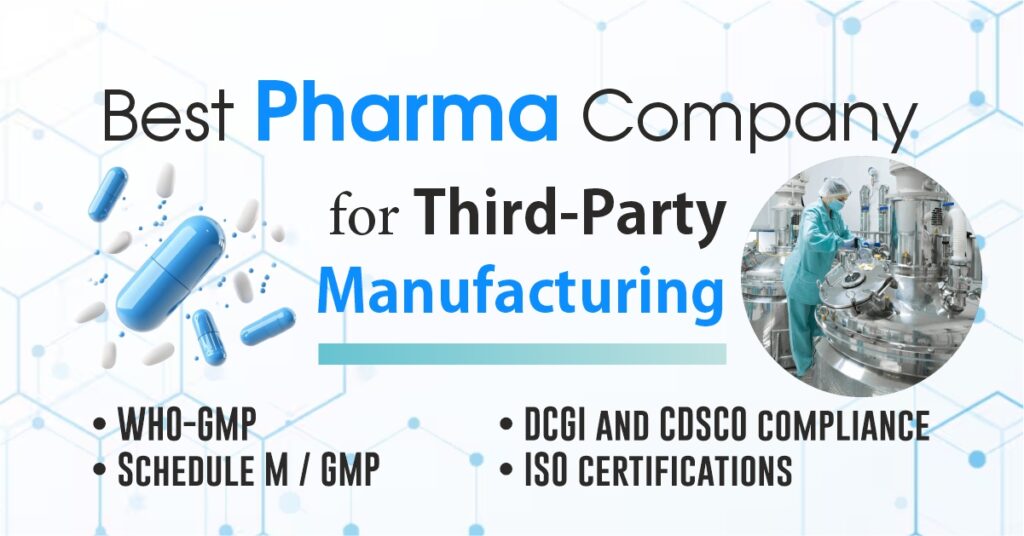
WHO-GMP (World Health Organization Good Manufacturing Practices) is the internationally recognised benchmark for pharmaceutical production, covering hygiene, equipment, documentation, and quality release procedures.
Schedule M / GMP compliance under India’s Drugs and Cosmetics Act sets the minimum requirements for premises, plant, and equipment that every legitimate Indian manufacturer must meet.
DCGI and CDSCO compliance confirms the manufacturer holds a valid drug manufacturing licence under the oversight of India’s Central Drugs Standard Control Organisation. You can review current regulatory guidance directly on the CDSCO website.
ISO certifications, such as ISO 9001 for quality management systems, are a useful supporting indicator of process discipline, though they do not replace WHO-GMP or DCGI compliance as the core regulatory requirement.
For broader regulatory context on drug standards and public health policy in India, the Ministry of Health & Family Welfare and the World Health Organization both publish guidance that shapes how Indian pharmaceutical manufacturing is regulated.
Callout: Always ask for original certificate copies with issue and expiry dates — not just a mention of “WHO-GMP certified” in marketing material. A manufacturer confident in its compliance will not hesitate to share this documentation.
Industries That Benefit from Third-Party Manufacturing
Third-party manufacturing is not limited to conventional pharma brands. A wide range of healthcare-adjacent businesses rely on this model.
- Pharmaceutical companies launching new brands or expanding into new therapeutic segments without adding factory capacity or retraining production teams for every new category.
- Nutraceutical brands that need consistent, tested production of supplements and wellness formulations, where batch-to-batch consistency directly affects repeat purchase trust.
- Ayurvedic and herbal companies looking for manufacturing partners experienced in natural formulations alongside conventional dosage forms, especially as demand for herbal healthcare products continues to grow across India.
- Healthcare startups entering the market with limited capital, for whom outsourced production is often the only realistic entry point — letting founders validate demand before committing to their own infrastructure.
- Hospitals and hospital procurement teams sourcing consistent, quality-tested private-label formulations for internal use or hospital pharmacy stock, where supply reliability matters as much as pricing.
- Export businesses that need a manufacturing partner capable of meeting the documentation, labelling, and quality standards required for shipments outside India, since export markets often carry additional regulatory expectations.
- Medicine distributors and wholesalers who want to move from purely reselling other brands to building a private-label product line of their own, using their existing market relationships as a head start.
Why Businesses Choose Rosette Pharma for Third-Party Manufacturing
If you are applying the criteria above to shortlist an actual manufacturing partner, here is where Rosette Pharma fits into that evaluation.
Rosette Pharma has been operating in the pharmaceutical sector since 2006, with over 20 years of presence in the industry. The company is based out of its facility in the HSIIDC Industrial Area, Sector 3, Karnal, Haryana, and operates a WHO-GMP compliant manufacturing network supplying DCGI-approved products. Its portfolio spans 500+ formulations across major therapeutic segments, and available product forms include tablets, capsules, dry syrup, injectables, ointments, softgel capsules, syrups, skin and haircare products, drops and suspensions, sachets, ear, eye and nasal drops, and dental care products.
Rosette Pharma offers third-party manufacturing for allopathic, derma, and herbal formulations, with its team involved from product development through to final packaging. This sits alongside the company’s PCD Pharma Franchise model, which offers district-level monopoly rights — useful context if you are weighing third-party manufacturing against a franchise arrangement, or considering a combination of both.
The company’s operations are organised across specialised divisions, giving third-party clients access to a genuinely diverse formulation base from a single manufacturing relationship: Rosette Pharmaceuticals for general allopathic formulations, Admetus Pharma focused on orthopedics, dermatology, and derma-cosmetics, and Yeux Care dedicated to ophthalmic products. You can review the full structure on the Divisions page.
On the business side, Rosette Pharma states it is trusted by 1200+ healthcare partners across India, and positions itself around quality-tested production, timely delivery, and support from onboarding through to ongoing account management. As with any manufacturer, we would encourage you to apply the same evaluation checklist from this guide directly to Rosette Pharma — request certificate copies, ask about MOQs for your specific product category, and discuss delivery timelines for your region with the team through the Contact Us page.
If you want a deeper, checklist-style walkthrough of the entire manufacturer-selection process, our related guide on how to choose the best pharma manufacturing company covers it in more depth.
Frequently Asked Questions
1. What does “best pharma company for third-party manufacturing” actually mean? It refers to a manufacturer that consistently meets WHO-GMP and DCGI regulatory standards, offers a genuine quality control process, maintains transparent pricing, and supports clients reliably beyond the first order — not simply the company with the lowest quote.
2. Is third-party manufacturing legal in India? Yes. Third-party manufacturing is a recognised and widely used business model in India’s pharmaceutical industry, provided the manufacturer holds a valid drug manufacturing licence and follows applicable regulations under the Drugs and Cosmetics Act.
3. How is third-party manufacturing different from a PCD pharma franchise? In third-party manufacturing, the client’s own brand is produced by the manufacturer. In a PCD franchise, the partner distributes the manufacturer’s existing branded products within an assigned territory rather than launching their own brand.
4. What is the minimum investment needed to start with third-party manufacturing? Investment varies by manufacturer and depends on the minimum order quantity, product category, and packaging choices. Always ask for a category-wise MOQ and cost breakdown before estimating your total investment.
5. How long does it take to launch a product through third-party manufacturing? Timelines depend on the manufacturer and product complexity, covering enquiry, quotation, artwork approval, manufacturing, testing, and dispatch. Ask your shortlisted manufacturer for a specific lead-time estimate for your product category.
6. What certifications should I insist on before signing an agreement? At minimum, request valid WHO-GMP compliance, Schedule M / GMP compliance, and a current DCGI-approved drug manufacturing licence. ISO certification is a useful additional indicator but not a substitute for these.
7. Can a small business or new startup work with a WHO-GMP compliant manufacturer? Yes. Many WHO-GMP compliant manufacturers offer flexible MOQs specifically to support new entrants, so certification level does not automatically mean a higher minimum investment.
8. What documents should a manufacturer provide with every order? At minimum, expect a proper invoice, a Certificate of Analysis for the batch, and GST-compliant documentation. Batch manufacturing records should also be available on request.
9. Can I get my own brand name and packaging on third-party manufactured products? Yes — this is the core feature of the model. You finalise your own brand name, logo, and packaging artwork, and the manufacturer produces under your label rather than theirs.
10. What therapeutic segments should I check for in a manufacturer’s product range? This depends on your target market, but a manufacturer offering breadth across general medicine, allopathic formulations, dermatology, ophthalmology, and herbal products gives you room to expand later without switching partners.
11. How do I verify a manufacturer’s certifications before signing anything? Request original certificate copies with issue and expiry dates, and cross-check the manufacturing licence status through the relevant regulatory channels rather than relying only on marketing claims.
12. What happens if a manufactured product fails quality testing? A reliable manufacturer will have a documented rejection and replacement process and will not release a failed batch to the market. Ask about this policy explicitly before signing.
13. Should I choose a manufacturer based on the lowest price quote? No. Unusually low pricing compared to industry norms is one of the most common red flags for compromised raw materials or skipped quality steps. Weigh pricing alongside certifications, delivery reliability, and documentation practices.
14. Can third-party manufacturing support export businesses? Yes, provided the manufacturer can meet the specific documentation, labelling, and quality standards required by the destination market. Discuss export-specific requirements with your manufacturer early in the conversation.
15. Is a plant visit necessary before finalising a manufacturing partner? It is not always mandatory, but it remains one of the most reliable ways to assess infrastructure and quality culture directly. If a visit isn’t feasible, request a documented facility audit report instead.
Final Thoughts
Finding the best pharma company for third-party manufacturing is not about picking the first quote that lands in your inbox. It comes down to verified certifications, a genuine quality control process, transparent pricing, dependable delivery, and a manufacturer willing to support your business well beyond the first purchase order.
Use the 15-question checklist and red flags in this guide as your working framework for any manufacturer you evaluate — including us. Rosette Pharma has been manufacturing in the pharmaceutical sector since 2006, with a WHO-GMP compliant network, DCGI-approved products, and a portfolio of 500+ formulations across allopathic, derma, and herbal segments.
If you are ready to discuss your product requirements, therapeutic segment, or order volumes, get in touch with the Rosette Pharma team — we’re happy to walk you through our certifications, product range, and manufacturing process in detail.
This article is published for general educational and informational purposes related to pharmaceutical business decisions and does not constitute legal or regulatory advice. Readers should independently verify certifications and consult relevant regulatory authorities before finalising any manufacturing agreement.