If you are a pharma entrepreneur, distributor, hospital procurement head, exporter, or a healthcare startup founder, one decision will shape your business more than any other: which pharma manufacturing company you choose to partner with.
The medicines you sell, the trust you build with doctors and chemists, and the regulatory ground you stand on all trace back to the manufacturer behind your products. Get this decision right, and you build a business on consistent quality and steady supply. Get it wrong, and you inherit someone else’s quality failures, stock-outs, and compliance headaches — often without realising it until it’s too late.
This guide walks you through exactly how to choose the best pharma manufacturing company in India — what to check, what questions to ask, which red flags to walk away from, and how the third-party manufacturing process actually works from the first phone call to the first dispatch.
Table of Contents
- What is a Pharma Manufacturing Company?
- Why Choosing the Right Pharma Manufacturing Company Matters
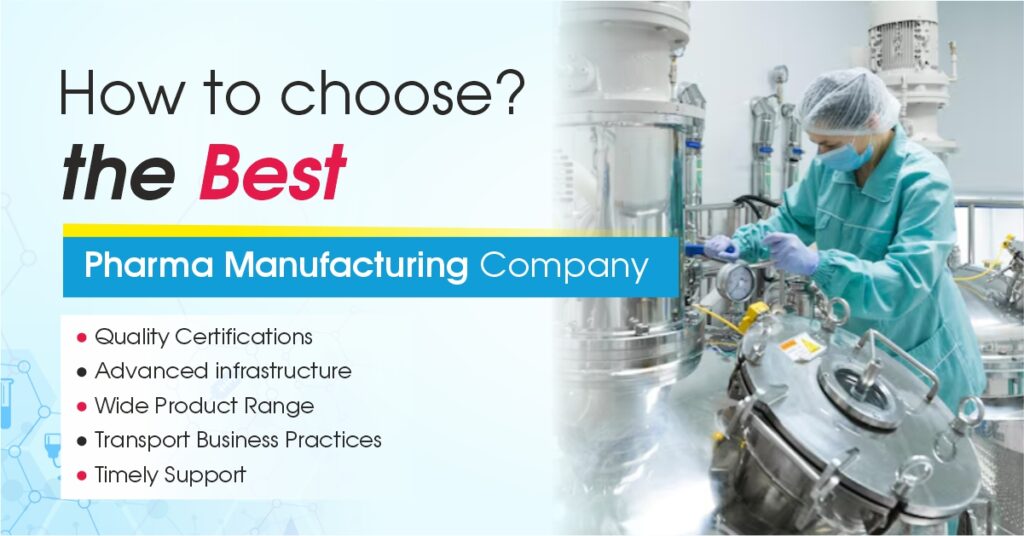
- 15 Factors to Consider Before Choosing a Pharma Manufacturing Company
- Questions You Should Ask Before Finalizing a Pharma Manufacturer
- Red Flags to Avoid
- Third-Party Manufacturing Process
- Why Third-Party Manufacturing is Growing in India
- Why Choose Rosette Pharma as Your Manufacturing Partner
- Frequently Asked Questions
- Conclusion
What is a Pharma Manufacturing Company?
A pharmaceutical manufacturing company is a licensed unit that produces medicines — tablets, capsules, syrups, injectables, ointments, and other dosage forms — under regulatory approval from India’s drug control authorities. But within this broad definition, there are several distinct business models, and understanding the difference matters before you start evaluating anyone.
Pharmaceutical manufacturing in the strictest sense refers to a company that owns its own production facility, holds a drug manufacturing licence, and produces formulations either for its own brand or on behalf of other companies.
Third-party manufacturing (also called contract manufacturing) is when a client company — a startup, a PCD franchise brand, or an established marketer — hires a licensed manufacturer to produce medicines under the client’s own brand name and packaging. The manufacturer handles production, quality testing, and regulatory compliance; the client handles branding, sales, and distribution.
Loan licence manufacturing is a specific regulatory arrangement under India’s Drugs and Cosmetics Rules where a company without its own manufacturing infrastructure is permitted to get its products made at another licensed manufacturer’s facility, using its own product approvals. This is closely related to third-party manufacturing but has a distinct legal basis (Form 25A) under Indian drug law.
Manufacturer vs. marketer is a distinction every new entrant should understand clearly. A manufacturer physically produces the medicine and is legally accountable for its quality under the Drugs and Cosmetics Act. A marketer (or marketing company) owns the brand and sells the product but may not manufacture it at all — they rely entirely on a manufacturing partner. If you are planning to start your own pharma brand without building a factory, you will almost always be operating as a marketer working with a third-party or contract manufacturer.
Pro Tip: Before you approach any manufacturer, decide which model fits your business — do you need someone to produce your own branded products (third-party manufacturing), or are you looking to distribute an existing company’s product range under a PCD arrangement? The evaluation criteria differ slightly for each. If you’re still deciding between these two paths, our guide on how to start a pharmaceutical company breaks down the investment and licensing differences.
Why Choosing the Right Pharma Manufacturing Company Matters
Pharmaceuticals are not like other consumer products. A defective batch of medicine does not just cost you a refund — it can cost a patient their health. This is why the manufacturer you select influences nearly every part of your business:
Product quality: The manufacturer’s raw material sourcing, formulation process, and quality control directly determine whether your product performs as intended, batch after batch.
Patient safety: Poorly manufactured medicines — with incorrect dosing, contamination, or stability issues — put patients at direct risk. This is the single most important reason regulatory certifications exist.
Regulatory compliance: If your manufacturing partner’s licence lapses, gets suspended, or fails a CDSCO inspection, your supply chain can be disrupted overnight, and you may face liability even though you didn’t manufacture the product yourself.
Brand reputation: In pharma, trust is earned slowly and lost quickly. One quality complaint from a doctor or chemist can undo months of relationship-building in a territory.
Business growth: A manufacturer with limited capacity or a narrow product range caps your ability to expand into new therapeutic segments or scale order volumes as your business grows.
Profitability: Manufacturing costs, MOQs, and pricing transparency directly affect your margins. A manufacturer with hidden charges or inconsistent pricing erodes profitability over time.
Customer trust: Ultimately, doctors, chemists, distributors, and patients are trusting you when they use your product — and you are trusting your manufacturer. This chain of trust only holds if every link in it is reliable.
15 Factors to Consider Before Choosing a Pharma Manufacturing Company
Here is a practical, experience-based checklist to evaluate before you sign any agreement.
1. Regulatory Certifications
This is the non-negotiable starting point. Before discussing pricing or product lists, confirm the manufacturer’s certifications:
- WHO-GMP (World Health Organization Good Manufacturing Practices): This is the internationally recognised benchmark for pharmaceutical production. It confirms the facility follows structured standards for hygiene, equipment, documentation, and quality release procedures.
- GMP / Schedule M: Under India’s Drugs and Cosmetics Act, Schedule M lays down the minimum requirements for premises, plant, and equipment. Every legitimate manufacturer must comply with this.
- DCGI compliance: A valid drug manufacturing licence issued under the oversight of India’s Central Drugs Standard Control Organisation (CDSCO) is mandatory for any manufacturer producing medicines legally. You can check current regulatory guidance directly on the CDSCO website.
- ISO certification (where applicable): Additional ISO certifications, such as ISO 9001 for quality management, are a supporting indicator — not a replacement for WHO-GMP or DCGI compliance.
Ask for copies of these certificates, note their issue and expiry dates, and don’t rely on claims made only in marketing material.
2. Product Quality Standards
Certifications tell you a company is allowed to manufacture; quality systems tell you whether they manufacture well. Look into:
- Raw materials: Are incoming materials tested for identity and purity before they enter production?
- Manufacturing process: Is the process validated and documented, or does it vary batch to batch?
- Batch consistency: Ask how the company ensures that batch 1 and batch 100 of the same product perform identically.
- Quality assurance (QA): QA covers the systems and documentation that build quality into the process from the start.
- Quality control (QC): QC is the testing function — raw material testing, in-process checks, and finished product testing before release.
A manufacturer that cannot clearly explain the difference between their QA and QC functions, or has no dedicated QC lab, is a warning sign.
3. Product Portfolio
A wider, well-structured product portfolio benefits your business in two ways — it gives you room to expand without switching manufacturers, and it signals genuine formulation expertise. Check whether the range covers:
- Tablets
- Capsules
- Syrups
- Injectables
- Ointments
- Eye drops
- Softgels
- Nutraceuticals
- Ayurvedic products
A manufacturer stuck at 20–30 stagnant SKUs in a single category limits your future growth. One offering formulations across multiple therapeutic segments and dosage forms gives you the flexibility to diversify as your market matures.
4. Manufacturing Infrastructure
The physical setup behind the certificate matters just as much as the certificate itself. During evaluation, look at:
- Modern machinery suited to the dosage forms you need
- Production capacity relative to your projected order volumes
- Automation levels, which affect both consistency and cost
- Cleanroom standards, especially critical for sterile or ophthalmic products
- Quality systems that are actually followed on the shop floor, not just documented on paper
Where possible, request a plant visit or a documented facility audit report. A manufacturer confident in its infrastructure will not be reluctant to show it.
5. Research & Development Capability
A manufacturer’s R&D capability tells you whether they can grow with you. Basic contract manufacturers simply reproduce existing formulations. Stronger partners can support:
- New combination products and line extensions
- Formulation troubleshooting (stability issues, taste masking, dissolution problems)
- Regulatory dossier support for new product approvals
If you plan to launch differentiated or combination products rather than standard generics, ask specifically about in-house formulation development experience — not just production capacity.
6. Packaging Quality
Packaging is both a regulatory requirement and your brand’s first impression on a chemist’s shelf. Evaluate:
- Blister packs: Sealing quality, foil strength, and print clarity
- Bottles: Tamper-evidence and child-resistant options where relevant
- Cartons: Print quality and durability during transit
- Label compliance: Batch number, manufacturing and expiry dates, MRP, composition, and Schedule H/H1 disclaimers where applicable, in line with the Drugs and Cosmetics Rules
- Brand presentation: Whether the manufacturer supports custom branded packaging or restricts you to generic formats
Poor packaging isn’t just a cosmetic issue — mislabeling or non-compliant packaging can trigger regulatory action against your brand.
7. Third-Party Manufacturing Experience
Manufacturing your own product line is different from manufacturing for internal brands only. Ask how long the company has been serving third-party and franchise clients, how many active third-party relationships they manage, and whether they have direct experience with your specific product category. A manufacturer new to third-party work may lack the documentation and communication processes this model requires.
8. Pricing Transparency
A trustworthy manufacturer gives you a clear, itemised cost breakdown — covering manufacturing cost, packaging, freight, and any documentation charges — rather than a single bundled number. Be specific in your questions:
- Is GST included or added separately?
- Are freight and logistics charged separately?
- Do prices change with order size, and if so, how?
Pricing transparency early in the relationship is usually a strong predictor of how the manufacturer will handle billing disputes later.
9. Minimum Order Quantity (MOQ)
MOQs vary significantly across manufacturers and directly affect how much capital you need to get started. A high, rigid MOQ can lock out smaller franchise partners and startups, while an unrealistically low MOQ from an unknown company can be a red flag for cutting corners on batch validation. Ask for MOQ by product category, since liquids, tablets, and injectables often carry different minimums due to batch-size economics.
10. Timely Delivery
Stock-outs directly damage your relationships with doctors and chemists. Ask about:
- Standard lead time from purchase order to dispatch
- How the company handles urgent or seasonal demand spikes
- Whether they provide order tracking and proactive delay communication
Common Mistake: Many new entrants finalise a manufacturer based purely on unit pricing, without asking a single question about delivery timelines — only to discover reliability issues after their first stock-out.
11. Documentation Support
Proper documentation protects your business legally and operationally. A reliable manufacturer should readily provide:
- Product permissions and drug approval copies
- Batch manufacturing records
- Certificate of Analysis (CoA) for each batch
- Invoices matching agreed pricing terms
- GST-compliant documentation, in line with requirements on the GST portal
If a manufacturer is slow or evasive about providing this documentation before you’ve even signed an agreement, expect the same — or worse — after you become a paying client.
12. Customer Support
Pharma partnerships run for years, not months. Before signing, gauge how the company communicates: Do they respond promptly to queries? Is there a dedicated point of contact, or do you get routed to a different person every time? A company’s pre-sales responsiveness is usually a fair preview of its post-sales support.
13. Scalability
Your business today is not your business in three years. Ask directly whether the manufacturer can scale production if your order volumes double or triple, whether they can add new product categories as your portfolio grows, and whether their infrastructure has room for expansion. A manufacturer operating at near-full capacity today may struggle to support your growth tomorrow.
14. Business Reputation
Verify reputation independently rather than relying solely on the manufacturer’s own claims:
- Website quality: Is the information current, specific, and consistent, or vague and generic?
- Customer reviews: Look for consistent themes across reviews, both positive and negative.
- Years in business: Longevity in a regulated industry like pharma is a meaningful (though not sole) indicator of stability.
- Existing clients: Ask for references from current franchise partners or third-party clients, and actually contact them.
- Industry reputation: Speak with other distributors, medical representatives, or pharma professionals in your network about their experience.
15. After-Sales Support
The relationship doesn’t end at dispatch. Evaluate how the manufacturer handles:
- Product complaints or quality escalations
- Replacement or return processes for damaged or defective stock
- Ongoing regulatory support, such as renewal of product approvals
- Continued access to marketing material, reorders, and account management
A manufacturer that disappears after the first invoice is paid is not a long-term partner — it’s a one-time vendor.
Questions You Should Ask Before Finalizing a Pharma Manufacturer
Use this list as a practical script for your first serious conversation with any prospective manufacturer:
- Are your WHO-GMP and DCGI certificates current, and can I see copies?
- Which specific products in your range hold valid drug approvals?
- What is your Schedule M compliance status, and when was your last regulatory inspection?
- What is your in-house quality control process, from raw material to finished product?
- Do you issue a Certificate of Analysis for every batch?
- Can I visit your manufacturing facility, or receive a documented facility audit report?
- What is your current production capacity for the specific dosage forms I need?
- What is your minimum order quantity, and does it vary by product category?
- What is your standard lead time from purchase order to dispatch?
- How do you handle urgent orders or seasonal demand spikes?
- What does your pricing structure include — is packaging, freight, and GST itemised separately?
- Do you offer monopoly or territory-based rights, and how are they defined in the agreement?
- What marketing and promotional support do you provide — visual aids, samples, product literature?
- How do you handle product complaints, recalls, or quality escalations?
- What documentation will I receive with every order — invoices, CoAs, batch records?
- Can you support custom formulations or new product development if I need them later?
- What is your policy on artwork and packaging design approval turnaround?
- Do you have experience manufacturing for other third-party or PCD franchise clients in my category?
- What happens if a batch fails quality testing — what is your rejection and replacement process?
- Can you provide references from existing clients I can speak with directly?
- What is your policy on expiry and stock returns?
- Is there a formal, written agreement covering all commercial and quality terms?
Red Flags to Avoid
Walk away — or at minimum, dig deeper — if you notice any of these warning signs:
- Unrealistically low pricing compared to industry benchmarks, often a sign of compromised raw materials or shortcuts in testing.
- Missing or unverifiable certifications — no WHO-GMP, no valid DCGI approval, or certificates they’re reluctant to share.
- Poor communication during the sales process itself, which almost always worsens after you’ve signed.
- No quality documentation — no CoA samples, no batch records, no willingness to explain their QC process.
- Delayed deliveries, even at the sampling or negotiation stage.
- Hidden charges that appear only after you’ve committed — packaging, freight, or “processing” fees not disclosed upfront.
- Lack of transparency about their manufacturing location, ownership, or actual production capability.
- No proper agreements — verbal promises instead of a written contract covering pricing, MOQs, and quality terms.
- Reluctance to allow a plant visit or provide any third-party audit documentation.
- Vague answers about raw material sourcing, especially for critical or high-risk formulations.
- No dedicated QC or regulatory affairs function within the organisation.
- History of drug recalls or regulatory warning letters, which you can partially check through public CDSCO records.
- Overpromising on monopoly rights without a written, enforceable clause in the agreement.
- Excessive pressure to sign quickly, discouraging you from doing proper due diligence.
- Inconsistent information between what the sales team tells you and what their website or documentation states.
Third-Party Manufacturing Process
Understanding the full workflow helps you know what to expect — and what might be missing — when you engage a manufacturer.
- Requirement discussion: You share your product requirements, target therapeutic segment, and expected order volumes with the manufacturer.
- Product selection: Based on your requirements, the manufacturer shares available formulations, dosage forms, and composition options.
- Quotation: You receive a detailed price quote covering manufacturing cost, packaging, and applicable taxes.
- Purchase order: Once terms are agreed, you place a formal purchase order specifying quantities, packaging, and delivery timelines.
- Artwork approval: You finalise and approve packaging artwork, labels, and cartons, ensuring compliance with labelling regulations.
- Manufacturing: Production begins according to the approved formulation and validated manufacturing process.
- Quality testing: Each batch undergoes in-process and finished-product testing before release, with results documented in the Certificate of Analysis.
- Packaging: Approved products are packed according to the finalised artwork and packaging specifications.
- Dispatch: Finished goods are dispatched according to the agreed delivery timeline, with invoices and batch documentation provided.
- Ongoing support: The manufacturer continues to support reorders, regulatory renewals, and any quality queries as your business scales.
Important Note: Every stage above should be backed by clear documentation — a verbal agreement at any step increases the risk of disputes later. Always insist on written confirmation for artwork approvals, pricing, and delivery commitments.
Why Third-Party Manufacturing is Growing in India
Third-party and contract manufacturing has become one of the fastest-growing models in India’s pharma sector, and the reasons are practical rather than trend-driven:
Lower investment: Setting up your own GMP-compliant manufacturing plant requires significant capital — often several crores. Third-party manufacturing lets you launch a branded product line without that upfront infrastructure cost.
Faster market entry: Building and validating your own facility can take years. Partnering with an established manufacturer lets you go from concept to market-ready product in a fraction of the time.
Focus on branding: Outsourcing production frees your time and resources to focus on what actually grows a pharma business — building doctor relationships, distribution networks, and brand recognition.
Reduced operational costs: You avoid the fixed costs of running a manufacturing unit — staffing, equipment maintenance, utilities, and compliance overhead — and instead pay per order.
Scalability: As your business grows, you can scale order volumes with your manufacturing partner rather than investing in additional plant capacity yourself.
This shift explains why so many PCD pharma franchise businesses and pharma startups in India today operate on a third-party manufacturing model rather than owning a factory from day one.
Why Choose Rosette Pharma as Your Manufacturing Partner
If you’re evaluating manufacturing partners against the criteria above, here’s where Rosette Pharma fits into that picture.
Rosette Pharma has been operating in the pharmaceutical sector since 2006, based out of its facility in the HSIIDC Industrial Area, Sector 3, Karnal, Haryana. Over this period, the company has built a WHO-GMP compliant manufacturing network supplying DCGI-approved products across 500+ formulations spanning multiple therapeutic segments.
The company offers third-party manufacturing for allopathic, derma, and herbal formulations, supported by an internal team involved from product development through to packaging. This is complemented by a structured PCD Pharma Franchise model that offers district-level monopoly rights, allowing partners to build their territory without internal brand competition.
Rosette Pharma’s operations are organised across specialised divisions — Rosette Pharmaceuticals for general allopathic formulations, Admetus Pharma focused on orthopedics and dermatology, Yeux Care dedicated to ophthalmic products, and Rosette Organics for herbal and natural formulations — giving partners access to a genuinely diverse product range from a single manufacturing relationship rather than juggling multiple vendors.
Beyond product range, the business support side matters just as much: partners receive marketing and promotional material, guidance from onboarding through territory growth, and transparent commercial terms without hidden clauses. On the operational side, the company emphasises quality-tested production and consistent delivery timelines, since supply reliability is often what separates a good manufacturing partner from a merely adequate one.
We’d encourage you to apply the same 15-point checklist from this guide to Rosette Pharma directly — request certification copies, ask about MOQs for your specific product category, and speak with our team about delivery timelines for your region. You can review our current product range and divisions or get in touch through our Contact Us page to start that conversation.
Frequently Asked Questions
Q1. What is the best way to choose a pharma manufacturing company in India? Start by verifying WHO-GMP and DCGI certifications, then evaluate product portfolio, manufacturing infrastructure, quality control systems, pricing transparency, and after-sales support. Avoid choosing based on price alone — the cheapest quote often reflects compromises elsewhere.
Q2. What certifications should a reliable pharma manufacturer have? At minimum, a legitimate manufacturer should hold a valid WHO-GMP certificate, a DCGI-approved drug manufacturing licence, and demonstrate Schedule M compliance under India’s Drugs and Cosmetics Act. ISO certification is a useful additional indicator of quality management systems.
Q3. What is the difference between a pharma manufacturing company and a PCD pharma company? A pharma manufacturing company produces the medicines themselves under a drug manufacturing licence. A PCD (Propaganda Cum Distribution) pharma company grants marketing and distribution rights for its products within a specific territory, usually with monopoly rights — the franchise partner focuses on sales, not production.
Q4. What is third-party pharma manufacturing? Third-party manufacturing is when a client company provides its brand name and product specifications, and a licensed manufacturer produces the medicine on the client’s behalf, handling production, quality testing, and packaging while the client manages branding and distribution.
Q5. How do I verify if a pharma manufacturer’s certifications are genuine? Request original certificate copies with issue and expiry dates, and cross-check the manufacturing licence status through the relevant State Drug Licensing Authority or the CDSCO portal. Reputable manufacturers are transparent about sharing this documentation.
Q6. What is a reasonable minimum order quantity (MOQ) for pharma contract manufacturing? MOQs vary by dosage form and manufacturer, since batch-size economics differ between tablets, liquids, and injectables. Always ask for MOQ by specific product category rather than a single blanket figure, and compare it against your initial investment capacity.
Q7. Why does packaging compliance matter when choosing a manufacturer? Packaging is subject to strict labelling requirements under the Drugs and Cosmetics Rules — covering batch numbers, expiry dates, MRP, and Schedule H/H1 disclaimers where applicable. Non-compliant packaging can lead to regulatory penalties and market rejection, regardless of product quality.
Q8. How long does the third-party manufacturing process typically take? Timelines vary by manufacturer and product complexity, covering requirement discussion, quotation, artwork approval, manufacturing, quality testing, and dispatch. Always ask your manufacturer for a specific lead-time estimate for your product category before placing an order.
Q9. What documents should I insist on before signing a manufacturing agreement? At minimum: WHO-GMP and DCGI certificate copies, product-specific drug approvals, sample Certificates of Analysis, a clear pricing sheet, and a written agreement covering MOQs, territory rights (if applicable), and quality terms.
Q10. Is it necessary to visit the manufacturer’s plant before finalizing an agreement? A plant visit isn’t always mandatory, but it remains one of the most reliable ways to assess infrastructure and quality culture firsthand. If an in-person visit isn’t feasible, request a documented facility audit report or a virtual tour as an alternative.
Q11. What is loan licence manufacturing, and how is it different from third-party manufacturing? Loan licence manufacturing is a specific regulatory arrangement under Form 25A of India’s drug licensing framework, where a company without its own facility manufactures products using another licensed unit’s infrastructure, under its own product approvals. It overlaps closely with third-party manufacturing but follows a distinct legal structure.
Q12. How can I check if a pharma manufacturing company is financially and operationally stable? Ask for references from existing clients or franchise partners, inquire about their raw material sourcing depth, and check how long they’ve operated without major supply disruptions. Longevity and consistent client relationships are meaningful indicators.
Q13. Should pricing be the main factor in choosing a pharma manufacturer? No. While pricing matters for margins, unusually low pricing compared to industry benchmarks is one of the most common red flags for compromised quality. Evaluate pricing alongside certifications, quality systems, and delivery reliability.
Q14. What therapeutic segments should I look for in a manufacturer’s product portfolio? This depends on your target market, but a manufacturer offering breadth across segments — general medicine, antibiotics, dermatology, ophthalmology, nutraceuticals, and herbal products — gives you room to expand your business without switching partners later.
Q15. Can a small distributor or new startup partner with a WHO-GMP certified manufacturer? Yes. Many WHO-GMP certified manufacturers offer flexible MOQs and franchise-friendly terms specifically to support new entrants. Certification level does not necessarily mean higher minimum investment — it reflects the manufacturer’s quality commitment.
Q16. What happens if a manufactured batch fails quality testing? A reliable manufacturer will have a documented rejection and replacement process, and will not release a failed batch to the market. Ask about this policy explicitly before signing any agreement, since it reflects how seriously the company treats quality control.
Conclusion
Choosing the best pharma manufacturing company is not a single checkbox decision — it’s a combination of verified certifications, real manufacturing infrastructure, transparent pricing, dependable delivery, and a genuine willingness to support your business as it grows. The 15 factors, questions, and red flags in this guide give you a practical framework to evaluate any manufacturer with confidence, rather than relying on sales pitches alone.
Whether you’re launching your first PCD pharma franchise, exploring third-party manufacturing for your own brand, or expanding an existing distribution business, take the time to apply this checklist before you sign anything. It’s a decision that will define your business for years to come.
If you’d like to discuss your specific product requirements, therapeutic segment, or franchise territory, get in touch with the Rosette Pharma team — we’re happy to walk you through our certifications, product range, and manufacturing process in detail.
This article is published for general educational and informational purposes related to pharmaceutical business decisions and does not constitute legal, regulatory, or medical advice. Readers should independently verify certifications and consult relevant regulatory authorities before finalizing any manufacturing agreement.