
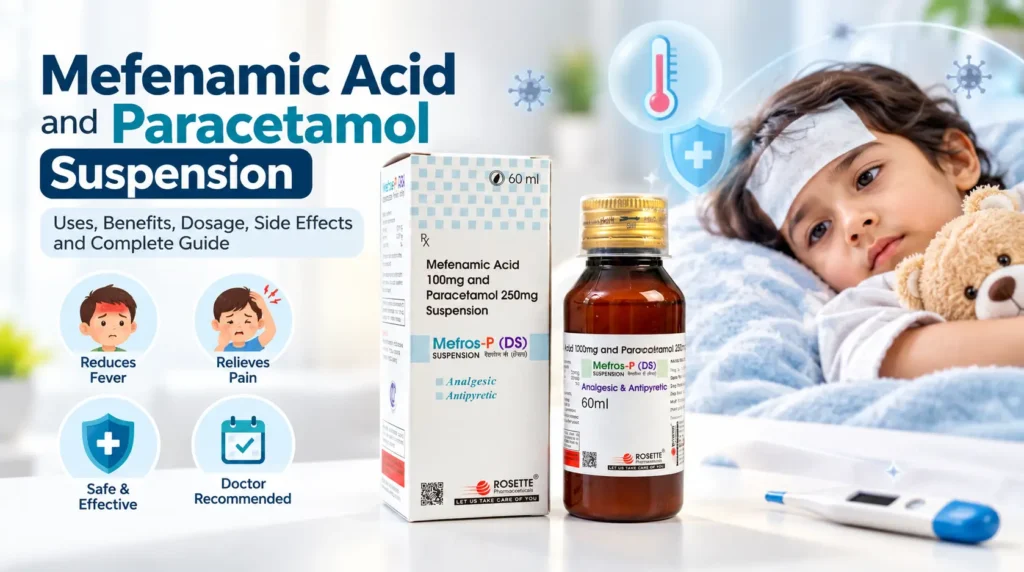
If you are reading about mefenamic acid and paracetamol suspension, you probably want to know what it contains, when it is used and what to watch out for. This guide explains the basics in plain language for adults, parents and caregivers.
The combination contains two active ingredients with different roles. Paracetamol helps relieve pain and reduce fever. Mefenamic acid is a non-steroidal anti-inflammatory drug (NSAID) that helps manage certain types of pain and inflammation. Whether the medicine is suitable, and how much should be given, depends on the exact product and its strength, the patient’s age and health, and a healthcare professional’s advice.
This article is general information. It is not a prescription and does not replace advice from a doctor or pharmacist.
What Is Mefenamic Acid and Paracetamol Suspension?
It is a liquid medicine that contains paracetamol (also called acetaminophen) and mefenamic acid. A suspension is a liquid in which the medicine is spread through the liquid rather than fully dissolved, which is why the bottle usually needs to be shaken before each use. In everyday speech people often call it mefenamic acid and paracetamol syrup, but the label may say “suspension”.
Manufacturers combine the two ingredients because they act in different ways, and one liquid can be easier to give than two separate medicines. Because a fixed combination delivers both ingredients together, a doctor decides whether both are needed for a particular person. The paracetamol and mefenamic acid combination is not interchangeable with single-ingredient medicines.
Strengths are not the same across brands. Always read the label for the amount of each ingredient per 5 ml, and never assume that directions for one product apply to another.
Mefenamic Acid and Paracetamol Suspension Uses
Combination suspensions of this kind are generally positioned for pain and fever. The exact approved indications are set out in each product’s label, which is the final reference. In general terms, the two ingredients contribute as follows:
- Pain relief: paracetamol is widely used for mild to moderate pain such as headache or toothache. Official labels for mefenamic acid on its own list certain types of pain, including muscular, dental and traumatic pain.
- Fever reduction: paracetamol is commonly used to bring down a high temperature, and mefenamic acid also has fever-lowering (antipyretic) activity.
- Pain with inflammation: as an NSAID, mefenamic acid can help where pain is linked to inflammation.
These are general mefenamic acid and paracetamol medicine uses, not a promise that the suspension suits every situation. Not every fever, body ache, toothache or childhood illness needs this medicine. The cause matters: a painful tooth may need dental treatment, and a fever may point to an infection that needs assessment. The suspension relieves symptoms. It does not treat the underlying cause, and it is not an antibiotic or an antiviral medicine.
How Do Mefenamic Acid and Paracetamol Work?
Both medicines can reduce pain and fever, but they work differently. Paracetamol is thought to act mainly in the brain, reducing chemical signals involved in pain and fever. It is not an NSAID. Mefenamic acid blocks cyclooxygenase enzymes, which lowers the production of prostaglandins, chemicals involved in pain, inflammation and fever.
| Ingredient | General role | Important consideration |
|---|---|---|
| Paracetamol | Helps relieve pain and reduce fever | Excessive exposure can cause serious liver injury |
| Mefenamic acid | NSAID that helps relieve certain types of pain and inflammation | Can cause gastrointestinal and other adverse effects |
This does not make one ingredient universally stronger or better than the other. They have different roles and different risks, which is why the combination should be used on professional advice.
Mefenamic Acid and Paracetamol Suspension Side Effects
Like all medicines, this combination can cause side effects, although not everyone gets them. Risk depends on the formulation, the amount taken, age, general health and other medicines. The information below is not a complete list. The product leaflet and your doctor are the best sources, and UK prescribing information for a single-ingredient mefenamic acid suspension is available in the electronic medicines compendium.
Possible side effects
For mefenamic acid, official labels say the stomach and gut are the most commonly affected. Possible effects include:
- Nausea, vomiting, indigestion or abdominal pain
- Diarrhoea or constipation
- Headache, dizziness or drowsiness
- Skin rash or itching
Paracetamol usually causes few side effects at correct doses. The main concern is overdose, which can damage the liver. NSAIDs such as mefenamic acid can also affect the kidneys and cause fluid retention or raised blood pressure in some people, and blood and liver effects have been reported. Labels for mefenamic acid also mention low body temperature (hypothermia), mainly reported in children.
Serious warning signs: get urgent medical help
Do not give another dose, and get urgent medical help, if any of these appear:
- Swelling of the face, lips, tongue or throat, wheezing or difficulty breathing, or widespread hives (possible severe allergic reaction)
- A severe skin rash, blistering or peeling, mouth sores, or a rash with fever and swollen glands
- Black or tarry stools, vomiting blood or material that looks like coffee grounds, or severe stomach pain (possible gastrointestinal bleeding)
- Yellowing of the skin or eyes, or dark urine (possible liver problems)
- Passing much less urine than usual, blood in the urine or marked swelling (possible kidney problems)
- Unusual bruising or nosebleeds
- Convulsions, extreme drowsiness or confusion
- Suspected overdose, even if the person seems well
In India, the Indian Pharmacopoeia Commission issued a drug safety alert in November 2023 about a rare but serious allergic reaction called DRESS syndrome in connection with mefenamic acid. Suspected reactions can be reported through the PvPI helpline on 1800-180-3024.
Precautions Before Using This Medicine
Speak to a doctor or pharmacist before use if the person has any of the following:
- Allergy: a previous reaction to paracetamol, mefenamic acid, aspirin, ibuprofen or other NSAIDs, including asthma, hives or swelling after such medicines.
- Stomach or gut problems: ulcers, gastrointestinal bleeding or inflammatory bowel disease. Mefenamic acid labels list some of these as reasons not to use the medicine.
- Kidney or liver problems: NSAIDs can affect the kidneys, and paracetamol is processed by the liver. Dehydration, for example from vomiting or diarrhoea, increases kidney risk.
- Heart and circulation conditions: such as high blood pressure or heart failure, where NSAIDs call for extra care.
- Pregnancy or breastfeeding: labels for mefenamic acid advise against use in the last three months of pregnancy, advise avoiding it while breastfeeding, and call for careful medical judgement at other times.
- Other medicines: blood thinners such as warfarin, other NSAIDs or aspirin, steroids, some blood pressure medicines and diuretics, lithium and methotrexate are among those that can interact with mefenamic acid.
Do not combine this suspension with any other paracetamol-containing medicine unless a doctor or pharmacist has said it is safe. Paracetamol appears in many cold, flu and pain products, so check every label. Alcohol can add to the risk of stomach bleeding with mefenamic acid. Inactive ingredients such as sugars, alcohol or preservatives vary by brand, so check the full ingredients list if the patient has allergies or intolerances.
Can Mefenamic Acid and Paracetamol Suspension Be Used in Children?
Many suspensions are designed with children in mind, and parents often look up the uses of this medicine in children. The honest answer is that it depends. Suitability varies with the specific product, its concentration, its approved directions, the child’s age and weight, their health and a doctor’s advice. Age limits can differ between brands and between countries’ labels for mefenamic acid, so one product’s guidance cannot be transferred to another.
For caregivers, the main points are:
- Follow the exact label of the product you have, and ask a doctor or pharmacist before giving it to a child, especially a baby or toddler.
- Do not use an adult formulation for a child without professional guidance, and do not work out a dose yourself.
- Use only the measuring device supplied with that product.
- Do not give any other medicine containing paracetamol, including cold and flu remedies, unless a healthcare professional confirms it is safe. NHS guidance on paracetamol for children lists this as a combination to avoid.
- The same NHS guidance says paracetamol and the NSAID ibuprofen should not be given at the same time unless a health professional advises it. A fixed combination of paracetamol and an NSAID is another reason to use this type of medicine only on professional advice.
- Tell the doctor if the child is dehydrated from vomiting or diarrhoea, because NSAIDs can affect the kidneys.
If a child’s fever or pain does not settle, or the child seems very unwell, see a doctor rather than repeating doses.
Dosage and Directions for Use
There is no single, universal mefenamic acid and paracetamol suspension dosage. The correct amount depends on the concentration of the product, the patient’s age and weight, their health, the official product information and a healthcare professional’s advice. Two bottles can look alike yet contain different amounts of each ingredient in every 5 ml, so a dose written for one cannot safely be used for the other. This article therefore does not give doses or treatment schedules.
General good practice with any liquid medicine:
- Read the label and leaflet each time, and shake the bottle if the label says so.
- Measure with the device supplied, not a kitchen spoon.
- Note the time of each dose to avoid accidental repeats, especially when several family members give medicine.
- Do not increase the dose, give it more often or continue for longer than advised.
- Store it as directed and keep it out of sight and reach of children.
If the directions on the label are unclear, ask a pharmacist or doctor before giving the medicine.
Mefenamic Acid and Paracetamol Suspension: Important Safety Considerations
Medicines for symptom relief still deserve respect. The main reasons for care are:
- Correct dosing matters. Too little may not help, while too much raises the risk of harm, particularly in children, where small measuring errors count.
- Duplicate paracetamol is a real hazard. Paracetamol overdose can damage the liver, and MedlinePlus explains that symptoms may not appear for 12 hours or more, so a person can feel well at first. Seek medical help straight away after any suspected overdose.
- Mefenamic acid has its own risks. As an NSAID it can irritate the stomach lining, cause bleeding or ulcers, and affect the kidneys, particularly with dehydration, older age or other risk factors.
- Persistent or worsening symptoms need assessment. Ongoing fever or pain suggests that something else may be going on.
- Relief is not a cure. A lower temperature or less pain does not mean the cause has been treated.
For NSAIDs in general, official labels advise using the lowest effective dose for the shortest time needed.
Mefros P Suspension by Rosette Pharma
At the time of writing, the product page for Mefros P Suspension by Rosette Pharma lists the following details:
- Composition: paracetamol 250 mg and mefenamic acid 100 mg per 5 ml
- Dosage form and pack: oral suspension in a 60 ml pack
- Described as: an analgesic and antipyretic (pain-relieving and fever-reducing) liquid
- Handling instructions: shake before every use, measure with a calibrated dropper, follow the dosage given by a healthcare provider and store in a cool, dry place
The page states that the product is intended for children and adults under medical guidance. It does not publish age-wise or weight-based dosing, a full list of contraindications or complete prescribing information. Those details must come from the product label or leaflet and a qualified healthcare professional. Mefros P Suspension is not suitable for every patient, and the precautions in this article apply to it just as they do to any similar medicine.
When Should You Consult a Doctor?
Get urgent medical help if:
- Any of the serious warning signs described under side effects appears
- An overdose is suspected, or more than one paracetamol-containing medicine has been given, even if the person seems well
- There is severe abdominal pain or vomiting of blood
- A child is very drowsy, hard to wake, struggling to breathe or has passed very little urine
In India, you can call 112 for emergency services or go to the nearest hospital.
Arrange a routine consultation if:
- Fever or pain continues, worsens or returns when the medicine wears off
- The medicine seems to be needed more often, or for longer, than advised
- Stomach upset, diarrhoea or a mild rash continues after a dose
- The patient is pregnant, breastfeeding, or has kidney, liver, stomach or heart conditions
- You are unsure about the dose, the product strength or the label
This medicine does not replace medical assessment, and this article cannot diagnose any condition.
Frequently Asked Questions
What is mefenamic acid and paracetamol suspension used for?
It is a liquid combination generally used for pain and fever. Paracetamol relieves pain and lowers fever, while mefenamic acid, an NSAID, helps with certain types of pain and inflammation. Approved uses depend on the product label, and a doctor should decide whether it suits the situation.
Does the combination help relieve pain and fever?
Both ingredients are used to relieve pain and reduce fever, so the combination is intended for those purposes. It treats symptoms, not the cause, and it is not a treatment for infection. Persistent or worsening symptoms need medical assessment.
What are the common side effects of mefenamic acid and paracetamol?
Stomach-related effects are most commonly reported with mefenamic acid, including nausea, vomiting, indigestion, abdominal pain and diarrhoea. Headache, dizziness, drowsiness and rash can also occur. Serious reactions are less common but need urgent care, as listed in the warning signs above.
Can this suspension be used in children?
It depends on the specific product, its strength, the child’s age and weight, and a doctor’s advice. Do not assume every suspension suits the same age group, and never give an adult product to a child without guidance. Follow the label and consult a healthcare professional.
Can it be taken with another paracetamol-containing medicine?
Not unless a doctor or pharmacist confirms it is safe. Paracetamol is found in many cold, flu and pain products, and taking more than one can cause an overdose and serious liver damage. Check every label.
What precautions are important before using this combination?
Tell a doctor or pharmacist about allergies to paracetamol or NSAIDs, stomach ulcers or bleeding, kidney, liver or heart conditions, pregnancy or breastfeeding, and all other medicines being taken. Measure carefully, avoid duplicate paracetamol and do not exceed the advised dose or duration.
Can people with kidney or liver problems use this medicine?
Only on a doctor’s advice. NSAIDs such as mefenamic acid can affect the kidneys, and official labels for mefenamic acid list severe kidney or liver failure among reasons not to use it. Paracetamol is processed by the liver, and overdose can cause liver injury.
What is Mefros P Suspension?
Mefros P Suspension is a Rosette Pharma oral suspension whose product page lists paracetamol 250 mg and mefenamic acid 100 mg per 5 ml in a 60 ml pack. It is meant to be used as directed by a healthcare professional. Check the label and leaflet for full directions.
Conclusion
Paracetamol relieves pain and lowers fever, while mefenamic acid is an NSAID used for certain types of pain and inflammation. Together in a liquid they can be convenient, but each ingredient carries risks: liver injury from too much paracetamol, and stomach, kidney and allergic reactions with mefenamic acid. The safest approach is to follow the exact label, avoid duplicate paracetamol, take extra care with children and seek advice when symptoms persist.
If you would like product-specific information, you can visit the Mefros P Suspension page on the Rosette Pharma website. This article is for general education and does not replace advice from a qualified healthcare professional.