
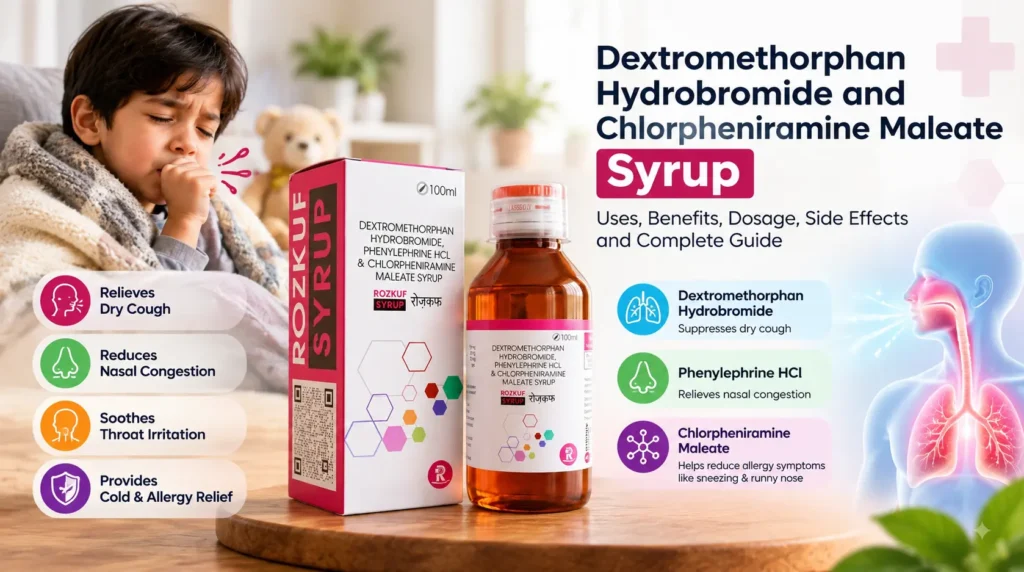
Dextromethorphan hydrobromide and chlorpheniramine maleate syrup brings together two different active ingredients: a cough suppressant and a sedating antihistamine. Depending on the formulation, such syrups may be used for certain dry, irritating coughs and allergy-type symptoms like a runny nose and sneezing.
The exact uses, strength, age limits and directions depend on the specific product label and on professional advice. Many Indian cough and cold syrups also add a third ingredient, a decongestant, so always read the full composition on the carton. This guide explains how the ingredients work, the side effects and precautions to know, and how two Rosette Pharma products, Rozkuf Junior Syrup and Rozkuf Syrup, compare.
This article is for general information only. It is not medical advice and does not replace a doctor’s or pharmacist’s guidance.
What Is Dextromethorphan Hydrobromide and Chlorpheniramine Maleate Syrup?
It is a liquid medicine that contains two active ingredients:
- Dextromethorphan hydrobromide is a cough suppressant. It helps reduce the urge to cough.
- Chlorpheniramine maleate (often written as CPM, and called chlorphenamine in the UK) is a first-generation antihistamine. It is used for allergy-related symptoms such as sneezing and a runny nose, and it commonly causes drowsiness.
Manufacturers may combine them in one bottle so that a person with a bothersome cough and allergy-type cold symptoms takes a single product. Whether this is appropriate depends on the person’s actual symptoms.
Not every syrup is the same. Strengths, extra ingredients, sugar content and approved indications differ between brands. In India, a number of cough and cold syrups also include phenylephrine, a nasal decongestant. Both Rozkuf products discussed below contain phenylephrine in addition to dextromethorphan and chlorpheniramine, so they are three-ingredient combinations. Check the composition on your own pack rather than assuming.
Dextromethorphan Hydrobromide and Chlorpheniramine Maleate Syrup Uses
Reliable references describe the ingredients’ roles separately:
- Dextromethorphan is used to suppress certain coughs. Cough suppressants are generally considered for dry, irritating coughs rather than coughs that bring up phlegm.
- Chlorpheniramine is used to relieve allergy symptoms. MedlinePlus lists it as an antihistamine for allergy symptoms and notes it appears in many combination cold products.
Neither ingredient treats the cause of a cough. They do not cure a viral infection, and this combination is not a treatment for bacterial infections, pneumonia or asthma. Cough medicines may also not be right for every situation, including coughs with a lot of phlegm.
The NHS 111 Wales cough guide notes that most coughs clear up on their own within 3 to 4 weeks, and that cough medicines may help you cough less but will not stop the cough.
Why the cause of the cough matters
A cough can come from a cold, an allergy, asthma, acid reflux, a chest infection, smoking or even a blood pressure medicine. A syrup that suits one cause may not help, or may hide an important sign, in another. A persistent, severe or unexplained cough needs a proper medical assessment rather than repeated self-treatment.
How Does the Combination Work?
In simple terms, dextromethorphan acts on the cough reflex in the brain, while chlorpheniramine blocks histamine, a chemical involved in allergic reactions. The table below summarises the general role of each ingredient, including phenylephrine, which is present in both Rozkuf products.
| Ingredient | General role | Important consideration |
|---|---|---|
| Dextromethorphan hydrobromide | Cough suppressant for certain coughs | Not appropriate for every cough or underlying cause; can interact with some medicines |
| Chlorpheniramine maleate | Antihistamine for certain allergy-related symptoms | May cause drowsiness, dry mouth and other side effects |
| Phenylephrine hydrochloride (only if listed on the label) | Decongestant for a blocked nose | Can raise blood pressure and heart rate in some people; some sources question how well the oral form works |
Dextromethorphan and Chlorpheniramine Syrup Side Effects
Side effects vary with the formulation, dose, age, other medicines and individual health. Possible effects reported in reliable sources include:
- Drowsiness or sleepiness. The NHS lists this as a common effect of chlorphenamine.
- Dizziness and difficulty concentrating. These are reported with both ingredients.
- Dry mouth, nose or throat. Also listed by NHS and MedlinePlus for chlorpheniramine.
- Nausea or stomach upset, headache and blurred vision. Listed by the NHS for chlorphenamine.
- Restlessness, excitement or confusion. The NHS notes children and people over 65 are more likely to have some side effects of this type.
If a phenylephrine-containing syrup is used, nervousness, headache, trouble sleeping and a higher blood pressure or heart rate are also possible. This is not a complete list. Read the patient leaflet for your product.
Warning signs that need urgent medical attention
Stop the medicine and get urgent medical help if any of the following occurs:
- Swelling of the lips, mouth, tongue or throat, or difficulty breathing, which can be signs of a serious allergic reaction
- A child who is limp, floppy or not responding as usual
- Severe confusion, agitation, tremor, seizures or very slow or shallow breathing
- A fast, pounding or irregular heartbeat, severe headache or blurred vision
- Yellowing of the skin or the whites of the eyes
Suspected overdose, especially in a young child, is an emergency. Do not wait for symptoms to develop.
Precautions Before Using This Cough Syrup
Speak to a doctor or pharmacist before use if any of the following applies:
- You take other medicines. This includes other cough, cold or allergy products, sleeping aids and sedatives. Duplicate ingredients can add up.
- You have a medical condition. Examples raised in reliable sources include epilepsy, an enlarged prostate, glaucoma, thyroid disease, diabetes, heart disease and high blood pressure. The last four are mainly relevant when a decongestant such as phenylephrine is present.
- You have had an allergic reaction to a medicine.
- You are pregnant or breastfeeding. Ask for advice specific to your product.
- You are an older adult. MedlinePlus says older adults should not usually take chlorpheniramine because other medicines are safer or more effective for the same purpose.
- Your symptoms are persistent or getting worse.
Drowsiness, driving and alcohol
Chlorpheniramine can make you sleepy and affect concentration. Avoid driving, cycling or operating machinery until you know how the medicine affects you. Alcohol can worsen drowsiness and dizziness, so it is usually advised to avoid it. Do not combine the syrup with other sedating medicines unless a healthcare professional has said it is acceptable.
Interactions with antidepressants and other medicines
Dextromethorphan can interact with certain medicines. Drug references advise against using it with monoamine oxidase inhibitors (MAOIs), a type of antidepressant, or within 14 days of stopping one, because of the risk of serotonin syndrome. Some other antidepressants and medicines that slow its breakdown in the body, such as bupropion, can also raise dextromethorphan levels. Phenylephrine, where present, also should not be used with MAOIs.
These interactions are complex. Do not try to judge them yourself. Show your full medicine list to a doctor or pharmacist.
No cough or cold syrup is safe for everyone.
Can Children Use Dextromethorphan and Chlorpheniramine Maleate Syrup?
Suitability for children depends on the exact ingredients, their strength, the child’s age and health, and the product label. Several important warnings apply:
- Indian regulation. India’s health authorities have directed that fixed-dose combinations containing chlorpheniramine maleate and phenylephrine hydrochloride must carry the warning that they should not be used in children below four years of age. Reports say this applies to all such combinations. Earlier CDSCO guidance issued in December 2023 had already asked manufacturers to add this warning.
- US FDA position. The FDA does not recommend over-the-counter cough and cold medicines for children younger than 2 years, and manufacturers voluntarily label such products “do not use in children under 4 years of age”. See the FDA’s consumer advice.
- Serious risks. MedlinePlus states that non-prescription cough and cold combination products containing chlorpheniramine can cause serious side effects or death in young children.
For parents and caregivers:
- Do not assume an adult cough syrup is suitable for a child.
- Do not work out a child’s dose from an adult dose, or from age or weight alone.
- Do not use an antihistamine syrup to make a child sleepy.
- Consult a qualified doctor before giving any cough and cold medicine to a young child, and keep all medicines out of children’s reach.
The NHS also notes that some cough medicines should not be given to children under 12.
Dosage and Directions for Use
There is no universal dose for this combination. Strength per 5 ml differs between brands, and the correct amount depends on the product, the person’s age and health, and a healthcare professional’s advice. Always follow the label and your doctor’s instructions.
- Use the measuring device supplied with the product, not a kitchen spoon.
- Shake the bottle well if the label says so.
- Do not increase the dose or take it more often than directed.
- Do not combine it with other cough, cold or allergy medicines unless advised.
- Do not continue it for longer than advised. If symptoms persist, see a doctor.
This article does not give a dose for any product. Rosette Pharma’s product pages state that both syrups should be used as directed by a healthcare professional, and neither page lists a dose chart.
Rozkuf Junior Syrup vs Rozkuf Syrup
Rosette Pharma lists two syrups with the same three active ingredients at the same strengths. The comparison below uses only what is stated on the two product pages when they were checked. It is informational and does not suggest that one product is safer, stronger or better than the other.
| Feature | Rozkuf Junior Syrup | Rozkuf Syrup |
|---|---|---|
| Composition | Dextromethorphan Hydrobromide 10 mg + Phenylephrine Hydrochloride 5 mg + Chlorpheniramine Maleate 2 mg | Dextromethorphan HBr 10 mg + Phenylephrine HCl 5 mg + Chlorpheniramine Maleate (CPM) 2 mg |
| Strength basis | Not confirmed in the available product information (the page does not state “per 5 ml”) | Not confirmed in the available product information (the page does not state “per 5 ml”) |
| Pack size | 60 ml | 100 ml |
| Dosage form | Syrup | Syrup; described as sugar-free |
| Labelled intended use | Described as helping relieve cough, nasal congestion, runny nose and sneezing linked to cold and allergy symptoms | Described in general terms as supporting respiratory comfort; no specific cough indication is stated on the page |
| Intended age group | No age range stated, other than the page noting that the combination should not be used in children below 4 years | Not confirmed in the available product information |
| Product-specific directions | Use as prescribed by a doctor; measure with a proper device; shake well; use in children only on a healthcare professional’s advice | Shake before use; use a calibrated dropper; use as directed by a healthcare provider |
| Product page | View the Rozkuf Junior Syrup page | View the Rozkuf Syrup page |
Key points when reading the two pages together:
- Both contain phenylephrine as well as dextromethorphan and chlorpheniramine, so the cautions for all three ingredients in this article apply.
- The word “Junior” does not by itself tell you the suitable age. Do not choose a syrup by name alone.
- The under-4 warning applies by regulation to chlorpheniramine and phenylephrine combinations. Check the carton and package insert of whichever product you have for the exact warning wording, age limits and directions.
- Pack text and label details can change. The carton and insert in your hand are the final authority.
When Should You Consult a Doctor?
Seek emergency care immediately if there is:
- Severe difficulty breathing or struggling to speak
- Severe chest pain, or pain spreading to the arm, back, neck or jaw
- Coughing up a large amount of blood
- Swelling of the face, lips, tongue or throat
- Seizures, collapse or extreme drowsiness
- A suspected overdose or accidental ingestion by a child
Book a doctor’s appointment if:
- The cough has lasted more than 3 weeks
- The cough is very bad or quickly getting worse
- You have chest pain, a significant fever or ongoing breathlessness
- You notice any blood in your phlegm (see a doctor urgently)
- The cough affects a young child or infant, or someone with a long-term lung or heart condition
- You need cough medicine regularly or for longer than advised
A cough syrup cannot diagnose the cause of a cough and should not replace a medical evaluation.
Frequently Asked Questions
1. What is dextromethorphan hydrobromide and chlorpheniramine maleate syrup used for?
It combines a cough suppressant with an antihistamine and may be used for certain coughs and allergy-type symptoms such as sneezing and a runny nose. The exact use depends on the product label. It does not treat the underlying cause of a cough.
2. Is this combination used for dry cough?
Dextromethorphan is generally used for dry, irritating coughs. It is not suited to every cough, and it is usually not recommended for coughs that bring up phlegm. Ask a doctor or pharmacist if you are unsure what type of cough you have.
3. Can this syrup cause sleepiness?
Yes. Chlorpheniramine commonly causes drowsiness and can affect concentration. Avoid driving or operating machinery until you know how it affects you, and avoid alcohol.
4. Can children take dextromethorphan and chlorpheniramine syrup?
Only on a healthcare professional’s advice and according to the product label. Indian regulation requires a warning that chlorpheniramine and phenylephrine combinations should not be used in children below four years of age. Never use an adult product for a child.
5. Can this syrup be taken with other cold medicines?
Do not combine it with other cough, cold or allergy products unless a healthcare professional approves. Many contain the same or similar ingredients, which can lead to excess drowsiness or an overdose.
6. How should the correct dose be determined?
By following the label of the specific product and the advice of a doctor or pharmacist. Strengths and directions differ between brands, so no universal dose applies.
7. What precautions should be taken while using this combination?
Tell your doctor about all your medicines (especially antidepressants and sedatives), medical conditions, pregnancy or breastfeeding, and any past medicine allergy. Avoid alcohol, use only the measuring device provided, and stop and seek help if you notice warning signs.
8. What is the difference between Rozkuf Junior Syrup and Rozkuf Syrup?
According to their product pages, both contain dextromethorphan 10 mg, phenylephrine 5 mg and chlorpheniramine maleate 2 mg. The pages differ in pack size (60 ml and 100 ml), the sugar-free description of Rozkuf, and how each describes its intended use. The Junior page states that the combination should not be used in children below 4 years, while the Rozkuf page does not state an age group. See the comparison table above and check your carton.
Conclusion
Dextromethorphan hydrobromide and chlorpheniramine maleate syrup combines a cough suppressant with an antihistamine, and many Indian products add a decongestant as well. These medicines can relieve certain symptoms but do not treat the cause of a cough. Drowsiness, interactions, and the strict warnings for young children are the main safety points.
Always check the exact composition and strength on the label, follow professional advice, and see a doctor if a cough is persistent, severe or worrying. To see the product-specific details Rosette Pharma has published, you can open the Rozkuf Junior Syrup and Rozkuf Syrup pages linked in the comparison section above. This article is not a substitute for professional medical advice.