Many people drawn to the pharmaceutical industry are not looking to build a factory. They are medical representatives who know their area’s doctors and chemists, stockists who understand local supply, or entrepreneurs who want to work in a sector where demand for medicines is steady. For many of them, the first business structure they meet is PCD pharma.
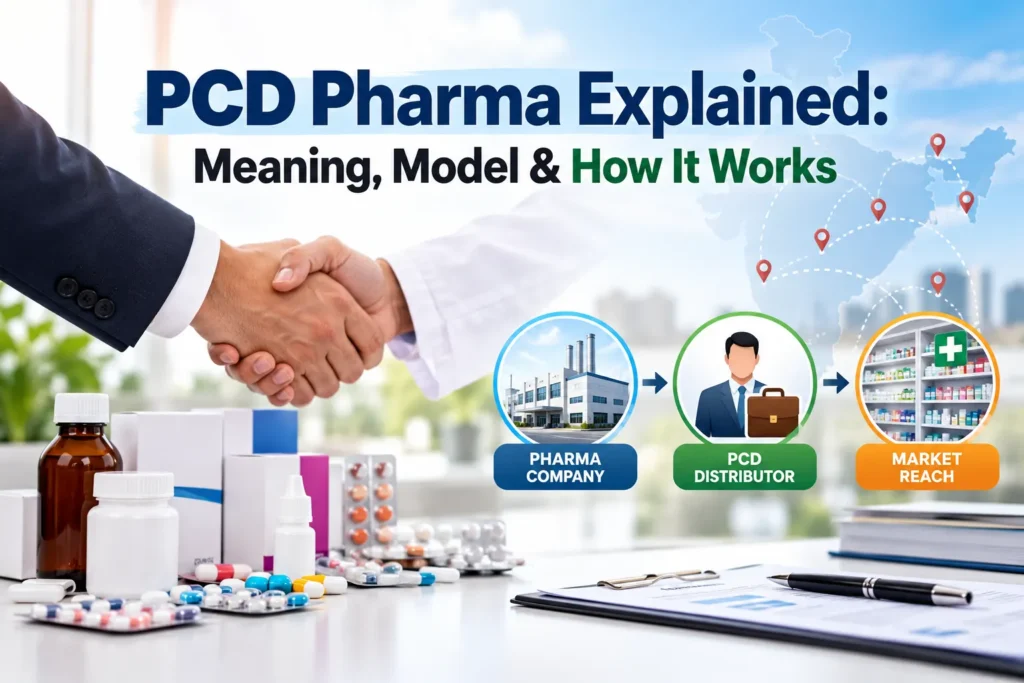
In simple terms, a PCD arrangement lets a partner market and distribute products from an established pharmaceutical company without setting up their own medicine manufacturing facility. The company and the partner then focus on different responsibilities: the company on making or sourcing products and supplying them, the partner on building the market in an agreed area.
That does not make it a shortcut. The business still involves investment, inventory, customer development, regulatory compliance, financial management and competition from many other brands. It is not risk-free, it does not guarantee income, and it rewards people who understand their local market. This guide explains the model from start to finish in plain language, compares it with traditional distribution, and lists what to verify before you commit.
What Is PCD Pharma? Meaning and Full Form
PCD stands for Propaganda Cum Distribution. In everyday English, “propaganda” sounds political. In pharma trade usage it simply means promoting a company’s products and communicating about them to the trade and to healthcare professionals. It has nothing to do with political messaging. “Distribution” means getting stock to eligible customers, such as licensed retailers, through the supply chain.
Put together, a PCD arrangement is a commercial agreement. A pharmaceutical company allows an independent partner to promote and distribute its branded products in an agreed area, on agreed terms. The partner is usually a separate business, not an employee. Because the company supplies finished products, the partner does not normally need to set up a manufacturing unit.
Terms differ by company and by contract. One company may offer a single district, another a wider area. One may provide promotional materials, another may not. Treat any definition, including this one, as a starting point and read the actual agreement. For a shorter, franchise-focused definition, see our PCD pharma franchise explainer.
How Does the PCD Pharma Business Model Work?
The table below follows a typical journey from first research to repeat orders. The order and detail vary by company, state and product category.
| Step | Pharmaceutical Company’s Role | Franchise Partner’s Role |
|---|---|---|
| 1. Research the business | Publishes information about its model and products | Studies how the supply chain works and what the local market needs |
| 2. Compare companies and portfolios | Shares product lists and pricing on request | Compares portfolios, documentation and reputation |
| 3. Enquire about investment, minimum orders and territory | Explains terms and checks whether the area is available | Asks for these details in writing |
| 4. Discuss commercial terms | Proposes prices, payment and order conditions | Checks whether the terms are affordable and workable |
| 5. Check licences and business requirements | May ask for specific documents | Confirms with the State Drugs Control authority which licences and registrations apply |
| 6. Agree written terms and territory rights | Issues an agreement; defines territory where offered | Reads every clause; may take legal advice |
| 7. Select products | Provides product information | Chooses according to local demand and available capital |
| 8. Place an order | Confirms the order and invoices it | Places the order and arranges payment |
| 9. Receive supply | Dispatches under agreed terms | Checks quantity, batch and expiry on arrival |
| 10. Develop the local market | Provides product information and materials, where offered | Carries out compliant promotion and builds customer relationships |
| 11. Reach eligible customers | Keeps supply flowing as agreed | Supplies licensed customers and records sales |
| 12. Monitor inventory, payments and repeat orders | Tracks orders and payments | Tracks stock, expiry dates and collections |
| 13. Review and plan | Reviews performance and discusses range or terms | Plans the next orders from actual sales |
The real split of responsibilities depends on the agreement and applicable law, and not every PCD company offers the same services. For a doctor-and-chemist view of the same process, read how a PCD franchise works in practice.
Roles and Responsibilities of the Company and Franchise Partner
What the pharmaceutical company may handle
- Product development or sourcing
- Manufacturing arrangements
- Quality systems
- Regulatory responsibilities tied to its own licensed activities
- Product supply and order coordination
- Branding and product information
- Promotional resources, where offered
What the franchise partner typically handles
- Local market research
- Customer and distributor development
- Product selection and sales planning
- Inventory management and order placement
- Financial management and recordkeeping
- Customer service
- Compliance with requirements that apply to the partner’s own activities
Be cautious about the claim that “the company handles all compliance.” Legal duties depend on the activity, the licence, the product and the business arrangement. A manufacturer has duties linked to manufacturing. A business that stocks, sells or distributes drugs has its own duties linked to its licence, premises, records and the customers it sells to. Ask every company to set out its responsibilities and yours in writing.
Promotion has rules too. The Department of Pharmaceuticals issued the Uniform Code for Pharmaceutical Marketing Practices (UCPMP) 2024, which covers areas such as gifts, samples and interactions with healthcare professionals. Anyone promoting medicines should read it.
PCD Pharma vs Traditional Pharma Distribution: What Is the Difference?
| Factor | PCD Pharma Franchise | Traditional Pharma Distribution |
|---|---|---|
| Business structure | Independent partner appointed by one company to promote and distribute its products | Distributor or wholesaler buys from one or several companies and supplies retailers or institutions |
| Brand relationship | Tied to one company’s brands | Often multi-brand, though it varies |
| Territory arrangements | May include defined territory rights, depending on the agreement | Open or assigned, depending on the supplier |
| Marketing responsibilities | Partner usually builds local demand for the company’s brands | Often centred on supply, though some distributors promote too |
| Promotional support | Varies; may include product information and materials | Varies by brand; some brands support their distributors |
| Product selection | From one company’s portfolio | From several companies’ catalogues |
| Customer development | A core task, often with prescribers and retailers | Often built on existing retail and institutional networks |
| Investment considerations | Can start at a smaller scale; depends on stock and terms | Often broader stock; depends on scale |
| Working capital | Stock, credit and expiry exposure still apply | Larger inventory and credit exposure are common, but vary |
| Commercial independence | Works within one company’s pricing and policies | More freedom to choose suppliers, but wider price competition |
| Agreement terms | Franchise-style terms: territory, targets, duration | Supply and distribution terms; vary widely |
Traditional distribution can involve many distributors and many brands. A PCD arrangement may assign defined territory rights for one company’s products. Do not assume that every traditional distributor lacks marketing support, or that every PCD franchise comes with exclusive territory. Exclusivity exists only if the agreement says so.
Neither model is universally better. PCD may suit people who already have local prescriber and chemist relationships, moderate capital, and a wish to build a brand-focused business. Traditional distribution may suit those with warehousing, logistics and retailer networks who want a broad product mix. For an investment and legal comparison, see PCD franchise vs distributorship.
Why Is PCD Pharma an Accessible Business Model in India?
Entrepreneurs and pharma sales professionals consider the model for several reasons:
- No need to build an independent manufacturing unit
- Access to an existing product portfolio
- A chance to develop a local customer network
- Possible defined territory rights
- Possible access to promotional materials
- The ability to start at a scale that suits available resources
- A way into an existing pharmaceutical supply chain
For a medical representative, the appeal is often practical: they already know prescribers and retailers, and the model lets them work for themselves. “Accessible” is the key word, though, and it does not mean risk-free or automatically profitable. Many brands compete for the same prescriptions, and building trust takes time. No reliable figure is quoted here for the model’s growth, because only current, authoritative data could support one.
How Much Investment Does a PCD Pharma Business Require?
The cost of a franchise is only part of the picture. Plan for these categories:
- Initial product stock
- Working capital to keep the business running
- Storage and handling
- Transportation
- Sales and market-development expenses
- Staff costs, if any
- Accounting and administration
- Customer credit and payment delays
- Funds for reorders
An advertised starting investment is not the same as the capital needed to run the business. Stock bought on day one has to be sold, and customers may pay weeks later while you still need money for the next order. Our working capital guide for PCD franchises walks through the calculation. No single amount suits every partner. Before committing, ask for written details of the investment, payment terms, minimum orders, territory availability and any other charges.
What Are Monopoly Rights in PCD Pharma?
“Monopoly rights” generally means a contractual arrangement that gives a partner specified rights, in a defined geographic area, for a company’s products. In practice it usually means the company agrees not to appoint other partners for those products in that area.
Possible advantages:
- Clear territory boundaries
- Less overlap with other partners of the same company
- More focused local market development
- Easier planning of customer coverage
Limitations to understand:
- Territory rights do not remove competing brands.
- They do not guarantee sales or profit.
- Geographic boundaries must be stated clearly.
- Rights, exclusions, duration and termination depend on the written agreement.
- Availability should be confirmed before you invest.
How Does a PCD Pharma Franchise Make Money?
The partner buys products at agreed prices and sells or distributes them under the commercial arrangement. Gross trading profit depends on the actual buying and selling prices. Net profit is lower, because it is reduced by operating costs, logistics, inventory losses, expiry, customer credit and other expenses. Repeat business depends on demand, product availability, customer relationships and how well the business is managed.
The example below is purely illustrative. The figures are invented to show how the calculation works and are not typical, expected or guaranteed results.
| Item (illustrative, per month) | Amount |
|---|---|
| Sales revenue | ₹2,00,000 |
| Cost of goods sold | ₹1,70,000 |
| Gross profit | ₹30,000 |
| Transport and courier | ₹5,000 |
| Field travel and promotion | ₹8,000 |
| Storage, accounting and administration | ₹5,000 |
| Expired or damaged stock written off | ₹3,000 |
| Losses from delayed or unpaid invoices | ₹2,000 |
| Total operating expenses | ₹23,000 |
| Net profit (before income tax) | ₹7,000 |
Notice how a ₹30,000 gross profit shrinks to ₹7,000 once running costs are counted. No fixed margin or monthly income can be promised in this business.
What Types of Products Are Available Through a PCD Pharma Company?
Portfolios differ by company and by the products it is authorised to supply. They commonly include tablets, capsules, syrups and suspensions, topical formulations such as ointments, and other authorised dosage forms, spread across different therapeutic categories.
Before choosing products, evaluate availability, regulatory status, local demand, price positioning, storage needs, expiry risk and the working capital each product ties up. This article is about business planning only. It does not recommend any medicine for treatment, and prescription medicines should never be used without a qualified practitioner’s advice.
How to Choose the Right PCD Pharma Company
Verify documents and claims instead of relying on promotional statements. A practical checklist:
- Company identity, address and contact details that you have confirmed independently
- Product portfolio, with product-wise composition and strengths
- Applicable product approvals and documentation
- Manufacturing and quality documentation
- Territory availability, confirmed in writing
- A written franchise agreement
- Minimum order requirements and payment terms
- Product availability and dispatch arrangements
- Promotional support, stated clearly
- Expiry and damaged-product policies
- A defined complaint-handling process
- Transparent commercial terms, with no pressure to pay before you have reviewed them
Do not accept a certification or approval claim unless you have checked it with a reliable, current source. A deeper due-diligence guide is available in 7 things to check before choosing a pharma franchise company.
Rosette Pharma as an Example of the PCD Pharma Model
Rosette Pharma is based in Karnal, Haryana, and its website says the company was established in 2006. It offers PCD franchise opportunities and third-party manufacturing, which makes it a useful real-world example of the model described above. The points below reflect what the company’s own website currently states.
Product portfolio. The website presents 500+ formulations across major therapeutic segments, in forms including tablets, capsules, syrups, injectables, ointments and drops. It describes its products as DCGI-approved and sourced from WHO-GMP-compliant facilities. These are the company’s own statements. Approval and manufacturing status can differ from product to product, so ask for product-wise documents rather than assuming one claim covers the whole range.
Partner support. The website lists onboarding and business mentorship, visual aids and marketing material, digital support, and guidance from product selection through to market launch. Ask what exactly is included and get it in writing.
Investment. Rosette Pharma’s homepage advertises a starting investment of ₹50,000, while its franchise page lists district-based packages at higher ranges. The pages do not spell out what each figure includes, and neither is the same as total operating costs. Confirm the current amount, inclusions and any additional charges with the company before deciding.
Territory. The company advertises district-level monopoly rights. Its franchise page states that these rights apply to the company’s own brands and do not stop other companies from selling similar medicines. Not every district is necessarily available, and the website offers a district availability check.
To review the current terms, visit the company’s official PCD franchise page and confirm the details directly with the team.
Common Beginner Mistakes and How to Avoid Them
- Confusing gross profit with net profit. Build a full monthly cost estimate before judging a margin.
- Investing without enough working capital. Plan for stock, credit delays and reorders, not just the first order.
- Failing to verify territory rights. Get the area, exclusions and duration in writing.
- Assuming monopoly rights guarantee sales. Competing brands still exist; demand must be built.
- Selecting too many products at once. Start with a focused range matched to local demand.
- Ignoring expiry and inventory management. Track batches and sell older stock first.
- Offering excessive customer credit. Set credit limits and follow up on dues.
- Skipping licensing checks. Confirm requirements with your State Drugs Control Department.
- Choosing a company on promises alone. Verify documents and speak to existing partners.
- Treating marketing materials as a substitute for local effort. Materials help, but relationships and follow-up drive repeat orders.
Frequently Asked Questions
1. What is the full form of PCD in pharma?
PCD stands for Propaganda Cum Distribution. Here, “propaganda” means product promotion and communication.
2. What is a PCD pharma franchise?
It is a commercial arrangement in which a pharmaceutical company authorises an independent partner to promote and distribute its products, often within an agreed area. Terms vary by company.
3. How does the PCD pharma business model work?
The partner chooses products, places orders, promotes them in compliance with the rules, supplies eligible customers, and manages stock and payments. The company supplies products under the agreed terms.
4. What is the difference between PCD pharma and traditional distribution?
PCD is tied to one company’s brands and may carry territory rights. Traditional distribution is often multi-brand and supply-focused. Both vary by contract.
5. Is PCD pharma suitable for beginners?
Some beginners enter without prior pharma experience, but there is a real learning curve. Local market knowledge, careful use of capital and compliance all matter, and success is not assured.
6. How much investment is required to start a PCD pharma franchise?
There is no single figure. It depends on the company, product range, minimum order, licences, premises and working capital. Ask for a written breakdown and prepare your own budget.
7. What are monopoly rights in pharma?
They are contractual rights in a defined area for a company’s products. They do not give control over the whole market, and their scope depends on the written agreement.
8. What support should a PCD pharma company provide?
At minimum: clear product information, price lists and order terms, lawful promotional materials, onboarding guidance, dispatch coordination and a stated policy for expiry, damage and complaints. Check what each company actually commits to in writing.
9. Do I need a licence to distribute pharmaceutical products?
Generally, selling or distributing drugs requires a licence under the Drugs and Cosmetics Act, 1940 and its Rules, issued by the State Licensing Authority. Wholesale licences are issued in Forms 20B and 21B, and retail licences in Forms 20 and 21. Which applies to you depends on your activity, product and state, so confirm with your State Drugs Control Department. This is general information, not legal advice.
10. How do I choose a reliable PCD pharma franchise company?
Verify the company’s identity and documents, read the full agreement before paying, compare total terms rather than headline offers, and speak to existing partners where you can.
Conclusion
PCD pharma is a business model in which a company and an independent partner share the work of bringing branded medicines to market. The company typically focuses on products, quality systems and supply, while the partner builds demand and manages local distribution, stock and finances. Compared with traditional distribution, it tends to be brand-focused and may include territory rights, but both models vary by contract.
Plan the investment realistically, including working capital. Treat territory rights as only as strong as the written agreement. Verify every product and company claim yourself. Rosette Pharma is one example you can investigate: review its franchise information and confirm product availability, territory rights, investment and support terms directly