Many people who want to enter pharmaceutical marketing do not want to build a manufacturing plant. A PCD pharma franchise is a common way in. The franchise partner works with an established company, buys its products on agreed terms and develops the market in an agreed territory.
The model lowers one barrier, which is manufacturing, but it does not remove the others. A partner still needs capital, compliant operations, local customer relationships, reliable product availability and careful financial planning. No PCD arrangement guarantees income, easy success or automatic demand.
This guide explains how the business works from first enquiry to repeat orders. It covers investment, territory rights, licensing, responsibilities and how to compare companies. Rosette Pharma, a PCD franchise and third-party manufacturing company based in Karnal, Haryana, appears as a real-world example. Company-specific statements are kept separate from general descriptions of the industry.
What Is a PCD Pharma Franchise in India?
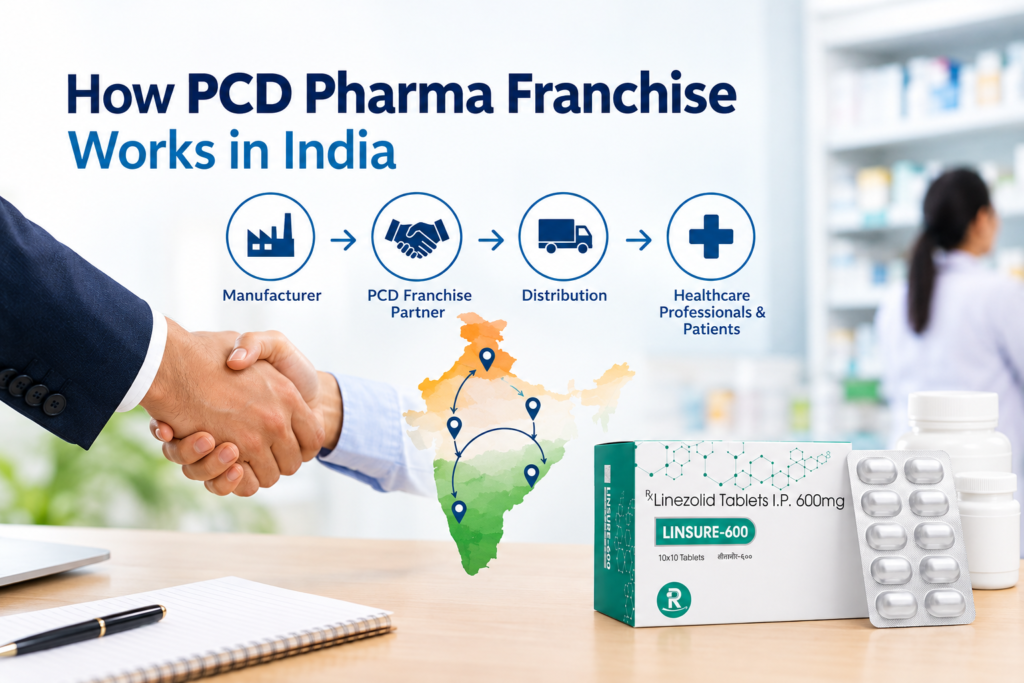
PCD stands for Propaganda Cum Distribution. A pharmaceutical company grants an individual or firm the right to promote and distribute its products in a defined area. The company produces the medicines, or has them produced. The franchise partner handles local marketing, orders and customer relationships.
Manufacturing versus marketing and distribution
Making a medicine involves licensed premises, equipment, qualified staff, quality control and regulatory approvals. Marketing and distribution involve promoting approved products, taking orders, holding stock, invoicing, delivering and collecting payment. In a PCD arrangement the company usually carries the first set of tasks and the partner carries the second.
How the roles generally divide
- Company: product portfolio, manufacturing arrangements, product approvals and labelling, supply, promotional material and partner guidance.
- Partner: local promotion, customer development, stock handling, order management, invoicing, record-keeping and payment collection.
Product supply, promotion and customer relationships work differently from company to company. The partner usually places orders with the company, receives stock and supplies it to eligible customers in the territory. Some partners focus on chemists and stockists, and others on doctors and clinics. The agreement and applicable law decide what is permitted.
Why this model is used in India
India has many district-level and small-city markets where local knowledge matters. A company cannot easily cover all of them directly. Appointing a local partner for each area lets the company grow its reach while the partner handles day-to-day relationships. Contract terms are not identical across companies, so never assume that one company’s terms apply to another.
How Does a PCD Pharma Franchise Work Step by Step?
- Research the market. Understand demand, competing companies and typical commercial terms in your area.
- Shortlist companies. Compare identity, history, portfolio and reputation.
- Evaluate products and terms. Look at the range, pricing structure, supply reliability and minimum commitments.
- Check territory availability. Confirm the exact district or area is open before any payment.
- Discuss investment and minimum order. Ask what the starting figure includes and what it does not.
- Verify licences and registrations. Confirm with the relevant authority or a qualified professional what you need before operating.
- Review the agreement. Read every clause, including duration, targets and termination.
- Confirm territory and monopoly terms in writing.
- Select products. Match the range to local demand and your available capital.
- Place the initial order. Start with quantities you can realistically sell before expiry.
- Arrange storage and distribution. Products need suitable storage and handling.
- Build a compliant sales plan. Decide how you will reach customers within the law.
- Build relationships through permitted activities. Follow the marketing code discussed later.
- Monitor stock, orders and payments. Track what moves, what is outstanding and what is ageing.
- Reorder against genuine demand. Do not restock on optimism.
- Review and expand only when justified. Add products or areas once the numbers support it.
| Stage | Pharmaceutical Company’s Role | Franchise Partner’s Role |
|---|---|---|
| Enquiry and selection | Shares portfolio, terms and territory status | Researches, compares and asks detailed questions |
| Agreement | Provides written terms and territory details | Reviews terms, verifies licences, seeks professional advice |
| Initial order | Processes order, arranges dispatch | Selects products, arranges payment and storage |
| Promotion | Supplies approved promotional material and product information | Plans and carries out compliant local promotion |
| Sales and invoicing | Maintains product availability | Takes orders, invoices, delivers, keeps records |
| Collections and reorder | Handles reorders and queries | Collects payments, monitors expiry, reorders by demand |
| Review | Reviews performance against the agreement | Assesses profitability before expanding |
This table is a general illustration. Actual responsibilities depend on the signed agreement and applicable law.
Who Can Start a PCD Pharma Franchise in India?
People from several backgrounds enter this business:
- Medical representatives who already know doctors, chemists and territory work.
- Pharma distributors and stockists who want to add a company’s range to existing operations.
- Pharma sales professionals moving from a salaried role to their own business.
- Entrepreneurs with distribution experience in related sectors.
- New business owners willing to learn the sector properly.
Eligibility depends on the specific arrangement and the activities you intend to carry out. Not everyone can legally distribute medicines without the required licences or qualifications. Before operating, verify drug licensing, GST, business registration, storage, invoicing and any other requirements with the relevant authorities or a qualified professional. Requirements vary by activity and business structure, so no single checklist fits everyone.
How Much Investment Is Required for a PCD Pharma Franchise?
The cost of starting a PCD franchise has several parts:
- Initial product purchase
- Working capital for reorders
- Storage and handling
- Transportation and delivery
- Local business development
- Staff costs, if applicable
- Sales and distribution expenses
- Accounting and compliance
- Money tied up in outstanding customer payments
An advertised starting investment is not the same as the total money a business needs to run comfortably. The first figure may cover only an initial order. Working capital for repeat orders, slow-paying customers and logistics usually sits on top of it.
Rosette Pharma’s advertised ₹50,000 entry point
Rosette Pharma’s website advertises a starting investment of ₹50,000 for its PCD franchise. Treat that as an advertised entry point, not an industry rate. It is also not a guarantee that every territory or product selection is available at that amount. The company’s franchise pages also describe package options that vary with territory size, so the amount that applies to you may depend on the area and range you choose.
Before paying anything, confirm directly with the company:
- What the ₹50,000 starting investment currently includes
- The minimum initial order value
- Product selection and quantity
- Freight, taxes and other applicable charges
- Whether additional working capital is advisable
- Territory availability
- Payment terms
- Reorder requirements
- The written franchise terms
| Cost Component | What a New Partner Should Check |
|---|---|
| Initial stock | Products, quantities and purchase value |
| Working capital | Funds available for repeat orders |
| Logistics | Dispatch, freight and local delivery costs |
| Business operations | Staff, storage and administrative expenses |
| Customer payments | Credit period and collection planning |
| Compliance | Applicable licences and other requirements |
No fixed total is sufficient for every territory or business size. Plan from your own territory, products and cash position.
What Are Monopoly Rights in a PCD Pharma Franchise?
Monopoly rights, also called territory rights, generally mean a written arrangement. The company allocates a defined geographic area to one franchise partner. It agrees not to appoint competing partners of the same company in that area, subject to the contract.
Potential benefits
- Clear geographic responsibility
- More predictable territory planning
- Less overlap between partners of the same company
- Better focus on local market development
- Greater confidence when investing in local relationships
Limitations to understand
- Monopoly rights do not remove competition from other pharmaceutical companies.
- They do not guarantee sales or profits.
- The exact boundaries matter. “District” and “city” can mean different things.
- The agreement should state the scope and duration of the rights.
- Exclusions, conditions, performance obligations and termination terms need to be understood.
- Territory availability must be confirmed before making payment.
Rosette Pharma’s territory model
Rosette Pharma advertises monopoly rights for its franchise partners. On its PCD pharma franchise page, the company describes this as one partner per assigned area for its own products. It also notes that the rights apply only to the company’s own brands and do not stop other companies from selling similar medicines. That is the correct way to read any monopoly arrangement. It concerns the company’s own products and partner appointments as defined in the agreement. It is not legal protection against every competitor. Availability varies by district, so confirm yours directly and get the terms in writing.
What Products Can You Sell Through a PCD Pharma Franchise?
The range depends on the company. At a general level, PCD portfolios commonly include:
- Tablets and capsules, including softgel capsules in some ranges
- Syrups, suspensions and dry syrups
- Topical formulations such as ointments and creams
- Drops for eye, ear or nasal use
- Other dosage forms, where available and appropriately authorised
Portfolios are usually grouped into therapeutic segments such as general medicine, dermatology, orthopaedics or ophthalmology, depending on what the company offers. Check the current product list from any company you consider rather than assuming a range.
Choose products using:
- Local demand and what prescribers in your area actually need
- Competition and price positioning against existing brands
- Stock availability from the company
- Expiry risk, since slow-moving stock can expire unsold
- Working capital, because a wide range ties up more money
- Storage requirements such as temperature or handling needs
- Regulatory status and labelling of each product
Prescription medicines are not for self-medication. Supply and promotion must follow the rules for the category of each product.
What Support Does a PCD Pharma Franchise Company Provide?
Support varies by company and should be confirmed before you join. Common elements include:
- Product information and literature
- Promotional material and visual aids
- Product samples, where legally permissible
- Order and dispatch coordination
- Business communication and partner guidance
- Territory-related documentation
- Training or onboarding
- Help with product selection
Rosette Pharma’s website lists onboarding and mentorship, visual aids and marketing material, digital support and partner guidance among the support it advertises. It does not say which of these are included in the starting investment, so ask. Support promises are also not a guarantee of delivery times, sales or income. Ask what is included in writing.
Responsibilities of a PCD Pharma Franchise Partner
A partner is not someone who buys stock and waits for orders. Typical responsibilities include:
- Learning the product portfolio well
- Maintaining suitable stock levels
- Developing the local customer network
- Managing orders and invoicing
- Keeping appropriate records
- Managing receivables
- Monitoring expiry and stock movement
- Planning replenishment
- Maintaining professional business relationships
- Following applicable laws and ethical marketing standards
- Reporting issues to the company promptly
Market development and financial management decide whether the business works. Most of the effort happens after the first order arrives.
How Does a PCD Pharma Franchise Earn Money?
- The partner buys products at the agreed trade price.
- Products are supplied to customers under applicable distribution arrangements.
- The partner earns a gross trading margin, which depends on actual purchase and selling prices.
- Operating expenses, credit losses, expiry losses, logistics and staff costs reduce that margin to net profit.
- Repeat orders depend on demand, availability, relationships and execution.
Illustrative example (hypothetical figures)
The numbers below are invented to show the difference between revenue and profit. They are not an industry benchmark and not a Rosette Pharma partner result.
| Item | Amount (₹) |
|---|---|
| Sales revenue | 1,00,000 |
| Cost of goods purchased | 82,000 |
| Gross profit | 18,000 |
| Operating expenses (travel, storage, admin, marketing) | 9,000 |
| Expiry and credit losses | 2,000 |
| Net profit | 7,000 |
Revenue of ₹1,00,000 produced a net profit of ₹7,000 in this example. Revenue is not profit. Cash flow matters too: a business can show sales and still run short of cash if customers pay late or unsold stock accumulates. Tools such as the company’s own profit margin calculator can help you test your own numbers, which factor in scheme, discount and expenses. Treat their results as estimates based on the figures you enter.
PCD Pharma Franchise Versus Other Business Models
| Factor | PCD Pharma Franchise | General Pharmaceutical Distribution | Third-Party Manufacturing |
|---|---|---|---|
| Main purpose | Promote and distribute a company’s products locally | Move products from suppliers to retailers and others | Have a manufacturer produce products for your own brand |
| Product or brand ownership | Company’s brands | Suppliers’ brands | Your brand, as per regulatory arrangements |
| Typical role | Local marketing and distribution partner | Wholesaler or stockist | Brand owner and marketer |
| Initial commitments | Initial order, working capital | Stock, premises, working capital | Minimum batch quantities, brand and packaging costs |
| Marketing responsibilities | Local promotion, supported by company material | Usually limited to supplying customers | Full responsibility for brand promotion |
| Territory arrangements | Often defined in the agreement | Varies by supplier | Chosen by the brand owner |
| Manufacturing responsibilities | None for the partner | None | Contracted to the manufacturer; brand owner has regulatory duties |
| Key considerations | Territory terms, margins, support | Credit, volumes, competition | Regulatory arrangements, minimum quantities, brand building |
Third-party manufacturing is a different model. A business contracts a manufacturer to produce products under agreed branding and regulatory arrangements. No model is always more profitable. The right one depends on capital, experience and goals.
What Licences and Documents May Be Required?
Requirements depend on the products, the activities, the business structure and applicable law. This section is general information, not legal advice. Investigate:
- Applicable drug licence requirements for the activities you plan
- Business and tax registration, including GST
- Supplier and customer documentation
- Invoices and purchase records
- Storage and handling requirements
- The written franchise or distribution agreement
- Territory allocation documents
- Product approvals and labelling compliance where relevant
Drug licensing in India is governed by the Drugs and Cosmetics Act, 1940 and the Drugs Rules, 1945, and state drug control authorities handle many licensing functions. One licence does not automatically authorise every pharmaceutical activity. Marketing conduct is covered by the Uniform Code for Pharmaceutical Marketing Practices (UCPMP) 2024 issued by the Department of Pharmaceuticals. It covers gifts, samples, and promotion consistent with a drug’s marketing approval. Both the company and the partner should understand their own responsibilities. Confirm current requirements with the licensing authority or a qualified professional before you start.
How to Choose a Reliable PCD Pharma Franchise Company
- Verify the company’s identity, address and contact details.
- Examine the product portfolio.
- Confirm the regulatory status of products.
- Ask about manufacturing and quality documentation.
- Confirm the minimum investment and initial order.
- Review the written territory agreement.
- Check product availability and dispatch arrangements.
- Understand payment and credit terms.
- Find out what marketing support is actually included.
- Ask about expiry, damaged goods and returns.
- Clarify how complaints and quality issues are handled.
- Check that claims and documents are genuine.
- Compare full commercial terms, not just the advertised price.
Ask for documents, not only assurances. Any credential a company mentions should be verifiable from a reliable source.
Common Mistakes Beginners Should Avoid
- Investing without understanding full costs. Build a simple budget covering stock, logistics, storage and compliance.
- Treating the starting investment as all the working capital you need. Keep reserves for reorders and delayed payments.
- Not checking territory availability in writing. Get the territory confirmed in the agreement before paying.
- Ignoring the agreement’s conditions. Read targets, duration and termination clauses carefully.
- Buying more stock than you can sell. Start modestly and scale with demand.
- Selecting products without studying local demand. Talk to chemists and prescribers first.
- Ignoring expiry and storage. Track batches and expiry dates from day one.
- Offering excessive customer credit. Set credit limits and follow up on collections.
- Assuming monopoly rights guarantee sales. They define who can sell the company’s products in your area, not how much you will sell.
- Confusing gross margin with net profit. Subtract all operating and loss costs.
- Ignoring licence and compliance requirements. Verify before you operate.
- Choosing a company only on promotional promises. Compare documented terms across several companies.
Frequently Asked Questions
1. What is a PCD pharma franchise in India?
It is an arrangement where a pharmaceutical company allows a partner to promote and distribute its products in a defined area, while the company handles manufacturing and product approvals.
2. How does a PCD pharma franchise work?
The partner signs an agreement, places an order, stocks products and sells within the agreed territory. They manage promotion, invoicing and collections, and reorder based on demand.
3. How much investment is needed to start a PCD pharma franchise?
It varies with the company, products, territory size and payment terms. Besides the initial order, budget for working capital, logistics, storage, compliance and any staff.
4. Can I start a PCD pharma franchise with ₹50,000?
Rosette Pharma advertises a starting investment at that level. You need to confirm current eligibility, what the package includes, territory availability, additional costs and terms directly with the company. ₹50,000 is not sufficient for every franchise arrangement.
5. What are monopoly rights in a pharma franchise?
They are a written arrangement where the company allocates an area to one partner and does not appoint other partners of the same company there, subject to the contract.
6. Does monopoly territory guarantee sales?
No. It limits internal overlap but does not stop other companies’ products competing, and it does not create demand.
7. What support should a PCD pharma company provide?
Common support includes product information, promotional material, onboarding and dispatch coordination. The exact package differs between companies, so confirm it in writing.
8. Do I need a drug licence to operate a PCD pharma franchise?
Licensing requirements depend on the activities you carry out, such as stocking and selling drugs. Verify with your state drug licensing authority or a qualified professional before operating.
9. How does a PCD pharma franchise earn money?
By buying at trade price and selling at a higher price, earning a gross margin. Net profit is what remains after operating costs and losses.
10. What is the difference between PCD pharma franchise and pharma distribution?
A PCD franchise usually involves promoting a specific company’s brands in an assigned territory. General distribution is mainly about supplying products from various sources to retailers.
11. How do I choose a reliable PCD pharma franchise company?
Verify identity and documents, review the product range, compare full commercial terms, read the agreement and check support and return policies.
12. How can I verify territory availability before investing?
Ask the company to confirm your exact district or area in writing before making any payment, and have the scope and duration stated in the agreement.
Conclusion
A PCD pharma franchise connects a manufacturing company with a local partner who promotes and distributes its products in an agreed territory. The company handles production and approvals. The partner carries the local work, which includes stock, customers, records and cash flow. Territory rights add clarity but do not guarantee sales, and the starting investment is only one part of the capital you need.
Rosette Pharma is one example of a company offering a PCD franchise opportunity with an advertised ₹50,000 starting investment and a monopoly territory model. If you are comparing options, review the franchise details, verify territory availability and confirm the current terms in writing before deciding. You can reach the company through its contact page. Whichever company you choose, compare more than one option and get every commitment documented.